BSCI 1511 - Development
 Call Kai
 Learn
Learn Practice Test
 Spaced Repetition
 Match
Match Flashcards
 Knowt Play
1/45

There's no tags or description
Looks like no tags are added yet.
Name | Mastery | Learn | Test | Matching | Spaced | Call with Kai |
|---|
No analytics yet
Send a link to your students to track their progress
46 Terms
How does cell division change after cleavage?
During cleavage: Only S phase (DNA replication) and M phase (mitosis) occur; no growth (G1/G2 phases are very short or absent). Relies on maternal RNA and proteins.
After cleavage: G1 and G2 phases appear; significant protein synthesis and cell growth occur.
Organogensis
Regions of three embryonic germ layers develop into the rudiments of organs
Ectoderm (Outer Layer)
This layer forms the epidermis of the skin, nervous and sensory systems, pituitary gland, adrenal medulla, and structures like jaws and teeth. It is responsible for the outer body covering and the nervous system.
Mesoderm (Middle Layer):
Forms skeletal and muscular systems, circulatory and lymphatic systems, and the excretory and reproductive systems (excluding germ cells)
Plays a role in the development of internal organs and systems.
Endodoerm (inner layer)
This layer forms the epithelial lining of the digestive tract and associated organs, as well as the respiratory, excretory, and reproductive tracts and ducts.
What are the key stages of devlopment?
fertilization, cleavage, gastrulation, and organogenesis
Cleavage
a series of rapid mitotic cell divisions that follow fertilization, producing blastomeres
Results in the formation of a blastula,
Egg activation and cleavage
The influx of Ca2+ into the cytoplasm activates the egg
Nuclei of sperm and egg fuse
Cell division begins
Cleavage results in blastomeres that form a blastula that surrounds a blastocoel
Holoblastic cleavage
Type of embryonic development where the cleavage furrow passes completely through the egg.
This results in blastomeres of similar size, especially in species with little yolk
Seen in frogs and humans
Meroblastic cleavage
type of embryonic development where the cleavage divisions are incomplete due to the presence of a large amount of yolk.
cleavage is incomplete due to the yolk's volume.
common for reptiles and birds
What is the difference between holoblastic and meroblastic cleavage?
Holoblastic: Cleavage furrow passes entirely through the egg. Occurs in eggs with little yolk (e.g., sea urchins, frogs, humans).
Meroblastic: Cleavage furrows do not pass through the entire egg due to large yolk. Occurs in eggs with much yolk (e.g., reptiles, birds, insects).
In insects: Multiple rounds of mitosis occur without cytokinesis; nuclei migrate to the outer edge, and plasma membranes form around them.
Gastrula
a stage in embryonic development following the blastula.
The blastula undergoes a dramatic reorganization into a multi-layered structure with distinct layers called embryonic germ layers: ectoderm, mesoderm, and endoderm.
Gastrulation
Cells at or near the surface of the blastula move to the interior.
The three germ layers are established: ectoderm, mesoderm, endoderm.
The embryo at this stage is called a gastrula.
What happens during gastrulation?
Invagination: Cells at the vegetal pole (or a specific region) begin to push inward.
Formation of the blastopore: The indentation creates an opening called the blastopore.
Migration of cells: Cells move inside through the blastopore.
Formation of the archenteron: The inward pocket deepens to form the primitive gut.
Formation of germ layers:
Cells that remain on the outside → ectoderm
Cells that move inside → endoderm (innermost)
Cells that move into the middle → mesoderm (in most animals)
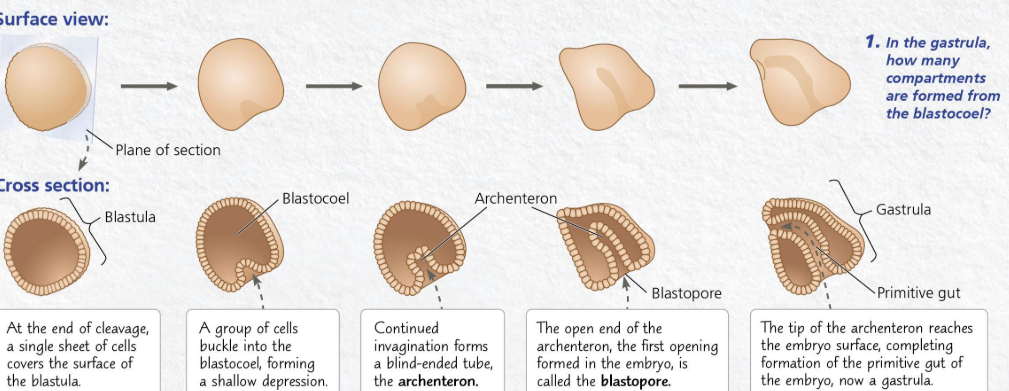
Describe the mechanism of gastrulation in sea urchins.
Invagination: Cells buckle inward, forming the blastopore.
Involution: Cells roll inward over the dorsal lip, moving into the embryo's interior to form endoderm and mesoderm.
Expansion: The archenteron grows as the blastocoel shrinks, eventually disappearing.
Layer Formation: The ectoderm remains on the surface, while the endoderm and mesoderm form internal layers.
Cleavage in frogs, humans and sea urchins
In frogs, cleavage is holoblastic, meaning the cleavage furrow passes entirely through the egg.The yolk is concentrated at the vegetal pole, affecting the size of blastomeres, with smaller cells forming in the animal hemisphere. This results in a blastocoel located in the animal hemisphere due to unequal cell division.
In humans, cleavage is also holoblastic, but the blastocoel forms centrally, and the blastomeres are of similar size during early divisions due to less yolk.
How does the human embryo appear and behave at the start of gastrulation?
It is a blastocyst. The outer trophoblast implants in the uterus, while the inner cell mass divides into the epiblast (forms the embryo) and the hypoblast (forms the yolk sac)
What is the result of gastrulation?
Formation of a gastrula with three germ layers: ectoderm, mesoderm, endoderm.
Establishment of the primitive gut (archenteron).
Formation of the blastopore (becomes mouth in protostomes, anus in deuterostomes).
How does gastrulation occur in humans?
The blastocyst (hollow ball of cells) implants in the uterus.
The inner cell mass (embryoblast) forms the embryo.
The trophoblast forms part of the placenta.
Gastrulation occurs similarly to other mammals, forming the three germ layers.
List the four extraembryonic membranes of amniotes and their functions.
Amnion: Protects the embryo in fluid.
◦ Allantois: Waste disposal (reptiles) or part of the umbilical cord. (mammals)
◦ Chorion: Gas exchange (reptiles) or nutrient transfer (mammals).
◦ Yolk Sac: Encloses yolk (reptiles) or forms early blood cells (mammals)
How is pregnancy maintained hormonally? Each trimester
First trimester: Progesterone from the corpus luteum initiates growth of the placenta and enlargement of the uterus.
Second trimester: The placenta takes over secretion of progesterone, maintaining pregnancy.
End of third trimester: Oxytocin from the posterior pituitary starts labor.
What is neurulation?
Process by which the ectoderm is transformed into the neural tube, which later becomes the central nervous system
What are the key structures formed during neurulation?
The notochord (from mesoderm) induces the neural plate (from ectoderm). The plate folds into the neural tube, which becomes the brain and spinal cord. Somites (mesoderm blocks) become vertebrae and muscle
Describe the hormonal positive feedback loop that drives labor
Oxytocin is released from the fetus and the mother's posterior pituitary.
• Activation: Oxytocin stimulates the uterus to contract and signals the placenta to make prostaglandins.
• Feedback Loop: Prostaglandins stimulate even more uterine contractions.
• The "Positive" Cycle: Increased contractions signal the release of more oxytocin, which leads to more prostaglandins and even stronger contractions until the baby is delivered
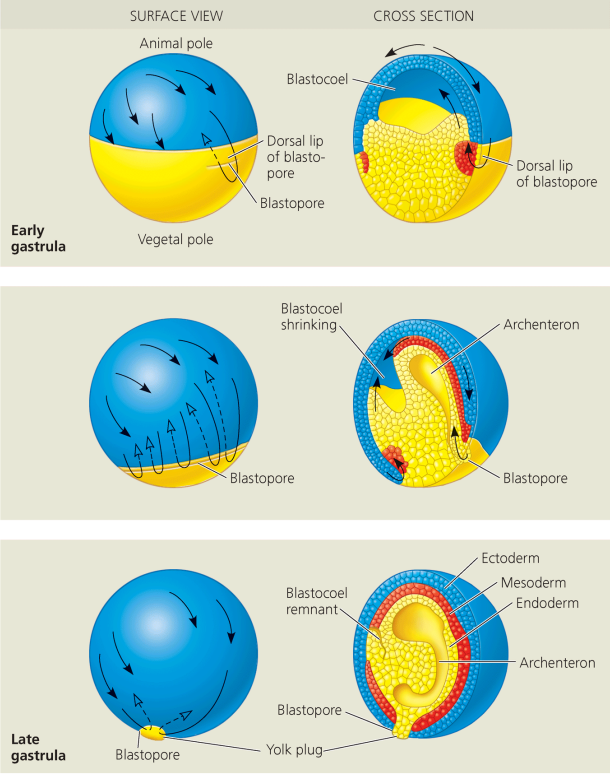
How does gastrulation occur in frogs, and what are the key structures involved?
Invagination: The process begins when cells on the dorsal side buckle inward to form a small crease called the blastopore.
• The Dorsal Lip: The part of the blastopore above the crease is the dorsal lip, which serves as a major signaling center.
• Involution: Cells from the animal pole roll inward over the dorsal lip to form the interior endoderm and mesoderm.
• Outcome: As the archenteron (primitive gut) grows, the blastocoel shrinks and eventually disappears, leaving the ectoderm on the surface and endoderm/mesoderm inside
What is unique about gastrulation in chicks compared to frogs?
Chicks have a large yolk.
The embryo forms from the epiblast; the hypoblast forms part of the yolk sac.
A primitive streak forms along the midline of the blastoderm.
Epiblast cells migrate inward and down through the primitive streak to form the three germ layers.
How do monozygotic twins form and what determines their placental structure?
Monozygotic (identical) twins result from the split of a single blastocyst or early-stage embryo.
Cell Potency: For this to occur, the early embryonic cells must be totipotent or pluripotent.
• Timing of the Split: The specific nature of the placentas and sacs depends entirely on when the split occurs
What are the three types of monozygotic twin arrangements based on the timing of the split?
1. Separate Placentas & Inner Sacs (~30%): Occurs if the early embryo splits before implanting in the womb.
2. Shared Placenta & Separate Inner Sacs (~70%): Occurs if the embryo implants first and then splits.
3. Shared Placenta & Shared Inner Sacs (~1%): Occurs if the embryo implants and splits much later.
How is the neural tube formed in frogs?
Cells in the dorsal mesoderm form the notochord (holds place of future vertebral column).
Notochord sends inductive signals to overlying ectoderm → forms neural plate.
Neural plate folds to form neural tube (becomes CNS: brain and spinal cord).
Neural crest forms (becomes peripheral nerves, teeth, skull).
Mesoderm forms somites (become vertebrae, ribs, muscle).
Notochord disappears before birth.
Allantois
For reptiles: Waste disposal
For humans: Become part of the umbilical cord
Chorion
For reptiles: Gas exchange
For humans: Nutrient transfer
Yolk sac
For reptiles:
What distinguishes chick neurulation from frog neurulation?
Archenteron forms when lateral folds pinch the embryo away from the yolk.
Notochord, neural tube, and somites develop much like in frogs.
By day 3, rudiments of most major organs are visible.
What is morphogenesis, and what are its three primary cellular mechanisms?
The process by which an organism's body takes physical shape.
◦ Mechanism 1 (Cell Shape): Microtubules elongate cells and actin filaments contract them into wedge shapes to bend tissue.
◦ Mechanism 2 (Cell Movement): Convergent extension allows a sheet of cells to become longer and narrower as they crawl between each other.
◦ Mechanism 3 (Cell Migration): Cells use amoeboid movement guided by Cell Adhesion Molecules (CAMs) and the Extracellular Matrix (ECM)
What is the difference between protostomes and deuterostomes in gastrulation?
Protostomes: Blastopore becomes the mouth (mollusks, annelids, arthropods).
Deuterostomes: Blastopore becomes the anus (echinoderms, chordates, including humans).
Why is cleavage not morphogenetic
Cleavage increases cell number but does not change the overall size or physical shape of the embryo, whereas gastrulation and organogenesis involve massive cell migration and tissue shaping
Why is apoptosis considered an essential part of morphogenesis, and what specific tissues does it affect in vertebrates?
Apoptosis is programmed cell death that helps "carve out" the final shape of an organism's body.
• Key Functions in Vertebrates:
◦ Digit Formation: It removes the interdigital tissue between future fingers and toes to create space between them.
◦ Nervous System Pruning: It disposes of nerve cells that fail to form functional synapses.
◦ Immune Regulation: It eliminates auto-reactive immune cells (a process that continues through adulthood).
◦ Structural Removal: It breaks down vestigial structures or tissues that are no longer needed by the developing organism
What is fate mapping, and how do researchers use it to understand cell differentiation?
:A technique where differentiated cells in an adult or larva are traced back to their specific origin in the embryo.
• Experimental Methods:
◦ Dye Marking (Frogs): Researchers mark different regions of a frog blastula with nontoxic dyes and observe which adult tissues contain those dyes later in development.
How are body axes established in frogs?
The animal pole (dark melanin) and vegetal pole (yellow yolk) are established before fertilization.
At fertilization, the pigmented cortex slides toward the sperm entry point, exposing the gray crescent.
The gray crescent marks the future dorsal side.
The first cleavage bisects the gray crescent, establishing the axes.
What did the salamander "belly piece" experiment prove about totipotency and the gray crescent?
• The Experiment: Fertilized eggs were constricted with a thread so that the first cleavage forced the gray crescent into only one of the two blastomeres.
• The Result:
◦ The blastomere with the gray crescent developed into a normal tadpole.
◦ The blastomere without the crescent developed into an unorganized "belly piece".
• Conclusion: Early embryonic cells lose their totipotency if essential cytoplasmic determinants (found in the gray crescent) are not properly distributed during the first cleavage.
What is Spemann’s organizer? and how does it show induction
The dorsal lip of the blastopore in frog embryos.
Transplanting the dorsal lip to another embryo induces gastrulation on that side as well.
This demonstrated induction (one group of cells signals to another to change fate).
What structures drive limb development in chicks?
Apical ectodermal ridge (AER): Makes fibroblast growth factor (FGF) → promotes limb outgrowth.
Zone of polarizing activity (ZPA): Makes Sonic hedgehog (Shh) → determines anterior-posterior pattern (e.g., which side is thumb vs. pinky).
What is the primitive streak?
Similar to the blastopore in frog embryos, the streak is s the site where cells from the upper layer (epiblast) migrate inward and downward to create the different cell layers
Due to the large yolk, symmetric cleavage cannot occur
Tripoblast
three germ layers: ectoderm, mesoderm, and endoderm
Dipoblasts
only two germ layers: ectoderm and endoderm
It is said that axis formation in the frog is determined at the time of fertilization. Why?
The point of fertilization sets the anterior-posterior axis and induces the cortical rotation that sets the dorsal-ventral axis. Once the anterior-posterior and dorsal-ventral axes are determined, the leftright axis is automatically set.