6.2 Other investment types: Partnerships
 Call Kai
 Learn
Learn Practice Test
 Spaced Repetition
 Match
Match Flashcards
 Knowt Play
1/26

Earn XP
Description and Tags
Partnerships
Name | Mastery | Learn | Test | Matching | Spaced | Call with Kai |
|---|
No analytics yet
Send a link to your students to track their progress
27 Terms
Partnerships
A business that is owned by two or more people as an unincorporated association
a type of business organization in which the partners manage the business and pay taxes on the business' profits (if any)
Partnerships are tax-reporting entities but not
tax-paying entities
The partnership reports profits and how much went to which partner to the IRS.
The partners reflect the income on their tax returns and pay income taxes on the amount they receive.
two types of business partnerships:
General partnership
Limited partnership
interest in a Limited Partnership is a type of security
true
general partnerships:
All the partners are general partners (GPs).
All the partners have some level of management authority
Ownership may be unequal.
Ownership interests may be found in the partnership agreement.
The business results (profits or losses) are distributed in proportion to the partner's ownership interest.
General partners have no liability protection.
Partners may be sued personally for actions taken by the partnership.
General partners have the following responsability
Making day-to-day business decisions
Limited partnership
A LP has one or more general partners and one or more limited partners.
General partners manage the business and have no liability protection.
Limited partners have no management responsibilities and are protected from the liabilities of the partnership.
If a limited partner participates in the management of the business, they may lose their liability protection.
Income received from the LP by limited partners is called passive income.
The most common industries are real estate, energy (oil and gas programs), and equipment leasing.
Limited partners (LPs) have a number of rights
to vote on business objectives
to inspect all books and records
if the GPs are not acting in their best interest, to sue them.
Another term for a limited partnership
direct participation program (DPP).
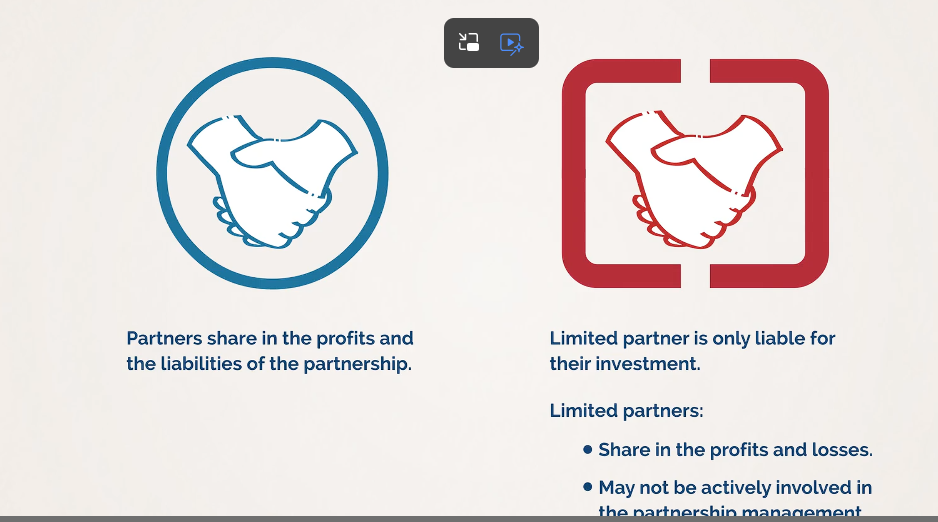
limited partnership vs partners
sales rules of limited partnerships.
LPs may be sold through private placements or public offerings.
If sold privately, investors receive a private placement memorandum for disclosure.
Private placements involve a small group of limited partners, each contributing a large sum of money.
In a public offering, LPs are sold by a prospectus.
In a public offering distribution, a larger number of limited partners each making a relatively small capital contribution is more likely.
liquidation rules of limited partnerships.
When dissolution occurs, the GP must settle accounts in the following order:
1. Secured lenders
2. Other creditors
3. Limited partners—first for their claims to shares of profits and then for their claims to a return of contributed capital
4. GPs
points to remember about limited partnerships.
The most common industries are real estate, energy (oil and gas programs), and equipment leasing.
These programs often experience losses in the early part of the program.
These losses pass through to the investors and may be used to offset sources of passive income from other programs.
DPPs use depreciation and depletion to reduce taxable income. These deductions are not actual cash costs. They reduce taxable income without affecting cash flow.
Benefits of Limited Partnerships
An investment managed by others (the GP)
Limited liability (a partner can only lose the amount invested)
Flow through of income and certain expenses
tax advantages relating to a DPP investment
accelerated depreciation.
depletion
intangible drilling costs.
Intangible drilling costs
those that are associated with items that have no resale or recoverable value when the program ends.
ex: wages and insurance premiums.
Tangible or recoverable costs
are those associated with items like equipment that can be sold when the program ends.
Depletion allowances can only be associated with
programs where natural resources might be depleted such as oil, gas, or even timber.
Depreciation
is common with buildings and equipment. Raw land does not cost much to run, doesn't depreciate, nor does it deplete.
For real estate DPPs, both income and capital growth are possible.
Income comes from the property rents received, and capital growth would come from the appreciation of the properties.
facts about income and loss for LPs
Income produced by LPs is called passive income
losses are called passive losses
Passive income is part of a customer's ordinary income
Passive losses may be used to reduce a taxpayer's passive income but are not applied to ordinary income
Risks of Limited Partnerships
Liquidity
Audit/Recapture of Tax Benefit
What is the greatest disadvantage of limited partnerships?
Lack of liquidity
Liquidity risk
LPs are highly illiquid (meaning very hard to sell
Audit/Recapture of Tax Benefit
If the IRS disallows a prior tax benefit, the consequences flow through to the limited partners.
The IRS would likely impose taxes and penalties for the underreporting of income plus interest on the unpaid taxes.
The limited partners would have to pay for the problem
n oil and gas DPP that invests in wells that are already producing is known as
income program.
Exploratory programs are
drilling new wells in search of new deposits.