Astronomy Exam 2 Ch 6
 Call Kai
 Learn
Learn Practice Test
 Spaced Repetition
 Match
Match Flashcards
 Knowt Play
1/33

There's no tags or description
Looks like no tags are added yet.
Name | Mastery | Learn | Test | Matching | Spaced | Call with Kai |
|---|
No analytics yet
Send a link to your students to track their progress
34 Terms
telescope
a tool to gather light of all kinds and focus the light
two main types of optical telescopes
refracting, reflecting
refracting
use an objective lens to bend and focus light, suffer from chromatic aberration, human eye, can only be supported on both sides
chromatic aberration
light of different colors are focused at different points
reflecting
use a primary mirror and a smaller secondary mirror to focus light, all modern research telescopes, can be supported from the back
seeing
caused by turbulence and atmospheric distortions in the atmosphere, warm blobs of air rise, cooler blobs sink
what causes the stars to twinkle in the sky
seeing
what are not effected by seeing
telescopes in space
diffraction
quantum mechanical effect due to waves impinging on the edges of mirrors and lenses
we cannot achieve angular resolution better than
the diffraction limit
primary purpose of telescopes
gather as much light as possible
more photons means that
dimmer features are brighter and detectable
light buckets
telescopes
secondary benefit of a bigger telescope
better angular resolution
angular size of an object is used because
it is difficult to determine how big it is if you do not know the distance
1 degree
60 arc minutes (‘)
1 arc minute (‘)
60 arc seconds (“)
½ degree
moon’s angular size
angular resolution
the ability to distinguish two objects next to each other, ability to see fine/small detail
angular resolution of a telescope
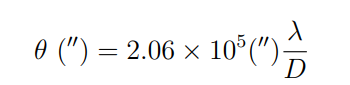
the smaller the angular resolution, the ____ angular resolution is
better
pixel analogy: the smaller the pixel, the more pixels you can fit, more detail can be seen
for angular resolution
gamma rays and x-rays
wavelengths that earth’s upper atmosphere absorbs
what absorbs most UV light
ozone layer
why do telescopes get built at a high altitude
to avoid water vapor interference
Where is SOFIA (stratospheric observatory for infrared astronomy) and why
above the clouds to get above water vapor to be able to see the wavelengths
which bands of light are absorbed by the atmosphere
infrared and microwave
spectrographs
instruments used to separate light out by each wavelength into its individual components
objects that are spectrographs
prisms, diffraction gratings
diffraction gratings
optical component with a periodic structure that splits and diffracts light into several beams traveling in different directions.
instruments that record the image from a telescope
human eye and drawings, photographic plate, CCD
photographic plate
early, high-resolution imaging mediums consisting of light-sensitive emulsion (usually silver gelatin) coated onto glass or metal
CCD (charge-coupled devices)
highly sensitive, silicon-based electronic detectors that replaced photographic plates
particle accelerators
determine how particles and light behave