Biodiversity Test 4
 Call Kai
 Learn
Learn Practice Test
 Spaced Repetition
 Match
Match Flashcards
 Knowt Play
1/86

There's no tags or description
Looks like no tags are added yet.
Name | Mastery | Learn | Test | Matching | Spaced | Call with Kai |
|---|
No analytics yet
Send a link to your students to track their progress
87 Terms
Alternation of Generations-
a life cycle held not only by green plants, but also other algae. Two different multi-cellular life stages.
Sporophyte-
produces spores.
Spores develop into gametophyte
Gameotophyte
produces gametes
Gametes (male and female) fuse and develop into sporophyte
Earliest plant fossils- 400 mya were
Spores
Terrestrial Plants- Green plants- and Charophycean is significant because
Algae are more similar to each other than either is to any other group of algae morpholgically, phsicologically, Genetically
Morphologically
structurally more similar
Physiologically
how metabolic processes are carried out
Genetically
DNA more similar
We DONT say that green plants came from charophycean so we DO say
Green plants and charophycean algae share a common ancestor
Charophycean algae may serve as the model for the ancestor of green plants
Two hypotheses for how the aquatic ancestor of GP moved onto land….
1) Seasonally Dry Pond Bed Hypothesis
When the pond dries up, the ancestor is left stranded on dry land for 2-6 weeks.
2) Splash Hypothesis-
As the tide goes out, the ancestor is stranded on dry land, until the tide comes back in (12 hours)
Charophycean algae and green plants both make a protein, sporopollenin that protects against dessication.
Why would the move onto land be favored by selection?
Easy access to: 4 things
1 Sunlight- not filtered out by water
2 Nutrients- soil is a bed of nutrients.
3 C02- dried access to C02 gas
4 Briefly- few or no herbivores
Adaptations unique to Green Plants- 3 things
1. Waxy cuticles- prevents water loss from leaves.
2. Stomata- pores for gas exchange to take place C02 in ; O2 out (?) ; H20 out
3. Roots and Shoots- regions of rapid cell division to increase length of branches and roots to compete for sunlight and nutrients.
Four Major plant Groups- 3 only
Bryophyte, Monilophytes, Spermatopsida
Bryophytes
The non-vascular plants
Non-vascular = no system devoted to moving water and nutrients around the plant. Instead, water and nutrients move via diffusion cell to cell.
No true leaves (photosynthetic organisms) or roots
Limited in height- moss
Gametophyte is dominant
Sporophyte grows off the gameophyte like a branch.
Sporophyte “dependent” on gametophyte for water and nutrients.
Water dependent reproduction- sperm must swim to egg.
Limited to damp environments.
Monilophytes
(ferns)- Seedless Vascular Plants.
Vascular system present.
True leaves and True Roots
Grow tall
Sporophyte Dominant
Gameophyte Independent of Sporophyte
Gametophyte is a separate plant.
Water-dependent reproduction. Sperm must swim to egg.
Limited to damp environments
Spermatopsida
Seed-bearing vascular plants
Vascular system
True leaves and roots
Can get big!
Sporophyte Dorminant.
Gametophytes dependent on Sporophyte Gametophyte are microscopic.
Male Gametophyte = inside the pollen grain. **Pollen doesn’t require water for dispersal. No longer dependent on water reproduction.
Seed- a sporophyte embryo packed with a nutrient supply.
Gymnosperms
(means naked seed) pine cones- Cone-bearing
Female cone- large, brown
Each blade contains 2 female gametophytes
Male cone- small, yellow
Each pollen grain is 1 male gametophyte.
Pollination is dependant on wind
Angiosperm
(vessel, fruit) flower bearing plants.
Both Male and female Gameophytes are in the flower.
Pollination depends heavily on animals.
Insects, birds, bats.
**Fruit– seed dispersal mechanism. Derived from the ovary of the flower.
Structure of the Fungi (name them)
The actual body of a fungus is an interwoven mat of filaments
*Individual filaments- hyphae
*Interwoven mat- mycelium
The mycelium is always embedded in a matrix- a rotten log, the ground, ect
*Hyphae grows up above ground to form a fruiting body- which produces spores
Fungi are haploid
Cells are coenocytic, The cell walls are incomplete and the cytoplasms of all the cells run together.
Four Phyla-
Chytridimomycota, Zygomycota, Ascomycota, Basidiomycota
Chytridimomycota (Chytrids) Charatristics
Fully aquatic
Maybe most similar to the aquatic ancestor of fungi.
Important parasites of fish and amphibians
-> Indicator species-
Decline of an ecosystem often begins with chytrid infection in fish and amphibians.
Zygomycota characteristics
Includes bread molds
Ascomycota characteristics
Associated with White Nose Syndrome in bats.
Toxic- morral. People still eat them though
Basidiomycota characteristics
The mushroom we eat.
“Gills” - carry spore- producing structures.
Mold
Fungus that’s somewhere you don't want it to be.
Stachybotrys
“toxic black mold”
Usually brought into the house via flooding
At this time, there’s no link between stachybotrys and the neurological symptoms associated with it
Yeast
Single-celled fungi- No mycelium/ hyphae
Saccharomyces
produces ethanol and C02 as byproducts of fermentation.
Co2- Makes bread rise
Ethanol- alcoholic beverage
Lichen
a symbiotic relationship between a fungus and photosynthetic partner (bacteria or algae)
Obligate mutualist-cant exist independently, Together, a single species- 25,000
Mycorrhizae
Symbiotic relationship between fungus and plants (roots)
Not obligate!
95% of all vascular plants have mycorrhizae
The earliest fossils of plant roots show mycorrhizae.
Our interactions with Fungi
Ringworm, Athlete’s foot/ Spring itch, Thrush (infants), Yeast Infection, other fungal infections
Ringworm
children inadvertently handle cat poop.
Athlete's foot/ Spring Itch
associated with being hot and sweaty
Thrush (infants)-
your body’s symbiotic candida gets out of control due to an underdeveloped immune system.
Yeast Infection-
Candida out of control in your reproductive tract.
Other fungal infections
really only appear in people with compromised immune systems.
HIV
Immune diseases like MS
Chitin
is the primary constituent of the cell wall. (beetle)
*Dna sequence date shows fungi are more closely related to animals than plants
ANIMALS- How do we define them? 3 things
1) Chemo-hetro-trophic
Energy derived from eating organic mols
Carbon
2) Motile- can move self around
3) Multicellular
What was the ancestor of animals like?
-Maybe similar to a Choanoflagellate.
- *Can live independently or in a colony.
-May serve as the model for the bridge between single-celled and multi-celled organism.
(know image)
Name Level 1- classification of animals
Presence of Tissue
*Tissue - a group of cells that perform a common task that benefits the entire organism. Such that no ind cell has to perform all the task required for survivals (specilzation of labor)
No tissue- sponge
Yes tissue- everything else
Name level 2- classification of animals
symmetry- how many planes can divide an object into mirror image halves
Radical- any plane through the midpoint divides an organism into mirror image halves.
Crindarians- jellyfish and Corals
Bilateral- only one place.
Everything else (above the level)
Jellyfish Polyp reproduction
Polyp
Adult
Reproduces a sexually. Budding or prodcuce Medusa
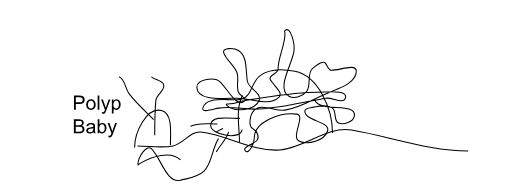
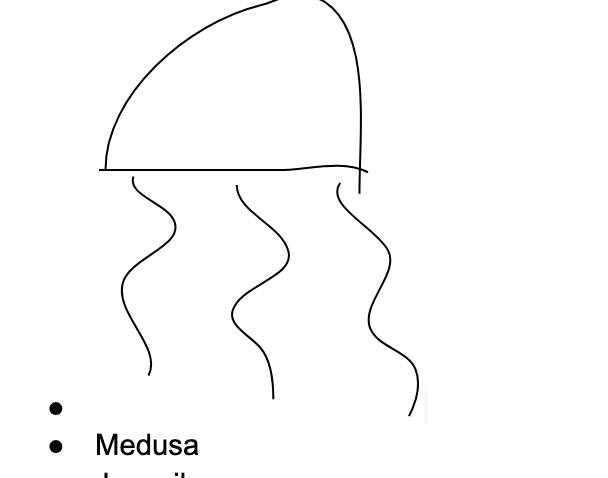
How does this reproduce?
Medusa
Juvenile
Reproduces sexually
Produces planilae
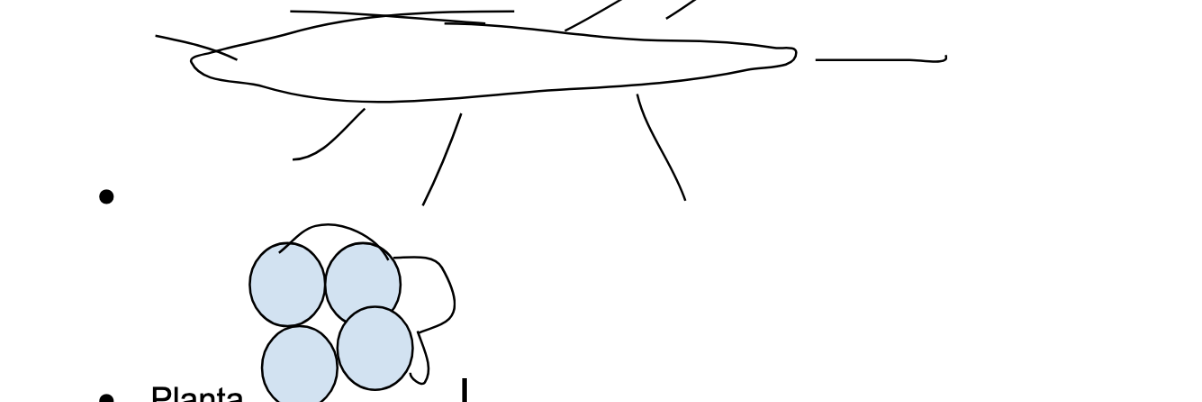
How does this reproduce
Planta
Dispersive
Sink to the ocean floor and become a polyp.
**Most jellyfish complete the entire life cycle.
In some species, the polyp is obsolete and they only exist as medusa.
In some species, the medusa is obsolete, and they only exist and polyps.
What is level 3 for classification of animals?
Patterns of Embryonic Development
At the eight-cell stage-
Protostome- The 8 cells are determinant; they’re stem cells
Indeterminant- they’re NOT stem cells
Deuterostome- the 8 cells are indeterminate- They’re NOT stem cells. Each cell could develop into a complete organisms.
*identical twins
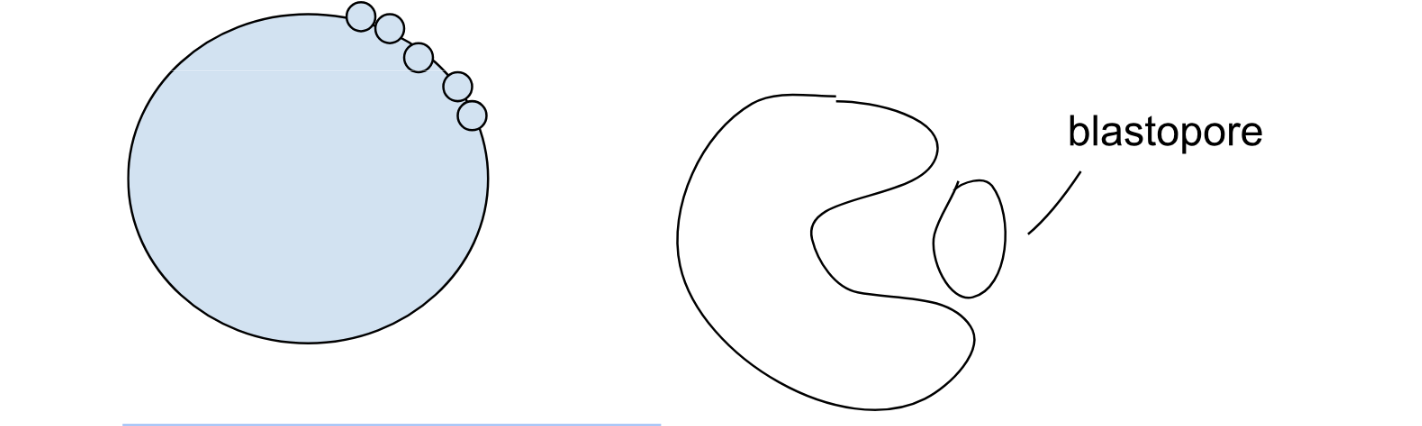
At the 100-cell stage-
hollow ball of cells
The digestive system starts to form.
The blastophore will either become the mouth or an anus.
Protostome- blastopore becomes the mouth.
Deuterostome- blastopore- becomes anus.
* Deutersomes= Echinoderms (star fish) and Chorates
*Protosomes= everything else.
What is level 4 for the classification of animals?
Growth After Hatching
What is an adder?
add new cells at a constant rate.
Flatworms- ex tapeworms
Annelis- ex Earthworms and leeches
mollusks - ex Octopods, bivalves, gastropods (snails)
What is a molter?
have a hard exoskeleton
Molt the old exoskeleton
Period of Rapid Growth
Secret a new exoskeleton
Roundworms
Insects- 3 body parts / 6 legs
Spiders- 2 body pats/ 8 legs
Crustaceans- ex. lobster.
The Four Characteristics of the Chordates:
Dorsal, hollow nerve chord.
Notochord- supports the nerve chord.
Pharyngeal Slits– gills– for us, present in embryonic development.
Post-anal tail- notochord extends beyond the pelvis.
For use, the coccyx- used as a muscle attachment site.
Ancestor of Chordates?
Maybe something like a Tunicate.
Has the 4 characters of the Chordates in the larval stage.
A perfect combination of Invertebrate and Chordate Characters.
May serve as the model for what the ancestor of chordates was like.
Classification of the Chordates- name all levels
Level 1: Brain
Level 2: Cranium and Cephalization
Level 3:Vertebral Column
Level 4: A lot of things happen at once
Level 5: Lungs
Level 6: Lobe fin
Level 7: Legs
Level 8: Amniotic Egg
Level 9: Milk
Level 1 for Chordates
Brain
Ex Lancelet- a slightly enlarged region on the anterior end of the nerves chord.
This may serve as the model for, the evolution of the brain
Level 2 for chordates
Cranium and Cephalization
Cranium- protection of brain
Cephalization- the aggregation of the major sense organs on the anterior end (head)
Ex. Hagfish- have a loosely woven cartilaginous basket that surrounds the brain
This may serve as a model for the evolution of the cranium.
Level 3 for chordates
Vertebral Colum-
Notochord surrounds nerve chord
Ex. Lamprey- notochord is a stiff cartilaginous rod, and may serve as the model for the evolution of the vertebral column.
Level 4 for chordates
A lot of things happen at once:
Jaws- more powerful opening/closing
Jointed Vertebral Column- more powerful tail
Paired pectoral and pelvic fins- increased maneuverability
** Active predation/ evasion- ex sharks and Rays
Level 5 for chordates
Lungs
Ex. Bony Fish-
Bony skeleton- preserves well in fossil record.
Swim bladder-
Originally for gas exchange
Secondarily adapted to control buoyancy
Height in the water column
Can still be used for gas exchange, somewhat.
Level 6 for chordates
Lobe-fin
Ex. Lobe finned fish ex. Coelecanth
Robust fins w/ heavy bony support structure.
Scientists- say the lobe-fin is for navigating through shallow, heavily vegetated waterways. (now found in underwater caves)
Level 7 for Chordates
Legs
Ex- Amphibians
“Two lives”- juvenile stage w/ gills in water adult stage w/ lungs on land.
Water dependent reproduction- egg is permeable → the embryo acquires water and nutrients from the environment.
Fish ribcage for lateral protection only.
Ribcage- lateral protection and comes through the weight of the internal organs
Sprawling posture= ectothermy, cold bloodedness
Level 8 for chordates
Amniotic Egg
Ex- Reptiles and Birds
Reptiles-
Amniotic egg- shelled and waterproof
Water and nutrients already inside.
The egg (yolk)
Reproduction no longer water dependent
Internal fertilization- fertilization must occur before shell forms.
Ribcage- LP + support + breathing
Two major lineages of Reptiles
1) Lepidosaurs- Snakes and Lizards-
(and ichthyosaur and plesiosaurs)
2) Archosaur- Crocodile and Birds
(and dinosaurs and pterodactyls)
Birds-
Arose from small bipedal carnivorous dinosaurs.
Feathers-
Probably organically adapted for insulation.
Probably secondarily for sexual selection.
Much later adapted for flight.
Upright posture- endothermy
Level 9 for chordates
Milk
Mammals
Upright posture= endothermy (warm bloodedness.
Diaphragm for breathing.
Hair and fat for insulation
Three major groups
1 Monotremes- echidna and platypus
** lay eggs. Mammary glands, but no nipples. Babies lick milk off the mothers coat.
Marsupitlas
Short gestation, followed by “birth” of an altricial (underdeveloped) offspring.
It climbs into the pouch and is attached to a nipple.
True Mammals (placentral)
Long gestation, followed by birth of a precocial (developed) offspring. (running)
Two types of behavior?
Instinctual (innate) and learned.
Instinctual (innate) behavior?
a behavior that is not based on experience with the environment.
* Most instinctual behavior can be modified by learning.
Some instinctual behavior cannot be modified.
Fixed Action Patterns?
behavioral responses that must be carried out to completion regardless of any new information from the environment.
Sign stimulus- an environmental cue that triggers a FAP.
What other behaviors may be innate?
Reproduction
Grooming
Suckling
Learned behavior?
behavior that is based on experience with the environment
Imprinting
an association of self or of safety formed in a critical time period following birth.
Habituation
absence of response to once relevant stimulus.
Spatial Learning
Using local landmarks for orientation
Foxes need to remember where they buried their food
Cognitive Mapping
regional orientation for large-scale migration.
**Can be instinctual. How do they know where the north star is?
Can be learned- socially
Associated Learning
based on positive or negative feedback from the environment. (trial and error)
Social learning
watching and mimicking others. (elephants migrating, sending out alarm calls)
Problem Solving
inventive behavior in a new situation (crows and dolphins and chimpz)
What is communication?
A signal intended to change the behavior of the receiver.
Selection favors signals that benefit_____________________?
both sender and receiver.
Communication display does
Provides context to a behavior.
*Reduces the likelihood of physical fighting.
Physical fighting can injure or kill all participants, including the winner.
Threat (Agonisitic) Behavior?
Intraspecific - to establish hierarchy
Interspecific- to deter a predator/ threat.
To preserve a resource
Tactile Display?
involve touching
Deception?
one organism uses a signal inappropriately for its own benefit
Sexual Selection: 2 things
Sexual Dimorphism and courtship display
Sexual Dimorphism as a signal conveys the age and health of the ____.
male
Courtship display
as a behavior
Mating Systems: 3 of them
Polygyny, Monogamy, Polyandry
Polygyny
one male mates with many females.
A group of females allows a male to join for protection.
A male controls a resources; he’ll share it with females
Both of those mean→ the male gets exclusive mating rights.
*Most common in mammals-
Developing offspring are inside the female, so there's nothing for the male to do.
Monogamy
pair bond– one male & one female (seasonal or lifelong)
*90% of bird species
The developing offspring are in the nest and even after hatching, requires constant protection and feeding.
Polyandry
one female mates with many males- only seen in a couple species of birds.
*Deception- all the offspring are from one father.