Synthetic Electrochemistry
 Call Kai
 Learn
Learn Practice Test
 Spaced Repetition
 Match
Match Flashcards
 Knowt Play
1/25

There's no tags or description
Looks like no tags are added yet.
Name | Mastery | Learn | Test | Matching | Spaced | Call with Kai |
|---|
No analytics yet
Send a link to your students to track their progress
26 Terms
how to predict if a reaction will proceed
by calculating the electricical potential of the electrochemcial cell:
reduction potential = tendency to take up electrons referenced to the standard hydrogen electrode
more positive is more oxidative power and will be reduced itself
standard reduction potential = reduction potential under standard conditions
Nernst equation
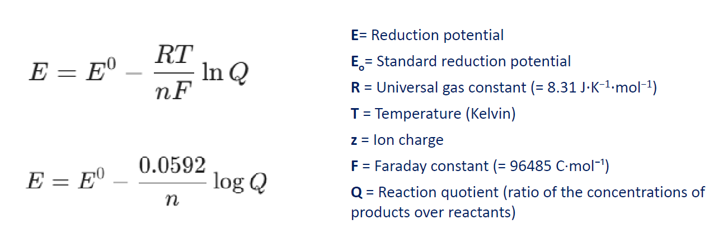
use standard reduction potentials, concentration of the reacting species and temperature to calculate the electrical potential under non-standard conditions
The reaction proceeds if
ΔE = E (reduction) - E(oxidation) >0
the reaction proceeds with strong oxidzing agents (induce reduction, high reduction potential) with strong reducing agent (induce oxidation, low reduction potential)
Caveats
data have to be compared under the same conditons (ref electrode, solvent,…)
it is thermodynamic data, says nothing about kinetcis
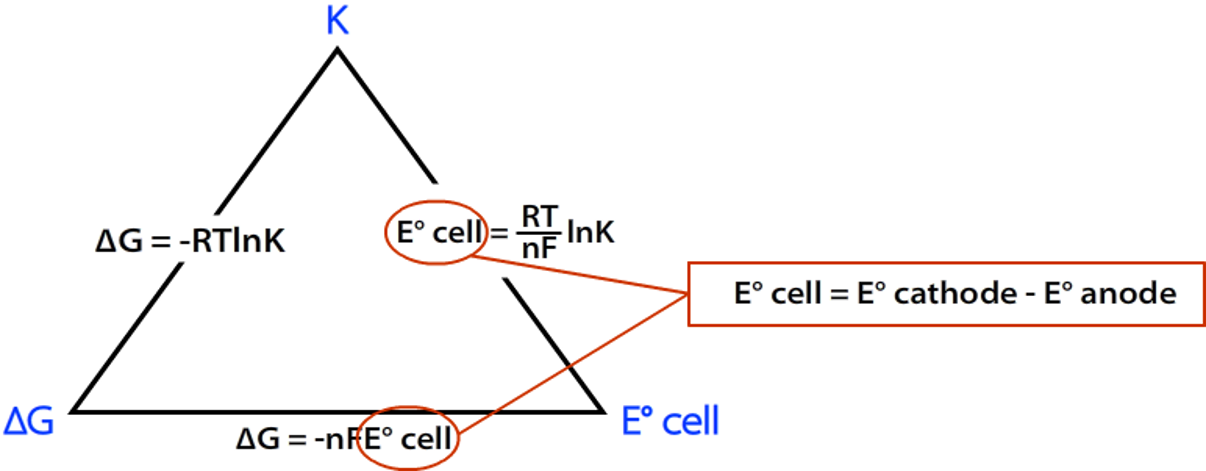
a positive cell potential means a negative delta G, meaning spontaneous reaction
but reaction can be thermodynamically favorable but still slow if activation barrier to high
E∘ tells you the inherent tendency of the reaction and the position of equilibrium.
E tells you whether the reaction is spontaneous under the actual conditions present.
movement of electrons
Electrochemical cell
oxidation and reduction occur in separate cell compartments
electrons from oxidaiton half cell to reduction half cell trhough an external conductor
this leads to charge build up, stopping electron flow, rapidly reacing equilibrium
Solution
maintaing charge ballance through ions
salt bride or ion-exchange membrane
for every mole of electrons transfered at an electrode, an equivalent amount of ionic charge must move
Equilibrium:
at specific concentrations, the cell has a certain voltage
as the reaction proceeds, conc change
therefore E gradually decreases (Q becomes K)
when E = 0, reaction reached chemical equilibrium
Types of electrochemical cell
Galvanic/Voltaic cell
electrochemical cell that converts chemical energy into electrical energy
Electrolytical cell
electrochemical cell that converts electrical energy into chemcial energy
Rechargeable battery can work in both directions
During discharge: bhaves like galvanic cell
during charge: electrolytical cell
Physical quantities
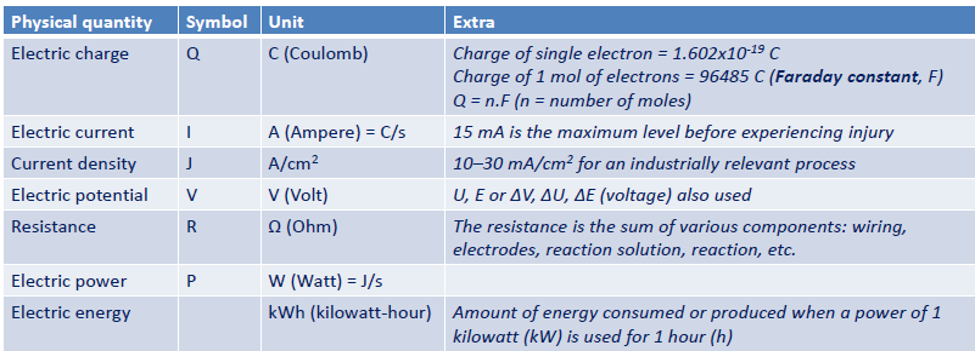
Electric current
flow of electric charge in a cricuit per unit time
current density
amount of current flowing through a unit area
electric potential
amount of work need to move a charge from one point to another inside an electric field
voltage is the potential difference
Key laws
Ohm’s lawy: V = I x R
Watt’s law: P = V x I
voltage is like water pressure: the higher the pressure the higher the flow
potential difference between electrodes pushes electrons through the circuit like pressure pushes water through a hose
current is like the flow of water: how much charge flows per second and is influence by the size of the hose
resistance is like sand in the hose blokcing flow
electrochemical cell in action
voltage is applied
ions move in electrolyte while electrons move through external circuit
no redox happens yet
only when voltage becomes high enough, it reaches a potential where molecules can give away electrons at the anode (oxidation) and accept electrons at the cathode (reduction)
electrons move from the anode to the cathode
But you often need to apply a higher voltage than the theoretical value calculated through the Nernst equation before the reaction actually starts
extra required voltage = overpotential
= differnce of theoretical and experimentally determined electrochemical potential difference

iRcell = loss in potential due to solution resistance
(depends on distance electrodes and conductivity of electrolyte)
Electrochemical window
Electrochemical window (EW) of a substance is the voltage range between which a substance is neither oxidized nor reduced
every component in the reaction mixture has an anodic and cathodic limit
Electrochemical reaction can only occur if the applied voltage is larger than the cell voltage, this causes:
charge imbalance: compensated by transport of ions
Consumption of substrate: substrates need to keep moving to the electrode
Therefore mass transfer is important (3 modes)
diffusion = transfer from region of high conc to lower conc
slow
migration = transfer of charge under influence of an electric field
fast
convection = transfer due to bulk motion of a fluid
Layers at the electrode
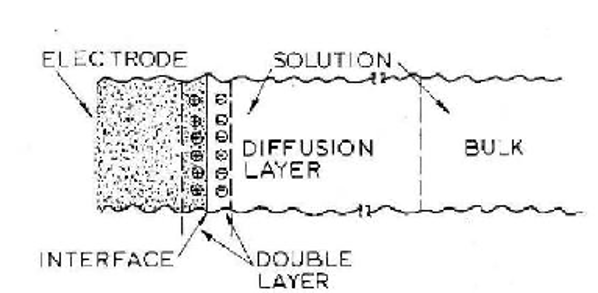
double layer: 1-10 nm
diffusion layer: 1-100 µm
depends on convection (confusing name)
—> situation at the electrode is totally different form the bulk (conc, solvation, pH)
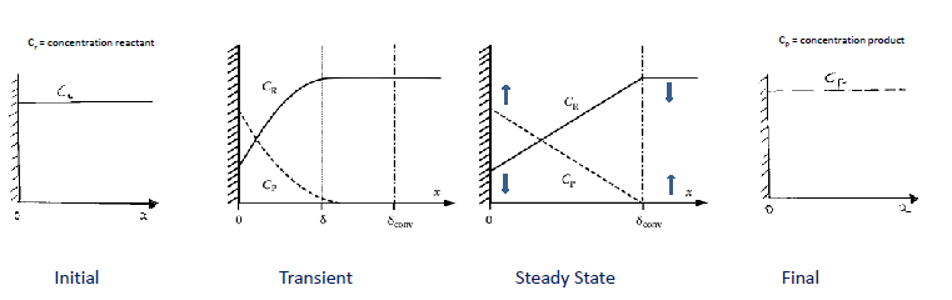
Change in concentration over time
V = 0: reactant concentration is the same everywhere in the cell
when Vapplied > Vcell
reactants are consumed and product is formed
conc at electrode become different from the bulk creating a concentration gradient
reactants have to move from the bulk to the electrode (mainly via diffusion)
Transient phase
concentration profile is till changing over time
steady state
reactant is consumed at the electrode but new reactant arrives at the same rate from the bulk
the total reactant concentration decreases while product concentration increase until all reactant is consumed
—> current is dependent on electron transfer rate of the substrates and mass transport to the electrodes
Limiting current
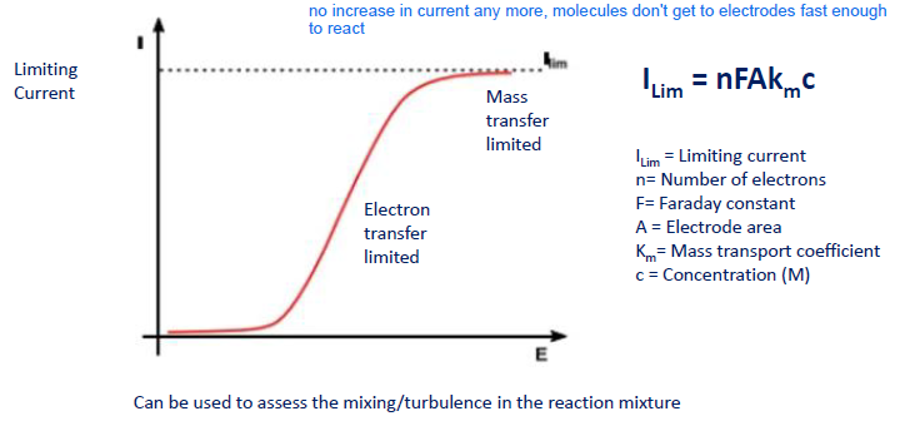
as the potential incrases the electrode becomes a stronger oxidizing or reducing surface so electron transfer bcomes faster so current increases
at higher potential the electron transfer becomes so fast that every molecule arriving at the electrode reacts immediately
this is the electron transfer limit
current is now only determined by the rate of mass transfer
Then the limitting current is reached
increased voltage does not lead to increase in current because the reactants cannot reach the electrode fast enough
depends on number of electrons, electrode surface area, concentration and mass transport coefficient
Operation modes
Galvanostic = constant current
current is kept constant, while the system adjusts the potential to keep it constant
at beginning: linear conversion because substrate conc is high
but due to decreasing concentration, at certain point mass transfer becomes limiting factor
potential needs to increase to maintain the same current level
if potential becomes too high it can cause side reaction
so good if you want a predicatble conversion rate but can be less eselective
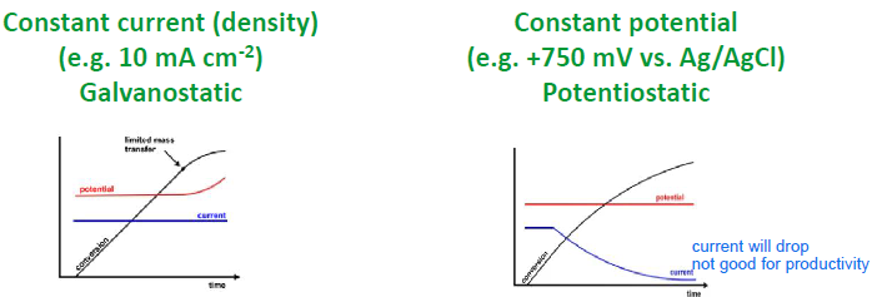
Potentiostatic = constant potential
Potential is kept constant
at beginning current is high because substrate concentration is high
over time concentration drops and therefore current drops as well meaning the reaction slows down over time
good for selectivity as potential doesn’t become too high but less productive as current drops
Electrode
= source of infinite oxidizing or reducing power generating no waste (if inert, sacrificial electrodes are consumed)
classifications:
working electrode
where target reaction occurs
counter electrode
used to complete the external circuit
reference electrode
has a stable known potential
does not participate in the reaction
used as a fixed reference to accurately control the potential at the working electrode (potentiostaci experiments
Electode materials
carbon based electrodes (stable, conductive, often cheaper than noble metals)
graphite
cheap but oxidized at high potential (to eg CO2) so it slowly degrades
boron doped diamond (new and wide electrochemical window)
Platinum
common
stable + conductive
but expensive (not scalable)
oxides
ITO (transparant)
gas diffusion electrod
used when reactant is a gas
A gas diffusion electrode brings a gas directly to a catalyst through porous layers, while the liquid electrolyte reaches the catalyst from the other side.
at catalytic layer: gas electrons and electrolyte meat and redox reaction occurs
electrons are provided or conducted by the current colector that travel through conductive parts of the micro and macroporous layers
The main challenge is flooding:
if too much liquid enters the pores, gas transport is blocked
then the electrode becomes less efficient
photoelectrode
absorb light adn create excited charges (electrons and holes)
these charges can drive electrochemical reactions at the elctrode surface
eg. electrons can cause reduction and holes oxidation
Electrolyte solution components
Substrate
Solvent
Considerations
Electric conductivity
low for organic solvetns but high for ionic liquids
participation in reaction
counter reaction
must balance the reaction at the working electrode by a counter reaction at the counter electrode
protic solvents could serve as a proton source for oxidation reactions with H+—> H2 reduciton as counter
electrochemcical winow
stabilization of intermeidates
fluorinated alcohols can stabilize radicals well
Protic
MeOH, water, acetic acids, fluorinated alcohols
Aprotic
ACN, THF, DCM
ionic liquids
Electrolytes
Added to lower resistance and increase conductivity, lower resistance is obtained form ions with highest mobility: smaller size and decreased coordinating properties
Considerations
must be chose carefully because they affect cost, purification, stability, recycling potential, solubility and selectivity
Cations
tetraalkyl ammonium salts
balance chain length for solubility and size for mobility
TBA used a lot
Alkali metal salts: Na+ or Li+
Anions
halides: Cl-, Br-
risk at oxidation at high potential
PF6- ot BF4-: non coordinating
ClO4- can act as weak oxidant but explosive in post processing
Additives
increase reaction performance
Interfering compounds
oxygen
can get reduced to superoxide leading to side reactions
degass
Water
can lead to water oxidation or reduction = electrolysis
drying recommended
Electrochemical cell designs
Undivided vs divide cell or Batch vs flow cell
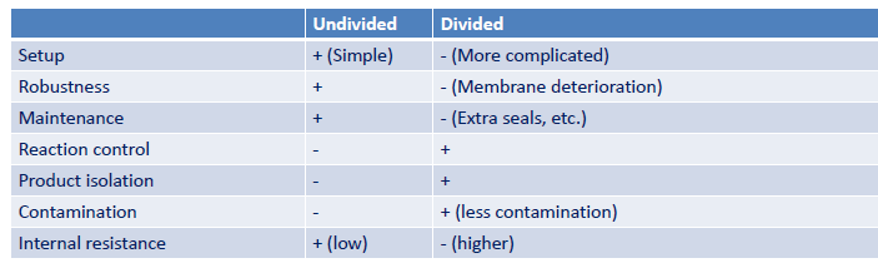
Undivided:
allows interference of reaction components
simple set-up + cost-effective —> preferred in industry
Disadvantages
Chemical shortcut: products oxidized at anode can get reduced again at the cathode if electrodes too close = energy waste
Not the case for electroplating
here the metal ion is reduced and deposited on the electrode
Divided
retains conductivity while retaining conductivity
separator allows allows ion transport but inhibits transport of reagents
Avoids interference reation components
undivided cell is industrially preferred although this is not allways beneficial or possible
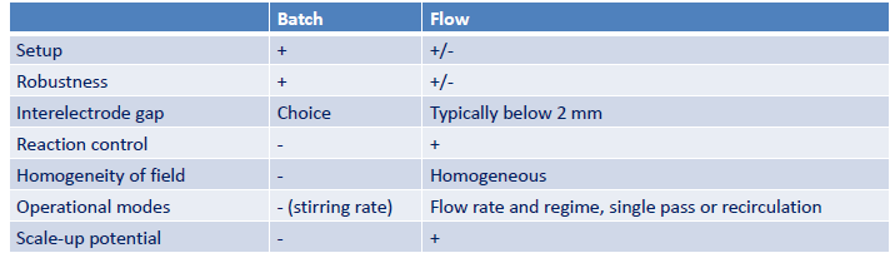
Batch vs Flow electrochemistry
Batch= reaction mixture is placed in one vessel and stirred
Traditional setup and common in industry
Flow = reaction mixture flows between 2 electrodes
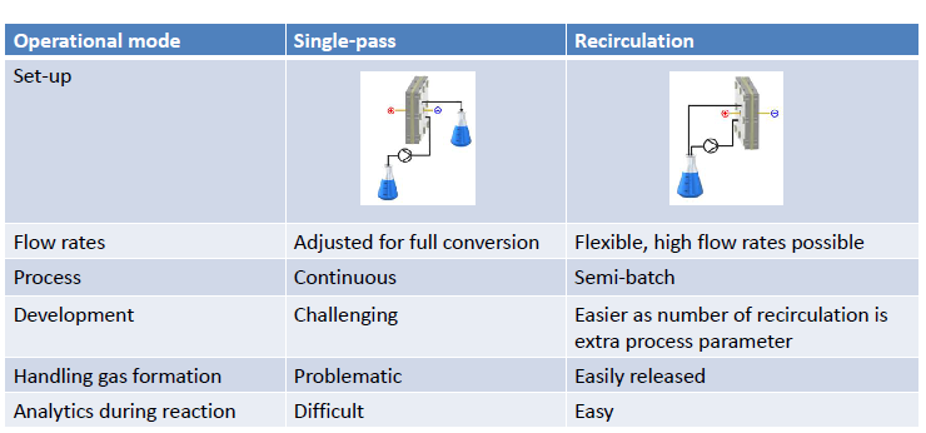
operation mode
single pass = continuous
if counter reaction gas formation, bubbles form that can reduce accessability to the electrodes —> need recirculation
recirculation = outcome is reinjected
scale up
batch: difficult because larger vessels give poorer mixing and less uniform current distribution
Flow: easier by running longer, increasing flow
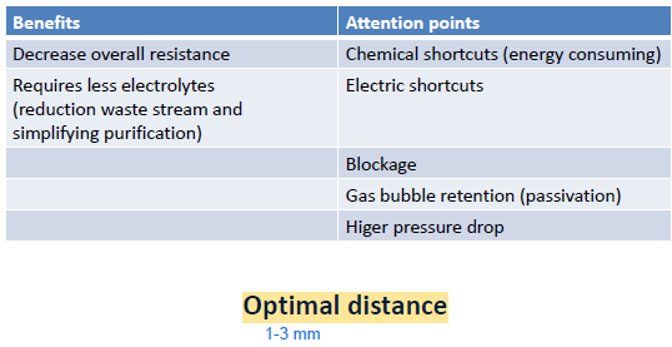
interelectrode gap
as small as possible
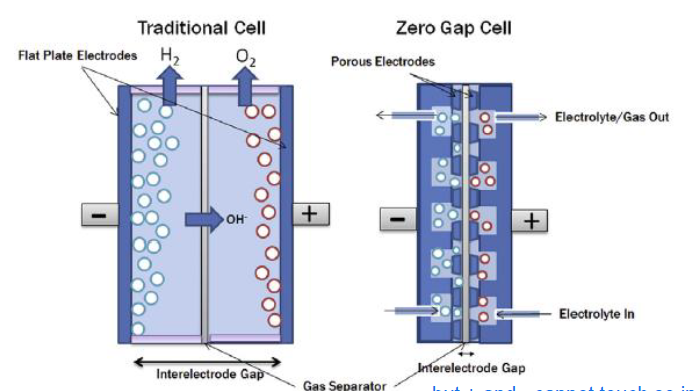
zero gap cell
electrodes are placed very coste togheter only sepearated by a membrane
the small gap lowers the electrolyte resistance of the cell
this means less voltage is lost and the process is more energy efficient
the electrodes are porus, so electrolytes and gasses can move through them
often used for water electrolysis (production of O2, H2)
Operational modes of the power supply
Galvanostic (constant current)
most used in industrial settings
2 electrode system (less expensive)
more control (exact equivalents of electrons knwon)
better space time yield
but voltage increase can lead to undesired side reactions
Potentiostatic (constant voltage)
more selective: less side reactions
need reference electrode (more expensive)
full conversion often not achieved
Voltage regime
DC (direct current)
curren flows in one direction only
like battery
AC (alternating current)
current changes direction back and forth
—> DC usually for electrochemsitry because you want oxidation at one electrode and reduction at the other. with AC the roles would switch continuously
Continuous vs pulsed voltage regime
continuous
current is applied at all time and the reaction proceeds continuously
simple and productive
but can cause side reactions
Pulsed current
Current switches on and off (DC) or changes polarity in a pulsed way (AC)
during ‘on’ electrochemcial reacition occurs
during ‘off’ new substrates can diffuse to the electrode
can improve selectivity
comparison electrochemistry and photochemsistry
efficiency
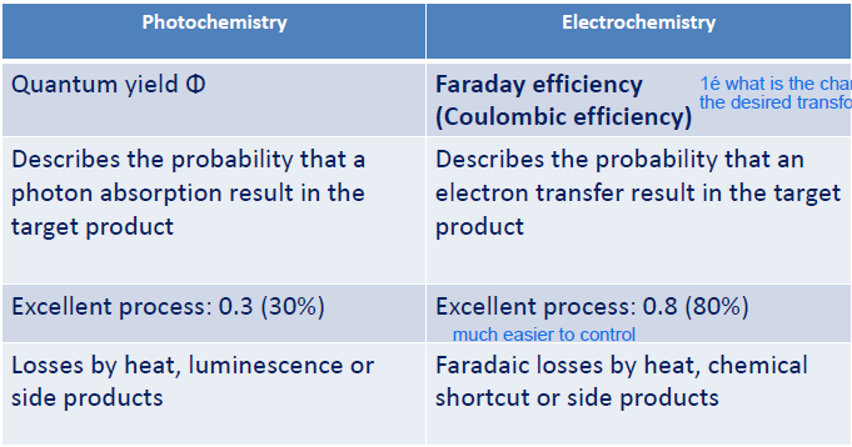
How many electrons needed:
catalytic quantities for initiation of radical chain process
equivalent amounts for others (often excess electrons)
Photochemsitry
energy transfer or electron transfer
electrochemsitry
only electron transfer
reaction mechanism
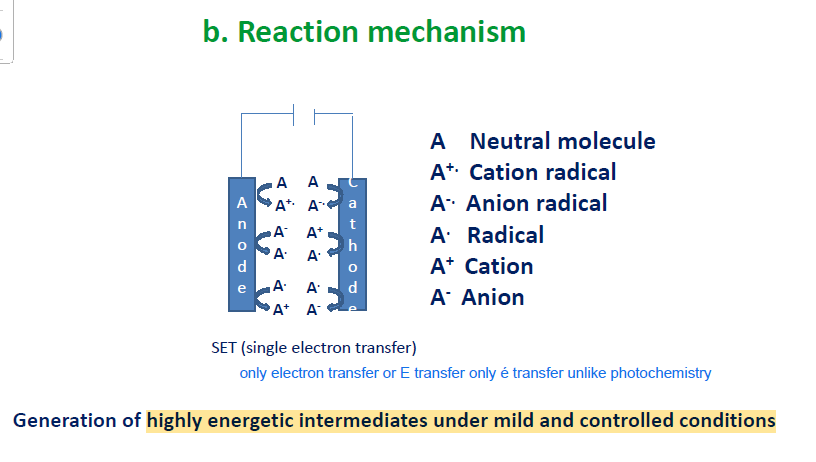
electromediated synthesis
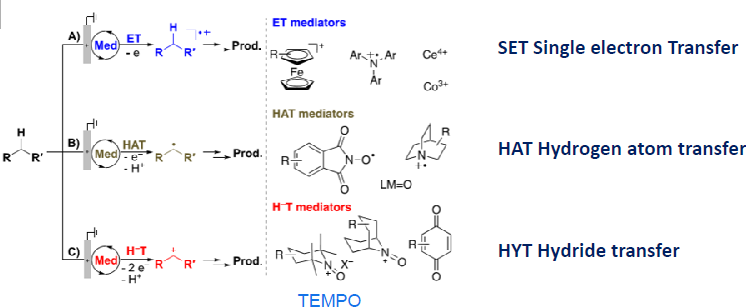
Target product is generated with an electron transfer via mediator
in addtion to SET, the mediator allows to switch to other electron transfer technologies
SET
HAT
HYT (hydride transfer
so electrochemistry is not a sole electron transfer technology
Advantages of electromediated synthesis
allows switch from heterogenous to homogenous electron transfer
rate determining step is shifted, leading to higher rates
eg. steric shielding of redox centre in proteins
better energy efficiency: electromediators are usually activated at lower potentials
this allows midler conditions and higher selectivity (when sensitive FG’s are present)
electrode passivation is avoided
= loss of electrode activity because a layer of product, impurities, gas bubbles or deposited material blocks the electrode surface
Separate or paired electrochemistry
Separate electrosynthesis
product is generated at one electrode
working electode + counter/sacrificial electrode
maximum 100% with full conversion
Paired electrosynthesis
product(s) is generate by contribution of 2 electodes
2 working electrodes
max 200% with full conversion
Examples
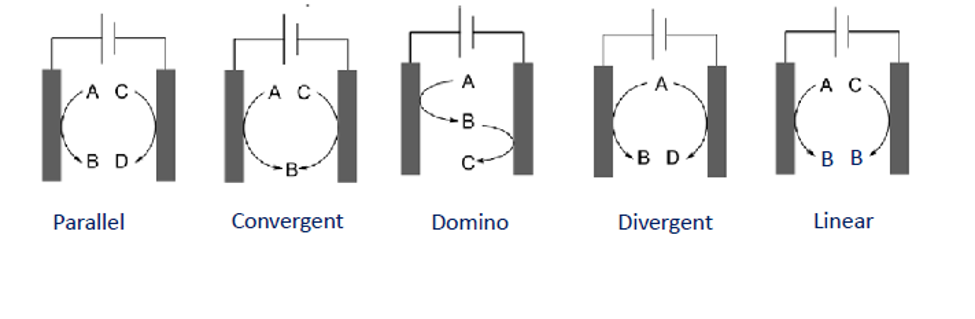
parallel:
2 different products max 200% cell conversion
convergent
A is reduced an C is oxidized these react togehter to B
Domino
A is oxidzed to B1 whcih reacts to B2 and reduced to C1
Divergent
C1 is oxidized to C1* and C2 is reduced to C2*
A reacts with C1* to B and with C2* to C
glucose example (glucose is the common starting point but is in itself not reduced nor exidized, makes use of an electromediator
Linear
A is oxidized to B and C is reduced to B
like water is oxidized to H202 at anode and O2 is reduced to H2o2 at cathode
name reactions 4
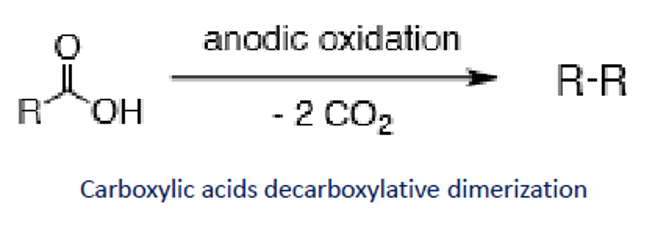
Kolbe oxidation
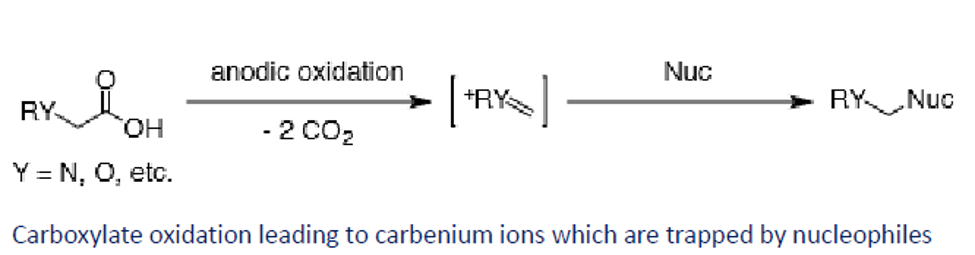
non-kolbe oxidation
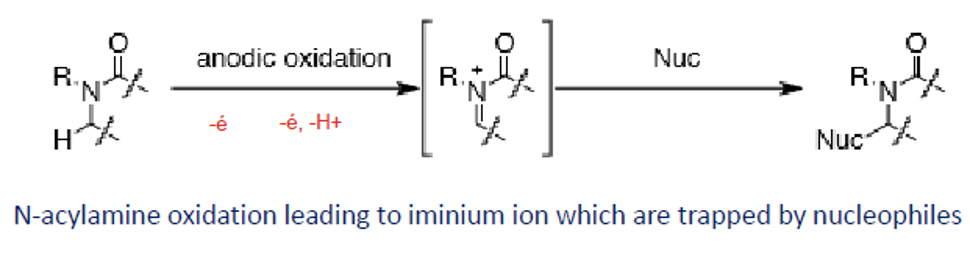
Shono oxidation
Markó-Lam deoxygenation

Cost and sustainability
Cost
electrochemistry is inexpensive compared to oxidants and reductants
Sustainability
cheapest and most versatile redox reagent
can be combined with green electricity
reduction/ elimination of:
toxic metal based oxidizing agents
purification of spent reagents
milder conditions (p or T)
higher selectivity (avoids need for protection)
Universal reagent (cell potential can be tuned, and chemcial reagents work at fixed potential)
opens new synthetic pathways = less steps to end product
industrially scalable
much more than photochemistry
chlor-alkali process
Divided cell→ separate Cl2 and NaOH +H2
Cl2 + H2→ HCl: explodes under pressure or exposure to heat
2NaOH + Cl2→ NaCl + NaOCl + H2O
Cl is oxidized and reduced
NaOCl is bleach → bad
Areas for improvement
Selectivity anodic oxidation to Cl2
H2O can also be oxidized to O2
Sluggish kinetic vor alkaline H2 evolution
Membrane and anode degradation

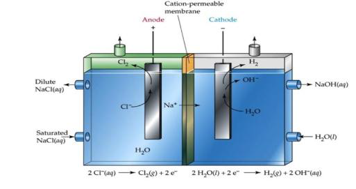
Design of electrolytic cell
Energy demand: theoretical voltage = 2.1 V, practical voltage = 5 V
Improvements
Use DSA = Dimensionally stable anode
RuO2 mixed with TiO2 supported by metallic Ti
Corrosion resistant + Ti support protects itself fur further corrosion by anodically forming an oxide layer
Ensures voltage reduction of >1 V + stable electrode performance
Gas bubble effect
in the chlor-alkali process, gas bubbles are formed at the electrodes:
Cl₂ at the anode H₂ at the cathode
These gas bubbles can stick to the electrode surface.
When bubbles cover the electrode, they block the active catalytic sites, so less surface is available for reaction.
Bubbles also make ion/electron transfer harder, causing an extra ohmic drop and requiring a higher voltage.
This higher local voltage/overpotential can accelerate electrode corrosion.
Therefore, good electrodes should release gas bubbles quickly.
DSA electrodes help because they are:
very hydrophilic, so liquid wets the surface well
structured with a “mud-crack” morphology, helping bubbles detach faster
Faster gas bubble removal lowers the required cell voltage and improves efficiency.
Cathode improvement
Cathode performs the hydrogen evolution reaction (HER): H2O +2é→ H2+OH-
But slow reaction in strongly basic solution
Oxygen-depolarized cathode (ODC)
Changes the cathode reaction
½ O2 + H2O + 2é→ 2OH-
Requires less E than HER (O2 is fed through a gas diffusion electrode)
By adding O2 you ‘depolarize’ it because you remove high E barrier of forming H2 bubbles
No gas bubble effect at cathode (although H2 evolution can be a useful side product
Bifunctional electrodes
Can facilitate 2 different chemical reaction
Can switch between HER and ODC (if H2 evolution is required or not)
Coupling with CO2 reduction
Instead of HER counter reaction
Use CO2 reduction so instead of H2, CO2 reduction products are obtained alongside Cl2 and NaOH
Membrane improvement
New combined polymer layers with low electrical resistance, high ion-selective permeability and can work in corrosive electrolyte environments
Future of electrochemistry
Electrochemistry is gaining importance in pharma
Drug companies are exploring electrochemistry as a cleaner and more efficient synthesis tool.
It can replace chemical oxidants/reductants by using electrons directly.
This can reduce waste and improve sustainability.
Main advantages for organic synthesis
Electrons can act as “reagents”.
Reactions can be more selective by controlling the potential.
It can enable transformations that are difficult with classical chemistry.
It fits well with green chemistry principles.
Artificial photosynthesis
Electrochemistry can be coupled with light-driven processes.
Sunlight can help drive oxidation and reduction reactions.
Example: water oxidation at one side and CO₂ reduction at the other side.
Goal: convert simple molecules such as CO₂ and water into useful fuels or chemicals.
Remote electrochemical plants
Future electrochemical systems could be powered by renewable electricity, such as solar panels.
This could allow small, decentralized chemical production units.
Chemicals could be produced locally instead of in very large centralized plants.
Flow electrochemistry
Flow reactors improve control over mixing, temperature, residence time, and current distribution.
They are easier to scale by running longer or numbering-up reactors.
Companies such as Creaflow develop scalable flow reactor technology.
Combination with other technologies
Flow platforms can combine:
multiphase chemistry
photochemistry
electrochemistry
This allows more efficient and flexible reaction development.
Application example: oxygenation reactions
Electrochemistry can use simple inputs such as air, water, and light.
This can make oxidation/oxygenation reactions more sustainable.
Reactions can be catalyst-free, selective, and scalable.
Pharmaceutical production
Electrochemistry in flow can be used to produce active pharmaceutical ingredients.
Example shown: production of an anti-cancer drug/API in a flow process.
This shows that electrochemistry is moving from academic research toward practical industrial application.