10.8 - Probability Distributions and Binomial Distributions
 Call Kai
 Learn
Learn Practice Test
 Spaced Repetition
 Match
Match Flashcards
 Knowt Play
1/12

Earn XP
Description and Tags
These flashcards cover key vocabulary and formulas related to probability distributions and binomial distributions, including definitions, formulas, and important concepts.
Name | Mastery | Learn | Test | Matching | Spaced | Call with Kai |
|---|
No analytics yet
Send a link to your students to track their progress
13 Terms
Probability Distribution
A function or rule that assigns probabilities to each possible outcome of a random variable.
Binomial Distribution
Calculates the probability of an event occurring a specified number of times in a fixed number of trials, with two possible outcomes (success/failure).
Expected Value (Mean)
The average value of a random variable, calculated as the sum of all possible values, each multiplied by the probability of its occurrence.
Variance
The measure of the dispersion of a set of values; in probability, it quantifies how far the values deviate from the expected value.
Standard Deviation
The square root of variance, representing the average distance of each data point from the mean.
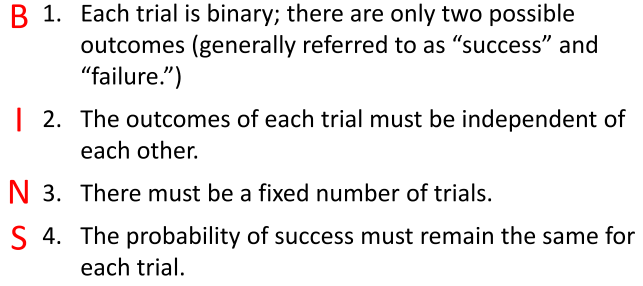
Conditions for Binomial Distribution
Each trial is binary (success/failure).
The trials are independent.
There is a fixed number of trials.
The probability of success is constant.
Notation for Binomial Distribution: n, p, X
n = number of trials
p = probability of success
X = desired number of successes.
Binomial Probability Formula
For exactly X successes in n trials: P(X)=nCximespximes(1−p)n−x.
Complement Rule for Binomial Distribution
To find the probability of at least k successes, calculate: P(X≥k)=1−P(X≤k−1).
Mean of Binomial Distribution
The mean (expected value) is given by the formula: μ=np.
Variance of Binomial Distribution
The variance is given by the formula: σ2=np(1−p).
Standard Deviation of Binomial Distribution
The standard deviation is given by the formula: σ=np(1−p).
Normal Distribution
A continuous probability distribution characterized by a symmetric, bell-shaped curve, defined by its mean (μ) and standard deviation (σ).