Insect Pest, Disease, and Weed Management: Monitoring, Assessment, and Pesticide Labeling
 Call Kai
 Learn
Learn Practice Test
 Spaced Repetition
 Match
Match Flashcards
 Knowt Play
1/55

There's no tags or description
Looks like no tags are added yet.
Name | Mastery | Learn | Test | Matching | Spaced | Call with Kai |
|---|
No analytics yet
Send a link to your students to track their progress
56 Terms
What does Integrated Pest Management (IPM) involve?
Monitoring and assessment to determine pest presence and damage level.
What is the purpose of monitoring in pest management?
Regular observation of pests, diseases, and crop damage.
What is the Action Threshold in pest management?
The pest population level where corrective action must be taken to avoid economic damage.
What are Damage Rating Scales used for?
To evaluate insect and disease severity on plants.
Define 'Monitoring' in the context of pest management.
Regular observation of pests, diseases, and crop conditions.
What does 'Assessment' refer to in pest management?
Evaluation of pest or disease severity using collected data.
What is Foliar Disease?
Disease affecting plant leaves such as rust, blight, chlorosis, and spots.
What does Pest Incidence measure?
The percentage of plants infested by pests.
How is Disease Severity defined?
The degree of disease damage observed on plant tissue.
What is an Arthropod Guild?
The functional role of insects such as pest, predator, parasitoid, or pollinator.
What is the purpose of the Insect Collection procedure?
To gather and preserve insects for assessment.
What should be observed during Insect Pest Damage Assessment?
Damage from the base to the tip of the plant and identification of the insect.
What symptoms should be observed in Disease Damage Assessment?
Chlorosis, spots, rust, and blight.
What does the Piercing-Sucking Insect Damage Scale measure?
The severity of damage caused by piercing-sucking insects.
What does a score of 0 on the Piercing-Sucking Insect Damage Scale indicate?
Highly Resistant with no symptoms.
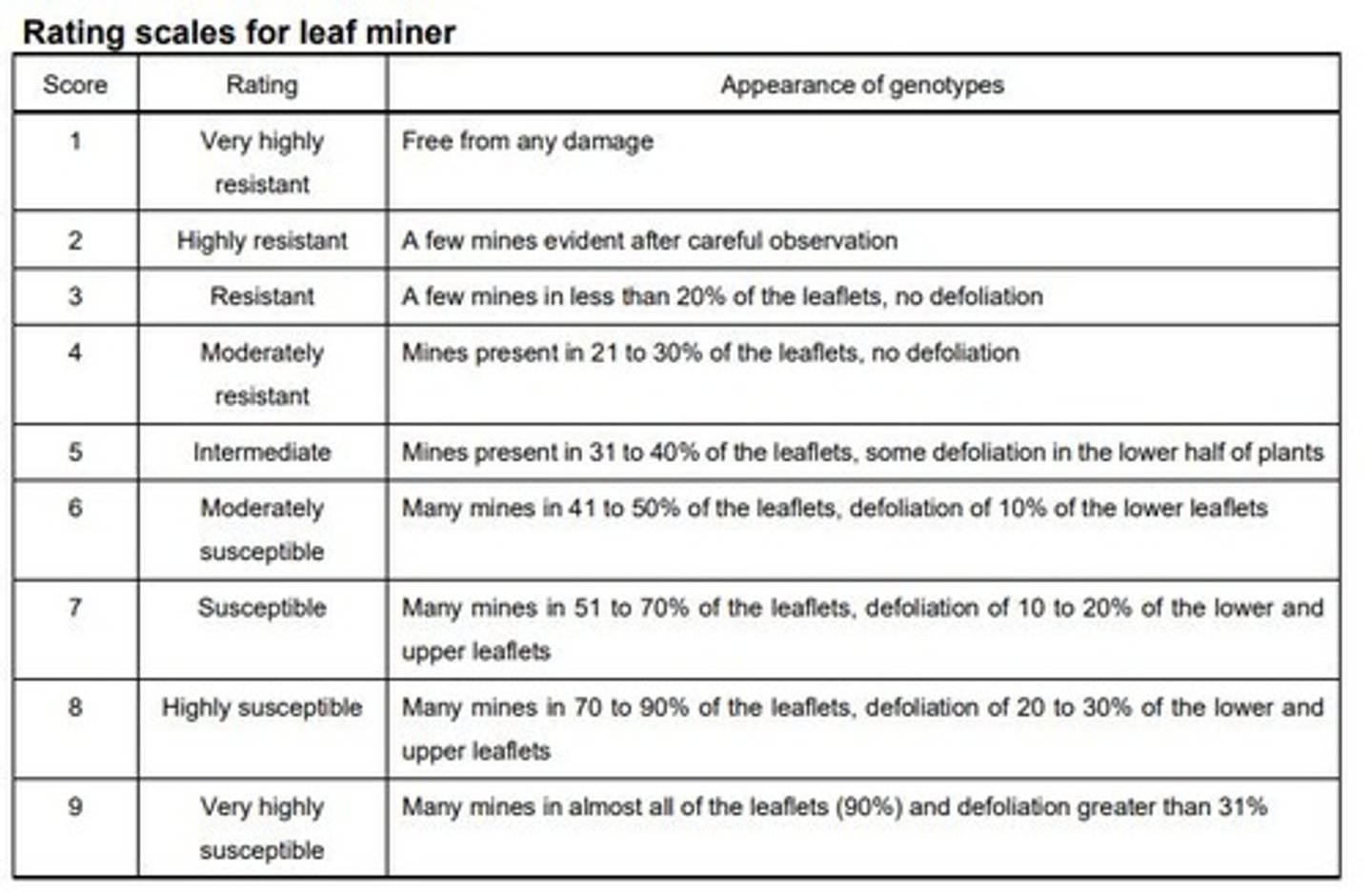
What does a score of 5 on the Leaf Miner Damage Scale indicate?
Intermediate damage with 31-40% mines and some defoliation.
What is the purpose of the Mean Percent Severity per Plant formula?
To calculate average disease severity of sampled plants.
What is a Pesticide Label?
A legal document containing instructions for the safe and effective use of pesticides.
What is the significance of understanding pesticide labels?
It reduces risks to humans, animals, and the environment.
What information is typically found on a pesticide label?
Toxicity, application methods, handling, storage, and emergency procedures.
What does the term 'Active Ingredient' refer to on a pesticide label?
The chemical component responsible for pest control action.
What does the Re-entry Period indicate?
The time required before entering a treated area safely without protective equipment.
What does a 'Signal Word' on a pesticide label indicate?
The pesticide toxicity level and hazard.
What is Mechanical Control in pest management?
Pest management using physical devices or manual techniques.
What is the purpose of a Light Trap?
To attract nocturnal insects for monitoring.
What is a Sticky Trap used for?
To capture flying insects using adhesive surfaces.
What is a Pheromone Trap?
A trap using chemical attractants to lure insects.
What is the importance of reading pesticide labels?
Ensures effective pest control, prevents misuse, protects health, and reduces contamination.
What is the purpose of a yellow sticky trap?
To attract aphids and whiteflies.
When should sticky traps be replaced?
When surfaces become fully covered.
What is the function of a pheromone trap?
To lure specific insect pests using chemical attractants.
What should be included on the label of a pheromone trap?
Group number, section code, and methyl eugenol.
What data should be recorded for a light trap?
Insect name, family, order, and number collected.
What are the advantages of mechanical pest control?
Low-cost, environmentally friendly, reduces pesticide dependence, and easy to fabricate.
Name three common insects collected by a light trap.
Moths, beetles, and flies.
What is a pest?
Any organism causing damage to crops, humans, or the environment.
What is a plant pathogen?
A disease-causing organism such as fungi, bacteria, or viruses.
What is the role of natural enemies in pest management?
To suppress pest populations, such as predators and parasitoids.
What is foliar damage?
Injury occurring on plant leaves.
What are the common symptoms of pest damage on vegetable crops?
Holes on leaves, yellowing leaves, leaf curling, wilting, spots and blights, stunted growth.
What is the importance of pest monitoring?
Detects pest outbreaks early, prevents severe crop damage, and supports sustainable agriculture.
What is a weed?
A plant growing where it is not desired.
What is the purpose of quadrat sampling?
To observe and count weeds within a fixed sampling area.
What is population density in the context of weed assessment?
The number of individuals per unit area.
What are the characteristics of broadleaf weeds?
Wide leaves with net veins.
What is the significance of weed composition analysis?
Helps improve weed management strategies.
What are the common categories of weeds?
Grasses, sedges, and broadleaf weeds.
What is the function of lady beetles in pest management?
They feed on aphids.
What does 'canopy cover' refer to?
The area of ground covered by plant foliage.
What is the likely pest if leaves have ragged edges?
Caterpillar.
What does 'basal cover' measure?
The ground area occupied by the base of plants.
What is the purpose of using a point transect method?
To estimate vegetation cover along a sampling line.
What is the role of spiders in pest management?
They are predators of various insects.
What is the objective of monitoring weeds in agroecosystems?
To identify dominant weed species and evaluate weed-crop competition.
What should be documented during pest observation?
Crop observed, pest identified, symptoms observed, and presence of natural enemies.
What is the likely cause of yellowing leaves in plants?
Nutrient deficiency or disease.