Econ 202 Final P.1
 Call Kai
 Learn
Learn Practice Test
 Spaced Repetition
 Match
Match Flashcards
 Knowt Play
1/64

There's no tags or description
Looks like no tags are added yet.
Name | Mastery | Learn | Test | Matching | Spaced | Call with Kai |
|---|
No analytics yet
Send a link to your students to track their progress
65 Terms
Macroeconomics
The study of the performance of the national economy.
Labor Market
The aggregate activity of firms searching for workers and workers searching for employment.
Fiscal Policy
The use of the federal budget—by setting and changing tax rates, making transfer payments, and purchasing goods and services—to achieve macroeconomic objectives.
Monetary policy
Changes to the level of interest rates in the national economy to achieve macroeconomic objectives. In the U.S., monetary policy is the responsibility of the Federal Reserve.
Nominal GDP
The market value of all final goods and services produced within a country in a year
Market Value
The market price for which a good or service was sold. Using market values allows heterogeneous goods and services to be added together
Final Goods and Services
"Finished" goods and services that are ready to be used or consumed by their final user.
Intermediate Goods and Services
Items produced by one firm, bought by another firm, and used as an input in the production of a final good or service. These are excluded from GDP to avoid double counting.
Expenditure Approach to Measure GDP
Measures total expenditures on final goods and services produced within a country in a year.
Output Approach to Measure GDP
Measures total value-added across the stages of production of goods and services within a country in a year.
Income Approach to Measure GDP
Measures total income received by factors of production operating within a country in a year
Personal Consumption Expenditures (C)
Spending by domestic households on consumer goods and services. (C ≈ 68% of U.S. GDP)
Gross Private Domestic Investment (I)
Spending by domestic firms on new capital goods and changes to inventories; also includes new home purchases by households. (I ≈ 18% of U.S. GDP)
Capital Goods
Goods used to produce other goods and services, but not completely used up in that production (e.g. tools, machines, buildings)
Government Expenditure on Goods and Services (G)
Purchases of goods and services by federal, state, and local governments. (G ≈ 17% of U.S. GDP)
Transfer Payments
Cash transfers from governments to households and firms (e.g. Social Security, unemployment compensation, subsidies). Transfer payments are NOT included in GDP.
Exports (X)
Sales of goods and services by the domestic economy to the rest of the world.
Imports (M)
Purchases of goods and services by the domestic economy from the rest of the world.
Net Exports (X − M)
The value of exports minus the value of imports. (X − M ≈ −3% of U.S. GDP)
Trade deficit/trade surplus
Trade Deficit: Occurs when Net Exports (X − M) < 0.
Trade Surplus: Occurs when Net Exports (X − M) > 0.
GDP Expenditure Equation
GDP = C + I + G + (X − M)
Value-Added
The amount by which the market value of an item exceeds the sum of the value of its intermediate inputs. Summing value-added across all stages of production yields the total market value of the final good.
Standard of Living
A comprehensive state of economic well-being, including income levels, quality of housing and food, medical care, educational opportunities, transportation, communications, and other measures.
Non-market production
Goods and services not bought or sold in a market (e.g. household production) are excluded from GDP
Shadow Economy
Markets for goods and services that are unobserved (e.g. illegal activity, unreported income); these are excluded from official GDP figures
Nominal GDP (GDP at Current Prices)
GDP measured using the market prices that existed in the year being measured. Useful for measuring aggregate production in a single year at current prices, but not suitable for comparing production across years
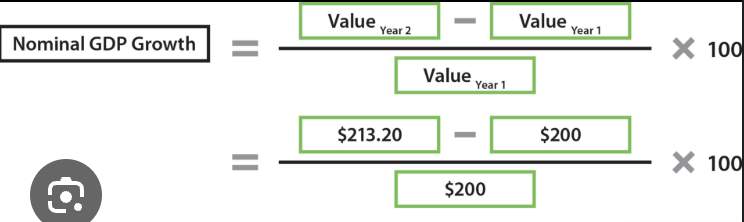
Nominal GDP Growth Rate
Real GDP
GDP measured by valuing production in two adjacent years using the average price across those years, thereby removing the effect of price changes.
Real GDP Growth Rate

Approximation relating nominal GDP growth, real GDP growth, and inflation
Nominal GDP Growth Rate ≈ Real GDP Growth Rate + % Change in Prices
Nominal GDP interpretation
Nominal GDP for a given year is expressed in the dollars of that same year
Chain Weighted Real GDP interpretation
Chain-Weighted Real GDP for a given year is expressed in the dollars of the base year (e.g., "$24 trillion in 2017 dollars").
Per-Capita (Per-Person
A scalar obtained by dividing an aggregate measure by the population of a nation. Used to make large numbers more interpretable.
Percentage change
Dividing a change in a variable by its starting value to express growth as a rate. Percentage Change = [(New Value − Old Value) / Old Value] × 100
Economic Growth (as a field of study):
The study of the long-run processes that determine why real income per person rises over time and why these rates differ so dramatically across countries.
Per-Capita Real GDP = Real GDP / Population
Has the interpretation of the average annual real income of the citizens of a nation. The primary measure used to compare living standards across countries and over time
Rule of 70
A rule stating that the number of years it takes any variable to double is approximately 70 divided by the annual percentage growth rate of that variable. Years to Double ≈ 70 / Annual Growth Rate (%)
Aggregate Production Function
The relationship by which a nation’s inputs are transformed into real GDP. It determines the total production that is possible for a nation with a given set of inputs
Aggregate Production Function equation:
Y = f(L, H, K) • Inputs (Factors of Production) in the aggregate production function: o Labor (L): The sum of all hours worked across the economy. o Human Capital (H): The accumulated knowledge and skills—developed through education, training, and practice—that make workers more productive. o Physical Capital (K): The tools, machinery, and structures that serve as inputs in the production process. Equivalent to capital goods.
Technological Progress
New ideas for using existing resources more efficiently. Represented as changes to f in the production function that yield more real GDP from the same amounts of L, H, and K. Includes new production techniques, scientific discoveries, and improved management methods.
Labor Productivity
The quantity of real GDP produced per hour of work. Long-run growth in per-capita real GDP requires sustained growth in labor productivity. Labor Productivity = Real GDP / Total Hours Worked
Capital Stock
The total quantity of physical capital available for use in the production of goods and services
Depreciation
The wearing out or obsolescence of existing physical capital over time. The capital stock grows in a given year only when Investment in new capital goods exceeds Depreciation.
Change in Capital Stock
= Gross Private Domestic Investment − Depreciation
Diminishing Returns (to capital):
As more capital is added while other inputs remain fixed, each additional unit of capital yields smaller and smaller increases in output. This limits capital accumulation as a source of sustained long-run growth.
Catch-Up Growth
The tendency for poorer countries to grow faster than richer ones, because they can adopt existing technologies and invest in capital goods where returns are still high, rather than having to innovate at the frontier
Working-Age Population
The total number of people aged 16 and over who are not in the military and are not institutionalized.
Employed
A person is considered employed if they worked at least one hour for pay during the survey reference week, or are on leave from a job.
Unemployed
A person is considered unemployed if they are not employed and meet at least one of the following: (1) made specific efforts to find a job within the previous four weeks, (2) are waiting to be called back from a layoff, or (3) are waiting to start a new job within 30 days.
Not in the Labor Force
A person in the working-age population who is neither employed nor unemployed.
Labor Force
The sum of the number of employed and unemployed persons. Labor Force = Number Employed + Number Unemployed
Unemployment Rate
The number of unemployed persons expressed as a percentage of the labor force
Unemployment Rate = (Number Unemployed / Labor Force) × 100
Labor Force Participation Rate (LFPR):
The percentage of the working-age population who are members of the labor force.
• LF Participation Rate = (Labor Force / Working-Age Population) × 100
Marginally Attached Workers
People who are available to work and have looked for work in the previous 12 months, but not in the previous four weeks. Not counted as unemployed in the official rate.
Discouraged Workers
A subset of marginally attached workers who have stopped looking for a job because they believe no jobs are available to them. When an unemployed person becomes a discouraged worker, both the numerator (unemployed) and denominator (labor force) of the unemployment rate equation fall, which actually reduces the official unemployment rate.
Employed Part-Time for Economic Reasons
Workers who hold part-time jobs but wish to have full-time jobs. Not counted as unemployed in the official rate
U-6 Unemployment Rate
A broader measure of unemployment that counts marginally attached workers and those employed part-time for economic reasons as unemployed.
Frictional Unemployment
Unemployment arising from normal labor market turnover—including time spent by people entering or re-entering the labor force, workers who quit to search for new jobs, and the ongoing creation and destruction of jobs. It exists because matching workers to jobs takes time, even when enough jobs exist in total.
Structural Unemployment
Unemployment that exists because structural features of the economy keep wages above the level that would set labor supply equal to labor demand. Always present to some degree in the economy.
Cyclical Unemployment
Unemployment that exists due to a temporary downturn in the economy (e.g., a recession). Increases during recessions and decreases during expansions.
Efficiency Wages
Wages paid above the market-clearing level because doing so increases firm profits (by reducing turnover, absenteeism, etc.). Because more workers want these jobs than positions available, efficiency wages generate unemployment.
Minimum Wage
A legally mandated wage floor that may exceed the marketclearing wage, particularly relevant for youth unemployment.
Inflation Rate
the annual percentage increase in the average price level for a nation.
Price Index
A measure of the overall level of prices in the economy.
Consumer Price Index
The most recognizable measure of the average level of prices in the United States. The CPI is computed by the Bureau of Labor Statistics (BLS).