COGSCI 200 - Final Exam
 Call Kai
 Learn
Learn Practice Test
 Spaced Repetition
 Match
Match Flashcards
 Knowt Play
1/70

There's no tags or description
Looks like no tags are added yet.
Name | Mastery | Learn | Test | Matching | Spaced | Call with Kai |
|---|
No analytics yet
Send a link to your students to track their progress
71 Terms
The great divide (of emotions)
The big contrast between emotional and computational/rational mind.
Why we reject the great divide (the theoretical appraoch)
in the theoretical approach: emotion and reason/cognition are deeply intertwined
Emotion is not an update to give an organism feeling but a crutial link between perception and action.
Marr’s three levels of explanation of emotions
Functional level: mapping from situations to feelings, bodily response patterns, facial expression…
Algorithmic level: appraisal, effector program
Physical level: low and high road of fear (amygdala)
What are emotions"?
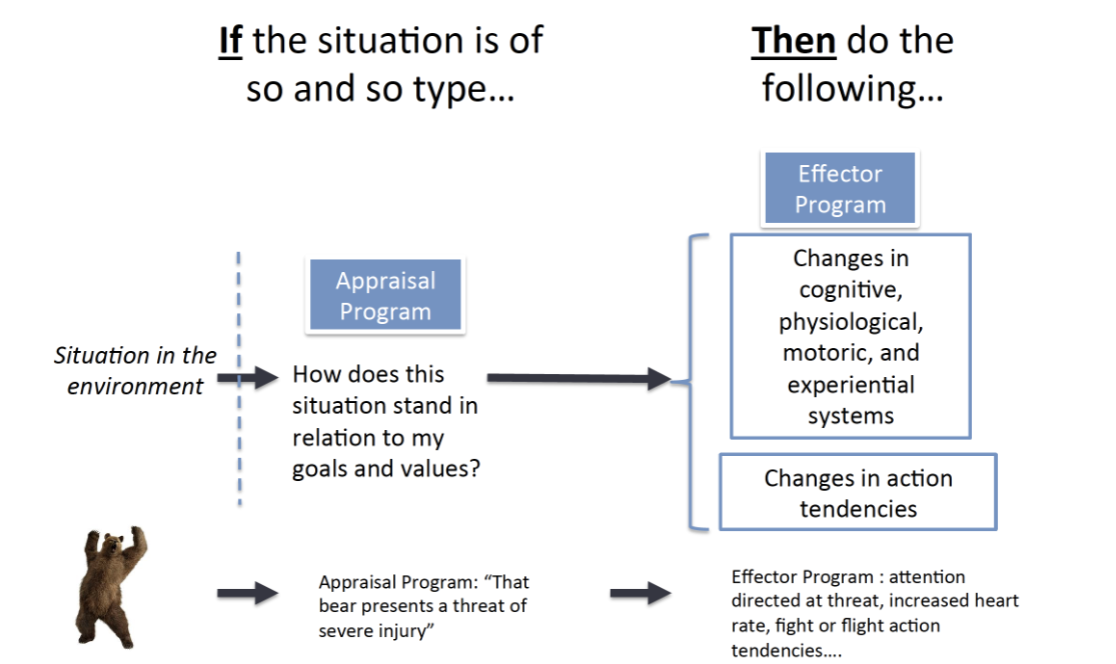
Emotions are special kinds of effector programs:
situation in the environment —> if teh situation is of so and so type… then do the following
Situation in the environment —>
Appraisal program (how does the situation stand in relation to goals and values?) —>
Effector program (changes in physiology, action tendencies)
The Consciousness Problem
The problem of providing a complete, purely physical explanation of the experiential character of a mental state.
Even if mental states are realized in physical brain states, there still seems to be an explanatory gap.
Conscious experience = “what it is like” aspect of being in a mental state (what does it feel like to have an emotion?)
How does the affect program explain the consciousness problem?
If we understand emotions as affect programs, the experiential stuff is part of the effector program which should explain the consciousness part.
This puts consciousness with feeling so that it does not invoke the great divide.
Fear appraisal program
Does the situation involve facing a relatively immediate, serious danger?
Fear effector program
cognitive changes:
thoughts/attention focused on threat, memory primed for threat-relevant information
physiological changes:
hormonal changes (norepinephrine, cortisol), enhanced sympathetic tone (increased heart rate/blood pressure, pupillary dilation, sweating, blood flow in skeletal muscles)
motoric changes:
postural, vocalization changes
experiential changes
feeling of fear
motivational changes
narrowing of goals —> from relaxing/seeing nature etc. to protecting yourself and staying alive
Happiness appraisal program
Does this situation involve making reasonable progress toward the realization of one’s goals.
Happiness effector program
cognitive changes:
thoughts/attention expand and broaden, memory primed for positive events
physiological changes:
hormonal changes (endogenous opioid system), decreased sympathetic tone
motoric changes:
postural, vocalization changes
experiential changes
feeling of happiness
motivational changes
broadening of goals —> from paying bills to addition of goals like meeting friends, starting new projects, etc.
Theories of Emotion
James-Lange theory: Stimulus → bodily response pattern → conscious interpretation of bodily response → feeling
Schacter-Singer theory: Stimulus → bodily response pattern → conscious interpretation of bodily response → feeling
Standard Appraisal theory: Stimulus → conscious interpretation of situation (appraisals) → Emotion effector program (includes bodily response pattern)
LeDoux’s low road/high road model
James-Lange Theory
Stimulus → bodily response → perception of body → feeling
Emotions are accompanied by bodily changes and we can sense what is going on in our bodies just as much as we can sense what is going on in the outside world.
Different situations elicit different bodily changes leading to differential feelings for different emotions →
bodily changes come first, then emotions
Example: we feel sad because we cry
James-Lange Theory Pros and Cons
Pros:
Helps explain feelings of emotion and makes them different from belief (because they arise from sensations in our body)
Helps explain what makes an emotion different from another.
Cons:
The bodily response profile can’t always explain what makes emotions feel different from “cold” belifs.
The bodily response pattern can’t explain what makes one emotion different from another.
Schacter-Singer Theory Theory of Emotion
Stimulus → bodily response → conscious interpretation of bodily response → feeling
Bodily response patterns are broad but conscious interpretations of these patterns give rise to specific emotions (bodily response can be interpreted differently.
Schacter-Singer Theory Pros and Cons
Pros:
Explains how non-specific bodily response patterns give rise to specific emotions
Cons:
How does the bodily response pattern come about in the first place?
Schacter-Singer Theory Bridge Study
Set up:
Male participants cross either a scary or a sturdy bridge and are greeted by a female on the other side who has them fill out a form. She then gives them her phone number to ask any other questions.
Results:
Men in the scary bridge condition called the female confederate for a date at a significantly higher rate than men in the sturdy bridge condition.
WHY?
The men on the scary bridge experienced increased arousal, they misattributed their arousal to being attracted to the female.
Arousal + cognitive interpretation = emotion
Standard Appraisal Theory
Stimulus → conscious interpretation of situation (appraisals) → emotion effector programs (bodily response pattern)
The same stimulus can invoke different appraisals leading to different bodily responses.
Standard Appraisal Theory Pros and Cons
Pros:
Explains how bodily response patterns come about
Explains specificity of emotions in terms of specific content of appraisals
Evidence for Appraisal Theory (gruesome accident study)
Set up:
Participants are shown a video of a gruesome industrial accident.
Control group: given no additional information
Test group: told that this is a safety film and the people in it are actors
Results:
Control group → emotions
Test group → no emotions
LeDoux’s low road/high road model
Incorporates both high level conscious appraisal (via high road/slow pathway) and low level subconscious appraisal (via low road/fast pathway)
Note: blindsight is also a dual pathway with both conscious and subconscious processing.
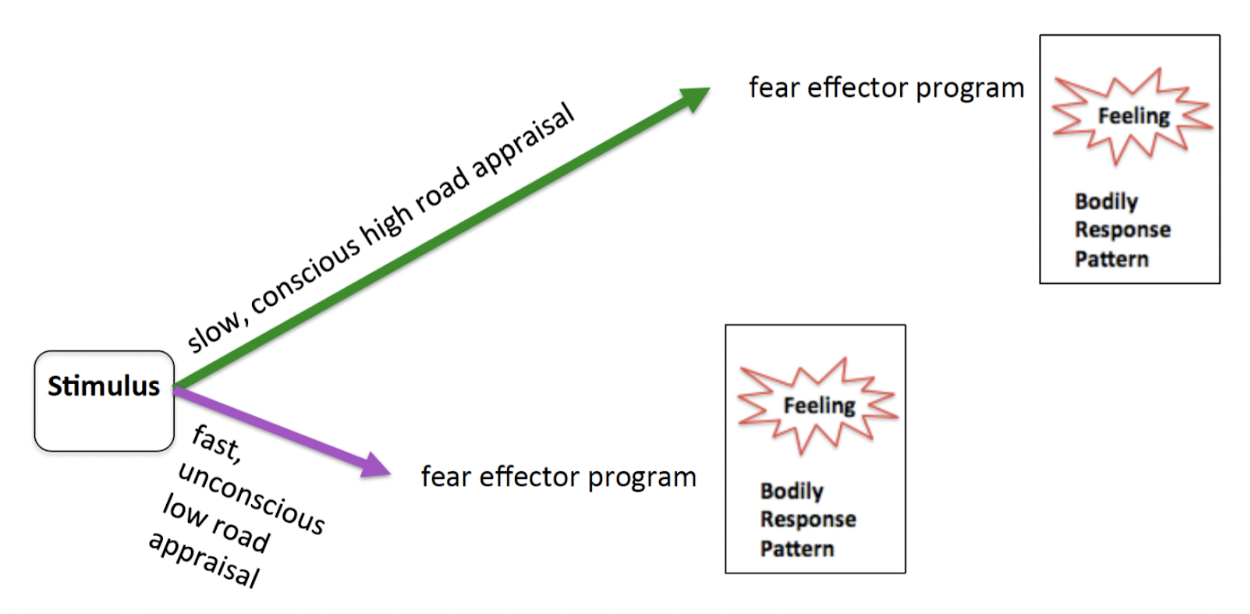
The low road (in LeDoux’s theory of emotion)
Thalamus to amygdala (close to j=hippocampus → memory) → subconscious
reaches lower cortical region
When fear is generated via the low road, the operation of fear’s affect program is fast and mandatory.
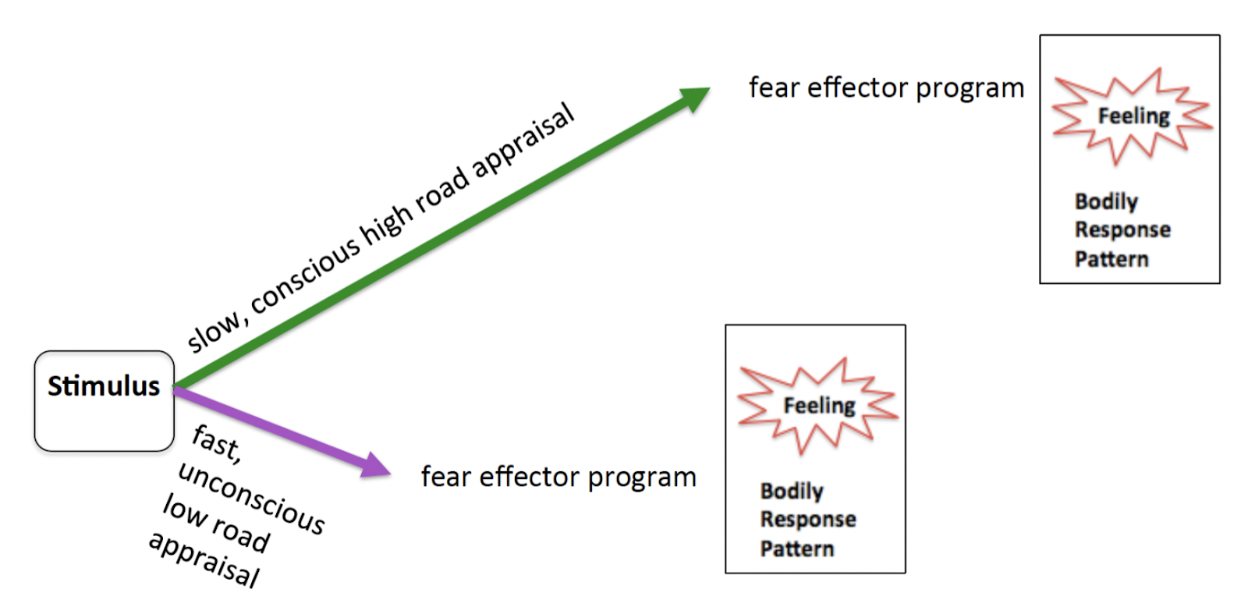
Dual processes example 1: Car backfire example (LeDoux’s theory of emotion)
A soldier fears gunfire from being in war. He know the probability of gunfire at home is near zero yet, when a car backfires, he feels fear.
Sound of car backfiring →
Low road pathway:
low level sensory processing in thalamus
unconscious appraisal of situation
activation of the fear effector program
High road pathway:
low level sensory processing in the thalamus
high level sensory precessing and belief formation in cortex
conscious interpretation of situation
activation of the feat effector programs
Low road plane example (LeDoux’s theory of emotion)
We have emotions that conflict with conscious appraisals: We consciously know all the facts and figures about the safety of planes yet people still have a very robust fear response to being on airplanes.
Informationally encapsualtes
The high road (in LeDoux’s theory of emotion)
Thalamus to sensory cortex to amygdala → conscious
reaches higher cortical region
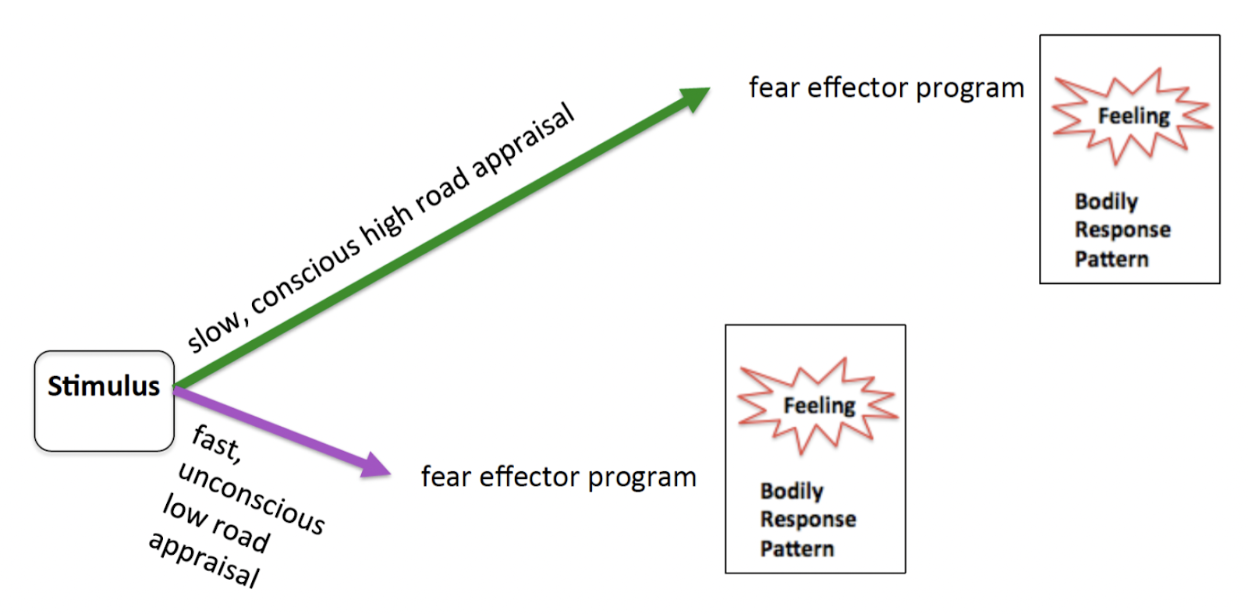
Modularity of fear processing
The features of fear processing are characteristically modular:
fast
mandatory
domain-specific
neurally discretely localized
informationally encapsulated
The amygdala
Both low and high processes end at the amygdala.
the amygdala is a small nucleus of neurons in the medial temporal lobes, adjacent to the hippocampus and close to the basal ganglia.
it is important in forming emotional responses to situations
plays a role in fear processing
Lesions to the amygdala
If the amygdala is lesioned, neither the low nor the high road can activate with the fear effector program.
Studies show that lesions to the amygdala prevent the activation of the fear effect program → only affects fear responses, not other emotions, which shows modularity
Amygdala lesions in humans and animals
Evidence from human lesions studies converges with results from animal studies (like monkeys and rats).
Juvenile monkeys with amygdala lesions were compared to healthy monkeys.
Monkeys with amygdala lesions were not scared of snakes while other monkeys were very afraid of them.
Proposals for explaining higher cognitive emotions
The affect program doesn’t consider higher, more cognitive emotions.
Proposals fro explaining these:
All emotions are (distinct) affect programs
Higher emotions are blends of the basic affect programs
Higher emotions are socially constructed
Are emotions universal?
Basic emotions:
Evidence shows that there is universality across cultures un the expression and recognition of these emotions.
Evidence:
People from a tribe in New Guinea were asked to identify emotions that go with expression and then asked to make facial expressions that showed specific expressions.
Results: they had similar facial expressions to those of other cultures.
Dual processes example 2: Cheater detection hypothesis
Non-social contract rule:
Rule 1: if there is an X on one side of the card, then there is a 3 on the other side of the card.
Social contract rule
Rule 2: if a person id drinking beer, then that person has to be over teh age of 18
People are better at guessing the second one because we have a cheater detection module (faster)
Dual processes example 3: Blindsight
Intact cortical visual processing:
retina → lateral geniculate nucleus → visual cortex → other cortical regions
Blindsight (subcortical processing):
retina → lateral geniculate nucleus → other cortical regions
skips over visual cortex, where complex processing with conscious awareness happens
What two topics have universality?
Language and Basic Emotions
Underdetermined problems solved by innate structures/knowledge + environmental input
language
infant cognition (physics)
perception (inverse optics, retinal patterns, assumptions)
Underdetermined problems and Poverty of Stimulus
Poverty of stimulus: there is a mismatch between meager input and rich output.
Language
language learning is shaped and enriched by an innate template: universal grammar,.
Moral judgement
Mikhail makes poverty of stimulus argument for Universal Moral Grammar.
Infant cognition
innately constrained learning mechanisms that explain how children acquire so much so rapidly.
Tacit knowledge
Information within a system that the person cannot articulate.
Example:
Language: question inversion
Perception: hidden assumptions of the perceptual system
Infant cognition: intuitive physics
Moral judgement: the doctrine of double effect
Modularity in topics
Information encapsulation
muller-lyer illusion
recalcitrant fear of flying
Inaccessibility
interrogative rule
moral grammar
language
perception
face processing
cheater detection
LeDoux’s low road
Marr’s levels of explanation of Rational Decision-Making
Functional: mapping from states to actions to maximize long-term discounted expected utility given that you are in a state.
Algorithmic: Q-learning algorithm
Physical: ventral tegmental area (VTA), ventral medial prefrontal cortex (vmPFC), striatum and how they link to Q learning algoritm.
What is rationality?
Rationality = performing actions that bring about the best outcomes
Takes on Rationality
Maximize objective value
Maximize expected objective value
Maximize expected utility
Maximize discounted expected utility
Take 1: Maximize objective value
Choosing the option with the highest literal worth.
Example: if action A leads to $500 and action B leads to $100, you would take action A.
HOWEVER: there are uncertainties of what the decision will lead to which requires the incorporation of probabilities.
Take 2: Maximize expected objective value
Choosing the option with the highest average outcome based on probability.
Example: action A has 0.99 probability of leading to $6000 and 0.01 probability of leading to. Action b has 0.99 probability of leading to $0 and 0.01 probability of leading to $6001.
Person would choose option A.
Expected value of action comes from multiplication of values and probabilities and addition.
Take 3: Maximize expected utility
Choosing based on the personal satisfaction of the “usefulness” of an outcome → subjective value
Two arguments in favor:
Diminishing marginal utility
Expanding beyond financial decisions.
The utility that money has to us depends largely on the amount of money we already have.
Diminishing marginal utility
The additional utility of the next dollar goes down the more dollar you have.
Pros and cons of take 3: Maximize Expected Utility
Pros: the expected utility model generalized to more complex situations → places candidate actions on a common scale, using a common currency.
Cons: can’t handle delay in reward.
Take 4: Maximize discounted expected utility
Choosing based on the utility while factoring in that rewards are generally worth more to us right now than they are in the future.
Modeled with an exponential function with parameter 𝜸:
Suppose an option has utility U if it arrives now but it will actually arrive in x weeks
Because U is delayed by x weeks it is worth less
The discounted utility of “U at delay x” is: U * (𝜸x)
Are people actually rational? Rationality Research Programs
Program 1: The Heuristics and Biases Research Program
Program 2: Evolutionary Psychology Research Program
Program 3: Neuroeconomics Research Program
Rationality Program 1: The Heuristics and Biases Research Program
Are people actually rational? No, especially at the automatic intuitive program. People rely on a limited number of heuristics which sometimes yield reasonable judgements and sometimes lead to sever and systematic errors.
Representativeness Heuristics
A heuristics according to which judgements of probability are made on the basis of assessments of similarity.
This leads to conjunction fallacy: a cognitive bias where people mistakenly judge a specific combination of events as more likely than a single general event.
(Lydia Bank teller) Example: Description of Linda given and people are asked which choice is most probable: (a) Linda is a bank teller (b) Linda is an active feminist (c) Linda is a bank teller and an active feminist. → people chose option c even though it is less probable because it includes to probabilities
Base rate neglect
representativeness heuristics leads to base rate neglect: a cognitive bias where people focus too much on specific, new information while ignoring general, statistical data.
Represented by the lawyer/engineer example:
People are given descriptions of men and are told that 30 are engineers and 70 are lawyers. They are then asked what is the probability that they are an engineer.
They’re answer should be based on the prior probability that they are given of how many engineers vs. lawyers they interviewed, not on the description of the person.
They then did another experiment with everything being the same but the prior probabilities reversed (70 engineers, 30 lawyers.
Findings: group 1 and group 2 probabilities were nearly equal → they’re answers didn’t change based on the prior probabilities, they are neglecting base rates
Availability heuristic
A heuristics in which judgements of frequency or proportion are made by the ease in which examples come to mind.
Example 1: Words with “n: in the first vs. third position
Question: If a random word is taken from an english text, is it more likely that the word starts with a N or that N is the third letter?
Results: Most people say there are more words that start with N, even though there are many times more words with N in the third position.
They make the same mistake with other letters
This is because it is easier to come up with words that start with N than those that have N in the third position
Example 2: Group 1 was asked to come up with 6 examples of times they have been assertive and group 2 was asked to come up with 12 examples. All subjects were asked “Are you an assertive person?”
Results: Group 2 subjects rate themselves as less assertive than group one. This can be explained by the availability heuristics because they struggle to come up with 12 examples so they infer they are only rarely assertive.
Affect heuristic
A heuristic in which the host of complex judgements are made on teh basis of quick, affective “gut” reactions.
Example 1: ford stock
Investing in Ford stock just because you like a car instead of investigating whether the stock was currently underpriced.
Example 2: Two groups are asked two questions, the difference is the order in which the questions are answered.
Group 1 → Q1: How happy are you with your life in general? Q2: How many dates did you have last month?
Group 2 as asked the dating question first.
Results: Group 1 → hardly any correlation between the answers to the questions; Group 2 → correlation between Q1 and A2 is 0.66 (pretty high)
This is because they’re answer to the first question makes them feel a certain way that affects their answer to the second question.
Framing Effects Heuristic
A heuristic in which the way information is presented, especially wheter an option is described in terms of potential gains or potential losses, disproportionately influences a person’s choices.
Example 1: Disease Outbreak
US is preparing for outbreak of disease that will kill 600 people and there are two alternatives to combat the disease:
Group 1: If program A is adopted, 200 people will be saved. If program B is adopted, there is a ⅓ probability that 600 people will be saved and a ⅔ probability that no people will be saved.
People tended to choose option A because A is certainty and B is uncertainty → uncertainty = more risky
Group 2: if program C is adopted, 400 people will die. If program D is adopted, there is a ⅓ probability that nobody will die and a ⅔ probability that 600 people will die.
People tended to choose option D because certainty is framed as a loss → uncertainty = less risky
Explaining heuristics and biases
System 1 (intuition): fast and effortless but may lead to wrong answer → heuristics.
System 2 (reasoning) → slow and effortful but will likely lead to the right answer.
The ball/bat example to explain heursitics
People are asked: A bat and a ball together cost $1.10. The bat cost $1
more than the ball. How much does the ball cost?
Roughy half of students at Princeton get this question wrong
Kahneman’s take: we barely use system 2
Rationality Program 2: Evolutionary Psychology Research Program
Are people actually rational? Often, if the problem is posed in the right format.
Evolutionary Psychology Research Program and Modularity
Evolutionary psychologists believe that the mind is massively modular.
Important features of modules:
domain-specific
adapted for input presented in formats similar to how input was received in the ancestral environment in which the module evolved.
Evolutionary Psychology Research Program Example
When we present the Linda bank teller example using frequencies (whole numbers/ratios) instead of percentages or decimals, most people provide the rationally correct answer.
Rationality Program 3: Neuroeconomics
Are people actually rational? Yes, especially at the automatic, intuitive (i.e. emotional/affective) level.
Research in neuroeconomics shows that subjective utility/desirability of options is computed and represented in animal and human brains.
What is reinforcement learning (RL)?
It is a problem: the problem of deciding what to do now to maximize future (long term, discounted) expected rewards → functional level
A set of methods or algorithms for solving the RL problem in different settings → algorithmic level
A field: a branch of machine learning and artificial intelligence
Another field: a branch of psychology and cognitive neuroscience
The problem of neuroeconomics
Designing an effective organism: How should we or evolution design an organism that acts effectively in the world?
One possibility of the problem of neuroconomics: “wire-in” innate stimulus-action mapping
Wiring-in" is essentially hard-coding a behavior. In biology, we call these instincts or reflexes.
It means an organism is born with a pre-set instruction manual: "If X happens, do Y." There is no learning or thinking required; the reaction is automatic because the "circuitry" is already built into the brain or nervous system.
How it works:
Stimulus: An input from the environment (e.g., a sudden loud noise).
Action Mapping: A direct, unchangeable link to a behavior (e.g., jumping/startle response).
Limitations to “wire-in” innate stimulus-action mapping
Wiring-in innate stimulus-response mapping is effective but limited
It will not, for example, help a rat in a maze because the rat needs to have already learned something about the world (maze) and how it world in order to make a good choice about where to go next.
The DeepMinds Solution to Neuroeconomics
Instead of "wiring-in" specific actions, they "wire-in" the ability to learn from experience.
Agents play 600+ iterations of a game, using trial-and-error to map raw input (pixels) to rewards.
Reward (Q-learning)
Rewards are quantities that are function of state. We usually say it is a function R(s) of mapping states to quantities.
The rewards signal defines the goals of the agent: maximize the sum of rewards.
Policty (Q-learning)
A policy specifies how the agent will behave in each state. It is a function of 𝞹(s) mapping state to action. The best optimal policy is the one that maximizes (average) sum of rewards.
Value (Q-learning)
The value function is a prediction about future rewards. It is usually represented as a function V(s) that maps states to predicted future discounted sum of rewards, or a function Q(s,a) that maps a state and action to a predicted future sum of rewards.
Reinforcement learning in the brain: What should we look for if we want to find neural correlates of reward-based learning?
Neurons that detect the presence of that reward → rewards function → striatum
Neurons that anticipate or predict the future (cumulative) reward → value function → vmPFC
Neurons that encode a prediction error → error signal → VTA
The big three subcortical structures (Reinforcement learning in the brain)
Striatum: major component of the basal ganglia → involved in processing rewards/punishments and in action control
Thalamus: involved in relying sensory information from sensory sources to other regions
Amygdala: involved in processing emotions, especially fear.
The striatum
Represents the reward function.
Experiment:
Task: subjects see a vue that tells them how much money they can win on that trial ($0-$5). They are told that to win the money they have to press the button fast enough.
Results": trial-to-trial variation in striatal activation matches the variation in trial-to-trial rewardingness in outcomes → more activation to $5 than to $0.20.
Conclusion: striatum represents the rewardingness of outcomes.
Also represents the magnitude of reward in aniamls.