Managing Global Expansion: A Conceptual Framework — Gupta & Govindarajan
 Call Kai
 Learn
Learn Practice Test
 Spaced Repetition
 Match
Match Flashcards
 Knowt Play
1/25

There's no tags or description
Looks like no tags are added yet.
Name | Mastery | Learn | Test | Matching | Spaced | Call with Kai |
|---|
No analytics yet
Send a link to your students to track their progress
26 Terms
[to read] Main exam idea
The reading says globalization is no longer just an optional growth move. But the important exam point is not “companies should globalize.” The important point is: global expansion must be sequenced and managed through clear choices:
Which product line to globalize first.
Which markets to enter.
Which entry mode to use.
How much corporate DNA to transfer.
How to win locally.
How fast to expand.
Small example:
A company should not enter China, India, Brazil, and Germany with all products at once. It should choose the product and market where the payoff is high and the risk is manageable.
Exam logic:
Do not answer: “Global expansion = enter many countries.”
Correct: global expansion = sequence product, market, entry mode, adaptation, and speed.
5 reasons companies globolaize
Imperative | Meaning | Small example |
|---|---|---|
Growth | Domestic markets may be mature, so firms need new demand abroad | A paper company looks at China/India because consumption is still low |
Efficiency | Global scale can reduce cost | Car companies need large sales volume to support R&D and production scale |
Knowledge | Foreign markets create learning that can be used globally | GE India develops cheaper CT scanners useful elsewhere |
Global customers | If customers globalize, suppliers must follow | GE Plastics follows AT&T/GTE abroad |
Global competitors | If rivals globalize first, they can attack you with scale and cross-subsidies | Fuji challenges Kodak internationally |
Exam trap:
These are not “motivations to export.” They explain why globalization becomes a strategic pressure, not just an opportunity.
Product choice: do not globalize the whole portfolio at once + framework
Product choice: do not globalize the whole portfolio at once
Printed pages 46–47 / PDF pages 2–3
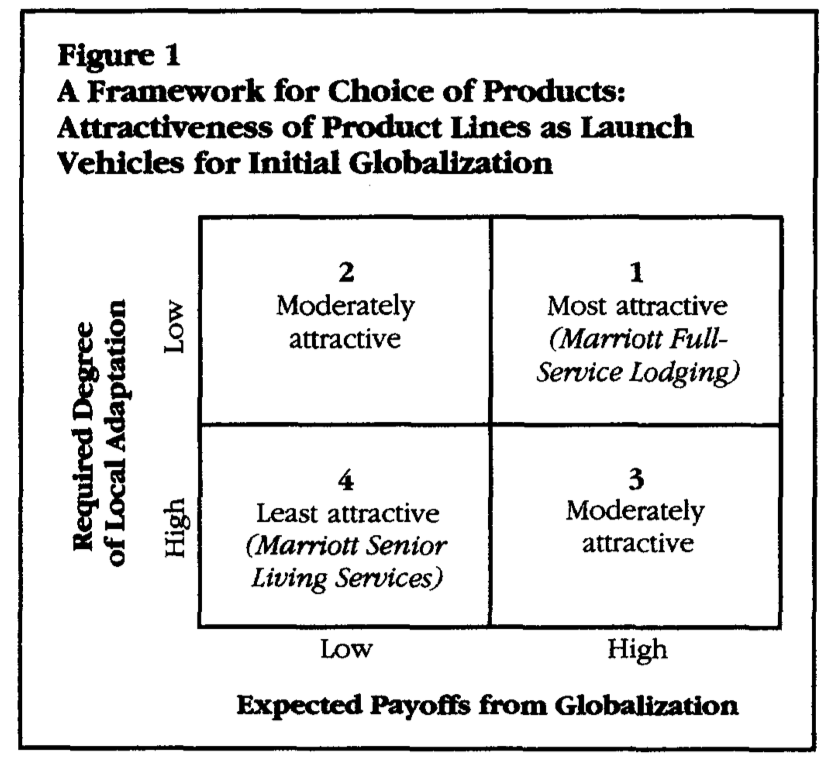
A multiproduct company should usually choose one or a few product lines as launch vehicles for globalization. The first global moves are learning experiments, so they should maximize return and minimize risk.
The framework uses two dimensions:
Expected payoffs from globalization
Required degree of local adaptation
Product type | Exam meaning |
|---|---|
High payoff + low adaptation | Best launch vehicle |
High payoff + high adaptation | Attractive but riskier |
Low payoff + low adaptation | Only moderately attractive |
Low payoff + high adaptation | Worst launch vehicle |
Small example from reading:
For Marriott, full-service lodging was a better first global product than senior living services. Full-service hotels serve international business travelers and can use global reservation systems, global service standards, and global brand reputation. Senior living is much more local and needs heavy adaptation.
Exam logic:
Start globalization with the product line where the company can transfer more of its existing advantage and adapt less.
[to read] Required local adaptation = risk
The more a product or service needs local redesign, the riskier it is as a first global move. Local adaptation is not bad, but it increases uncertainty because the firm is already suffering from liability of foreignness.
Small example:
A hotel brand can copy many service standards abroad. But a retirement-home business needs deep adaptation to local family norms, regulation, healthcare systems, and elderly-care culture.
Exam trap:
High global potential is not enough. If adaptation is too high, it may be a bad first move.
Strategic market choice
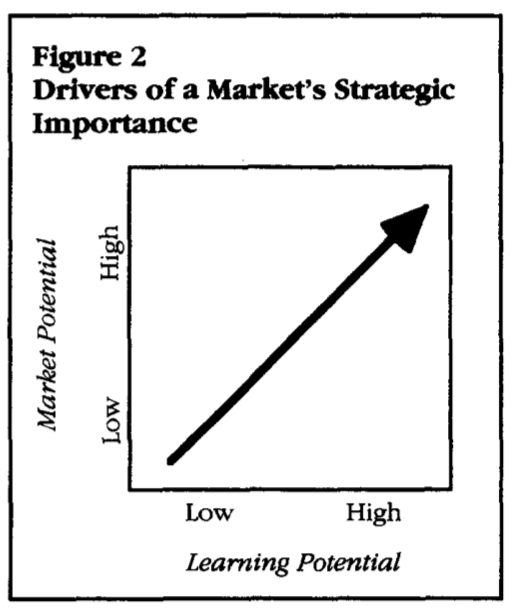
A market is strategically important for two reasons:
Market potential = current size + expected growth for that product.
Learning potential = how much the market helps the firm learn from demanding customers, advanced competitors, technologies, universities, or related industries.
Small example:
France and Italy matter for fashion not only because they sell fashion, but because they contain sophisticated customers and trends that help firms learn.
Exam logic:
A market can be strategic even if it is not the biggest GDP market.
[to read] Do not confuse GDP with market potential
The reading explicitly warns that market potential does not always match country GDP. A country can be economically large but not strategically important for your specific business; another country can be smaller but crucial for your industry.
Small example:
For ABB’s power-plant business, demand may be stronger outside the classic “triad” of Europe, Japan, and North America.
Exam trap:
Do not say: “A strategic market is always a rich country.”
Correct: strategic market depends on your product-market.
Market entry choice
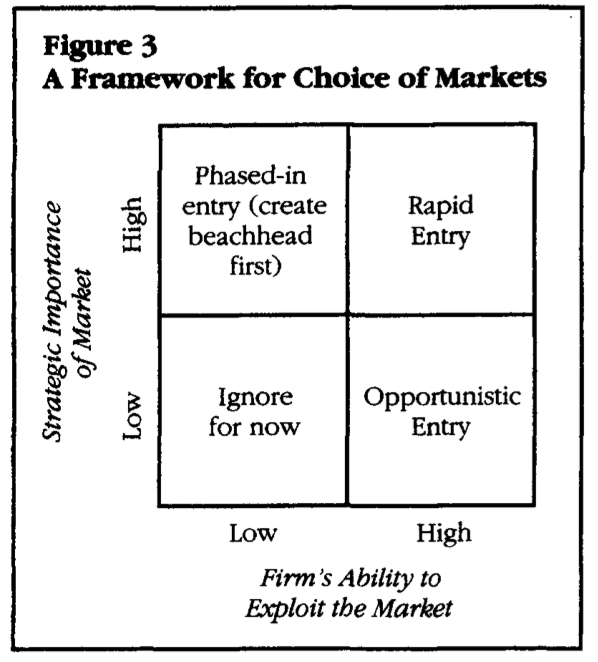
The reading gives a market-entry matrix:
Strategic importance | Ability to exploit | Recommended action |
|---|---|---|
High | High | Rapid entry |
High | Low | Phased-in entry / beachhead first (постепенно а не резко) |
Low | High | Opportunistic entry |
Low | Low | Ignore for now |
Small example:
China may be strategically important, but if your company cannot yet handle local regulation, culture, or competition, you may first enter Hong Kong or Taiwan as a safer beachhead.
Exam logic:
A strategically important market is not always entered immediately. You enter fast only if you can exploit it.
Ability to exploit depends on 2 things
A firm’s ability to exploit a market depends on:
Entry barriers: regulation, distance, culture, language, trade restrictions.
Competitive intensity: strength of local and existing foreign competitors.
Small example:
The US retail market is large, but foreign retailers can fail because local competition is extremely intense.
Exam trap:
Large market + open entry does not automatically mean easy success.
Beachhead market
A beachhead market is a safer, similar market used to build capabilities before entering the difficult strategic market.
Small examples from reading:
Canada before the US
Austria or Switzerland before Germany
Hong Kong or Taiwan before China
Exam logic:
Beachhead entry is useful when a market is important but too difficult to enter directly.
Entry mode has two decisions
Entry mode is not just “export or joint venture.” The article says entry mode has two separate decisions:
Export vs local production
Degree of ownership/control: licensing/franchising, joint venture, affiliate, acquisition, or wholly owned subsidiary.
Small example:
A company can export finished goods with no local ownership, or produce locally through a joint venture, or build a wholly owned factory.
Exam logic:
Mode of entry = production location + ownership control.
When local production is better than exporting of 4
Local production is more appropriate when:
Local market size is bigger than minimum efficient scale.
Shipping/tariff costs are too high.
Product customization needs are high.
Local content requirements are strong.
Small example:
Cement is expensive to ship relative to value, so cement companies often produce locally instead of exporting.
Exam trap:
Local production is not always “more committed and therefore better.” It is better only when economics or adaptation require it.
When alliances / joint ventures are more appropriate of 5
Alliance-based entry is more appropriate when:
Cultural, linguistic, or physical distance is high.
The subsidiary does not need tight integration with the global network.
Risk of asymmetric learning by the partner is low.
The company lacks capital.
Government requires local equity participation.
Small example:
Ford entered India with Mahindra & Mahindra partly because it needed local knowledge and networks.
Exam logic:
Joint ventures help with local knowledge and risk-sharing, but they create control problems and learning risks.
—
Government
High physical & cultural distance
Low assymetric learning
No need for the help (hub)
No capital
[to read] Asymmetric learning risk
A joint venture can become a learning race. If one partner learns faster, it may later leave the alliance and compete alone.
Small example:
A local partner learns the foreign firm’s technology and brand-management methods, then later becomes a direct competitor.
Exam trap:
A joint venture is not only cooperation. It can also transfer your advantage to a future rival.
Greenfield vs cross-border acquisition
If the firm chooses local production, it must choose between:
Greenfield = build from scratch
Cross-border acquisition = buy an existing local company
Greenfield is better when the company has a unique corporate culture it needs to preserve. Acquisition is better when speed matters and the local market is mature, because building new capacity can intensify competition.
Small example:
Nucor’s culture was very unique, so greenfield made sense. International Paper used acquisitions in mature Europe because adding new capacity would worsen competition.
Exam logic:
Greenfield protects culture but is slower. Acquisition gives speed but creates integration problems.
Corporate DNA: what must transfer and what must adapt of 2
Corporate DNA means the company’s core beliefs, practices, and business model. The key is to separate:
Core elements = must be transferred
Peripheral (Secondary) elements = can be adapted locally
Small example:
Wal-Mart can define its core as “promote locally manufactured goods” instead of narrowly “promote Made in America goods.” The abstract version allows local adaptation.
Exam logic:
The company must know what cannot change and what should change.
Transplanting corporate DNA requires “DNA carriers”
To transfer core practices to a new subsidiary, companies often need to send committed employees from the parent company: DNA carriers. Their role is to transfer culture, routines, and standards.
Small example:
Ritz-Carlton brought expatriates to Shanghai to embed its service standards, but also demonstrated those standards by upgrading employee areas first.
Exam logic:
Corporate culture does not transfer through documents. It transfers through people, training, incentives, and visible actions.
Winning the local battle (we must manage the 3)
To win locally, a global firm must manage three host-country forces:
Customers
Competitors
Government / non-market stakeholders
Small example:
A company may have a strong global product, but still fail if it ignores local tastes, local competitor retaliation, or government regulation.
Exam logic:
International strategy is not only entry. It is also local execution after entry.
[to read] Customer adaptation depends on target segment
If the foreign-market customer segment is similar to the home-market customer segment, the firm can transfer more of its business model. If it targets a different local segment, it must adapt more.
Small example:
FedEx in China targeted multinational companies, similar to its existing customers, so it could transfer much of its US model. If it had targeted local Chinese firms, it would have needed more adaptation.
Exam trap:
Adaptation depends not only on the country. It depends on which customer segment the firm targets.
[to read] Domino’s India example: adaptation beats blind standardization
Domino’s adapted its menu and business model in India: it removed pepperoni and used toppings like chicken, ginger, and lamb to fit local culture and taste.
Small example:
A food brand entering India cannot just copy the US menu if religious and taste differences are central to consumption.
Exam logic:
Winning local customers often requires changing the offer, not just translating the promotion.
4 options against local competitors
When entering a market, local competitors may retaliate. The reading gives four options:
Acquire a dominant local competitor
Acquire a weak local competitor and transform it quickly
Enter a poorly defended niche
Frontal attack on dominant incumbents
Small example:
Japanese carmakers entered the US at the low end, a poorly defended niche, then moved upward.
Exam logic:
Do not assume the entrant always attacks the whole market directly. Niche entry can be smarter.
Acquiring a weak player is risky, why?
Buying a weak local competitor works only if the global firm can transform it quickly. Otherwise, the acquisition signals an attack and stronger local rivals respond before the weak player becomes competitive.
Small example:
Whirlpool bought Philips’s European appliance division but could not transform it fast enough. Electrolux and Bosch-Siemens reacted strongly, and Whirlpool underperformed.
Exam trap:
Acquisition is not automatically fast success. If integration and transformation are slow, competitors punish you.
Frontal attack only works with …
A direct attack on dominant incumbents is dangerous unless the entrant has a major competitive advantage that works abroad.
Small example:
Lexus attacked Mercedes and BMW in the US because it had strong product quality and around a 30% cost advantage.
Exam logic:
Do not attack strong incumbents head-on unless your advantage is clearly superior and transferable.
[to read] Government is part of the local battle
Especially in emerging markets, government can strongly affect market success. Firms should not only react to regulation; they should anticipate future regulatory changes and use constructive dialogue to shape the environment.
Small example:
China banning direct selling directly affected Mary Kay and Avon because their business models depended on direct selling.
Exam logic:
Government is not background noise. It can change the viability of the business model.
We do rapid expansion when… of 3
Fast global expansion can create first-mover advantages, but it can also overstretch resources. Rapid expansion is appropriate when:
Competitors can easily copy your success formula.
Scale economies are very important.
Management can handle global operations and transfer learning quickly.
Small example:
Microsoft, Dell, and Compaq expanded rapidly partly to prevent copying and piracy. Tire companies globalized quickly because scale economies mattered strongly.
Exam trap:
Fast expansion is not always good. PepsiCo expanded too fast in Latin America and ended up with market positions that were hard to defend and not profitable.
Final concept: directed opportunism
The conclusion is important: global expansion should not be a rigid master plan, but it should also not be random opportunism. The best approach is directed opportunism: stay flexible, but within a systematic strategic framework.
Small example:
A firm may take an unexpected opportunity in a new market, but only if it fits its product priorities, market logic, entry capabilities, and long-term global direction.
Exam logic:
Best answer: global expansion requires structured flexibility.
[to read] Final
This reading gives a complete framework for managing global expansion. The key is sequence and fit. A company must choose the right product line first, then select strategic markets based on market potential and learning potential, then check whether it can exploit the market. Entry mode depends on export vs local production and ownership/control. Local production is justified by scale, tariffs, customization, or local-content rules. Alliances help when distance is high or capital is limited, but they create control and learning risks. Greenfield protects corporate culture; acquisition gives speed but creates integration problems. After entry, the firm must transfer only the right parts of its corporate DNA, adapt to local customers, respond to competitors, manage government, and choose expansion speed carefully. The final logic is directed opportunism: flexible expansion, but guided by a clear framework.