AP Biology: Unit 3 - Cellular Energetics (Mrs. Majoros)
 Call Kai
 Learn
Learn Practice Test
 Spaced Repetition
 Match
Match Flashcards
 Knowt Play
1/74

There's no tags or description
Looks like no tags are added yet.
Name | Mastery | Learn | Test | Matching | Spaced | Call with Kai |
|---|
No analytics yet
Send a link to your students to track their progress
75 Terms
Calvin cycle
The second of two major stages in photosynthesis (following the light reactions), involving fixation of atmospheric CO2 and reduction of the fixed carbon into carbohydrate.
carbon fixation
the incorporation of carbon dioxide into organic compounds, such as in photosynthesis
Carotenoid
An accessory pigment, either yellow or orange, in the chloroplasts of plants and in some prokaryotes. By absorbing wavelengths of light that chlorophyll cannot, they broaden the spectrum of colors that can drive photosynthesis.
chlorophyll a
A photosynthetic pigment that participates directly in the light reactions, which convert solar energy to chemical energy.
chlorophyll b
An accessory photosynthetic pigment that transfers energy to chlorophyll a.
cyclic electron flow
A route of electron flow during the light reactions of photosynthesis that involves only photosystem I and that produces ATP but not NADPH or O2.
glyceraldehyde 3-phosphate (G3P)
A three-carbon carbohydrate that is the direct product of the Calvin cycle
light reactions
The first of two major stages in photosynthesis (preceding the Calvin cycle). These reactions, which occur on the thylakoid membranes of the chloroplast or on membranes of certain prokaryotes, convert solar energy to the chemical energy of ATP and NADPH, releasing oxygen in the process.
Photophosphorylation
The process of generating ATP from ADP and phosphate by means of a proton-motive force generated across the thylakoid membrane of the chloroplast or the membrane of certain prokaryotes during the light reactions of photosynthesis.
Photorespiration
A metabolic pathway that consumes oxygen and ATP, releases carbon dioxide, and decreases photosynthetic output. This process generally occurs on hot, dry, bright days, when stomata close and the oxygen concentration in the leaf exceeds that of carbon dioxide.
photosystem I (PS I)
One of two light-capturing units in a chloroplast's thylakoid membrane or in the membrane of some prokaryotes; it has two molecules of P700 chlorophyll a at its reaction center. NADPH producing
photosystem II (PS II)
One of two light-capturing units in a chloroplast's thylakoid membrane or in the membrane of some prokaryotes; it has two molecules of P680 chlorophyll a at its reaction center.
RubisCO
The enzyme that catalyzes the first step of the Calvin cycle (the addition of CO2 to RuBP).
Stomata
A microscopic pore surrounded by guard cells in the epidermis of leaves and stems that allows gas exchange between the environment and the interior of the plant., the small openings on the undersides of most leaves through which oxygen and carbon dioxide can move
Stroma
Within the chloroplast, the dense fluid of the chloroplast surrounding the thylakoid membrane; involved in the synthesis of organic molecules from carbon dioxide and water.
thylakoid
A flattened membranous sac inside a chloroplast. They exist in an interconnected system in the chloroplast and contain the molecular "machinery" used to convert light energy to chemical energy.
grana
the stacks of thylakoids embedded in the stroma of a chloroplast
sugar
chemical product of Calvin cycle
ATP and NADPH
high energy products made by the light reactions and used in the Calvin cycle
ADP & P & NADP+
low energy products made by the Calvin cycle and made back into high energy products in the light reactions
ATP synthase
protein on thylakoid membrane that makes ATP when hydrogen ions pass through it from thylakoid space to stroma
ribulose bisphosphate
molecule that grabs and fixes carbon dioxide in the Calvin cycle
G3P
molecule that is made in the Calvin cycle; glucose is formed when two of these molecules combine
starch
what is made when excess sugar is made in the Calvin cycle
linear electron flow
Primary Pathway: involves both photosystems and produces ATP and NADPH using light energy
primary electron acceptor
in chloroplasts, an acceptor of electrons lost from chlorophyll a; found in the thylakoid membrane
absorption spectrum
The range of a pigment's ability to absorb various wavelengths of light
visible light
That portion of the electromagnetic spectrum detected as various colors by the human eye, ranging in wavelength from about 380 nm to about 750 nm.
photosynthesis
process by which plants and some other organisms use light energy to convert water and carbon dioxide into oxygen and high-energy carbohydrates such as sugars and starches
autotrophs
organisms that make their own food
heterotrophs
organisms that cannot make their own food
photoautotrophs
photosynthetic prokaryotic organisms that harness light energy to drive the synthesis of organic compounds from CO2
Photosynthesis
Generates oxygen and organic molecules used for cellular respiration.
Cellular Respiration
Breaks down fuel from photosynthesis, generating ATP and waste materials used for photosynthesis.
Sun
Energy ultimately comes from the ___.
Exergonic
Compounds that can participate in ____ reactions can act as fuel.
Fermentation
Partial degradation of sugars without oxygen. Glycolysis reactions and reactions that regenerate NAD⁺ in the matrix.
Oxidation
Substance loses electrons.
Reduction
Substance gains electrons.
Oxidized, Reduced
In cellular respiration, glucose is ____ and oxygen is ______.
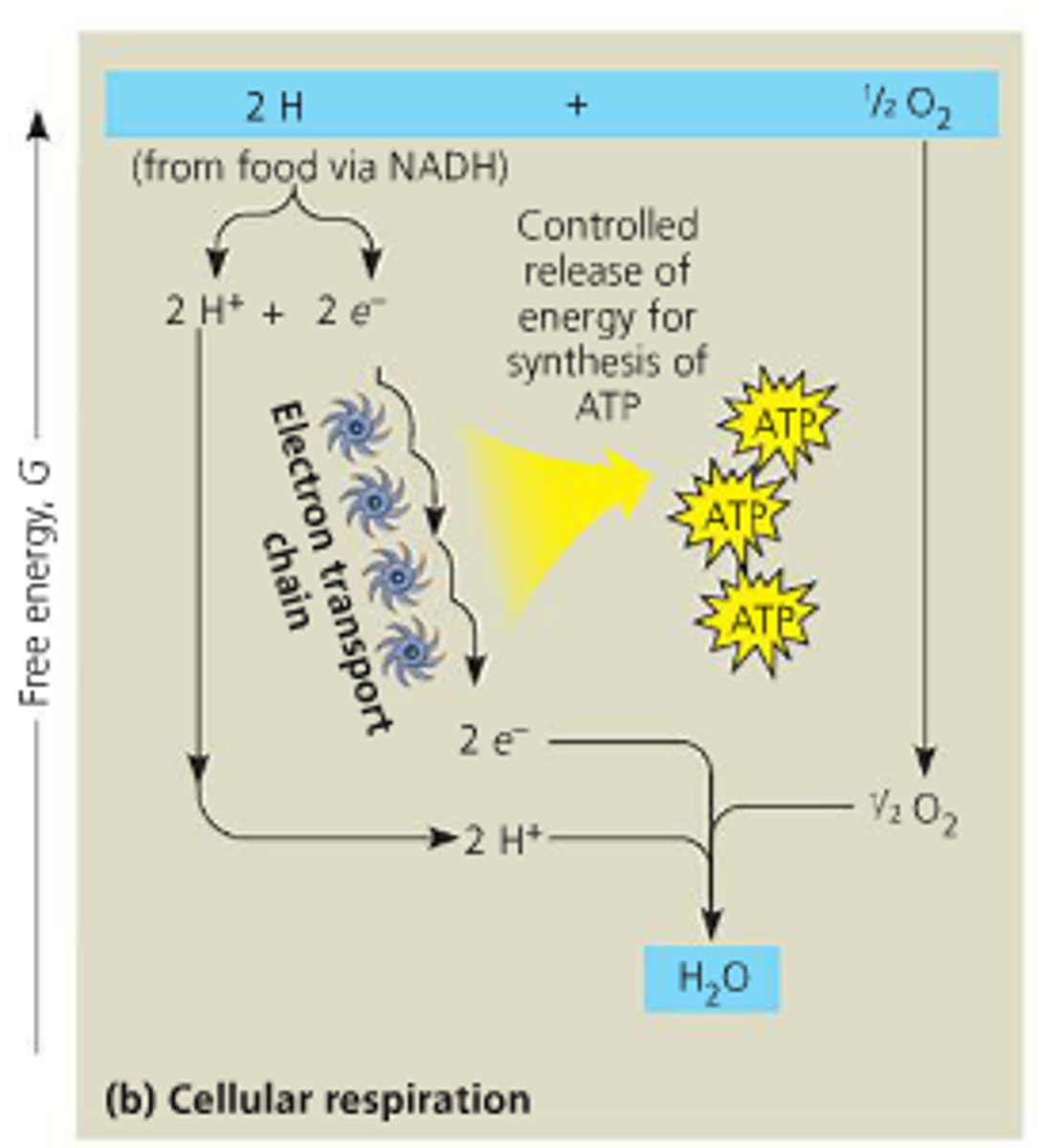
Electron Transport Chain
A series of steps. The energy from the electron transfer goes to make ATP. O₂ is the final electron acceptor. Occurs in the inner membrane of the mitochondria. Electronegativity builds until it gets to oxygen. Does not directly make ATP.
NAD⁺
An electron acceptor or oxidizing agent.
NADH
Electron carrier. The reduced form of NAD⁺.
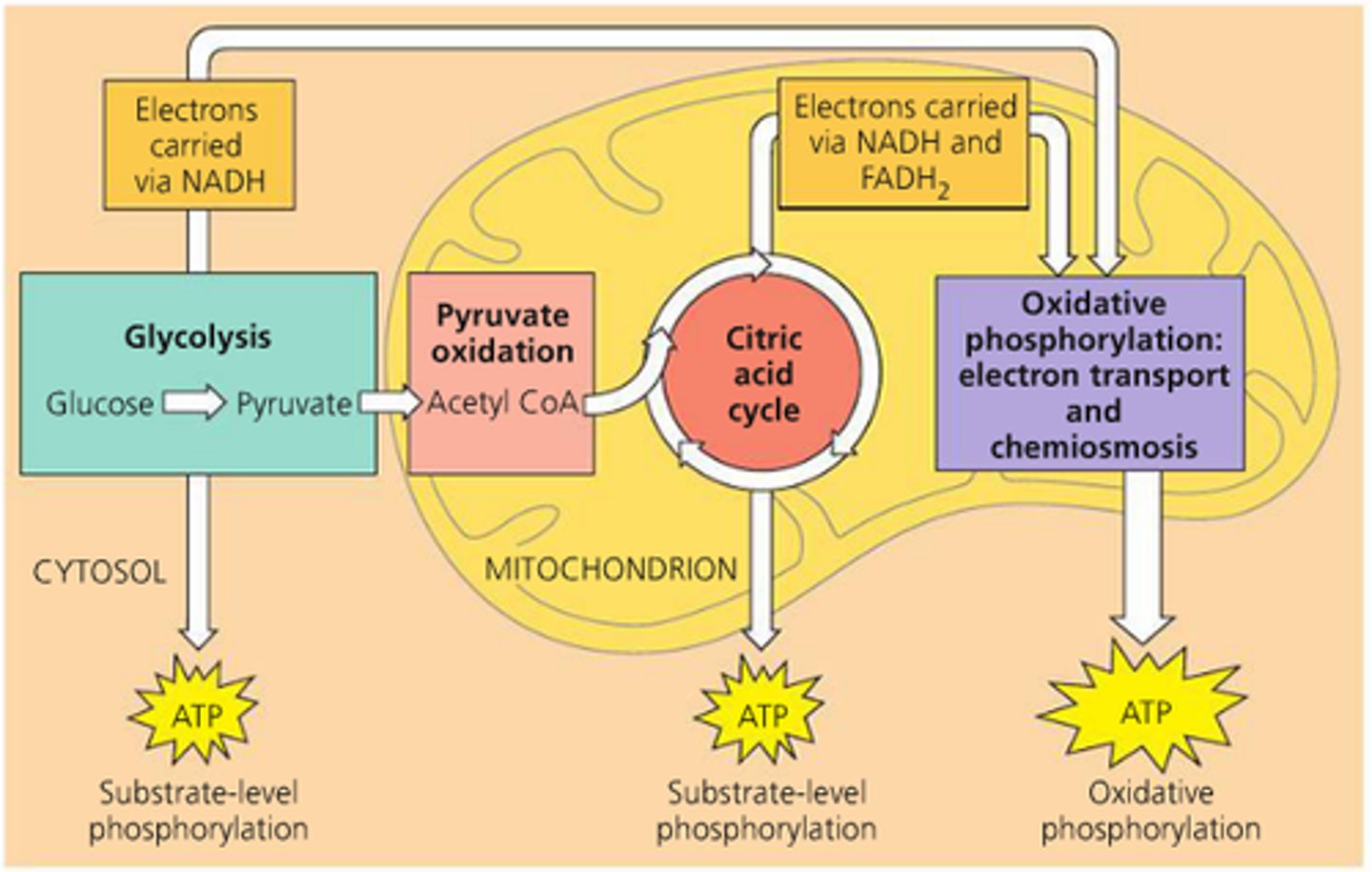
Glycolysis
In the cytosol. "Sugar splitting."
Citric Acid Cycle
Completes the breakdown of glucose
Oxidative Phosphorylation
In the inner membrane. Makes most of the ATP.
Substrate Level Phosphorlyation
Glycolysis and the citric acid cycle. Substrate gives ADP a phosphate group, creating ATP.
-kinase
Enzyme that has to do with the transfer of phosphate.
FADH₂
Electron carrier that adds electrons at a lower energy level than NADH in the electron transport chain.
ATP Synthase
Enzyme that catalyzes synthesis of ATP in the inner membrane of the mitochondrion.
Chemiosmosis
An energy coupling mechanism that uses energy stored in the form of a hydrogen ion gradient across a membrane to drive cellular work; such as the synthesis of ATP.
Proton-Motive Force
In the electron transport chain, what force propels protons through ATP synthase to manufacture ATP?
Aerobic
Requires oxygen. Cellular respiration.
Anaerobic
Does not require oxygen. Fermentation.
NAD⁺
Fermentation regenerates ____.
Alcohol Fermentation
The conversion of pyruvate to carbon dioxide and ethyl alcohol.
Lactic Acid Fermentation
The conversion of pyruvate to lactate with no release of carbon dioxide.
Catabolic Pathways
Regulate ATP production, makes/has inhibitors and activators (phosphofructokinase).
activation energy
the minimum amount of energy required to start a chemical reaction
active site
The specific region of an enzyme that binds the substrate and that forms the pocket in which catalysis occurs
allosteric regulation
The binding of a regulatory molecule to a protein at one site that affects the function of the protein at a different site.
catalyst
A chemical agent that selectively increases the rate of a reaction without being consumed by the reaction.
coenzyme
An organic molecule serving as a cofactor.
cofactor
Any nonprotein molecule or ion that is required for the proper functioning of an enzyme.
competitive inhibitor
A substance that reduces the activity of an enzyme by entering the active site in place of the substrate, whose structure it mimics.
enzyme
A macromolecule serving as a catalyst, a chemical agent that increases the rate of a reaction without being consumed by the reaction.
enzyme-substrate complex
A temporary complex formed when an enzyme binds to its substrate molecule(s).
noncompetitive inhibitor
A substance that impedes the activity of an enzyme without entering an active site.
substrate
The reactant on which an enzyme works.
mesophyll
Leaf cells specialized for photosynthesis.
palisade layer
where most of the photosynthesis occurs in the leaf
spongy layer
loosely-packed chloroplast-bearing cells in the interior of leaves; surrounded by air space
guard cells
control the opening and closing of stomata
xylem
vascular tissue that carries water upward from the roots to every part of a plant
Phloem
vascular tissue that carries sugar and organic substances throughout a plant