Human Anatomy Chapter 1: Sections 5-6
 Call Kai
 Learn
Learn Practice Test
 Spaced Repetition
 Match
Match Flashcards
 Knowt Play
1/39

There's no tags or description
Looks like no tags are added yet.
Name | Mastery | Learn | Test | Matching | Spaced | Call with Kai |
|---|
No analytics yet
Send a link to your students to track their progress
40 Terms
Which of the following statements with regards to regional terms is correct?
Olecranal is appendicular
Which of the following statements with regards to regional terms is correct?
Acromial and brachial are in the upper limb
Which internal organ is not housed in the ventral body cavity?
Spinal cord
Which of the following statements is true?
The pollex is distal to the antebrachial region?
Which of the following pairings with regards to regional terms is correct?
Inguinal is the more medically accurate term for groin
Which group of regional terms only contains anterior body areas?
Mammary, crural, palmar, and antecubital
Which of the following is correctly matched?
Inferior is sometimes referred to as caudal
The median or midsagittal plane ____
Divides the body into left and right parts along the midline
Which usage of a directional term is correct?
The arms are lateral to the chest
Which of the following is true?
The elbow is proximal to the wrist
Which of the following statements with regards to regional terms is correct?
In anatomical position, palmar is anterior
Match the following: The abdominal regions that are located immediately left or right of the umbilical region
Lateral (lumbar) regions
A person with appendicitus will most often present pain in the ____
right lower quadrant
Which of the following statements with regard to regional terms is incorrect?
Antebrachial refers solely to the anterior portion of the forearm
Which of the following statements with regards to regional terms is correct?
The term digital can pertain to both the pedal and manus
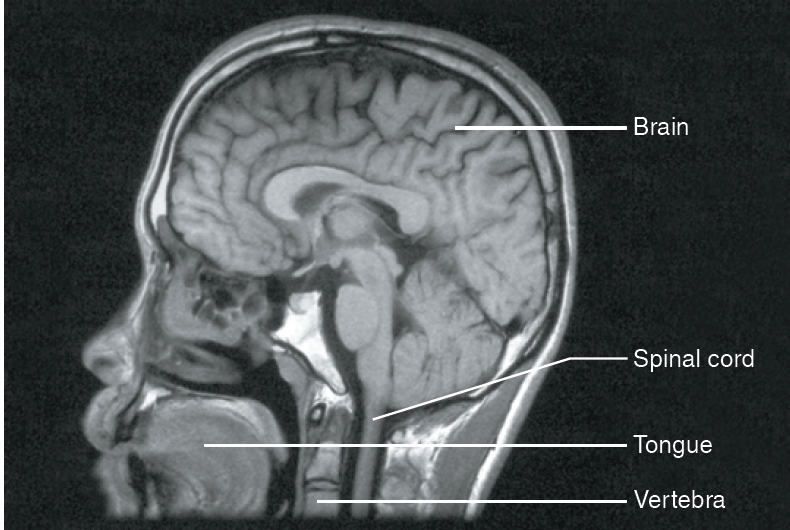
The magnetic resonance image (MRI) shown is a ____ section of the head
Sagittal
Which cavity contains the lungs and heart?
Thoracic cavity
The body cavity that houses a lung is known as a ____
Pleural cavity
Serous membranes line the cavity walls and the surfaces of the organs that are contained within which of the following cavities?
Abdominopelvic cavity
Why are directional terms so important?
Because they allow us to explain where one body structure is in relation to another
Which cavity contains the brain?
Cranial cavity
Match the following: The abdominal regions that are directly lateral to the pubic (hypogastric) region
Inguinal (illiac) regions
If you know that the appendix lies in the right lower part of the trunk, you could also say it lies in the ____
Right inguinal (iliac) region
Anatomical position is characterizec by ____
The pollex as the most lateral feature
Which serous membrane layer is closest to the surface of the heart?
Visceral pericardium
Which of the following statements with regard to regional terms is correct?
Sural refers to the calf
Which of the following best describes a sagittal plane?
A vertical plane that divides the body into right and left parts.
The ventral body cavity is subdivided into which of the following sets of cavities?
The thoracic and abdominopelvic cavities.
A person with appendicitis will most often present pain in the ____
Right lower quadrant
Which cavity contains the spinal cord?
Vertebral cavity
A section that will allow you to look at the superior surface of the liver would be considered _____
Transverse
What is the anatomical position?
The anatomical position is a standard reference stance in which the body is standing upright, facing forward, arms at the sides with palms facing forward, and feet parallel. This position provides a consistent frame of reference for describing locations and movements of various body parts.
Why is it important that you learn the anatomical position?
Learning the anatomical position is crucial because it establishes a standardized frame of reference for accurately describing the locations and movements of body parts, facilitating clear communication in anatomy and medicine.
The axillary and acromial regions are both in the general area of the shoulder. Where specifically is each located?
The axillary region refers to the armpit area, while the acromial region is located at the top of the shoulder where the acromion process of the scapula is situated.
What type of cut would separate the brain into anterior and posterior parts?
A transverse cut, also known as a horizontal section, would separate the brain into anterior and posterior parts.
Select the correct pairing of a regional term and the specific body area it indicates
Axillary; armpit
What type of cut would separate the brain into anterior and posterior parts?
Frontal
The knee is ______ to the ankle
Proximal
Of the uterus, small intestine, spinal cord, and heart, which is/are in the dorsal body cavity?
The spinal cord is in the dorsal body cavity, while the uterus, small intestine, and heart are located in the ventral body cavity.
When you rub your cold hands together, the friction between them results in heat that warms your hands. Why doesn’t warming friction result during movements of the heart, lungs, and digestive organs?
The movement of mobile organs such as the heart, lungs, and digestive organs creates friction, which is minimized by serous fluid. This fluid lubricates the serous membranes, allowing them to glide smoothly against each other