SENSATION, PERCEPTION, ATTENTION BLOCK 4: PART 1
 Call Kai
 Learn
Learn Practice Test
 Spaced Repetition
 Match
Match Flashcards
 Knowt Play
1/32

There's no tags or description
Looks like no tags are added yet.
Name | Mastery | Learn | Test | Matching | Spaced | Call with Kai |
|---|
No analytics yet
Send a link to your students to track their progress
33 Terms
what is attention? 1 pt
an umbrella term that has been used to refer to all those aspects of human cognition that the subject can control and to all aspects of cognition having to do with limited resources or capacity, and methods of dealing with such restraints
what is attention according to cognitivism? 1 pt
the process that allows the selection of relevant info
what is stimulus onset asynchrony (SOA)? 1 pt
the time interval between the onset of one stimulus and the onset of another
what is the psychological refractory period? 1 pt
the delay in response to the second stimulus in the short SOA condition because you are still processing the first stimulus
what is attention as a quality of perception? 1 pt
a neurocognitive function that consists of the aility of the individual to select actively and voluntarily and to focus passively and non-voluntarily on the sensory info coming from the outside and inside worlds choosing what is most relevant to later relate with prior knowledge
attention: mechanism of limited capacity? 1 pt
it is responsibble for controlling anf organizing cognitive activity and sensory motor coordination
how do we measure attention? 7 pts
A. inner phsyiological activity
cortical activity- EEG, event related potentials
peripheral activity- electroderman activity
heart rate
pupil dilation
B. external and motor activity
most frequenct bodily changes e.g. inhibition of other motor activities, eye movements
C. cognitive/mental activity
different tasks e.g. reaction times, recall, recognition, visual searches
D. subjective experience
inner feeling of being related to the level of mental effort that we make when focusing on a demanding task
types of attention? 5 pts
internal/external attention- depends on whether the attentional focus is directed towards our mental processes or interoceptive stimulation or towards the stimuli that comes from the outside
voluntarily/involuntary attention- voluntary attention demands the conscious effort on our part e.g. solving a math equation while involuntary attention is arounsed without any conscious effort e.g. loud sounds
overt/covert attention- overt attention is the act of directing sense organs towards the stimulus source and is mentally focusing on one of several possible sensory stimuli accompanied by a series of motor and physiological responses that produce postural changes in the subject
divided/selective/focused attention- in divided attention several stimuli or situations enter the attention field while in selective attention the effort is directed towards a specific stimulus
visual/auditory attention- visual attention is more related to spatial concepts while auditory attention is related to temporal parameters
selective attention: factors related to selective attention? 6 pts
size- larger objects capture our attention faster
intensity- brighter color attract attention more
duration/repetition- persisting stimuli capture our attention more but excessive repetition will divert our attention
emotional content- a stimulus that carries emotional tone will catch our attention
contrasting stimuli will attract attention more than similar stimuli
attentional capture- something in motion will attract our attention more
slective attention: broadbent’s filter model? 4 pts
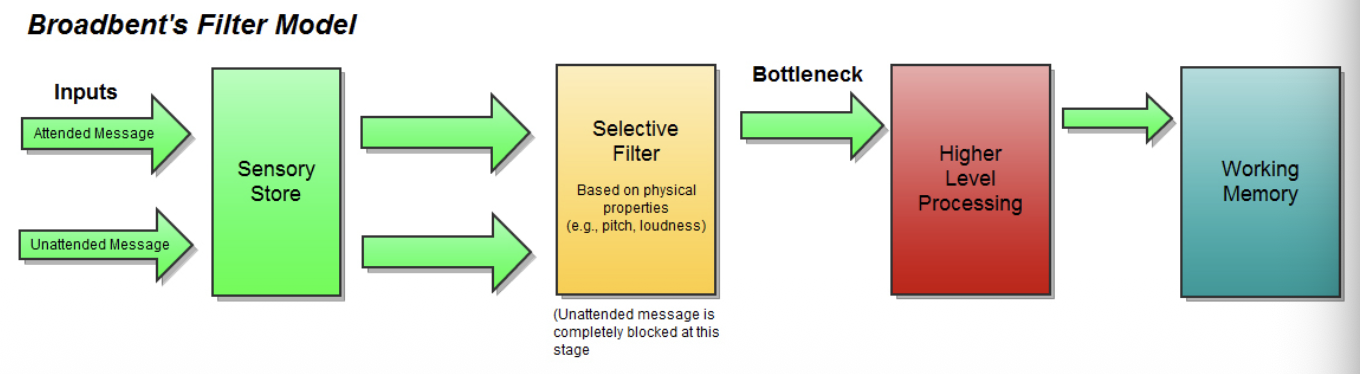
broadbent filter is a central and limited capacity structure that allows certain stimuli to pass through for further processing while unattended stimuli is filtered out
this filter focuses on one sensory system/item at a time
this filter works using serial procesing and is needed to deal with the overwhelming amount of info entering the channels
filter selects info based on a physical analysis of the sensory info e.g. high voice over lower voice
selective attention: limitations of broadbent’s filter model? 2 pts
doesn’t explain the cocktail party phenomenon whereby an individual who is focused on one thing can pick up sounds from another area nearby
meaning of messages was proven to be relevant to each ear for selection
selective attention: what does the trainman attentuated filter model state? 1 pt
our channel is selected based on its physical properties but the filter does not entirely block the unselected messages it only weakens them
selective attention: limitations of the treisman attenuated filter? 2 pts
it is not clear what attenuated mean
recognizing the meaning of a word requires extensive processing
selective attention: pertinence/late filter model of selective attention? 4 pts
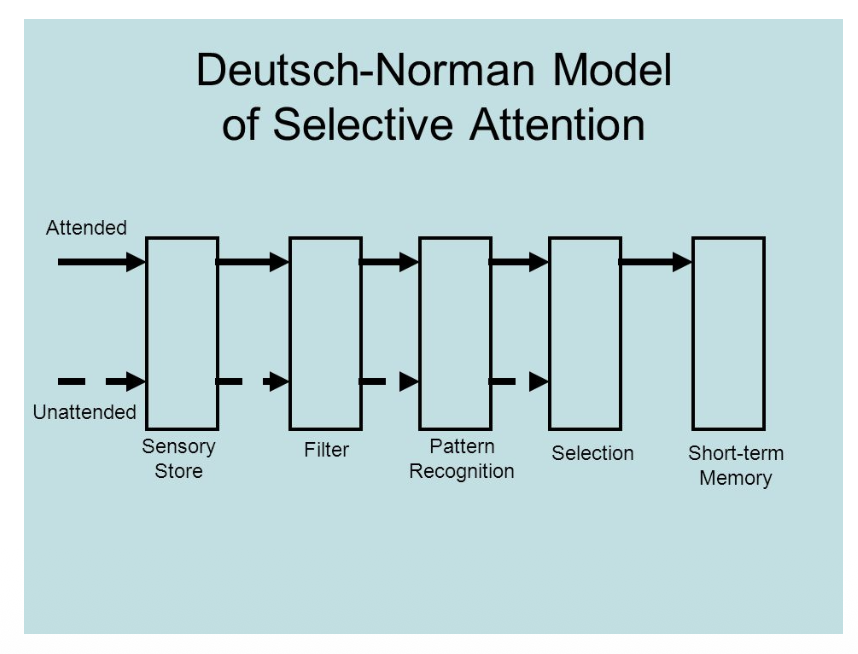
deutsch and deutsch proposed this theory stating the filter is placed closer to the output of processing systems
all info is initially analysed for relevance then passed on to a filter if found pertinent
selection occurs at a much later stage of processing and involves much more complex categories than physical stimulus porperties
the filter comes after meaning is ful yprocessed for both channels and info makes it to the detection/processing of meaning stage and passed on to STM for further processing and perhaps eventually to LTM
selective attention: limitations of the deustch and deustch model? 1 pt
it is a very uneconomical use of resources as it involves processing a large amount of material that is not going to be used
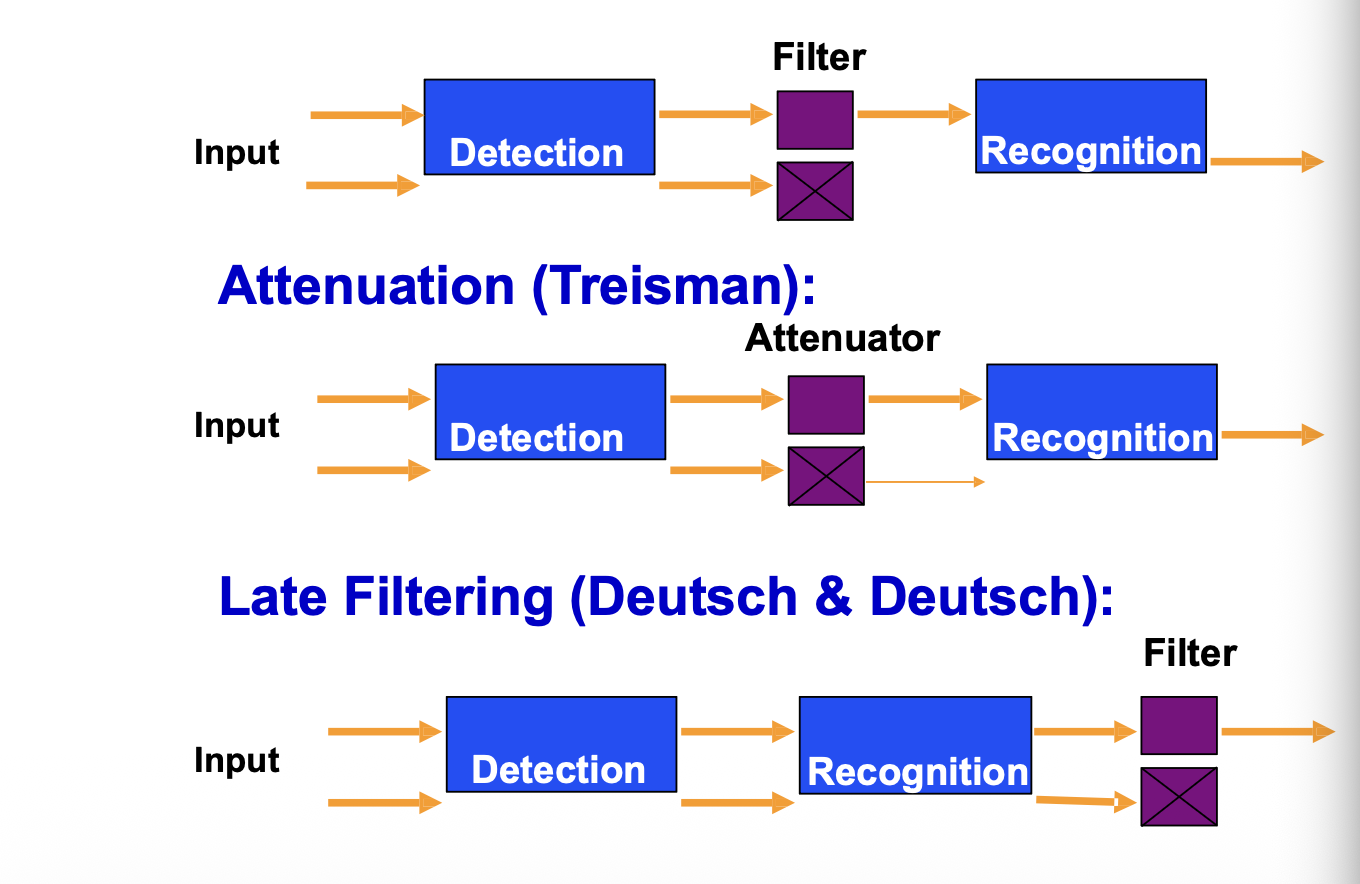
selective attention: comparison of the three models? 3 pts
broadbent filter model:
input→ detection→ filter→ recognition
treisman attenuation model:
input→ detection→ attenuator→ recognition
late filtering model:
input→ detection→ recognition→ filter
selective attention: features shared by attentional blindness tasks? 5 pts
the participant is engaged in some attention-demanding task (primary task)
the primary task can be anything as long as it demands focused attention
each task involves an unexpected event that occurs while the observer carries out the primary task
the unexpected event should be obvious to people who are not engaged in the primary attention task and it must be unusual so people are likely to report it
the critical event must be unexpected
what is change blindness? 1 pt
a phenomenon that occurs when a change is introduced in the visual stimulus and the observer does not notice it
selective attention: research on change blindness? 3 pts
flicker paradigm- original and changed imaes alternate back and forth separated by a brief blank screen; people often need multiple alterations to localize the change
motion-picture perception- in teh 90s studies created a set of simple films with intentional editing mistakes and showed participants failed to notice major changes
real world studies- a researcher asked a pedestrian for directions and uring the conversation, two confederates carrying a door walk between the pedestrian and the researcher. One of the workers switches places with the researcher. 50% participants do not know their conversation partner had changed.
selective attention: requirements of change detection? 5 pts
direct attention to the changing location
encode into memory the target location before the change
encode what is at the target location after the change
compare what you represented from the target before and after the change
recognize the discrepancy
selective attention: similarities between inattentional blindness and change blindness? 3 pts
both research appeared in 1990s
both refer to a failure to perceive events that appear in plain sight
both phenomena involve a failure to report events that are easily seen once noticed
selective attention: differences between inattentional blindness and change blindness? 4 pts
inattentional blindness occurs for unexpected objects that become transparent once we know we have to look for them while change blindness persists through active search for the target
change blindness requires memory while inattentional blindness does not
change blindness requires before and after images (2) while inattentional blindness requires only one
change blindness shows attention is necessary but not sufficient for visual awareness while inattentional blindness shows that attention can work as a filter for irrelevant info (distinctive but unexpected events do not attract our attention
how do we measure divided attention? 1 pt
with dual task experiments where participants perform multiple tasks and the effects of these dual tasks on their performance is evaluated
when is divided attention hard? 3 pts
when tasks are:
very similar
difficult
require conscious attention
when is divided attention easier? 4 pts
when tasks are:
very different
simple
when one task does not require conscious attention
have been practiced before
divided attention: automatic processing vs controlled processing? 8 pts
A. automatic processing
fast and efficient
unavailable to consciousness
unintentional
familiar straightforward tasks
B. controlled processing
slow and less efficient
available to consciousness
controllable
intentional
complex unfamiliar tasks
divided attention: feature integration theory treisman? 3 pts
pre-attentive processing- the individual scans and registers features right across the visual field using parallel processing
focused attention- the individual identifies objects one at a time by serial processing
feature search tasks can be done pre attentively but conjuction searcher require conscious attention
divided attention: limited capacity-cognitive paradigm? 5 pts
attention is more like resources
factors determining allocation are required mental effort and a person’s level of arousal
when a particular tasks demands lots of processing resources other tasks get fewer resources
attention works felxibly because it requires limited mental effort that must be distributed among different aspects
more capacity is available when arousal levels are high
divided attention: what does arousal depend on? 4 pts
the overall level of stimulation
a personal natural disposition
circadian rhythms
momentary intentions and enduring dispositions
sustained attention vs selective attention? 2 pts
sustained attention- we attend to a constant stimulus for a long period of time in the hope of being able to detect any relevant changes
selective attention- the stimulus has changed or is changing in some way that requires our attention
sustained attention: three tasks used to examine performance decrement? 3 pts
radar test- participatns watched a radar screen for periodic signals presented against a background of visual noise
auditory listening task- participants listed sound tones presented every 18 seconds
clock test- participants observe a clock with a pointer which moves at regular intervals but often makes a double jump
sustained attention: performance is affected by? 5 pts
aspects of the signal- performance is better if there is an increase in the signal’s intensity, frequency, and duration
knowledge of results- performance decrement decreases if participants get feedback
stimulation- being stimulated/being witg others improves performance
stimulant substances reduce performance decrement
personality- highly introverted participants show almost no performance decrement
sustained attention: endogenous and exogenous factors influencing arousal?
A. endogenous
personality
circadian rhythms
B. exogenous
drives and incentives
environmental circumstances
surprising or novel events
drugs
difficulty of task