3.1.4.3 COMPETITIVE MARKETS
 Call Kai
 Learn
Learn Practice Test
 Spaced Repetition
 Match
Match Flashcards
 Knowt Play
1/36

There's no tags or description
Looks like no tags are added yet.
Name | Mastery | Learn | Test | Matching | Spaced | Call with Kai |
|---|
No analytics yet
Send a link to your students to track their progress
37 Terms
Define perfect competiton?
A market strucure where there are many buyers and sellers, all firms sell identical products, where firms are price takers
What are some characteristics of a perfectly competitive market?
many buyers and sellers
homogenous products (identical)
price takers
free entry and exit
perfect information
no barriers
profit maximizers
How do you define the short run and long run in macroeconomics?
Short - when at least one factor of production is fixed, usually capital
Long - when all factors of production are variable
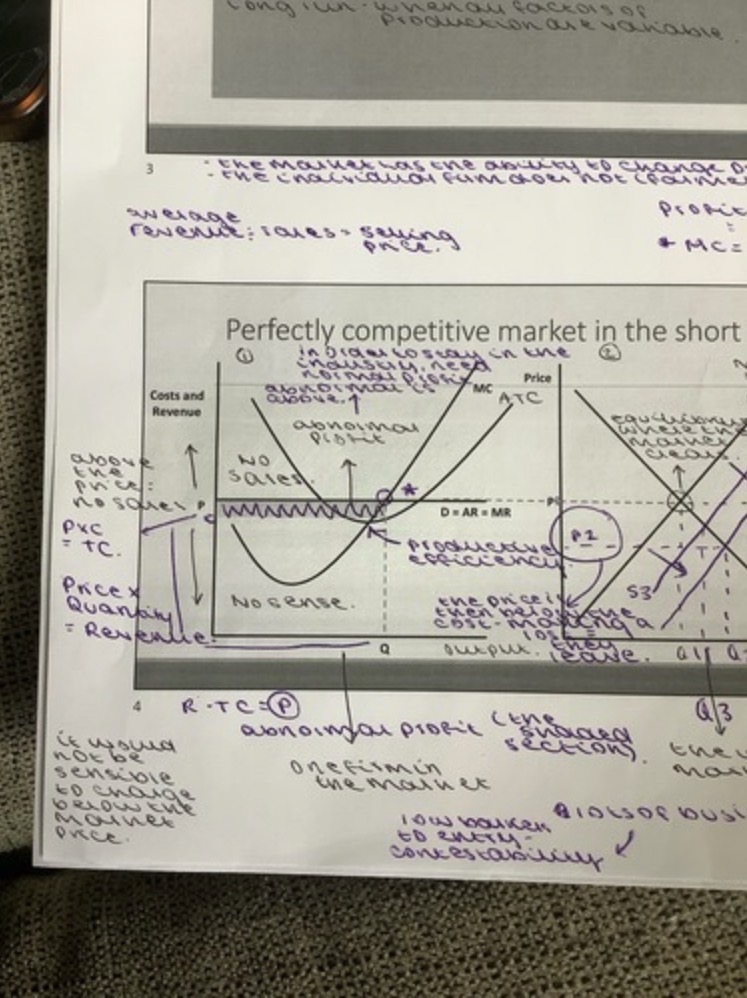
Is there abnormal or normal profit in the short run in a perfectly competitive market?
Abnormal
Is there abnormal or normal profit in the long run in a perfectly competitive market?
Normal
In the short run, in a perfectly competitive market, who determined prices? (Market, firm)
the market has the ability to change prices
the individual firm does not (eg, farmers)
How do you work out selling price?
Average revenue / sales
What equals profit max?
MC = MR
What is the diagram of a perfectly competitive market in the short run? (One firm)
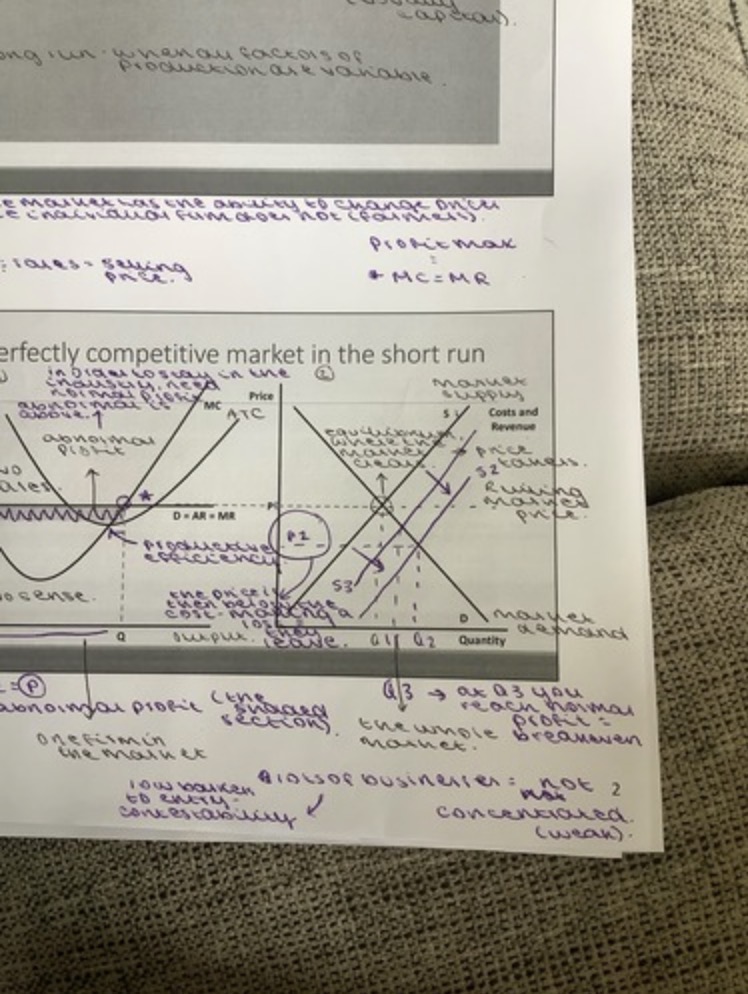
What is the diagram of a perfectly competitive market in the short run? (Whole market)
In order to stay in the market, what type of profit do you need to have?
Normal (abnormal profit is profit)
When is productive efficiency on a graph?
ATC = MC
If there are lots of businesses in a market, is it concentrated or not?
Not concentrated
If there are low barriers, does this mean it is or is not contestability?
Yes contestability
How does the supply curve move on the graph for the entire market?
Supply shifts outwards - decrease price, increases quantity
THEN
Supply shifts inwards slightly - increased price, decreases quantity
How do diagrams move in the long run?
in the long run, firms can enter and exit the market
initially, too many firms enter, shifting supply outwards (S1 to S2)
this causes prices to all (P1 to P2)
when this happens, firms make a loss
some firms leave the market
then supply shifts inwards (S2 to S3)
this causes prices to rise
this then leads to normal profit
Define productive efficiency?
Where a firm produced the maximum possible output from the minimum amount of inputs, resulting in the lowest possible average cost
Define allocative efficiency?
Where resources are distributed to produce the goods and services most desired by consumers
P = MC (the value a consumer places, P, equals the cost of producing it, C)
Where is the most productively efficient point?
The lowest possible point of the ATC curve
Why is the most productively efficient point at the lowest point of the ATC curve?
This is the point where a firm produces maximum output at the lowest possible cost per unit
Give an example of how a waitress cannot be allocatively efficient? And what does this lead to?
If a waiter is not allocatively efficient and is doing too many jobs - customers would not return to the restaurant
If the customer is not satisfied with the good/service, what does this mean for them?
This discourages them from purchasing the good/service again
What point demonstrates allocatively efficient?
The point where society gets exactly what it wants in the right quantities
What does P = MC mean?
Allocatively efficient
What does P < MC mean?
Over-consumption
What does P > MC mean?
Businesses may loose customers
Briefly
What is the difference between productively and allocatively efficient?
Productive - produces at the lowest point on the LRAC curve
Allocative - produces when price equals marginal cost P = MC
In the long run the firm might be both productively efficient and allocatively efficient at the same time
It depends on 3 things, what are they?
No barriers to enter and exit
Profit maximization (MC = MR)
P = MC
Expand on 1. No barriers to enter and exit?
In the long run, there are low barrier to enter and exit
If firms make super norms profits in the short run, new firms will enter
This increases supply
Thus decreases price
Until normal profits are made
Leads to loss and exit
As normal profits exit, firms produce at the lowest possible cost
This equals productive efficiency
Is a monopoly an abstract phenomenon (textbook) or happen in the real world?
Textbook
The conditions required almost never exist simultaneously
Which efficiency does this link to (allocative efficiency or inefficiency)?
P > MC
Allocative efficiency
Which efficiency does this link to (allocative efficiency or inefficiency)?
P < MC
Allocative inefficiency
Why would P > MC discourage consumption?
the price is higher than the cost of production
the firm is essentially “overcharging”
leads to underconsumption
Why would P < MC encourage consumption?
the price is lower than the cost of production
because the price is low, consumers buy the product even if they don’t value it very much
leads to overconsumption
Give me an example of the price being lower then cost of production?
Price - £2
CoP- £10
Customers feel you have got a deal but £8 of resources are wasted to give you a product you do not value highly
When does allocative inefficiency occur? (P > MC / P < MC / P = MC)
P > MC / P < MC
When does allocative efficiency occur? (P > MC / P < MC / P = MC)
P = MC