Songs, calls, and sonations (Week 2 lab)
 Call Kai
 Learn
Learn Practice Test
 Spaced Repetition
 Match
Match Flashcards
 Knowt Play
1/18

There's no tags or description
Looks like no tags are added yet.
Name | Mastery | Learn | Test | Matching | Spaced | Call with Kai |
|---|
No analytics yet
Send a link to your students to track their progress
19 Terms
Two main categories of bird sounds
Vocal sounds and non-vocal-sounds
What produces vocal sounds in birds?
The spraying and the trachea
Syrinx: vibration-based sound
Membranes vibrate as air flows past them
Spraying: constriction-based sound
Airway narrows; can be unilateral (one side) or bilateral (both sides) independently
Non-vocal bird sounds (donations)
Mechanical sounds made by wings, feathers, bill, tail, or objects
Bird songs: what are they?
Long, complex sounds used mainly for territoriality and courtship
Main purpose of bird songs
Defending territory or attracting mates
Bird calls: What are they?
Short, simple sounds used for quick communication
Examples of bird call functions
Alarm, flock contact, begging calls of chicks
Donations: What are they?
Non-vocal mechanical sounds made with feathers, wings, bills, or tails
What organs do birds use to produce sound?
The syrinx, located where the trachea splits into the bronchi near the lungs
Why is the syrinx important (extra-ish)
Its unique to birds and lets them produce a wide range of vocal sounds
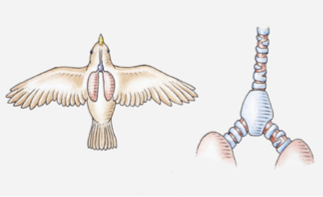
Where exactly is the syrinx located?
At the junction of the bronchi, deep in the chest, close to the lungs.
What is this part?
Syringeal muscle
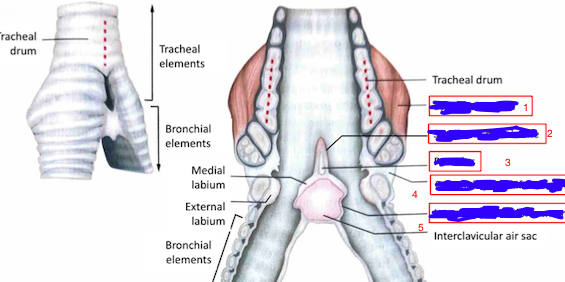
What is the part labeled number 1
Syringeal muscle
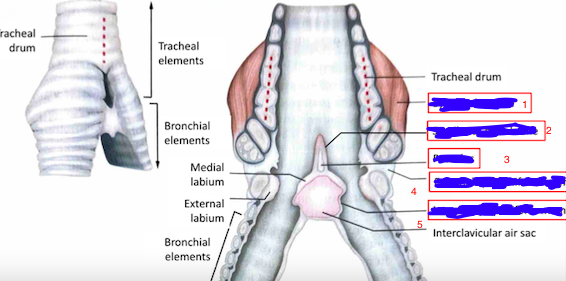
What is the part labeled number 2
Semilunar membrane
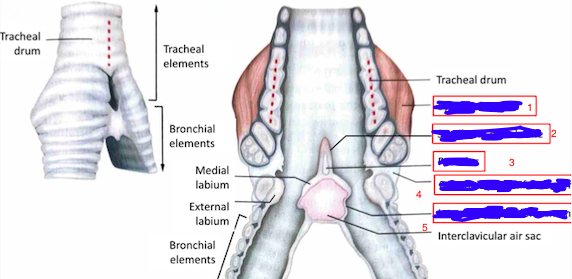
What is the part labeled number 3
Pessulus
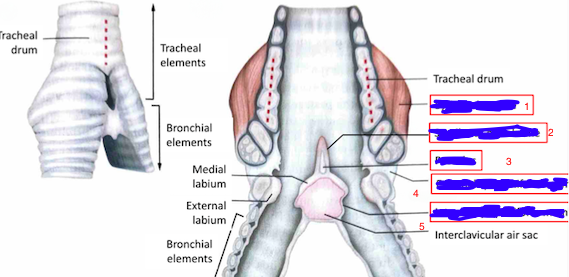
What is the part labeled number 4
External tympaniform membrane
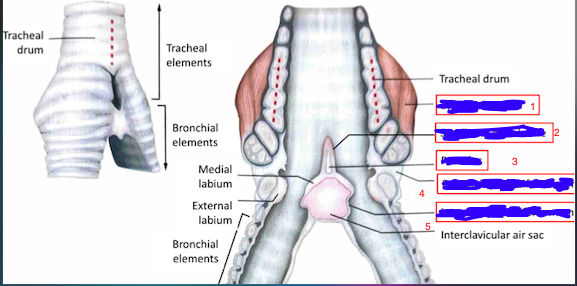
What is the part labeled number 5
Internal tympaniform membrane