Week 6 - Smooth muscle regulation
 Call Kai
 Learn
Learn Practice Test
 Spaced Repetition
 Match
Match Flashcards
 Knowt Play
1/9

There's no tags or description
Looks like no tags are added yet.
Name | Mastery | Learn | Test | Matching | Spaced | Call with Kai |
|---|
No analytics yet
Send a link to your students to track their progress
10 Terms
2 forms of smooth muscle regulation
Electric (electromechanical) regulation → membrane potential changes, contraction only
Pharmacomechanical regulation → membrane potential does NOT change, contraction AND relaxation
Smooth muscle: Electric (electromechanical) regulation
3 methods of Ca2+ entry into smooth muscles
Voltage-gated Ca2+ channels - Triggered by membrane potential changes
Ligand-gated Ca2+ channels - Triggered by chemical signals
Stretch-activated channels - Triggered by stretch of membrane, Ca2+ enters
Example:
Blood vessels are surrounded by smooth muscle cells
Stretch-activated channels
Increase in blood volume → increases blood pressure → smooth muscle cell membranes stretched → Stretch-activated channels open
Smooth muscle contraction results
Smooth muscle: Electric (electromechanical) regulation
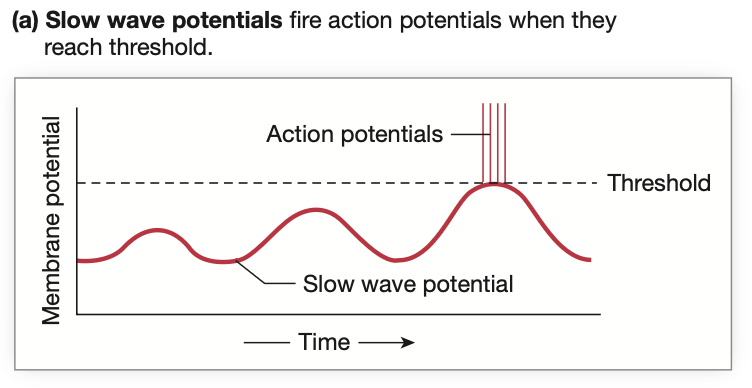
Slow wave potential
Membrane potential is COMPLEX in smooth muscle.
Smooth muscle membrane potentials can:
Hyperpolarise
Depolarise
Both without reaching threshold potential (consult diagram).
A cell has slow wave potentials when they have cyclic depolarization and repolarization of their membrane potential.
allows a smooth muscle to “ride a wave” of potential
If a stimulus is added, that pushes the wave to threshold potential, causing muscle contraction
E.g Intestines when empty, when food enters, stimulus pushes wave to threshold and contraction, pushing food through.
Smooth muscle: Electric (electromechanical) regulation
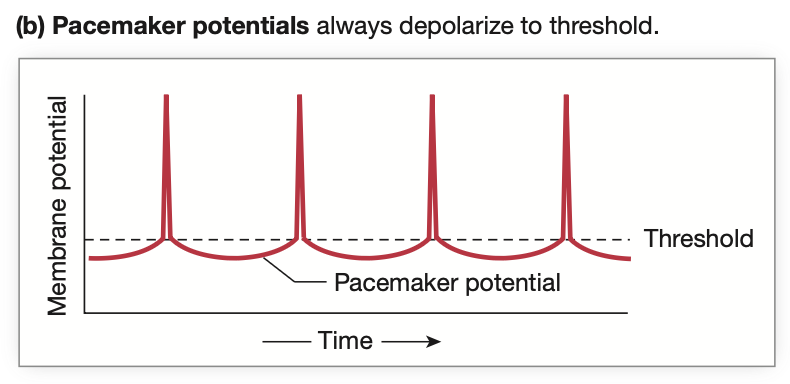
Pacemaker potential
These are also found in cardiac muscle cells.
Establishes a regular rhythm.
Action potentials and contractions occur at a regular rhythm.
Used in phasic contractions (e.g GI tract)
Smooth muscle: Pharmacomechanical regulation
3 forms of communication:
Neurotransmitters → nervous system
Hormones → endocrine system
Paracrine signalling → neighbouring cells
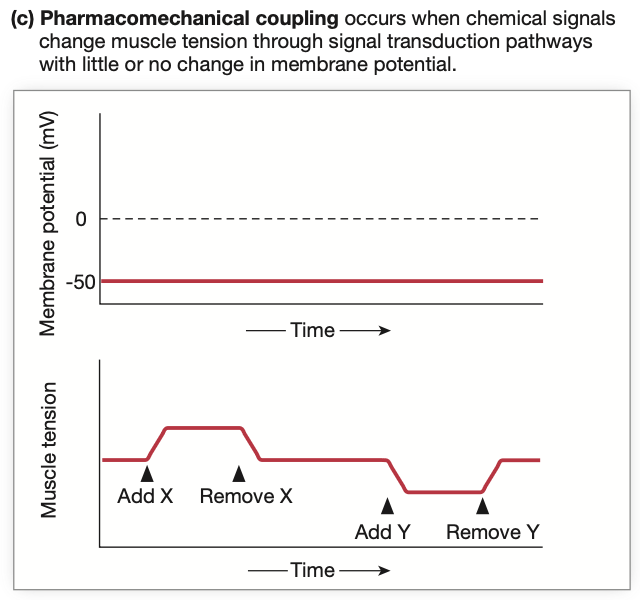
Smooth muscle contraction occurs WITHOUT membrane potential changes.
Pharmacomechanical regulation allows contraction AND relaxation
Smooth muscle: Pharmacomechanical regulation
Example:
IP3 pathway - Causes contraction
Regulates intracellular release of Ca2+ from sarcoplasmic reticulum.
Neurotransmitters, hormones or paracrine signals interact with membrane receptors on smooth muscle cells
Increases intracellular IP3
IP3 opens IP3 channels on sarcoplasmic reticulum
Ca2+ released into smooth muscle cell cytosol
Causes muscle contraction
Smooth muscle: Pharmacomechanical regulation
Example:
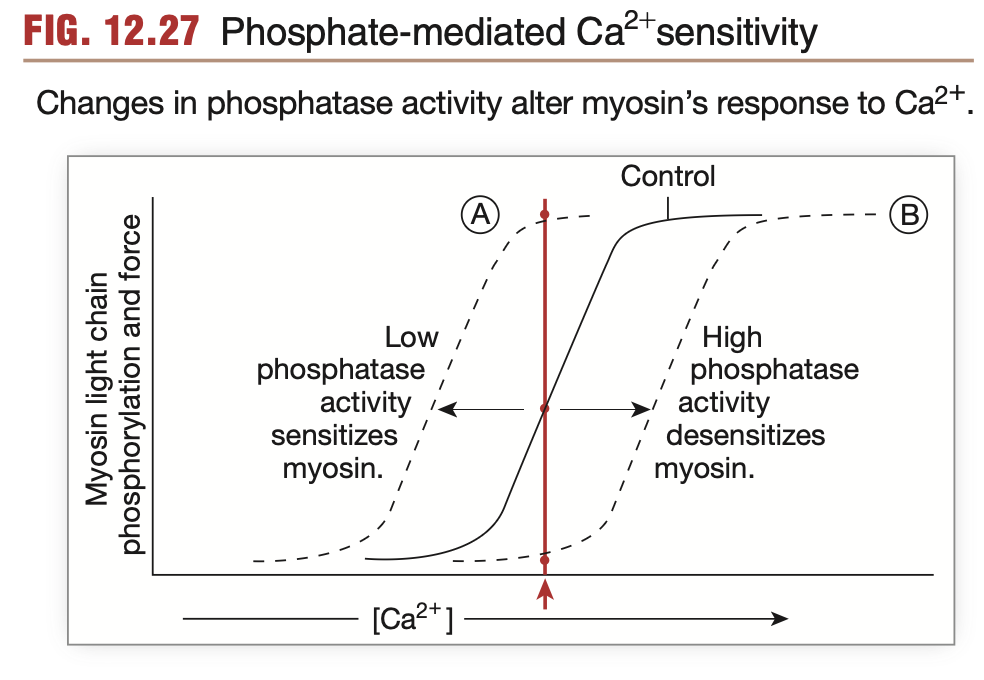
MCLP & Ca2+sensitivity - Causes contraction OR relaxation
MLCP controls Ca2+ sensitivity:
Increase in MCLP (phosphatase) activity → Decreases myosin-ATPase activity → Decreases muscle force → muscle relaxation
Decrease in MCLP (phosphatase) activity → Increases myosin-ATPase activity → Increases muscle force → muscle contraction
MCLP activity can be influenced by Pharmacomechanical regulation (Neurotransmitters, hormones or paracrine signals)
Smooth muscle: Pharmacomechanical regulation
Neurotransmitters - Causes contraction OR relaxation
Neurotransmitters from the autonomic nervous system (parasympathetic & sympathetic)
Acetylcholine (Ach)
Adrenaline
2 receptors: ⍺ or β receptors
⍺-receptors - Causes contraction - sympathetic nervous system
muscles of Blood vessels; radial dilator muscle of the eye; GI tract and bladder sphincters; pregnant uterus
β-receptors - Causes relaxation - parasympathetic nervous system
muscles of Airways; walls of stomach, small intestine, and bladder; some blood vessels
Smooth muscle: Pharmacomechanical regulation
Neurotransmitters
Hormones from the endocrine system (long-term signalling)
Angiostenin 2
Smooth muscle: Pharmacomechanical regulation
Paracrine signals
Paracrine signals from the neighbouring cells
Histamine
Activates IP3 pathway - Causes contraction
Contraction of airways, think allergies, anaphylaxis
Nitric oxide
Manages vasoconstriction & vasodilation
Increasing nitric oxide → Causes relaxation
K+ ions
Put into bloodstream during exercise (by-product of skeletal muscle use)
Muscles require more oxygenated blood
K+ causes vasodilation → Causes relaxation
K+ ions and nitric oxide work in tandem.