GCSE Physics Electricity: Circuit Symbols, Resistance, and Safety
 Call Kai
 Learn
Learn Practice Test
 Spaced Repetition
 Match
Match Flashcards
 Knowt Play
1/46

There's no tags or description
Looks like no tags are added yet.
Name | Mastery | Learn | Test | Matching | Spaced | Call with Kai |
|---|
No analytics yet
Send a link to your students to track their progress
47 Terms
What must be true for electrical charge to flow?
The circuit must be closed and there must be a source of potential difference.
What is electrical current?
Current is the flow of electrical charge.
What happens to current if the rate of flow of charge increases?
The current increases.
What is the formula relating charge (Q), current (I), and time (t)?
Q = I × t, where Q is in coulombs, I is in amperes, and t is in seconds.
In a single closed loop, how does current behave?
The current has the same value at any point in the loop.
What factors determine the current through a component?
The resistance (R) of the component and the potential difference (V) across it.
What is the relationship between resistance and current for a given potential difference?
The greater the resistance, the smaller the current.
What is the formula for potential difference (V) in relation to current (I) and resistance (R)?
V = I × R, where V is in volts, I is in amperes, and R is in ohms.
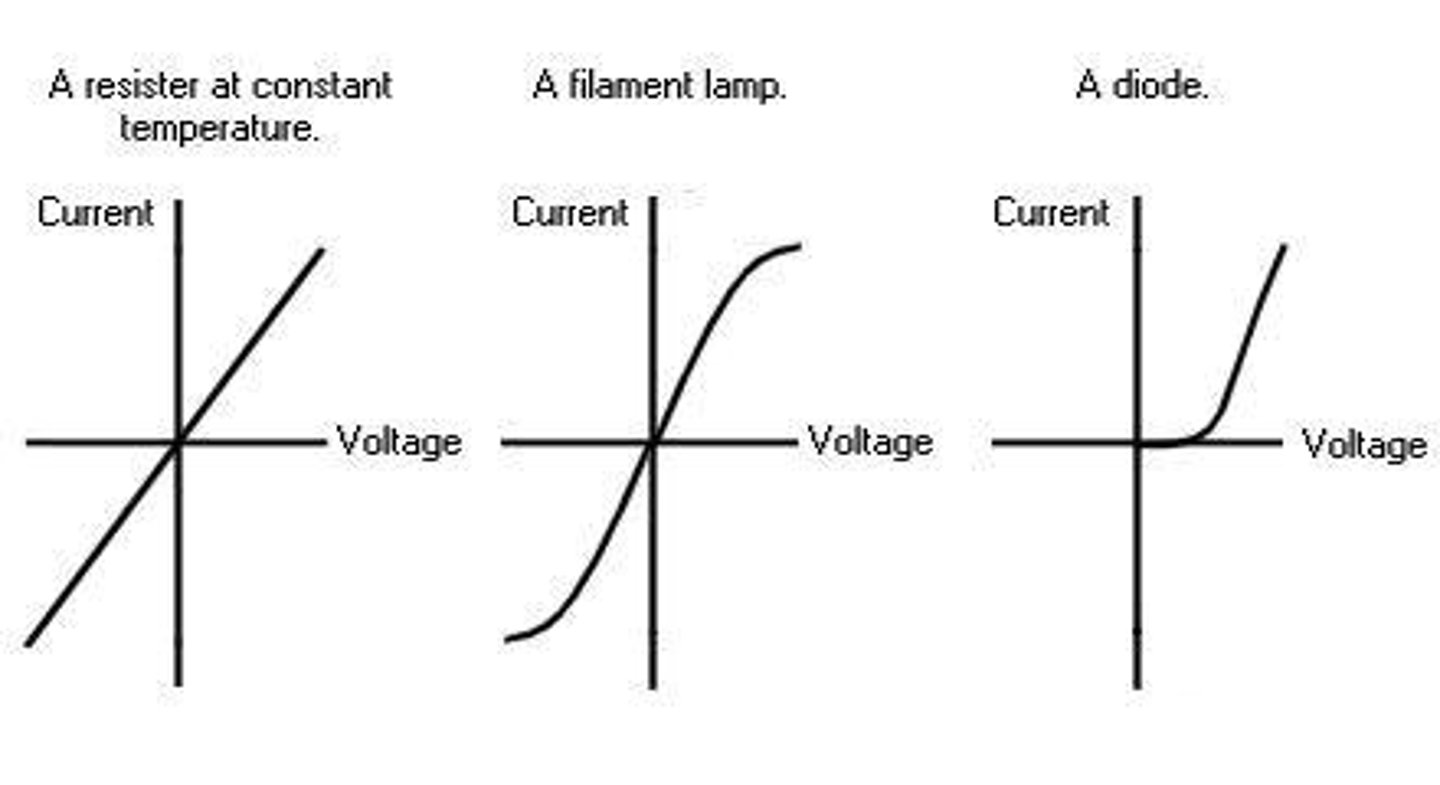
What characterizes an ohmic conductor?
If the resistance is constant, the current is directly proportional to the potential difference, resulting in a linear graph.
What happens to the resistance of a filament lamp as temperature increases?
The resistance increases as the temperature of the filament increases.
How does current affect resistance in a resistor?
As current increases, electrons gain more energy and collide with atoms, causing resistance to increase.
What is the effect of temperature on a thermistor?
In higher temperatures, the resistance of a thermistor is lower.
How does the length of a wire affect resistance?
The greater the length, the more resistance and the lower the current.
What is an LDR (Light Dependent Resistor)?
An LDR's resistance decreases with increasing light intensity and is greatest in the dark.
What is the use of LDRs?
LDRs are used in automatic night lights.
What happens to electrons when they flow through a resistor?
They collide with atoms, transferring energy and causing the atoms to vibrate more.
What is the relationship between the gradient of a resistance graph and resistance?
The gradient is 1/resistance; a sharper gradient indicates lower resistance.
What is the effect of light intensity on an LDR?
The greater the intensity of light, the lower the resistance of the LDR.
What is the significance of a closed circuit in electrical charge flow?
A closed circuit allows electrical charge to flow continuously.
What does a nonlinear graph indicate about a component's resistance?
It indicates that the resistance changes with the current through the component.
What is the role of a battery or cell in a circuit?
It provides the potential difference necessary for charge to flow.
What is the function of a diode?
A diode allows current to flow freely in one direction and has very high resistance in the opposite direction.
What characterizes a series circuit?
In a series circuit, current follows a single path, is the same everywhere, and total resistance is the sum of individual resistances.
What happens to current in a parallel circuit?
In a parallel circuit, current splits into multiple paths, and the total current into a junction equals the total current in each branch.
What is the potential difference in a series circuit?
The potential difference (PD) of the power supply is equal to the sum of the PD across each component.
How is total resistance calculated in a series circuit?
Total resistance in a series circuit is the sum of the resistance of each component.
What is the mains electricity supply in the UK?
The mains electricity supply in the UK is an AC supply with a frequency of 50 Hz and a voltage of about 230 V.
What is the difference between AC and DC?
AC (alternating current) continuously varies from positive to negative, while DC (direct current) moves charge in one direction only.
What is the role of the live wire in a plug?
The live wire (brown) carries the alternating potential difference from the supply and may be dangerous even if the circuit is off.
What does the earth wire do?
The earth wire (green and yellow stripes) is a safety wire that carries current only if there is a fault, preventing appliances from becoming live.
How is power defined in electrical terms?
Power is the energy transferred per second and is directly proportional to current and voltage.
What is the formula for energy transferred?
Energy transferred (E) = Power (P) × Time (t).
What is the National Grid?
The National Grid is a system of cables and transformers that links power stations to consumers across the UK.
What do step-up transformers do?
Step-up transformers increase the potential difference from the power station to the National Grid.
What do step-down transformers do?
Step-down transformers decrease the potential difference from the National Grid to consumers for safety.
What is static electricity?
Static electricity occurs when two insulators are rubbed together, causing electrons to transfer and creating positive and negative charges.
What happens when enough charge builds up in static electricity?
Sparking occurs when the charge jumps through the air from a highly negative object to a highly positive object.
What is the electrostatic force?
The electrostatic force is the force of attraction or repulsion between charged objects, which is greater with larger charges and closer distances.
What are electric fields?
Electric fields are regions around charged objects where forces are exerted, pointing away from positive charges and towards negative charges.
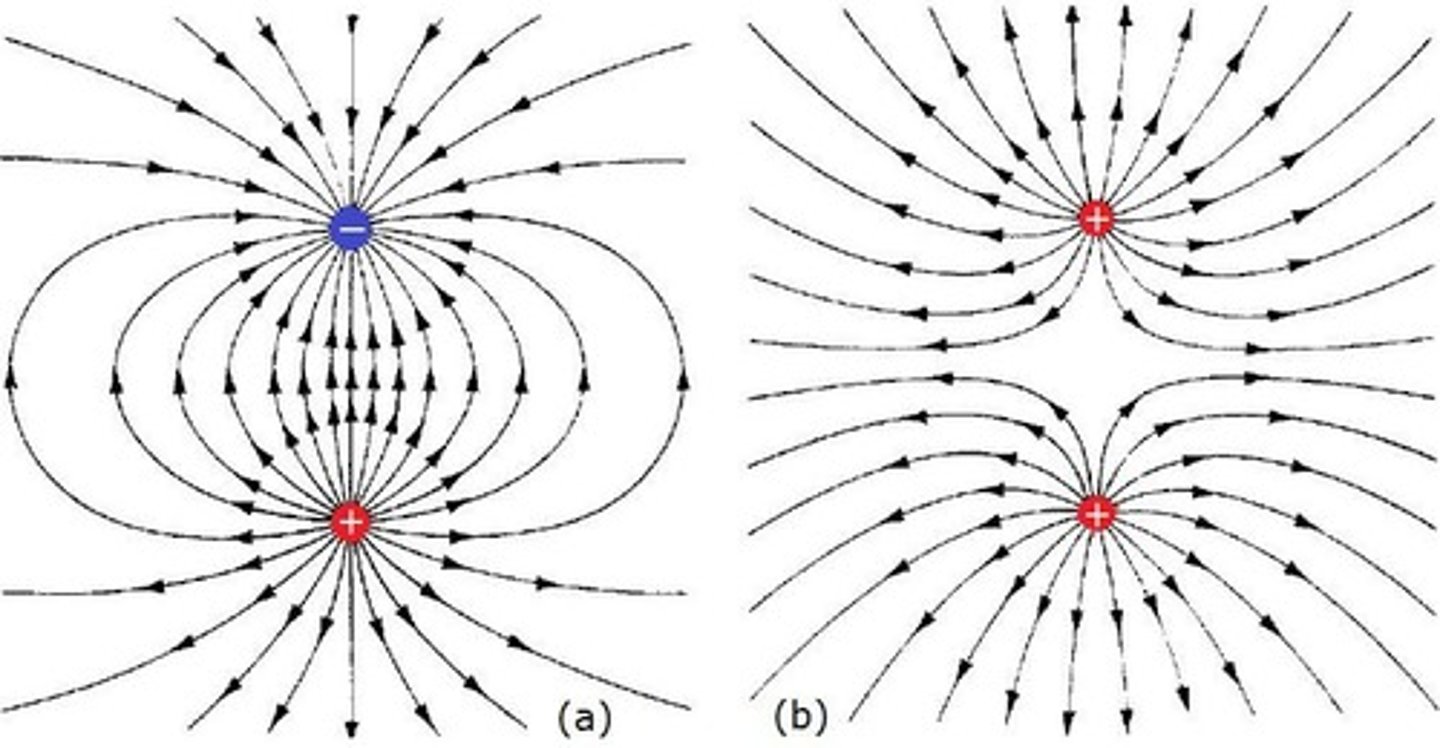
What is the relationship between charge and electric field strength?
The stronger the charge, the more field lines are present, indicating a stronger force felt.
What is the significance of the neutral body in charge?
A neutral body has equal amounts of positive and negative charge, resulting in no net charge.
What occurs in conductors versus insulators regarding electricity?
Conductors allow electrons to flow freely, while insulators have fixed electrons that cannot flow.
What is the formula for power loss in electrical circuits?
Power loss is proportional to resistance and to the square of the current.
What is the effect of resistance in a series circuit?
The total resistance in a series circuit is greater than that of any individual component.
What does the power rating of an appliance indicate?
The power rating shows the power an appliance uses in watts; a higher rating means it uses more energy.
What is the relationship between current and voltage in electrical power?
Power (P) is calculated as the product of current (I) and voltage (V): P = IV.
What happens to charge in a parallel circuit?
In a parallel circuit, charge can flow through multiple branches, reducing overall resistance.