Biology Definitions (Leaving Cert)
 Call Kai
 Learn
Learn Practice Test
 Spaced Repetition
 Match
Match Flashcards
 Knowt Play
1/296

There's no tags or description
Looks like no tags are added yet.
Name | Mastery | Learn | Test | Matching | Spaced | Call with Kai |
|---|
No analytics yet
Send a link to your students to track their progress
297 Terms
Biology
Is the study of living things.
The scientific method
is the process of investigation in which problems are identified and their suggested solutions are tested by carrying out experiments.
An observation
Is when something is noticed.
A hypothesis
Is an educated guess.
An experiment
Is designed to test a hypothesis.
Data
Consists of the MEASUREMENTS, OBSERVATIONS or INFORMATION GATHERED from experiments.
A conclusion
Is a summary of the results of an experiment.
A theory
Is a hypothesis that has been SUPPORTED by many different experiments.
A principle or law
Arises from a theory that has been shown to be VALID when FULLY TESTED over a long period of time.
A variable
Is a factor that may change in an experiment.
A control
is used to provide a comparison against which the actual experiment is being tested.
A replicate
Is a repeat of an experiment, under the same conditions.
Double blind
Means that both the investigator and the participant are unaware of the nature of the treatment the participant is receiving.
Ethics
Relates to whether conduct is right or wrong.
An Organism
Is a living thing.
Metabolism
Is the sum of all chemical reactions in an organism.
Continuity of life
Means that living things arise from other living things of the same type.
Life
Is defined as the possession of these five characteristics: organisation, nutrition, excretion, response, reproduction.
Organisation
Means that living things are composed of cells, tissues, organs, and organ systems.
Nutrition
Is the way living things get and use food FOR ENERGY.
Exrection
Is the removal of waste products of METABOLISM.
Response
is the way living things REACT to changes in their environment.
Reproduction
Is the production of new individuals.
Sexual Reproduction
Involves the union of sex cells.
Asexual Reproduction
Dose not involve the union of sex cells.
Biomolecules
Are the chemicals that are made inside a living thing.
Phospholipids
Are fat-like substances in which one of the fatty acids is replaced by a phosphate group or has a phosphate group added to it.
Anabolic reactions
The USE energy to convert smaller molecules into larger molecules.
Catabolic reactions
The RELEASE energy when a complex molecule is broken down to a simpler form.
Cytoplasm
Is the living material in a cell outside the nucleus.
Transmission Electron Microscope
Shows the internal structure of a specimen.
Scanning Electron Microscope
Shows a surface view of a specimen.
Cell ultra-structure
Is the fine detail of a cell as seen with an electron microscope.
Chromatin
Is the name given to chromosomes when they are elongated and not dividing.
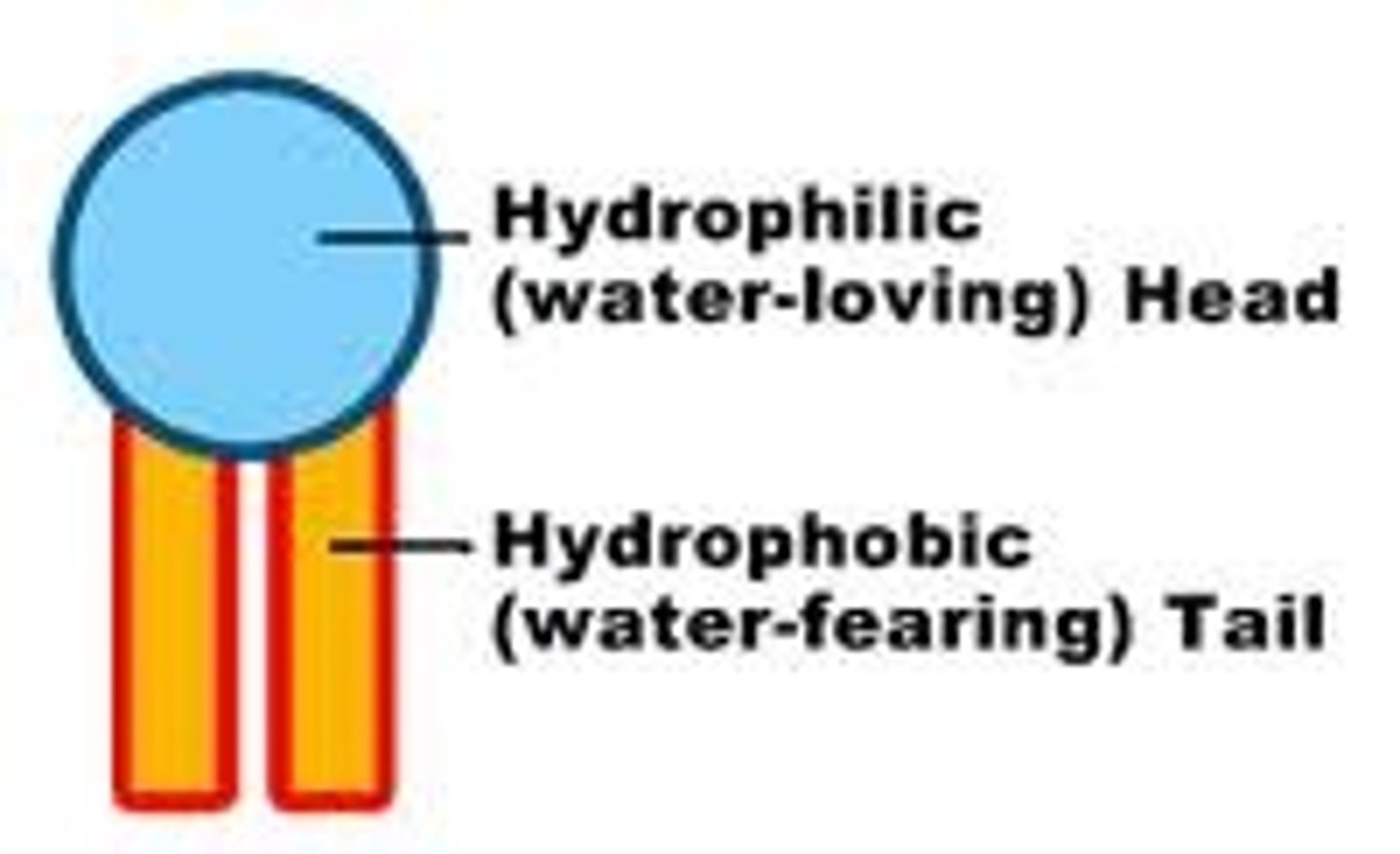
Hydrophilic
Water loving.
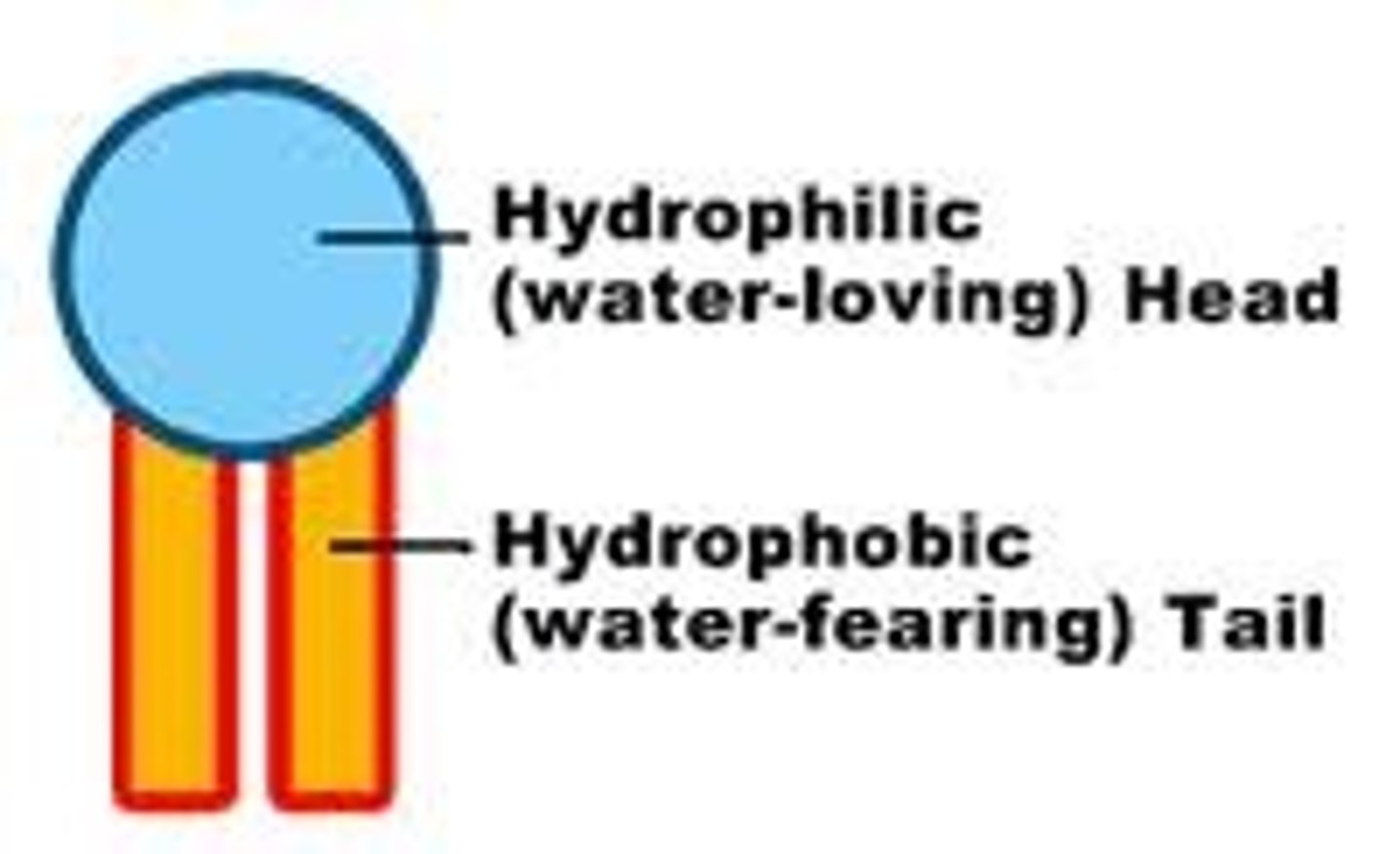
Hydrophobic
Water hating.
Prokaryotic cells
Do not have a nucleus or membrane bound organelles. e.g. bacteria cells.
Eukaryotic cells
Have a Nucleus and membrane bound organelles. e.g. animal and plant cells.
Tissue
Are groups of similar cells that have the same structure and function.
Micropropogation
Is the growth of new plants from plant cells.
Callus
A group of cells.
Tissue culture
Is the growth of new cells in or on a sterile nutrient medium outside the organism.
Monoclonal antibodies
Cancer treatment antibodies.
In vitro
Outside of the body.
Organ
Is a structure composed of a number of different tissues that work together to carry out one or more functions.
Organ system
Consists of a number of Organs working together to carry out one or more functions.
Organism
A group of organ systems working together to allow life.
Diffusion
Is the spreading of gas molecules from a region of high concentration to a region of low concentration. (Passive Process)
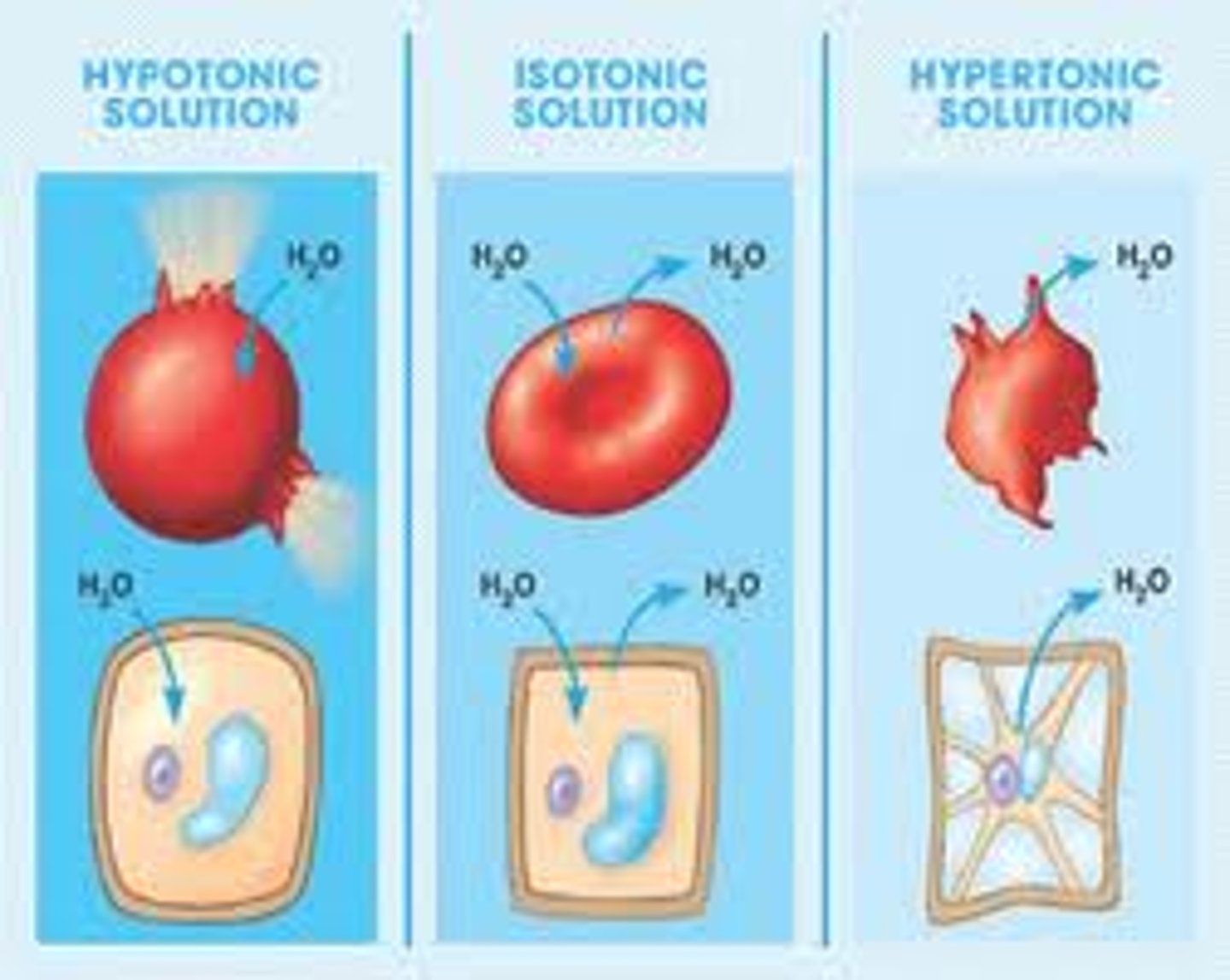
Osmosis
Is the movement of water molecules from a region of high water concentration to a region of low water concentration across a selectively permeable membrane. (Passive Process)
A selectively permeable membrane
Allows some but not all molecules through.
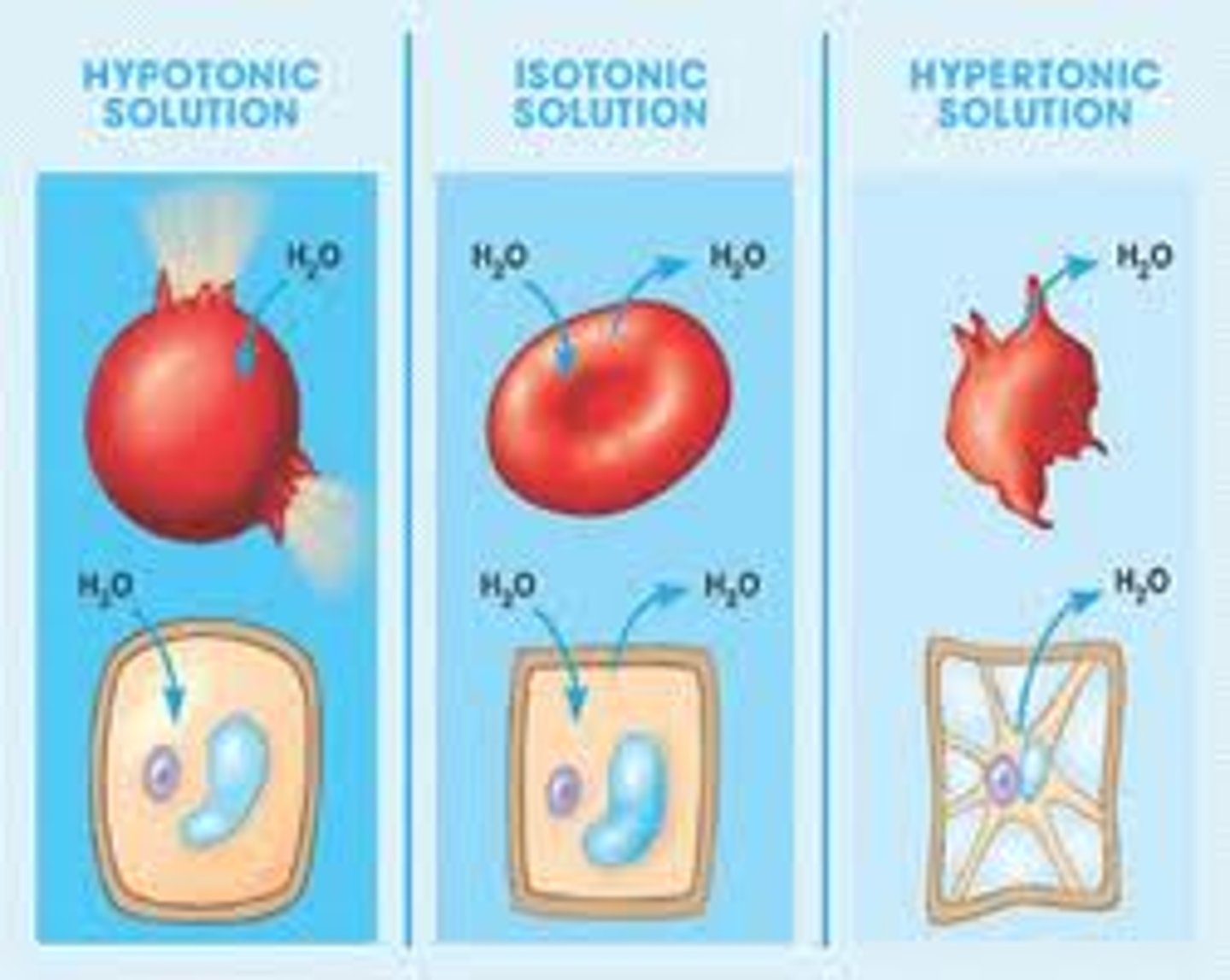
Hypertonic
Water concentration is higher inside than outside the cell.
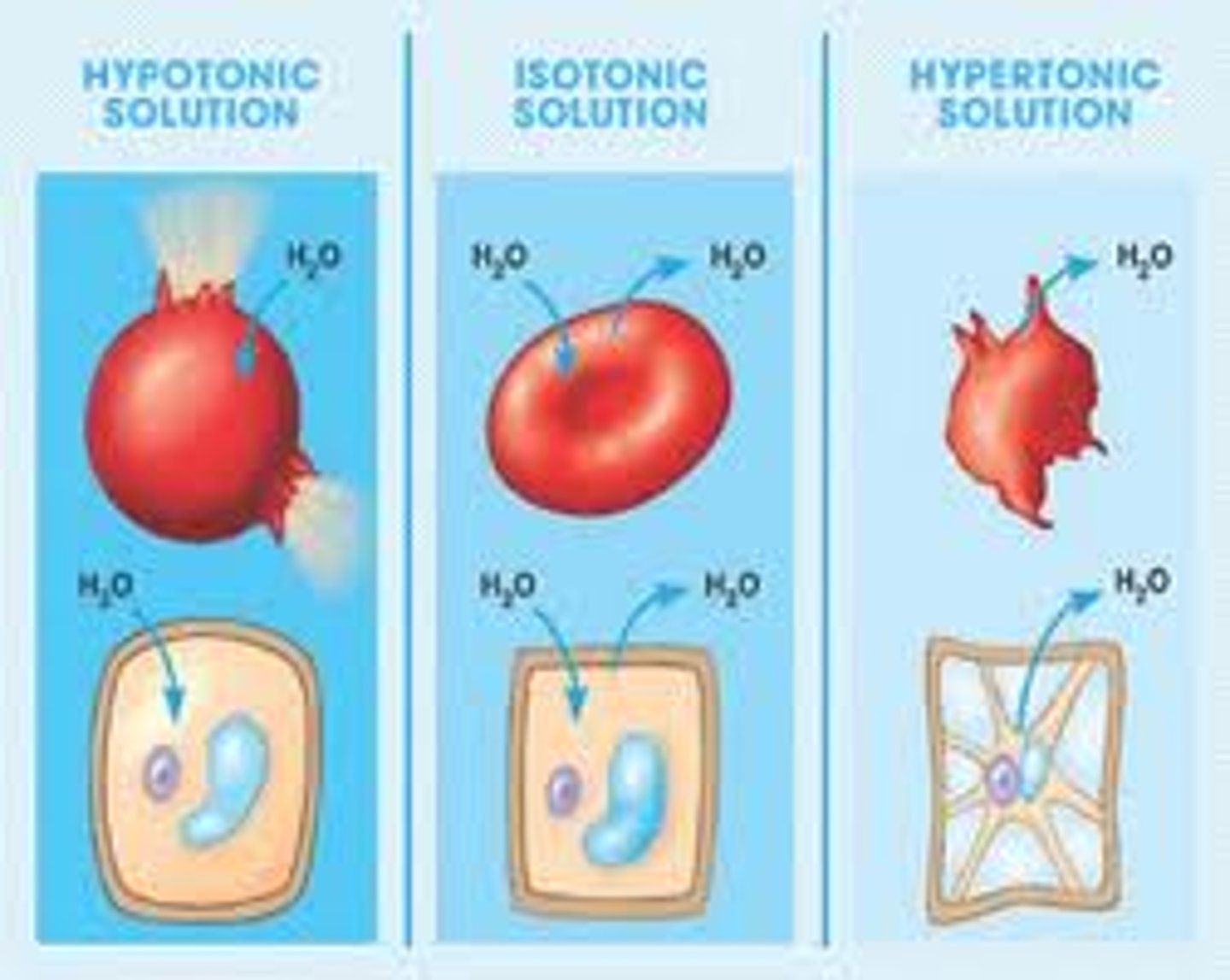
Isotonic
Water concentration is the same inside and outside the cell.
Hypotonic
Water concentration is higher outside the cell than inside the cell.
Protoplasm
Is all the living parts of a cell.
Turgor or Turgor pressure
Is the OUTWARD pressure of the cytoplasm and vacuole AGAINST the cell wall of the plant.
Cell continuity
Means that cells develop from pre-existing cells.
Chromosomes
Are COILED THREADS of DNA and protein.
A gene
Is a section of DNA that contains the instructions to make a protein.
A diploid Cell
Has two sets of chromosomes, one from the mother and one from the father. (2n)
A homologous Pair
is two chromosomes of similar size, with the same sequence of genes.
Haploid cells
Have one set of chromosomes. (n)
Interphase
Is the phase in the cell cycle when the cell is not dividing.
A centromere
Is the point where chromosomes attach.
Mitosis
Is a form of nuclear division in which one nucleus divides into two nuclei, each containing identical sets of chromosomes.
Cancer
Is a group of disorders in which certain cells lose their ability to control both the rate of mitosis and the number of times it happens.
Meosis
Is the form of nuclear division in which 4 daughter nuclei contain half the number of parent chromosomes.
Micro-organisms
Are small living things.
Autotrophic
Means an organism makes its own food.
Chemosynthesis
Is the production of food using energy released from chemical reactions.
Photosynthetic
Describes bacteria that make their own food using light energy.
Heterotrophic
Means an organism takes in food made by other organisms.
Saprophytes
Are organisms that take in food from dead organic matter.
Parasites
Are organisms that take in food from a live host and usually cause harm.
Pathogenic Bacteria
Are bacteria that cause disease.
Antibiotics
Are chemicals produced by micro-organisms that stop the growth of, or kill other micro-organisms without damaging human tissue.
Batch Culture
Is the cell growth of cells in a sealed container, or bioreactor, over a short period of time under ideal conditions until all the nutrients are used up.
A Bioreactor
Is a vessel or container in which living cells or their products are used to make a product.
Continuous Flow
Food processing is the growth of cells in an open container, or bioreactor, where nutrients are added and the end products are removed all the time at a rate that maintains the volume of liquid and the number of cells.
Aerobic Bacteria
Use oxygen
Anaerobic Bacteria
Do not use oxygen
Hypha
Is a tube or filament in a fungus.
Mycelium
Is a visible mass of hyphae.
Obligate parasite
Can only take it's food from a live host.
Facultative parasite
Can get its food from a live or dead host.
Sporulation
Is the process of making spores.
Meristem
Is a plant tissue capable of mitosis.
Herbaceous plants
do not contain wood (lignin)
Woody plants
contain wood (lignin)
Node
Is the point of a stem at which the leaf is attached
internode
is the region on a stem between two nodes
bud
is a potential growth point which may develop into a shoot, a leaf or flower
lenticel
is an opening on a stem for gas exchange
venation
is the pattern of veins in a leaf
Lignin
is a strengthening material found in some plant cell walls
cotyledon
is a seed leaf
Plasma
Is the liquid part of the blood
Serum
Is plasma with the blood clotting proteins removed.
Erythrocytes
Red blood cells
Lymphocytes
White blood cells that produce antibodies
Monocytes
White blood cells that engulf pathogens.