Microbiology- History
 Call Kai
 Learn
Learn Practice Test
 Spaced Repetition
 Match
Match Flashcards
 Knowt Play
1/18

There's no tags or description
Looks like no tags are added yet.
Name | Mastery | Learn | Test | Matching | Spaced | Call with Kai |
|---|
No analytics yet
Send a link to your students to track their progress
19 Terms
Scientists 1500-1700
Hans Janssen and Zacharias Janssen (1590s)
the Dutch spectacle‑making duo widely credited with creating the first compound (binocular‑style) microscope in the 1590s.
Hooke (1665)
cellular composition of cork and introduction of the word “cell” to science
Francesco Redi (1668)
test spontaneous generation with experiment. Meat with lid vs meat w/o lid = maggots. Then added mesh meat variable.
Antoni Van Leeuwenhoek (1683)
resolution improves as lens polishes
“anamacules” discovered
discovered bacteria from saliva
dutch linen merchant
first to observe living microbes
single lens magnified up to 300x
sperm: thought a human was fully in sperm from dad
Scientists 1700- 1850
Louis Jablot (1710)
boiled hay infusions; reasoned that even microscopic organisms must have parents *thought dust might be culprit*
heat up 2 things to kill bacteria. leave one open, one with lid. one open gets bacteria
John Needham
boiled mutton gravy. different outcome than jablot.
determined organic matter had a vital force
endospores dont die from just boiling
higher pressure
Lazzaro Spallanzani (1765)
tested needham
found that a “hermetic” deal was required to prevent microbial growth
Matthias Schleiden
all plants made of cells
Theodor Schwann (1839)
all animals made of cells
Cell Theory
Rudolph Virchow (1855)
“Cellular Pathology”
living things come from other living things
came from robert renak
origin of cells by division of preexisting cells
Cell theory
all living things made up of cells
cells basic unit of structure and function in living things
living cells come only from other living cells
Light
resolution
wavelength/ 2 (numerical aperture)
refraction occurs when light bounces
straight pole bends at angle as enters water. large difference between refractive indices of air & water
lens collection of prisms; light passes convex lens it is refracted toward focal point on the other side of the lens. focal length is distance to focal point
Visible spectrum of light
(infrared) ROY G BIV (ultraviolet)
700nm —————> 400nm wavelength
insert spectrum
Brightfield image vs. Phase contrast image
unstained brightfield invisible
TEM machine- show 3D
TED Talk- Martin Hanczyc: the line between life and nonlife
living systems
body
metabolism (convert resources into building block)
inheritable information
movement replication
evolution: synthesis of
viruses arent alive: no cells
Living characteristics
growth
metabolism (breathing & breaking food down)
Hereditary information (DNA)
heredity (reproduction)movement
cellular
Scientists (1860s-1900s)
Louis Pasteur (1862)
studying beer and wine. “father of microbiology”
schwann neck flask gives air into flask. Boil. one broken stem one not. broken stem has microbial growth
John Tyndall
microbes in air and dust have high heat resistance.
boiling doesnt kill endospores. can have them turn back to vegetative cell
tyndalization: fractional sterilization designed to destroy spores indirectly. prep is exposed to flowing stem for hour, then material allowed to incubate to permit spore germination. resultant vegetative cells destroyed by repeated steaming incubation. “STERILE:- void of life
Ferdinand Cohn
cohn determined forms to be heat resistant endospores
Any life including endospores- nonsterile
Vaccinations and Variolation
Edward Jenner
small pox similar to cow pox. People with cowpox doesn’t get small pox.
gave kid cow pox. Later gave him small pox and he didn’t get it.
“father of immunology”
Lady Mary Wortley Montagu
intro inoculation against smallpox to europe
protection against disease by giving child pus
variolation: deliberately exposing a healthy person to material from a smallpox sore (usually dried scabs or pus). The goal was to cause a mild, controlled infection that would give the person lifelong immunity.
In australia cervical cancer could soon be eliminated
3 dose course for hpv for teenage girls
given to kids
Cleaning
Oliver Wendel Holmes
mothers give birth at home fewer infections than hospital birth
Dr. Ignaz Semmelweis
women became infected in maternity ward after examinations by physicians coming from autopsy room
Joseph Lister
aseptic techniques to reduce microbes in medical setting and preventing wound infetion
washing hands, spraying air with strong anti septic chemicals like phenol prior to surgery
Florence Nightingale
setting standards of hygiene
Robert Koch
anthrax in cattle. Bacillus anthracis
Koch’s postulates- sequence of experimental steps that verified the germ theory
identified cause of anthrax, TB, and cholera
developed pure culture methods (1 species being grown)
microorganisms isolated from dead animal
microorganisms grown in pure culture
microorganisms identified
microorganisms injected into healthy animals
disease reproduced in second animal
microorganisms are grown in pure culture
identification of identical microorganisms
exceptions
microorganisms are unable to be cultured on artificial media
2 or more organism work in synergy to cause disease
symptoms and diseases can be caused by any one of several microbes
To prove that a specific microorganism causes a specific disease.
They provide a systematic, scientific method for linking a pathogen to the illness it produces. Before Koch, people suspected microbes caused disease, but there was no experimental proof. His postulates created the first evidence‑based framework for identifying infectious agents.
Microbiology terms
Microbiology — The study of microorganisms and their interactions with humans, animals, plants, and the environment.
Plankton — Tiny drifting organisms in aquatic environments that serve as the base of many food webs.
Pathogen — A microorganism capable of causing disease in a host.
Bacteria — Single‑celled prokaryotic microorganisms that reproduce quickly and inhabit nearly every environment.
Protozoa — Single‑celled eukaryotic organisms that often live in water and may cause disease.
Fungi — Eukaryotic organisms such as yeasts, molds, and mushrooms that absorb nutrients from their environment.
Helminth — A parasitic worm that infects hosts and causes disease.
Prokaryotic — Describes cells lacking a nucleus and membrane‑bound organelles.
Eukaryotic — Describes cells that contain a true nucleus and membrane‑bound organelles..
Eukaryote — An organism whose cells contain a true nucleus and membrane‑bound organelles.
Prokaryote — An organism whose cells lack a nucleus and membrane‑bound organelles.
How broad is the scope of microbiology? (Hint: see all the fields of study”ologies” above) Identify fields of microbiology that affect "everyday living")
Microbiology Subfields (Small Definitions)
Bacteriology — Study of bacteria and their roles in health, disease, and the environment. Affects food safety, probiotics, antibiotics, gut health, and environmental cleanup.
Mycology — Study of fungi, including yeasts, molds, and mushrooms. Impacts food production (bread, cheese), medicine (penicillin), and fungal infections.
Protozoology — Study of protozoa, single‑celled eukaryotic microorganisms. Relevant to waterborne diseases, sanitation, and environmental health.
Virology — Study of viruses and how they infect hosts. Relates to common illnesses (colds, flu), vaccines, antiviral drugs, and public health
Parasitology — Study of parasites and the diseases they cause. Connects to water safety, foodborne parasites, and prevention of vector‑borne diseases.
Microbial Structure & Function
Morphology — Study of the shape, size, and structure of microorganisms.
Microbial Physiology — Study of how microbes function, grow, and metabolize. Affects fermentation (yogurt, beer), waste treatment, and industrial enzyme production.
Classification & Genetics
Taxonomy — Science of naming, classifying, and organizing organisms. Helps identify microbes in food, water, medicine, and clinical labs.
Molecular Biology — Study of biological processes at the DNA, RNA, and protein level. Used in genetic testing, forensic science, biotechnology, and medical diagnostics.
Host–Microbe Interaction & Disease Spread
Immunology — Study of the immune system and how it defends against microbes. Shapes vaccines, allergies, autoimmune disorders, and how your body fights infections.
Epidemiology — Study of how diseases spread, who they affect, and how to control outbreaks. Influences disease tracking, outbreak control, public health guidelines, and risk reduction.
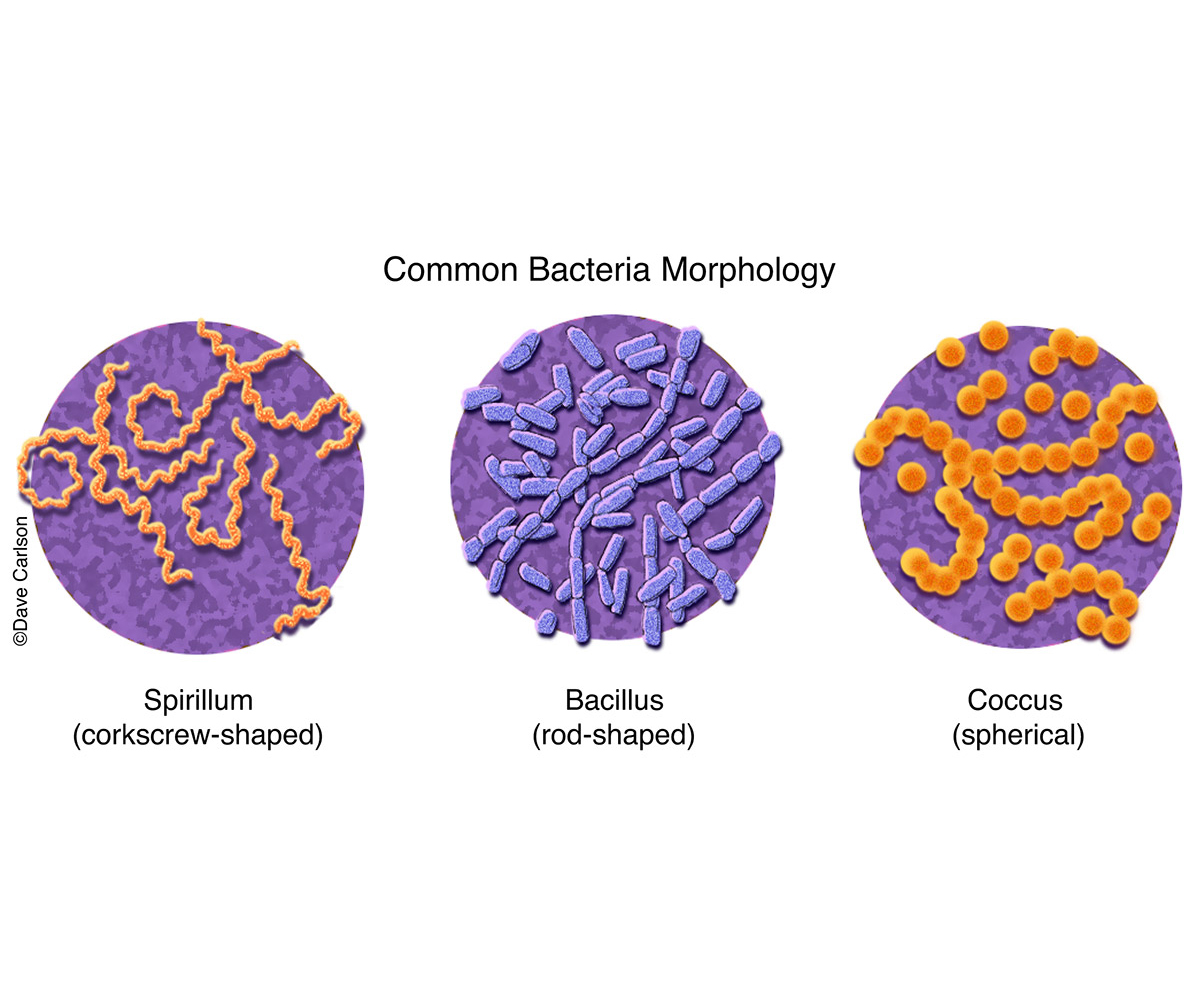
Know the appropriate scientific terminology applied to the three shapes of bacteria (coccus, bacillus, and spirillum, and be able to describe each.
1. Coccus (plural: cocci)
Shape: Spherical or round
Description:
Look like little dots or beads
Can appear alone or in characteristic arrangements
Diplococci — pairs
Streptococci — chains
Staphylococci — clusters (grape‑like)
2. Bacillus (plural: bacilli)
Shape: Rod‑shaped
Description:
Cylindrical, longer than they are wide
Arrangements include:
Diplobacilli — pairs
Streptobacilli — chains
Coccobacilli — very short rods that look almost round
3. Spirillum (plural: spirilla)
Shape: Rigid spiral or corkscrew
Description:
Spiral‑shaped with a stiff, helical form
Move using external flagella
Not to be confused with spirochetes, which are flexible spirals with internal flagella
What are bacterial endospores
Bacterial endospores are highly resistant, dormant structures formed by certain bacteria (like Bacillus and Clostridium) to survive extreme conditions such as heat, drying, chemicals, and radiation.
Purpose: Survival, not reproduction.
Why they matter: Endospores can withstand boiling, disinfectants, and harsh environments.
When they form: When nutrients are low or conditions become unfavorable.
Why they’re dangerous: Some cause serious diseases (e.g., tetanus, anthrax, botulism).
How to destroy: Requires autoclaving or Tyndallization—normal boiling is not enough
How did Louis Pasteur disprove the theory of Spontaneous Generation? What problems remained (see your notes about John Tyndall and or text discussion of Needham)
How did Pasteur disprove Spontaneous Generation?
With swan‑neck flasks that allowed air in but trapped dust. Broth stayed sterile unless it touched dust, proving microbes come from other microbes—not from nonliving matter.
What problem remained after Pasteur’s experiment?
Some broths still produced growth after boiling, leading critics to claim spontaneous generation still occurred.
How did John Tyndall resolve this problem?
He discovered heat‑resistant spores and showed dust carried them. He created Tyndallization to kill spores, explaining why Needham’s experiments were flawed.
Describe process of Tyndallization
Heat the Material (Day 1) Critical Step
The first heating cycle kills all vegetative (actively growing) microbes.
Vegetative cells die, but spores survive
Allow material to cool and sit overnight
Incubate to Allow Spore Germination Biology Principle
Cooling and resting the material encourages surviving spores to germinate.
Spores transform into vegetative cells, which are easier to kill
Repeat Heating (Day 2)
The second heating cycle kills the newly germinated vegetative cells.
Spores that did not germinate may still remain
Repeat Incubation
Another rest period allows any remaining spores to germinate.
Ensures maximum spore germination before final heating
Final Heating (Day 3)Sterilization Achieved
The last heating cycle destroys all remaining vegetative cells.
All vegetative cells are now eliminated
Material is considered sterile