Acid Base Balance (MOD EXAM-1)
 Call Kai
 Learn
Learn Practice Test
 Spaced Repetition
 Match
Match Flashcards
 Knowt Play
1/20

There's no tags or description
Looks like no tags are added yet.
Name | Mastery | Learn | Test | Matching | Spaced | Call with Kai |
|---|
No analytics yet
Send a link to your students to track their progress
21 Terms
Describe acids in the blood and the types there are in the body
Molecules that release H+ into the blood
Hydrochloric acid:
•HCl → H+ + Cl-
•HCL really want to move to the right (strong)
Carbonic Acid
•H2CO3 → H+ + HCO3–
Strong acids dissociate_______ than weak acids
easier
Describe bases in the blood
Molecules that can accept H+ or increase OH- when in water
Bicarbonate
•HCO3– + H+ → H2CO3
Strong bases react _____ and _____ to neutralize H+
rapidly and strongly
Describe buffers in the blood
Substances that reversibly bind to H+ to keep the body's pH in balance and prevent the body from becoming too acidic or alkalotic.
Carbonic acid is the most important buffer
Identify the normal range for pH
arterial blood pH is 7.35 to 7.45
Describe the respiratory response to altered pH
The lungs control the "acid" by regulating carbon dioxide.
If arterial pCO2 increases, the alveoli work harder to excrete more CO2.
Hyperventilation →gets rid of CO2→ (decreasing arterial pCO2)→ causing a respiratory alkalosis
Hypoventilation→ holds onto CO2 (increasing arterial pCO2)→ causing a respiratory acidosis
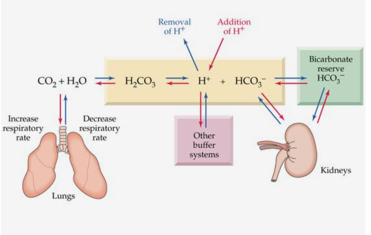
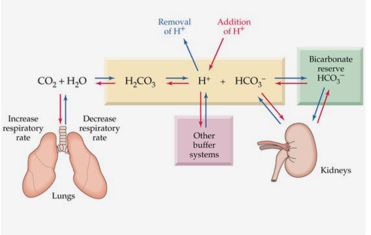
Describe the renal response to altered pH
The kidneys control the "base" by regulating bicarbonate.
Their two main jobs are to get rid of hydrogen ions through the urine and to regenerate bicarbonate from the urine to account for acid production
Carbonic anhydrase enzyme drives acid-base balance and bicarbonate reabsorption
Discuss the relationship of potassium in response to acid base disturbances.
98% of the body's potassium is intracellular (inside the cell).
In acidemia (too much H+), the cell exchanges its intracellular K+ for the extracellular H+ to compensate. This causes increased K+ in the blood (hyperkalemia), which can lead to fatal arrhythmias.
In alkalemia (too little H+), the cell exchanges intracellular H+ for extracellular K+, leading to decreased K+ in the blood (hypokalemia).
What does acidemia lead to with regards to potassium?
HYPERkalemia
What does alkalemia lead to with regards to potassium?
HYPOkalemia
Describe the difference between (1) acidosis and (2) acidemia
An excess of acid in the body fluids
Specifically refers to arterial blood pH dropping below 7.35 (think of numbers)
Describe the difference between (1)alkalosis and (2) alkalemia
An excess of base in the body fluids
Specifically refers to arterial blood pH rising above 7.45 (think of numbers)
State which values in a normal arterial blood gas are actually measured, and which is/are calculated from the others.
MEASURED: pH, pCO2, pO2
CALCULATED: HCO3- (Bicarbonate), Base Excess / Deficit, SO2 (Oxygen Saturation)
Demonstrate the ability to interpret a set of ABG values (pH, pCO2 and HCO3) and indicate which type is present. (respiratory acidemia/alkalemia or metabolic acidemia/alkalemia)
Interpret these values using the ROME rule
Respiratory is Opposite: If pH goes up and PCO2 goes down, it is Respiratory alkalosis. If pH goes down and PCO2 goes up, it is Respiratory acidosis.
Metabolic is Equal: If pH goes up and HCO3 goes up, it is Metabolic alkalosis. If pH goes down and HCO3 goes down, it is Metabolic acidosis.
If pH goes up and PCO2 goes down, it is…
Respiratory alkalosis
If pH goes down and PCO2 goes up, it is..
Respiratory acidosis
If pH goes up and HCO3 goes up, it is..
Metabolic alkalosis
If pH goes down and HCO3 goes down, it is…
Metabolic acidosis
Describe what it means to have a simple disturbance
The disturbance is limited to just the primary disorder and the body's expected secondary (adaptive) response
Describe what it means to have a mixed acid-base disturbance
There are at least 2 separate primary acid-base abnormalities occurring at the exact same time. A mixed disturbance is suspected when the body's adaptive response is not what you would expect it to be
Need to look at the hx and PE in these pts to understand the process occuring