9- Diagnosis and Tx planning (Dr. Nui)
 Call Kai
 Learn
Learn Practice Test
 Spaced Repetition
 Match
Match Flashcards
 Knowt Play
1/115

There's no tags or description
Looks like no tags are added yet.
Name | Mastery | Learn | Test | Matching | Spaced | Call with Kai |
|---|
No analytics yet
Send a link to your students to track their progress
116 Terms
- Oral surgery error
- Diagnosis error
- Implant error
What are the three highest number of malpractice claims in dentistry?
Diagnosis
Define the following:
- The determination of the nature of a disease
- Identification of problems and understanding the needs of the patient
Treatment Plan
Define the following:
The sequence of procedures planned for the treatment of a patient after diagnosis
Primary goal
Define the following:
To stop progression of disease and maintain existing structures
Secondary goal
Define the following:
To restore patient's function and quality of life
True
T/F: In Prosthodontics, we are dealing with the consequences of dental caries and periodontal disease i.e. Partially edentulism, worn down dentition, mutilated occlusion etc
- Remaining coronal tooth structure
- Remaining number and quality of strategic dentition
What are the determining factors of fixed prosth diagnosis?
Mount diagnostic casts on an articulator
What should you make prior to making a treatment plan?
Concept of Short Dental Arch (SDA)
Define the following:
As teeth are lost, the structural integrity of dental arch is disrupted with a sequential realignment of teeth until a new state of equilibrium is reached
True
T/F: Premolar occlusion is acceptable
FALSE -- Loss of teeth does not necessarily lead to further problems
T/F: Loss of teeth always leads to further problems unless we can correct
FALSE -- There is no convincing evidence to show that a shortened dental arch provokes s&s of mand. dysfunction
T/F: Shortened dental arch provokes signs/symptoms of mandibular dysfunction
Identifying patient's chief complaint
What is the first step in the process of diagnosis and treatment planning?
1. Identify Patient’s chief complaint
2. History: all necessary information concerning the reason for seeking treatment
3. Examinations: Extraoral and Intraoral
4. Mounted Diagnostic Casts on a semi-adjustable articulator
5. FMX and/or Panoramic Radiograph
What are the five steps of diagnosis and treatment planning?
fmx and/or panoramic radiograph
What radiographs do we use for fixed prosth dx and tx planning?
A) Subjective
A patient's chief complaint is:
A) Subjective
B) Objective
C) Assessment
D) Plan
Assessment
You obtain your diagnosis in which step of the SOAP?
- Subjective
- Objective
- Assessment
- Plan
What does SOAP stand for?
- Caries
- Trauma
- Hereditary condition
- Cracked tooth syndrome
The main indications for a full coverage crown include structural damage due to: ___________ (4)
- Direct restoration on DOL --> less invasive/lasts shorter
- Full coverage crown --> definitive/lasts longer
What are some things to consider when deciding the treatment for this tooth?
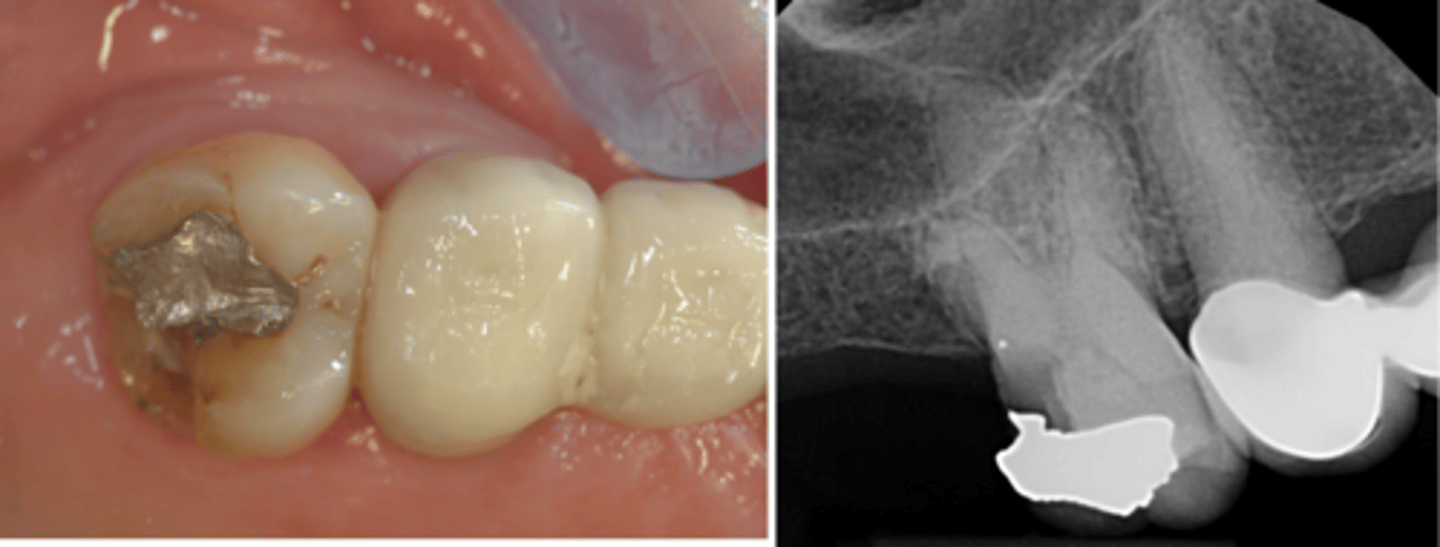
Caries
What caused this defect?
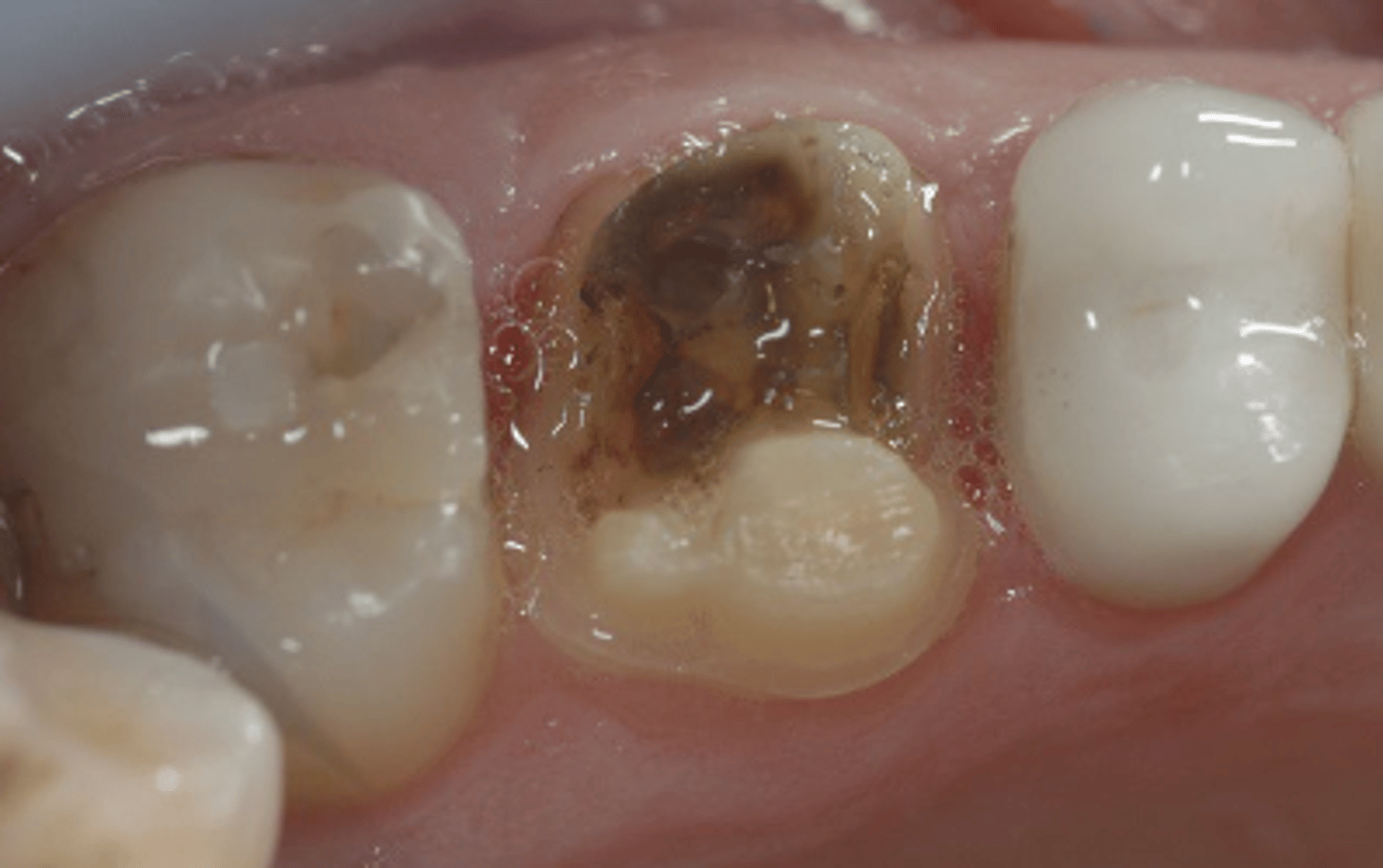
Trauma
What caused this defect?
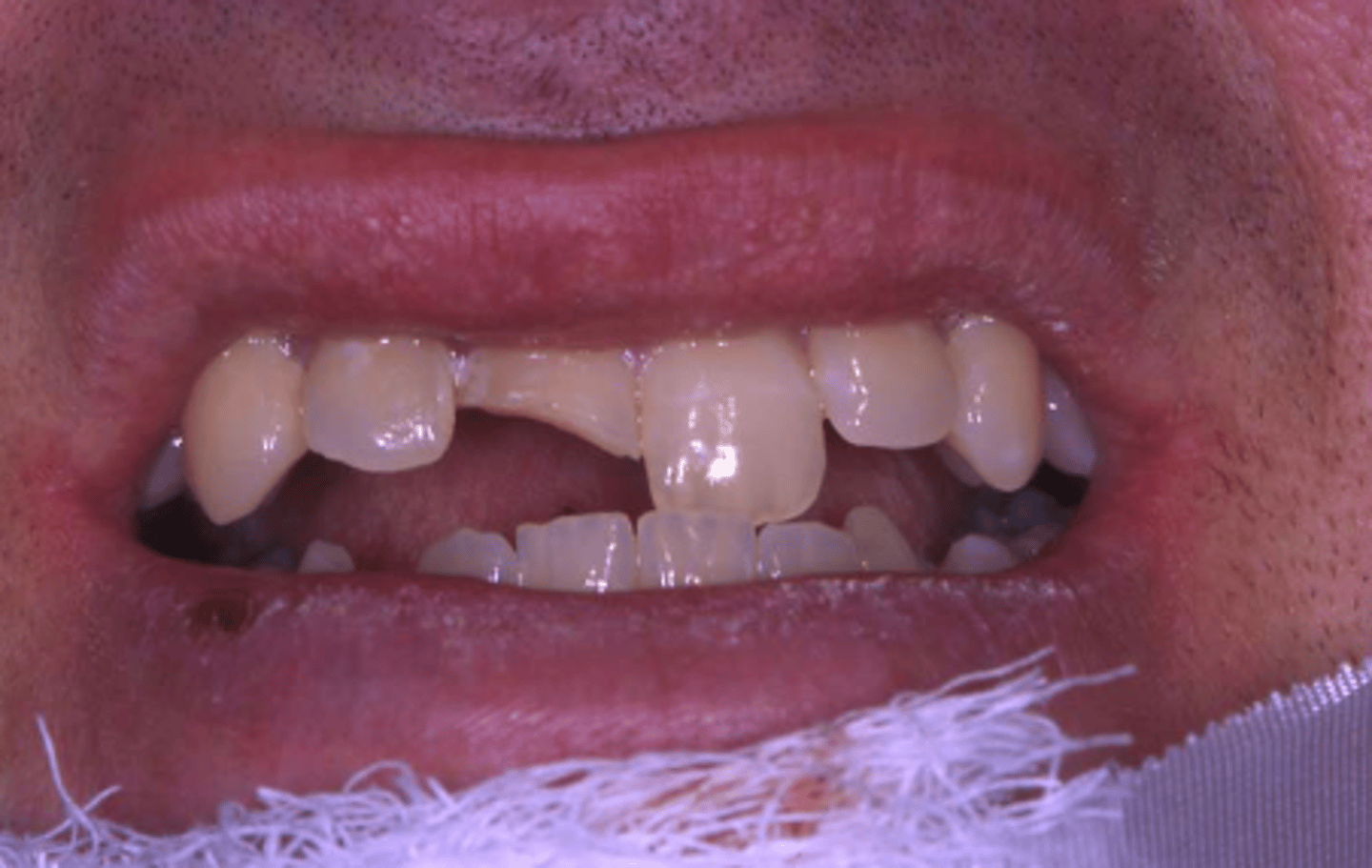
Hereditary
What caused this defect?
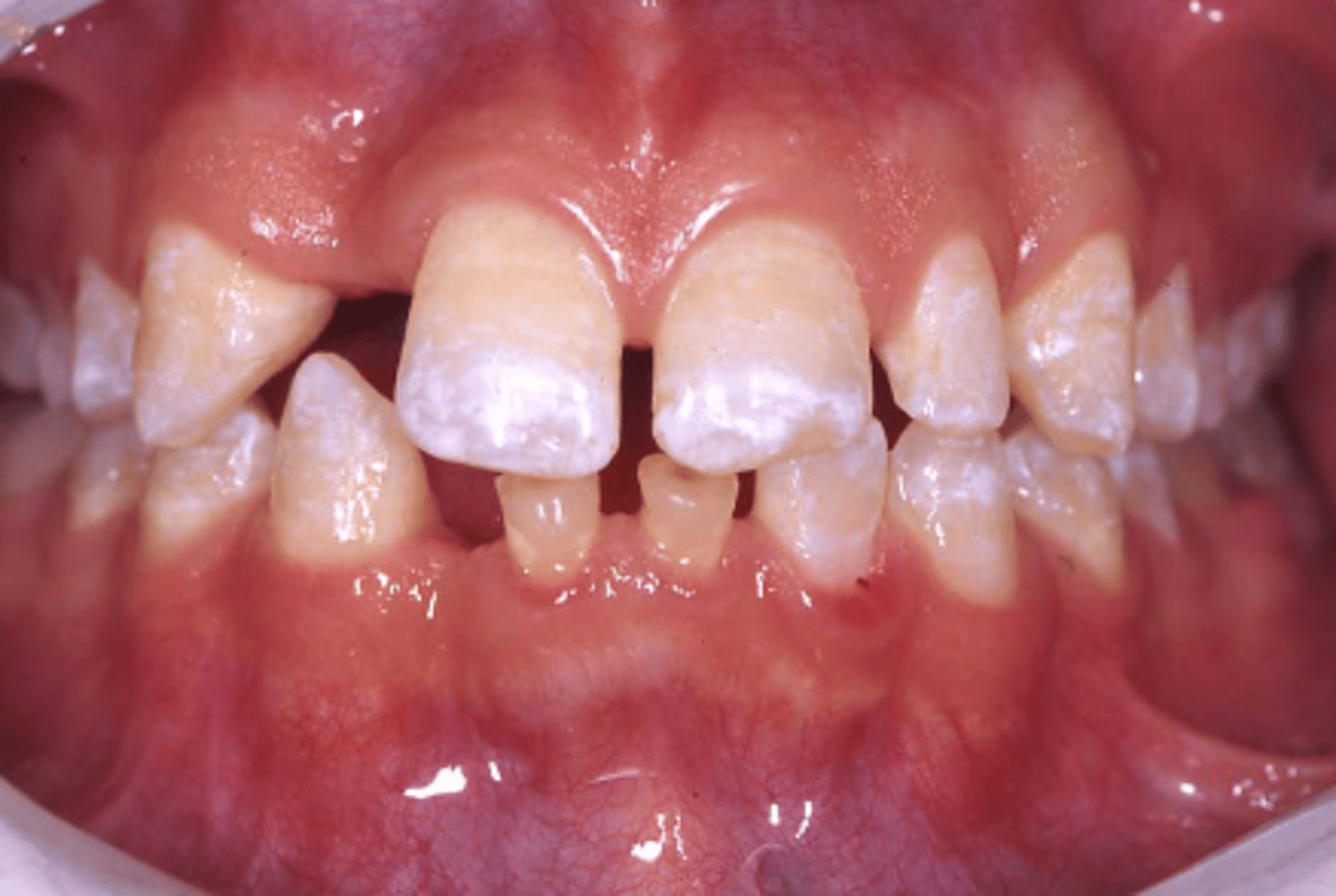
Existing defective crown (open margin)
What caused this defect?
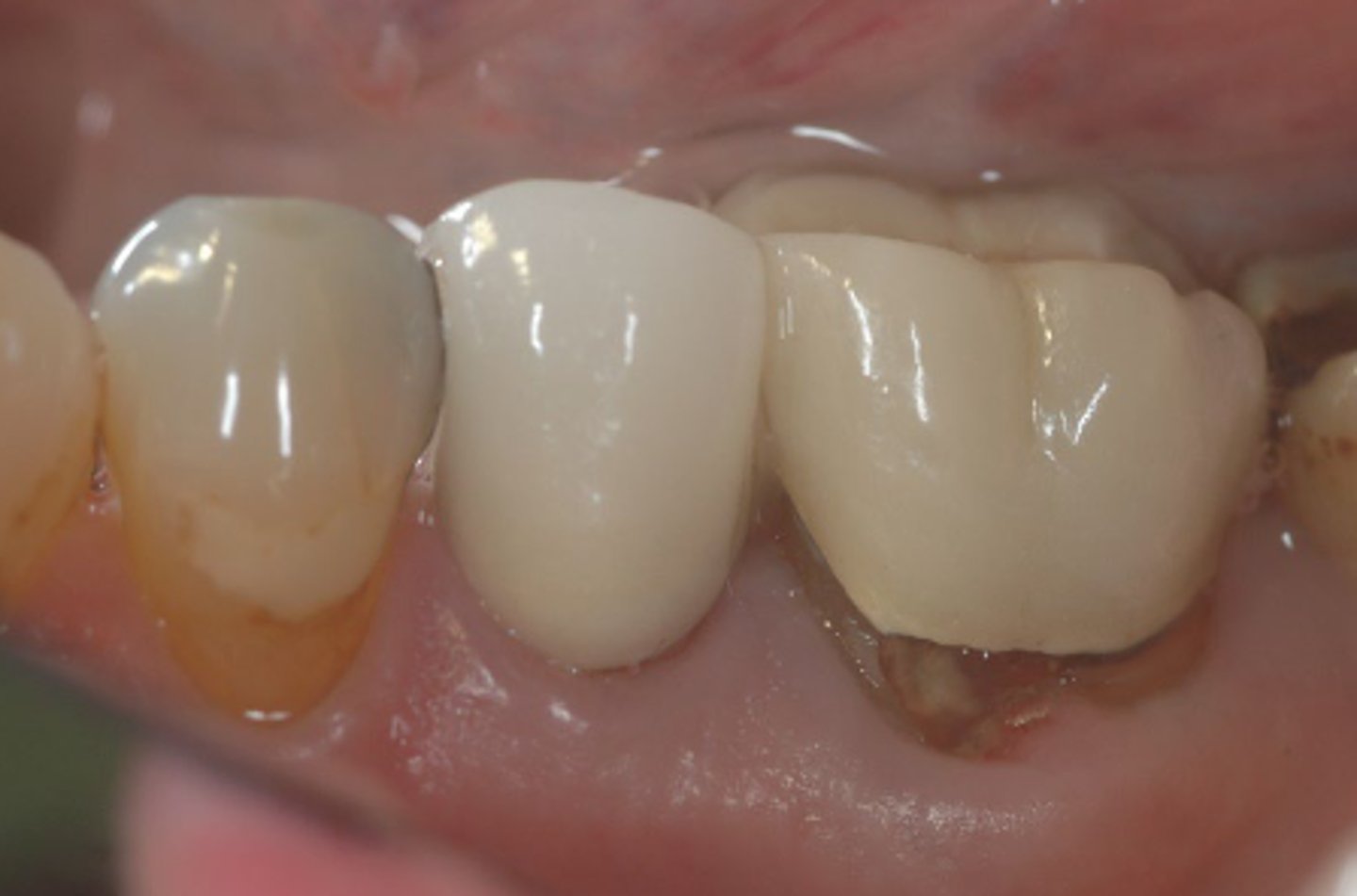
Existing defective restoration
What caused this defect?
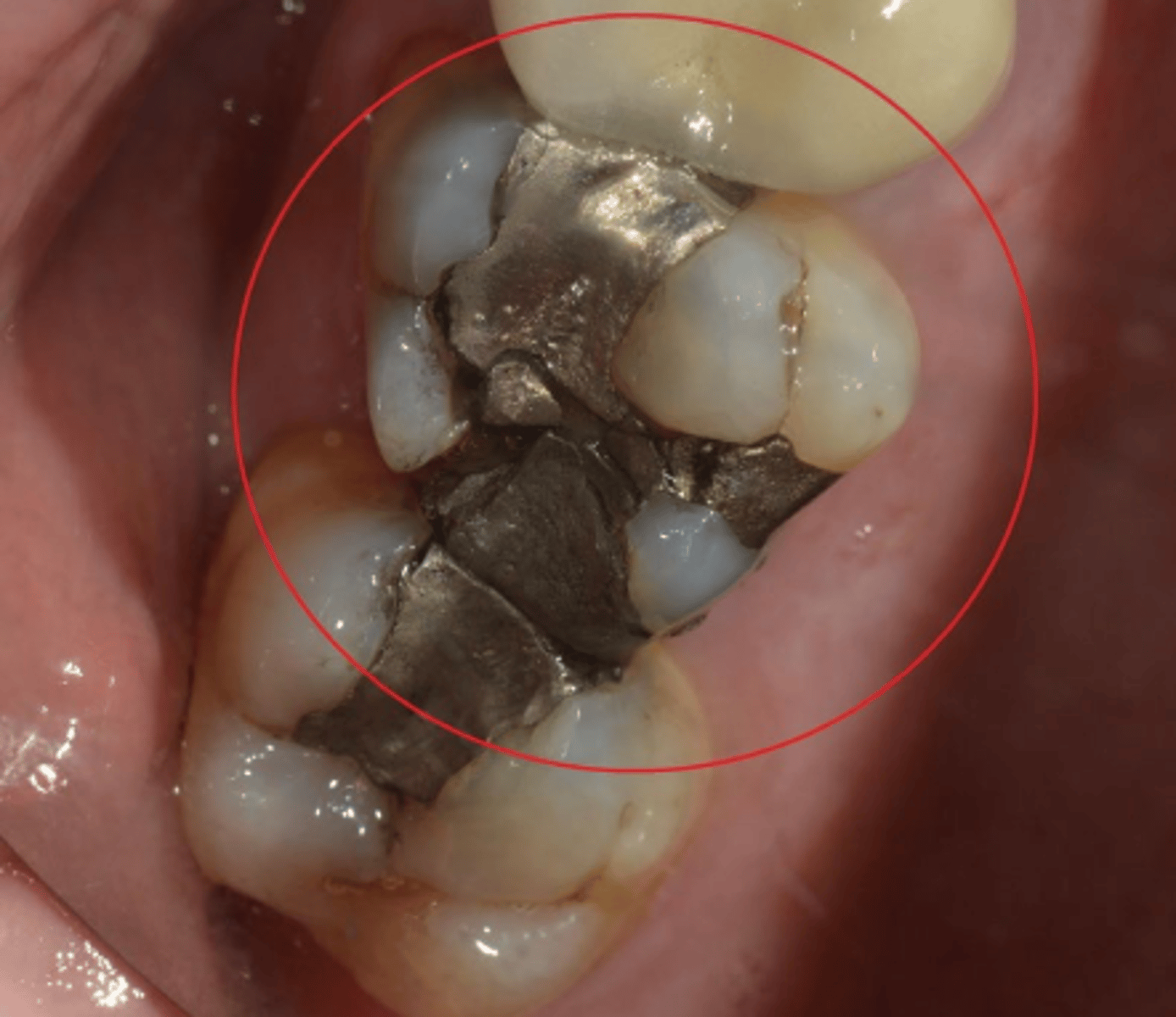
Existing defective restoration
What caused this defect?
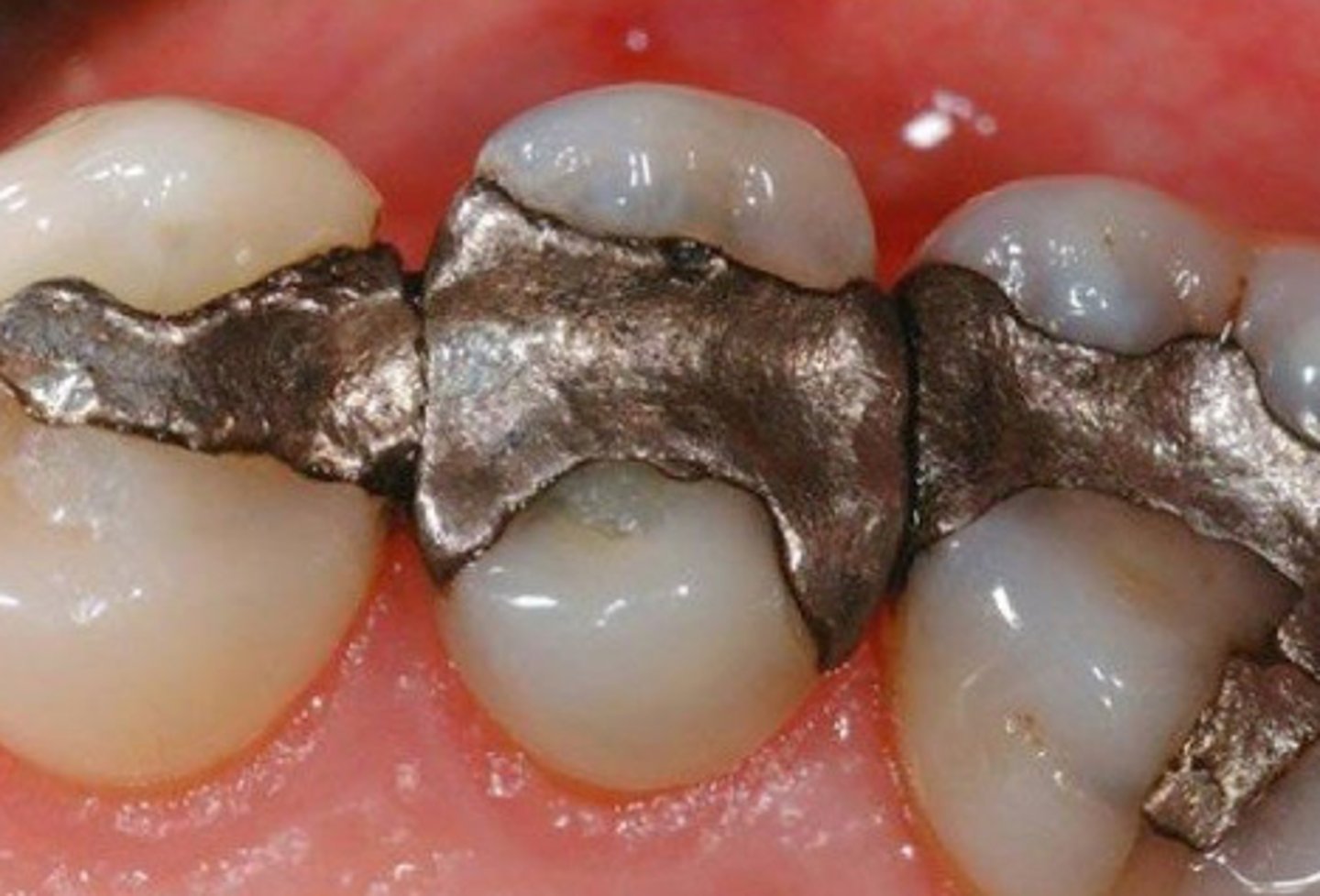
True
T/F: You would create a crown for a pre-existing defective crown
True
T/F: You would create a crown for a pre-existing defective large restoration
True
T/F: You would create a crown for a pre-existing large restoration for preventative measure
- Loss Part of Tooth Structure (Structural Damaged Dentition)
- 1 to 3 Tooth Missing (Partially Edentulism)
Diagnosis in Predoc Clinic for Fixed Prosth will focus on what two things?
Mild coronal tooth structure damage
Define the following:
When there is sufficient retention provided after tooth preparation for a direct restoration
Moderate coronal tooth structure
Define the following:
- When sufficient retention is provided after tooth prep for an in-direct restoration
- e.g. inlay, onlay, or 3/4 crown or 7/8 crown
Moderate to severe coronal tooth structure damage
Define the following:
When sufficient retention is provided after a tooth preparation for a full coverage restoration
Severe coronal tooth structure damage
Define the following:
- When there is insufficient retention provided after tooth preparation
- i.e. <1.5mm circular ferrule or when crown lengthening OR force eruption is NOT feasible
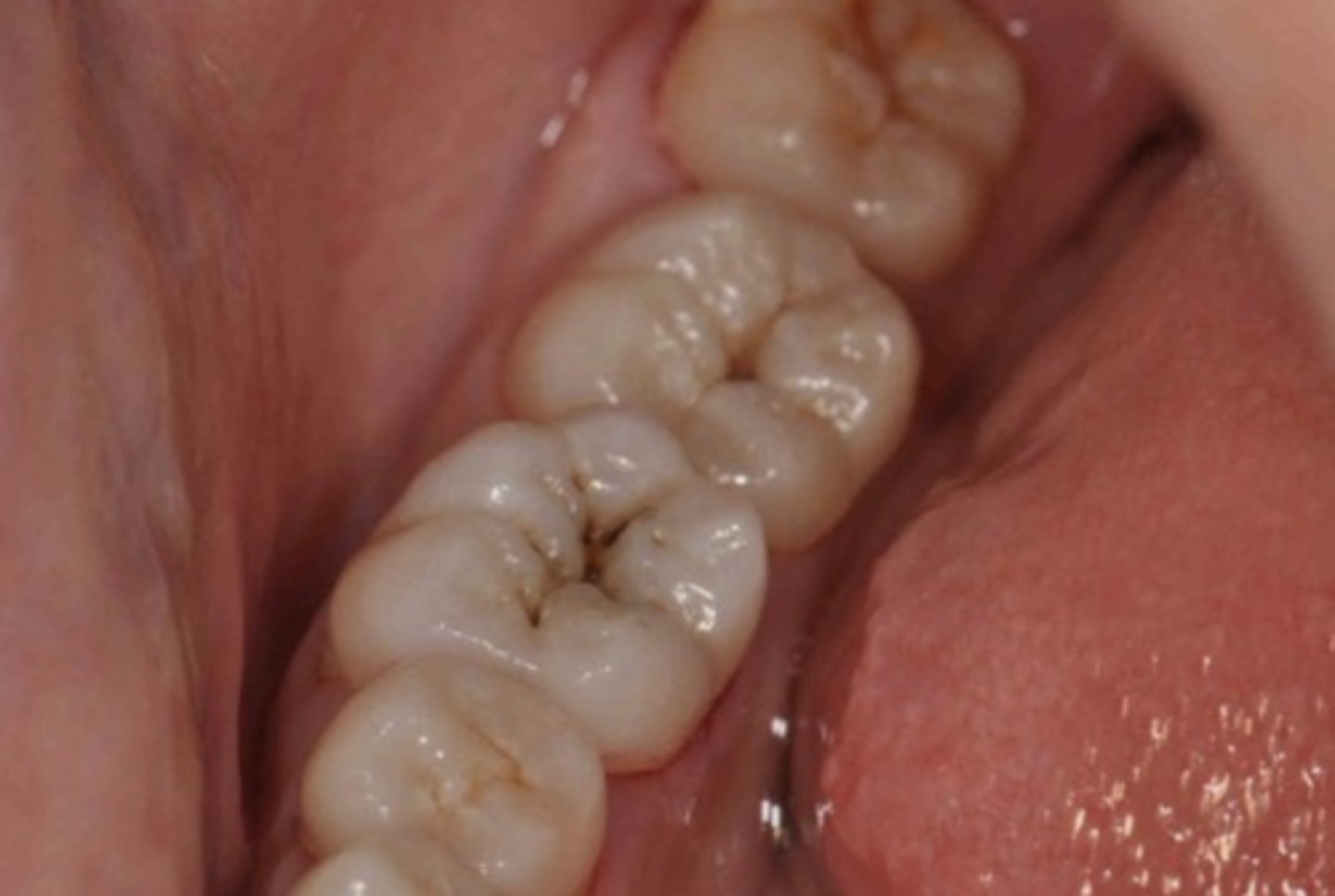
Mild
How would you define the structural damage to this tooth?
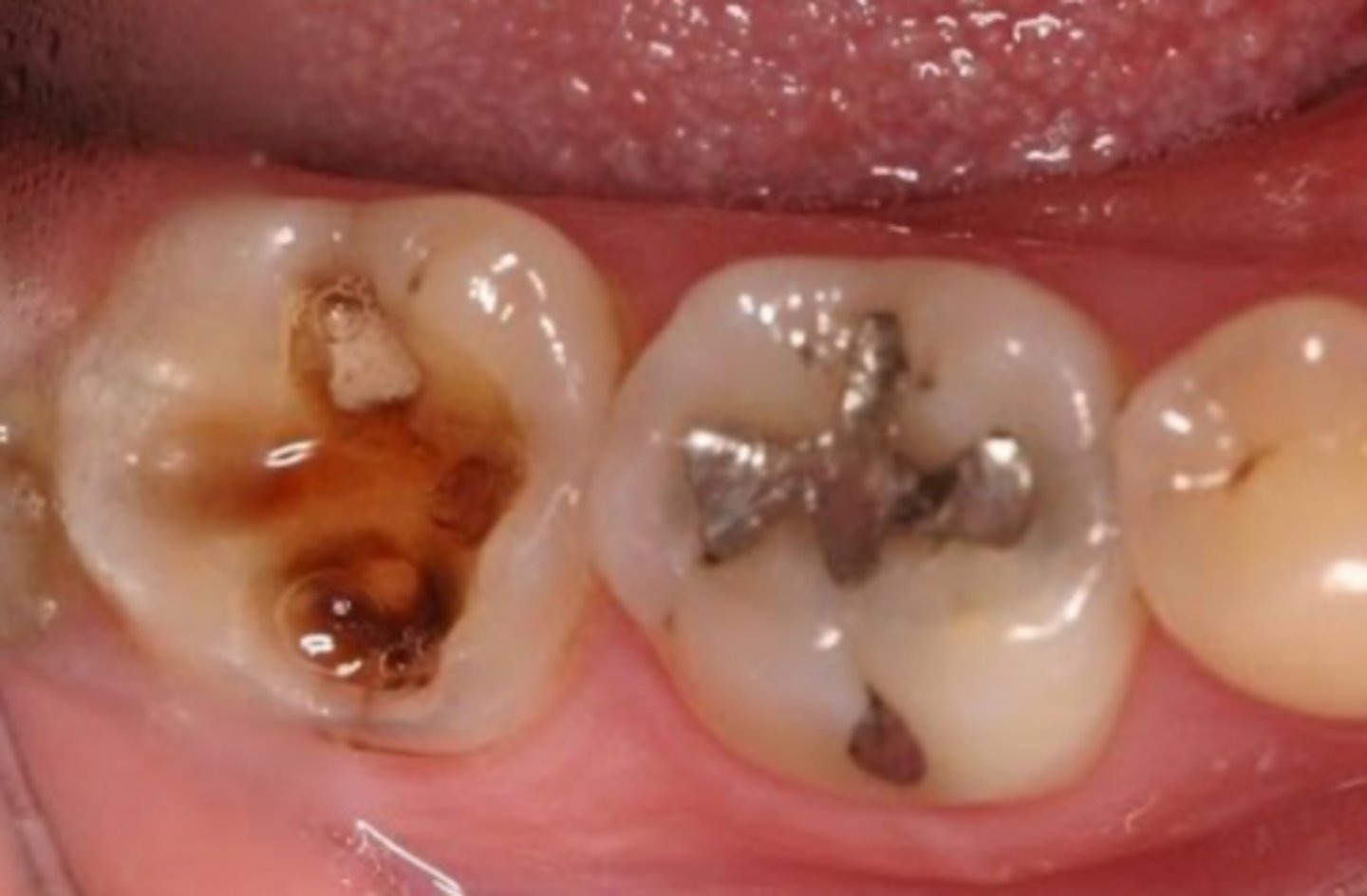
Moderate
How would you define the structural damage to this tooth?
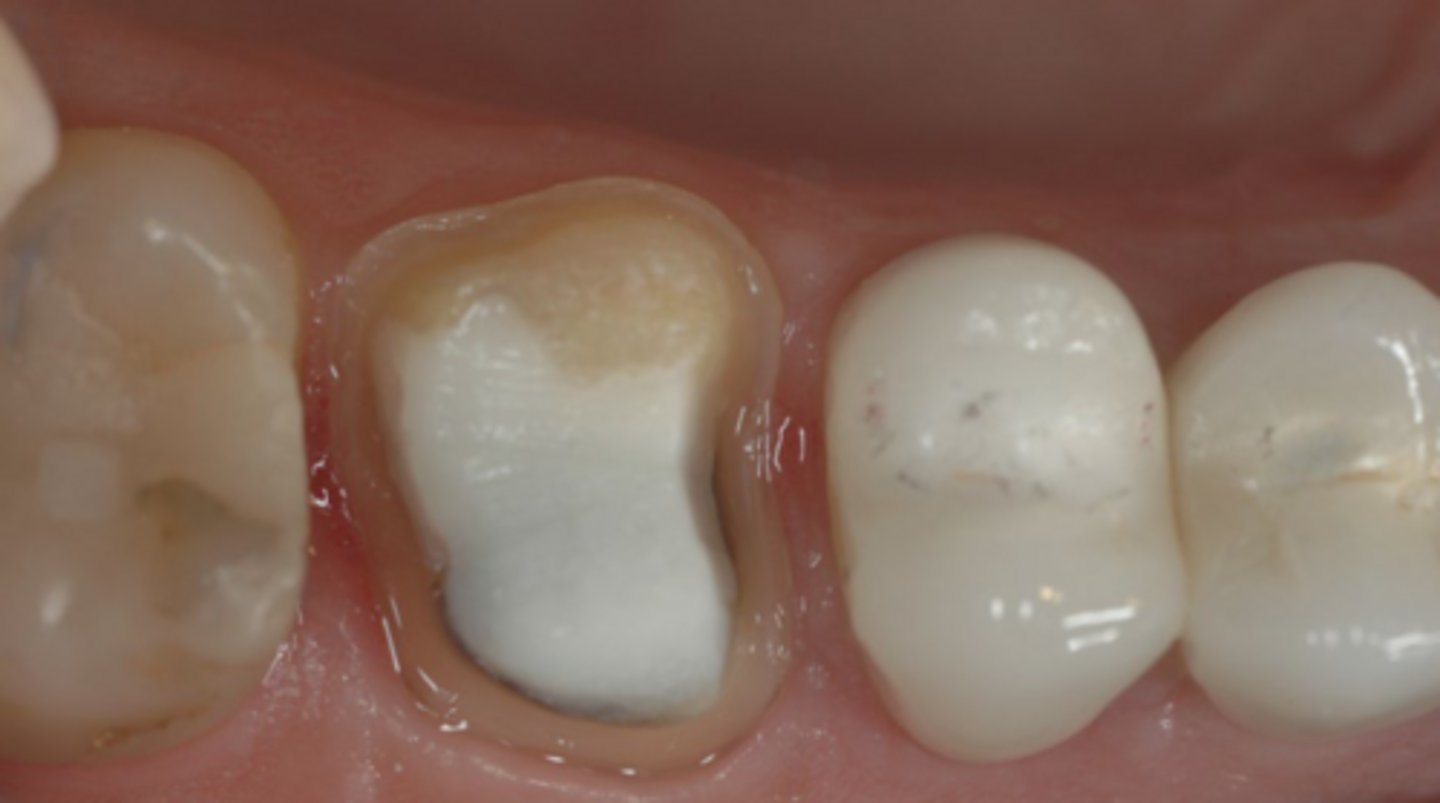
Moderate to severe
How would you define the structural damage to this tooth?
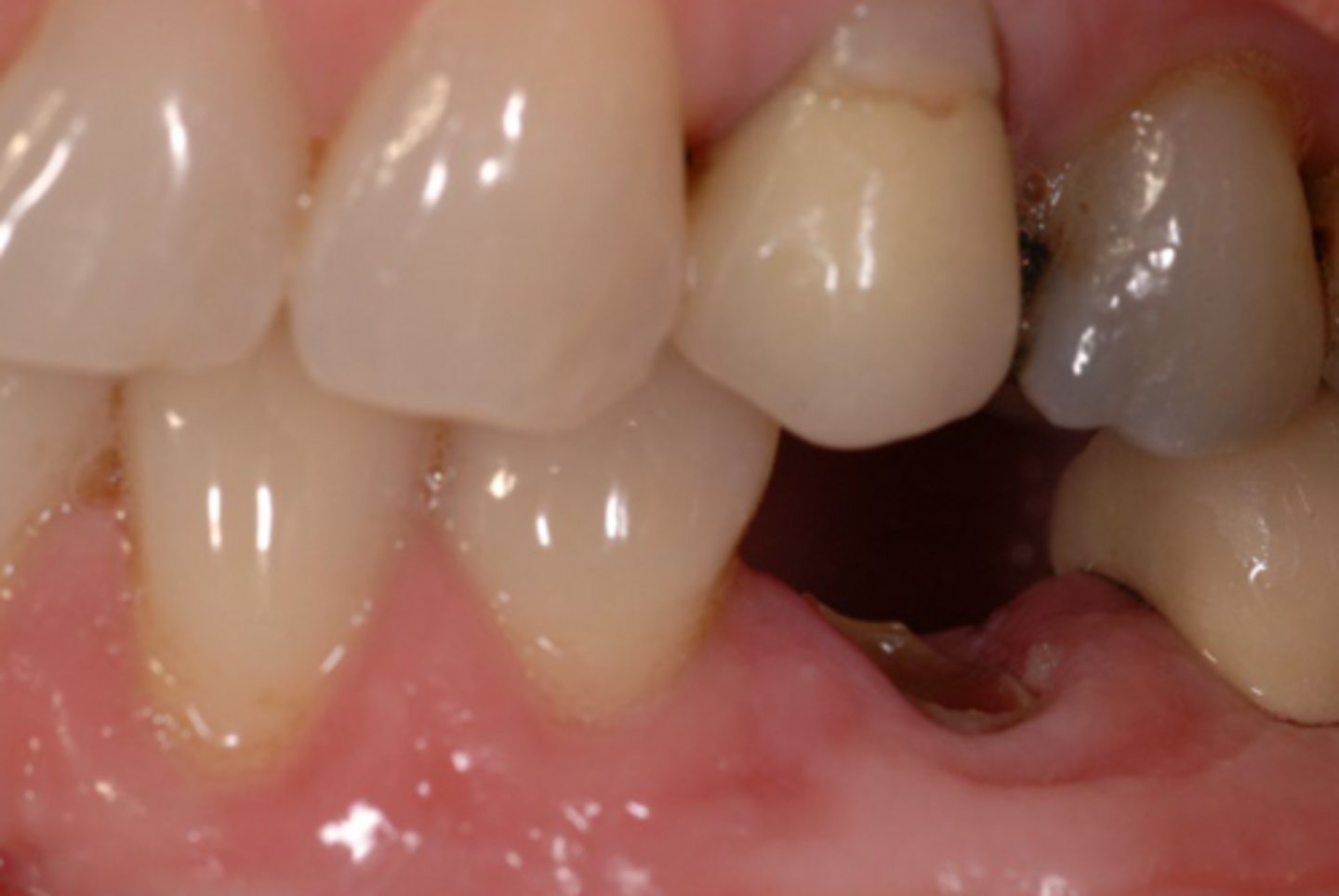
Severe
How would you define the structural damage to this tooth?
Mild to moderate
What category of structurally damaged teeth would you recommend for Indirect Partial Coverage restoration i.e. Inlays, Onlays, Veneer?
Moderate to severe
What category of structurally damaged teeth would you recommend for full coverage restoration?
- Foundation Portion (Crown-Root Ratio, Periodontal & Endodontic Health Status)
- Coronal Portion (Retention Form, Resistance Form)
- Position
- Angulation
What four tooth conditions do you consider before tooth preparation?
- Occlusal Analysis (plane, space and scheme)
- Smile Line
- Tissue Biotype
- Path of Insertion
- Root Proximity
- Patient's underlying systemic condition(s)
What six environmental conditions do you consider before tooth preparation?
2:3
The optimum crown-root ratio for a fixed partial denture abutment is _______
1:1
The maximum acceptable crown-root ratio for a fixed partial denture abutment is _______
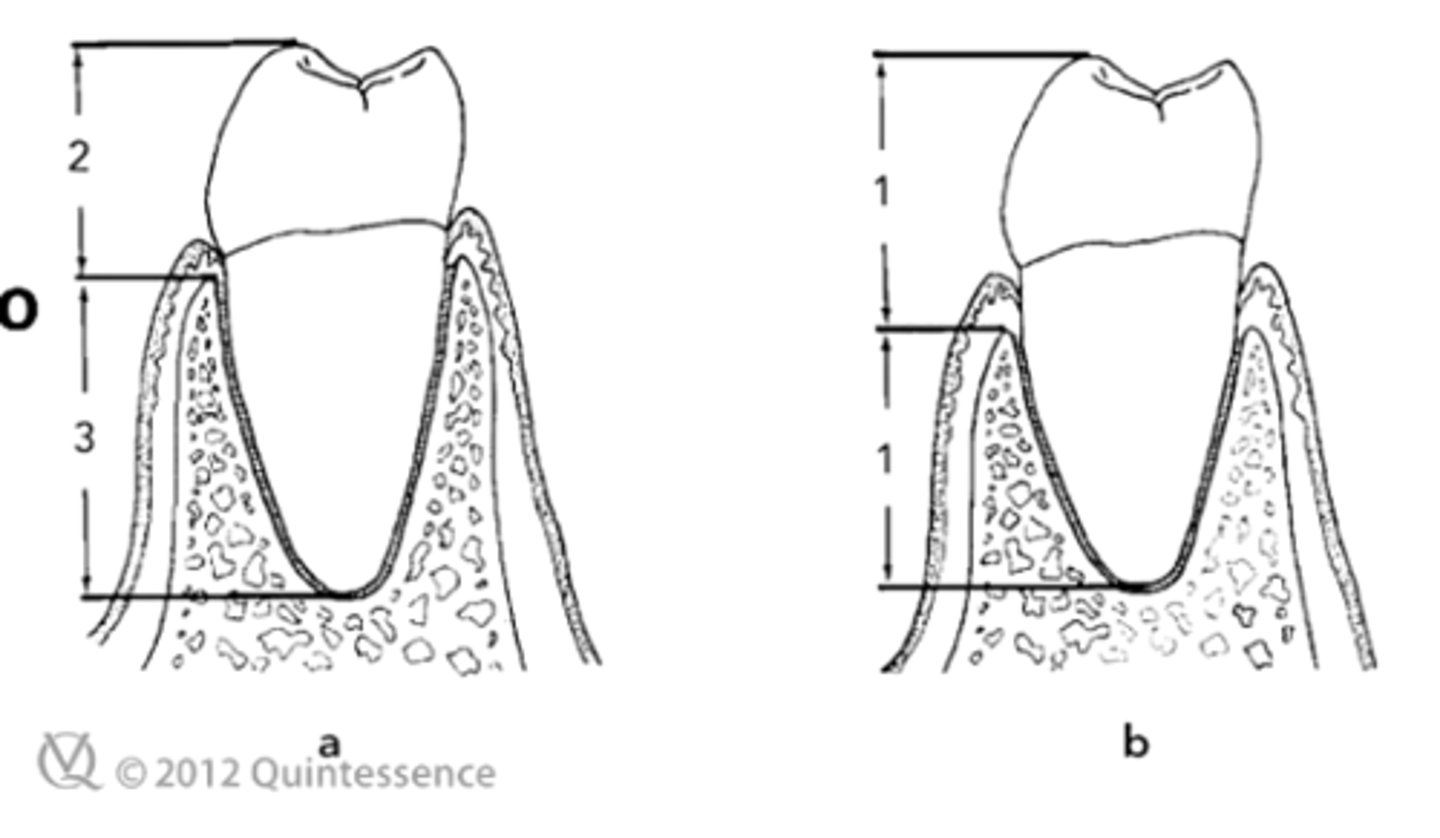
Retention
Define the following:
- Feature of tooth prep that resists dislodgment of crown in a vertical direction or along path of placement
- Usually due to tooth being too short
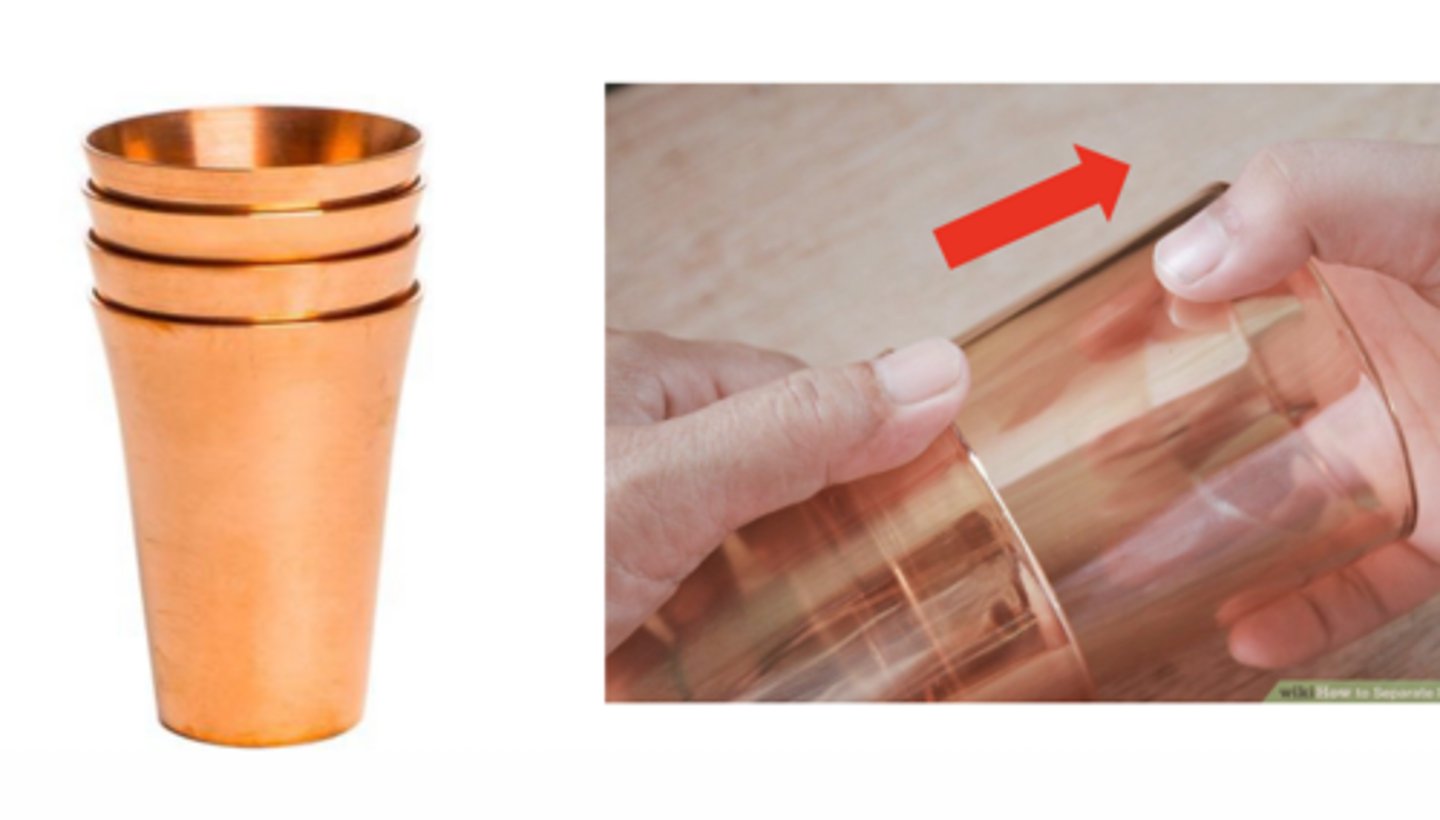
Resistance
Define the following:
- Feature of tooth prep that resists dislodgment of crown in an axis other than the path of placement
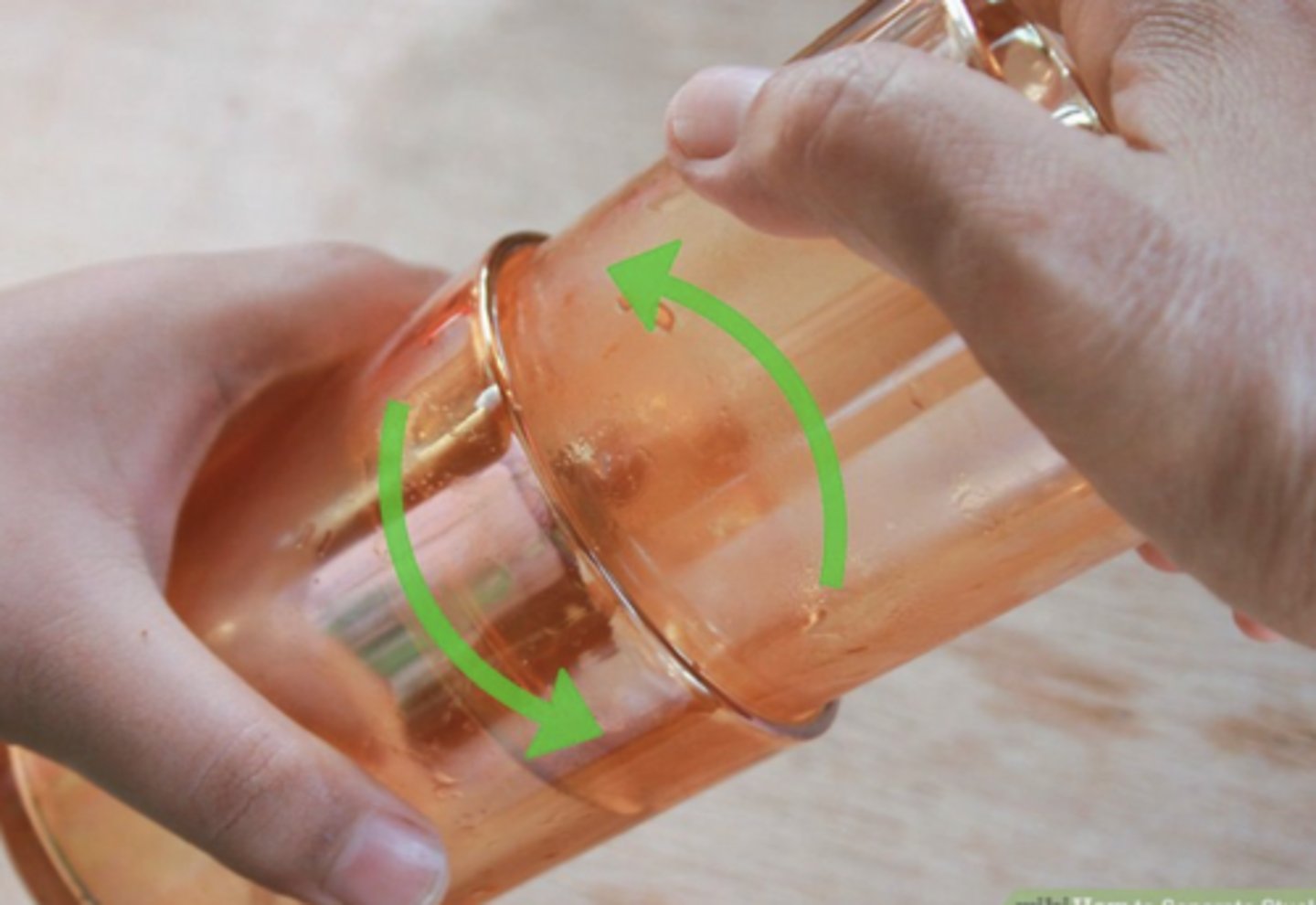
Resistance form
The most common problem that will fail your tooth prep form is __________ form
True
T/F: The supra-erupted tooth does not always need elective RCT
True
T/F: You may want to do tooth modification on the mounted diagnostic casts to achieve (1) reasonable height of the pontic and (2) no occlusal interferences. You can mimic the amount of tooth reduction from the casts into pt's mouth if there is no hypersensitivity to the affected tooth.
True
T/F: You can reassess whether you will have adequate interocclusal space for a pontic and it does not cause occlusal interferences during lateral movements
Interocclusal Distance
What is a major concern when considering the treatment plan for these teeth?
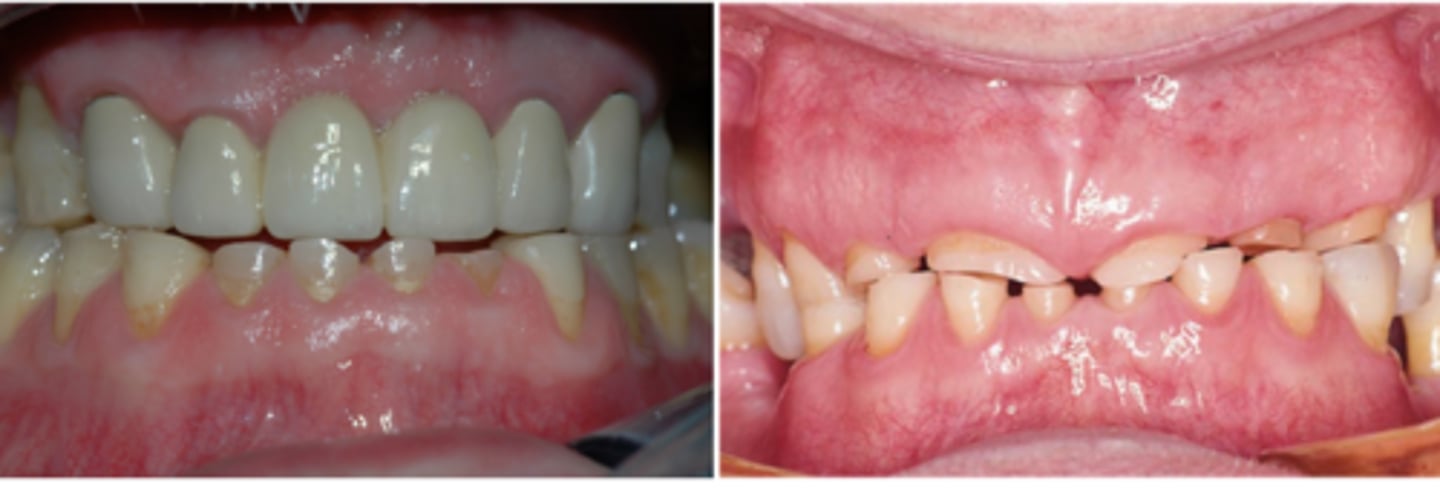
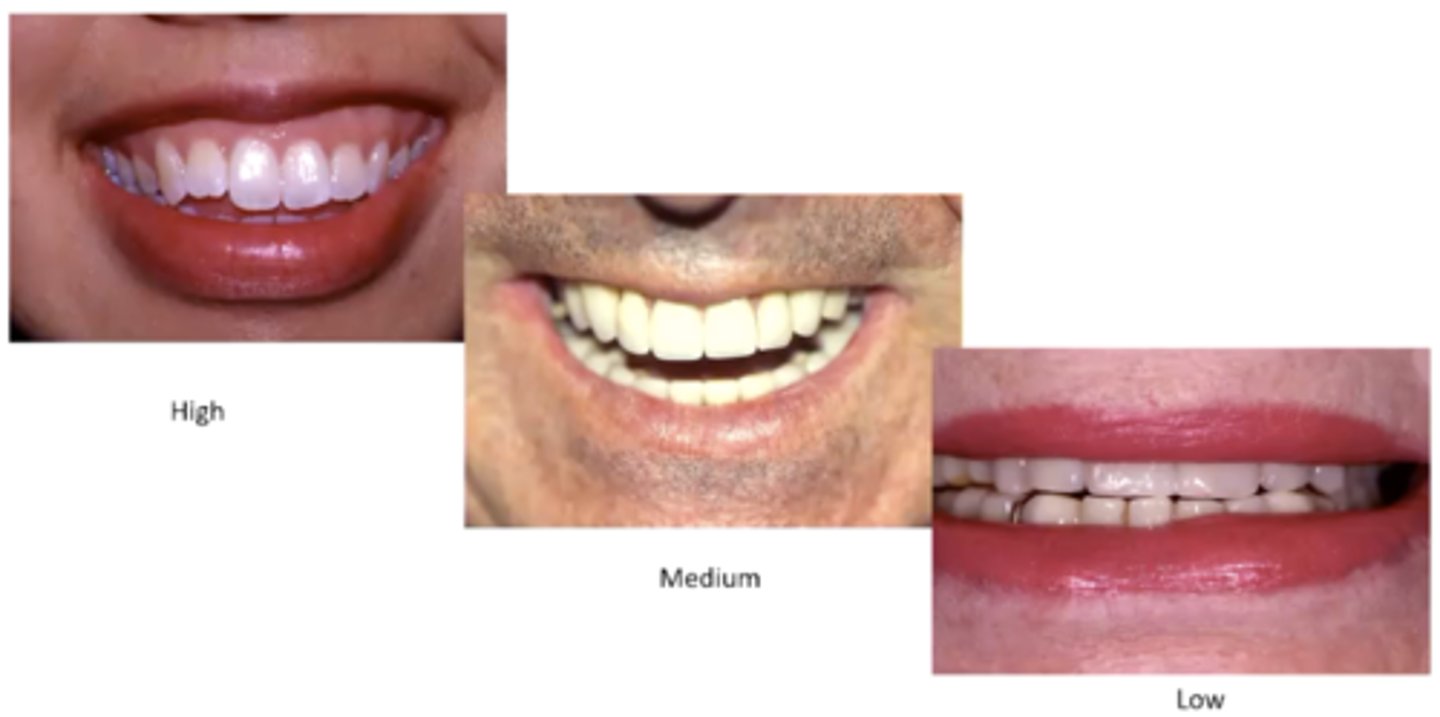
Smile line
What are these showing differences of?
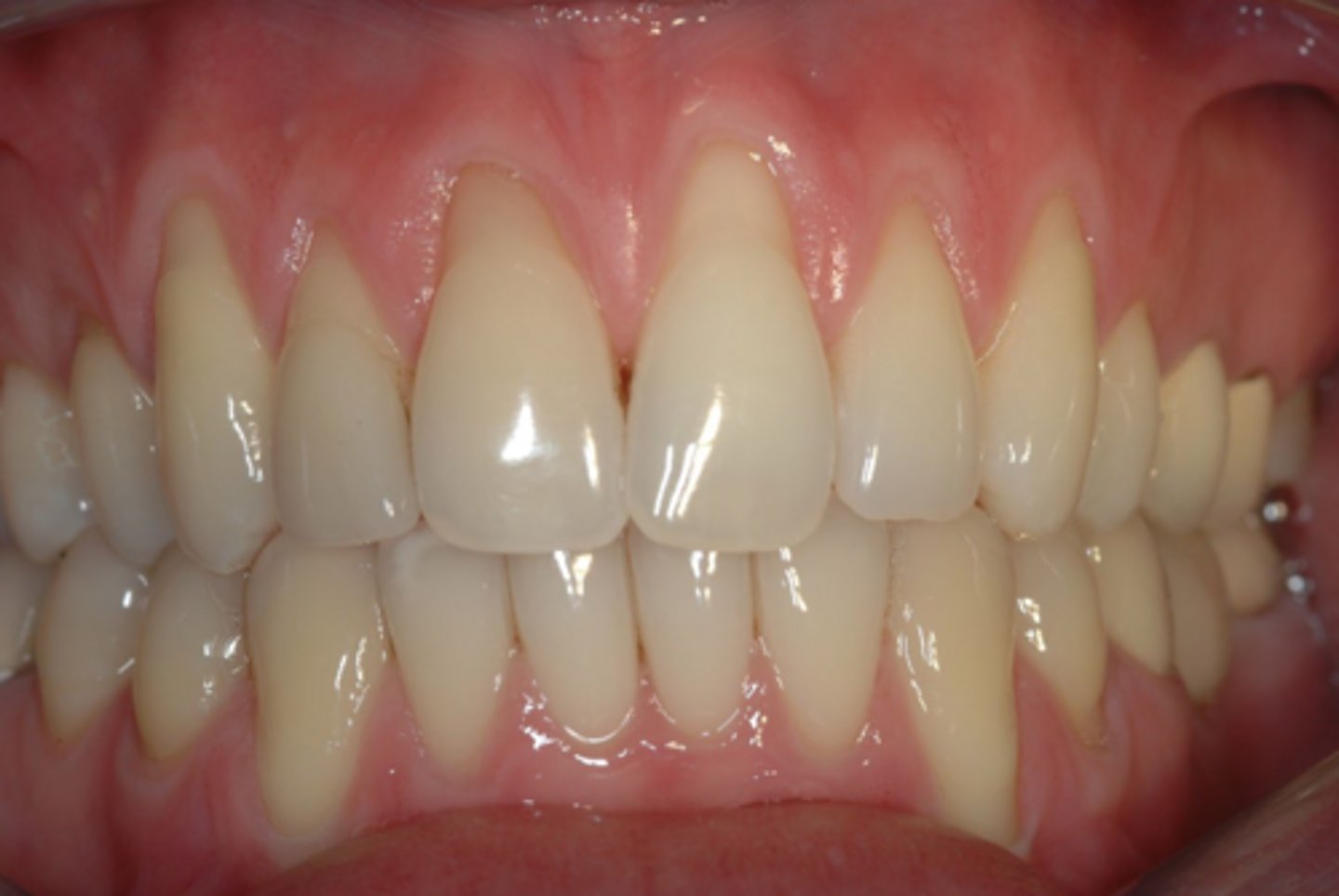
Thin Scalloped gingiva
What is the tissue biotype?
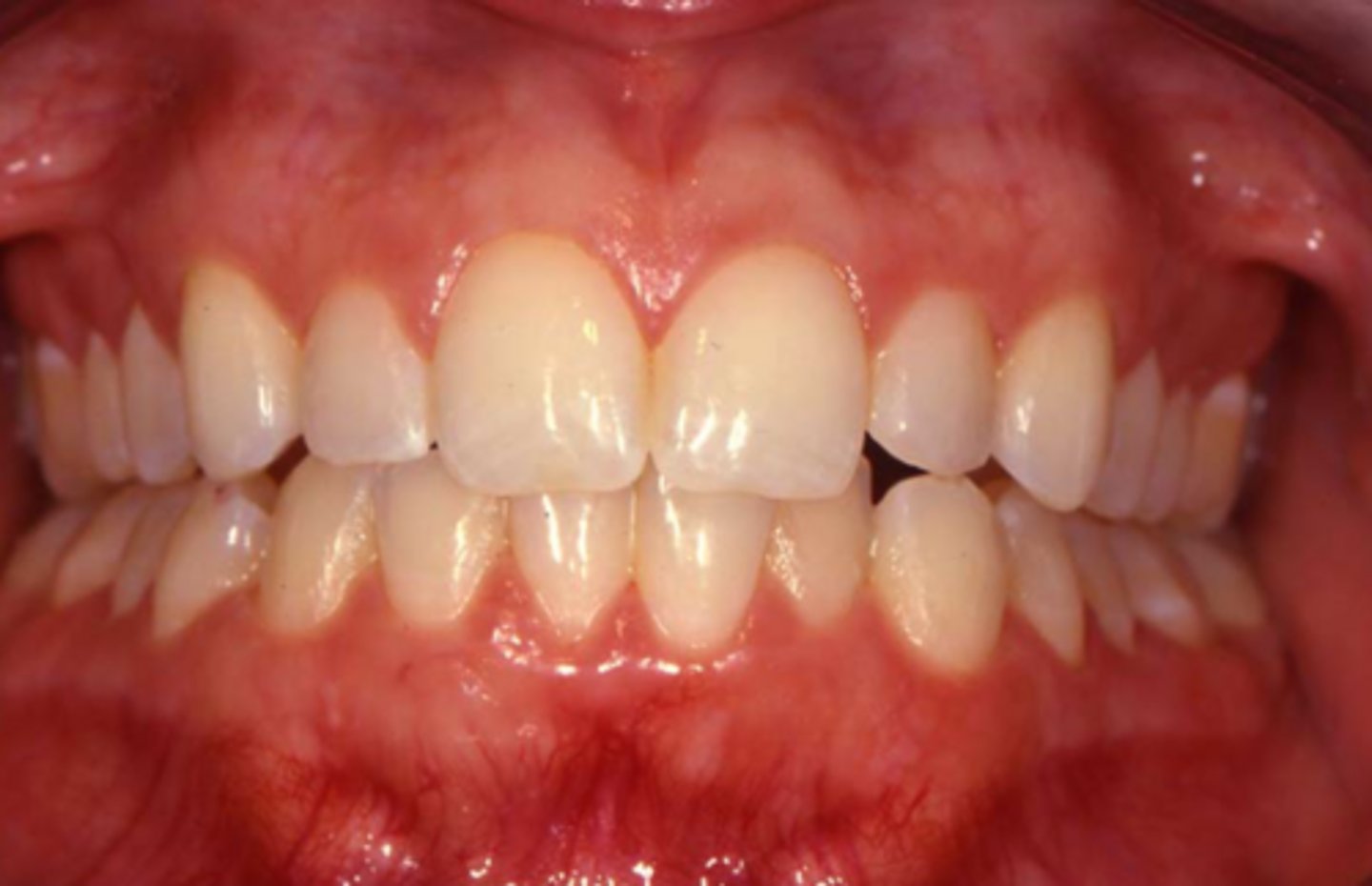
Thick Flat gingiva
What is the tissue biotype?
b) thick flat
you want ________ gingiva
a) thin scalloped
b) thick flat
Tooth #14 D margin is too close to Tooth #15M. This can cause inaccurate impression. Proximal margin contacts must be broken prior to final impression
What is the issue with the distal of #14?
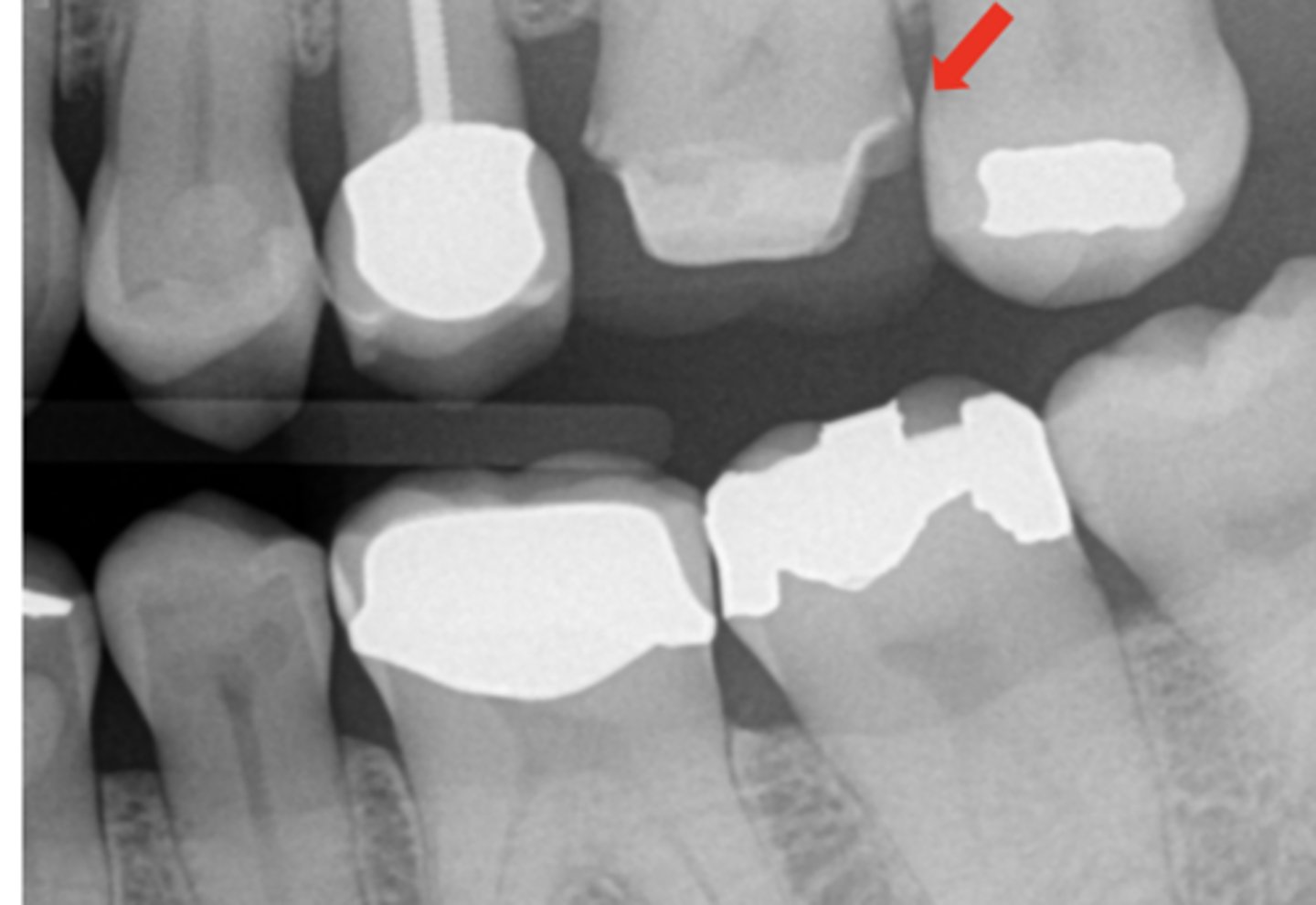
TRUE -- if the margin is too close to the next tooth, it can cause an inaccurate impression
T/F: Proximal margin contacts must be broken prior to final impressions
Cord packer -- the cord packer can be used as a tool to verify clearance. this is something a perio probe will not be able to achieve
You must use the _______ to pack the cord.
True
T/F: You should always eliminate the main etiology of underlying systemic condition prior to fixed prosth therapy
A) Function over form first
You should improve:
A) Function over form first
B) Form over function first
C) Path of insertion
All the following are considerations of the tooth condition before tooth preparation except:
a) crown-root ratio
b) angulation
c) path of insertion
d) resistance/retention form
e) position
D) Crown position
All the following are considerations of the environmental condition before tooth preparation except:
a) occlusal analysis
b) smile line
c) tissue biotype
d) crown position
e) root proximity
f) PDL surface
g) root configuration
Fixed prosthodontic treatment-planning factors, especially when evaluating abutment teeth for crowns and fixed partial dentures (bridges)
What are all of the following?
- Root Configuration
- PDL Surface Area
- Cantilever
- Tilt Abutment
- Intermediate Abutment
- Condition of Partially Edentulous Area
A
(Although the root surface area of these teeth is similar, the root configuration of the maxillary premolar, a, with its greater faciolingual dimension, makes it a superior abutment to the maxillary central incisor, b, whose root is essentially circular in cross section)
What root configuration is a superior choice for an abutment: A or B?
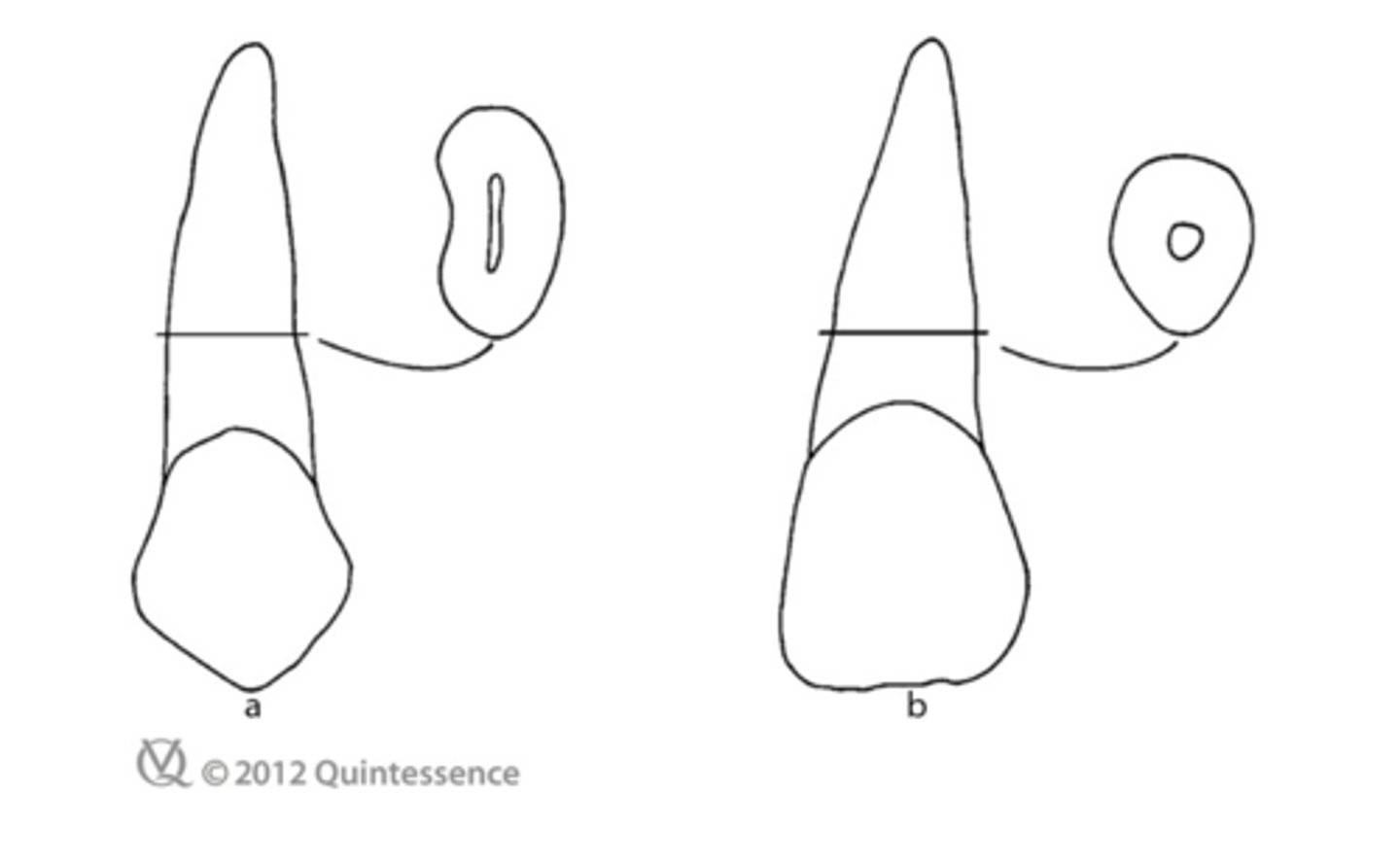
A
(The molar with divergent roots, a, will be a better abutment tooth than one whose roots are fused, b)
What root configuration is a superior choice for an abutment: A or B?
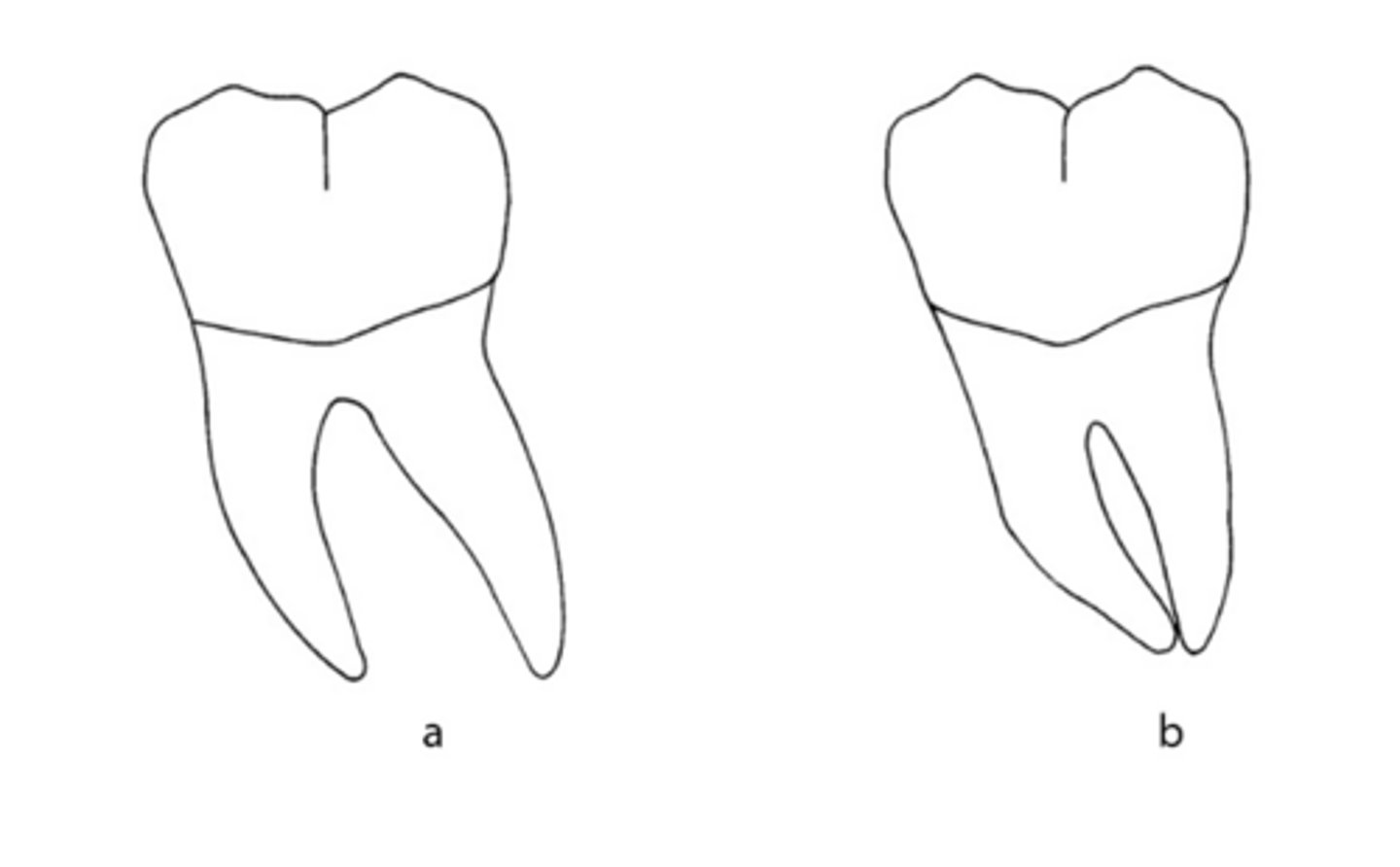
True
T/F: The finish line should NOT be under contour of adjacent teeth
B) Greater faciolingual dimension
so premolar (>>faciolingual) is greater than central incisor (circular)
when choosing abutment teeth, what is better?
A) Circular cross-section
B) Greater faciolingual dimension
C) Greater mesiodistal dimension
B) Divergent roots
When choosing abutment teeth, what is better?
A) Fused roots
B) Divergent roots
The surface area of the teeth being replaced by a fixed partial denture
the PDL surface area of the abutment teeth should EXCEED/BE APPROXIMATELY EQUAL TO ___________________
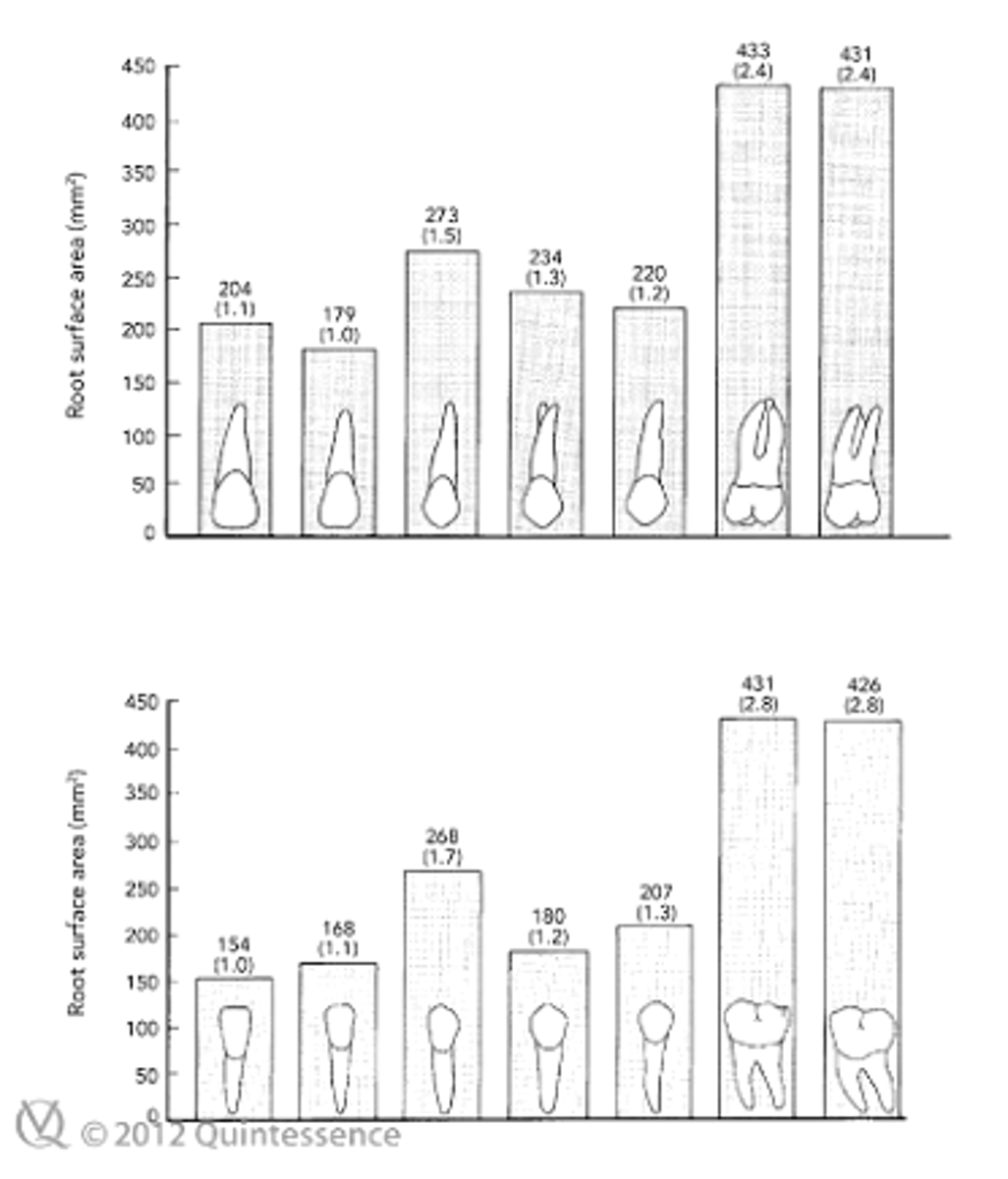
PDL surface area rule
(The number in parentheses above each tooth is the ratio between the root surface area of the respective tooth and the root surface area of the smallest tooth in the arch, the central incisor, based on data by Jepsen)
What does this show an example of?
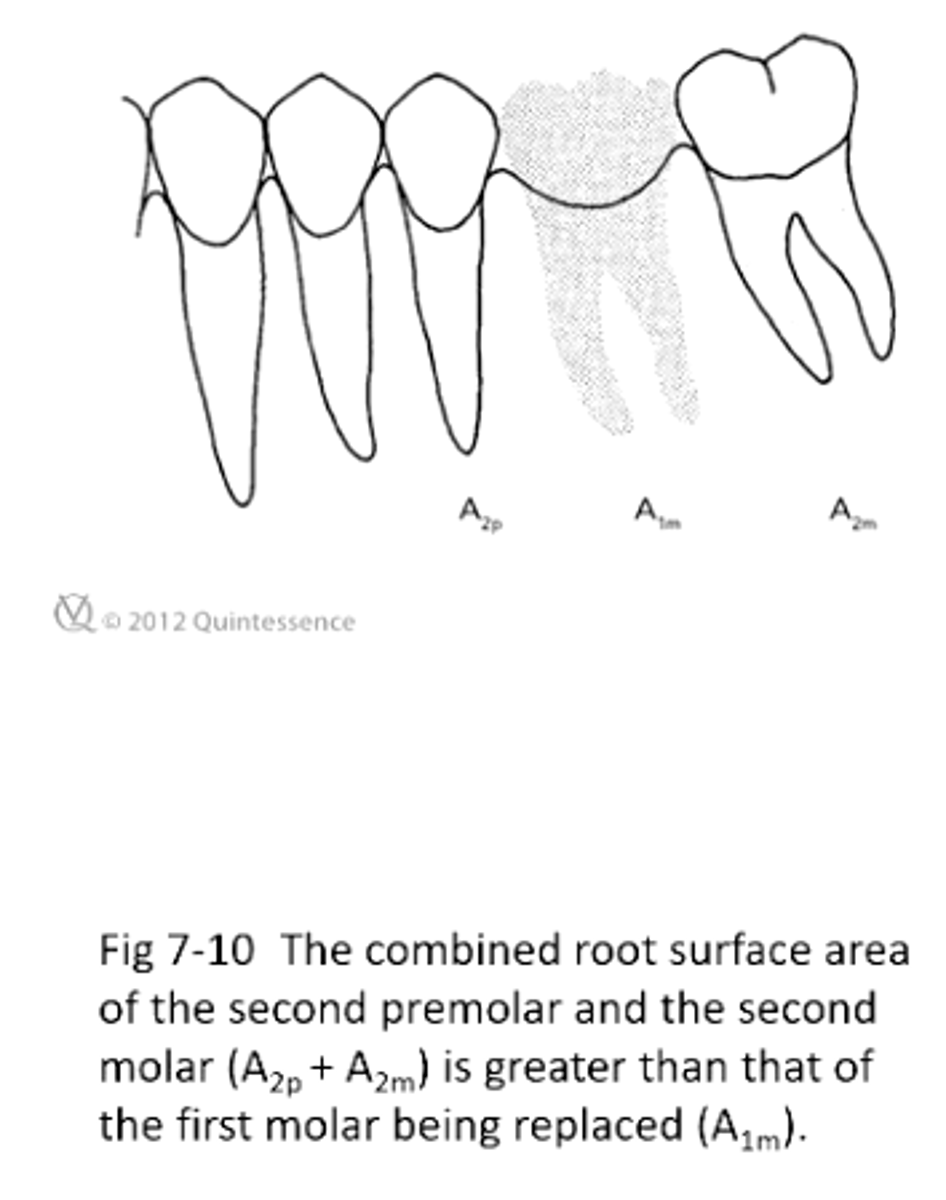
B. Equal to or greater than the teeth being replaced
According to Ante's law, the combined periodontal ligament/root surface area of the abutment teeth should ideally be:
A. Less than the teeth being replaced
B. Equal to or greater than the teeth being replaced
C. Twice the pontic area
D. Independent of pontic span
Abutment root surface area support
The prosthodontic principle illustrated in these figures is primarily related to _________
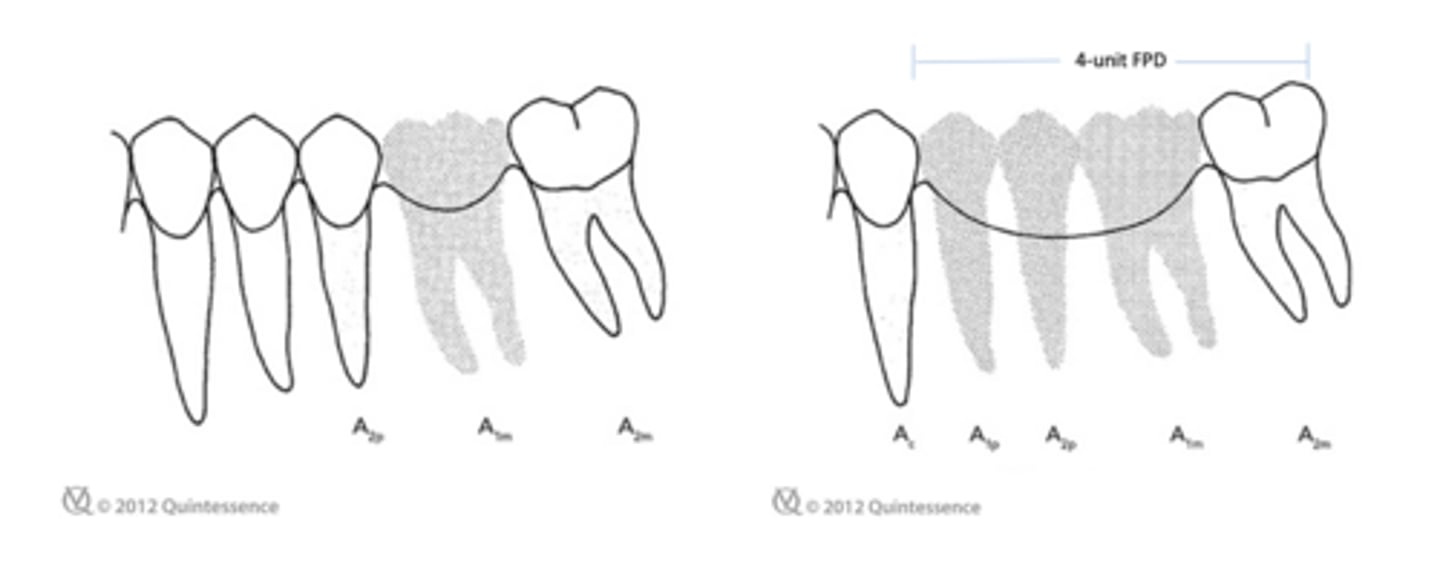
c) 8x
There is _________ times deflection if pontic thickness is decreased by 1/2
a) 2x
b) 4x
c) 8x
d) 16x
e) 27x
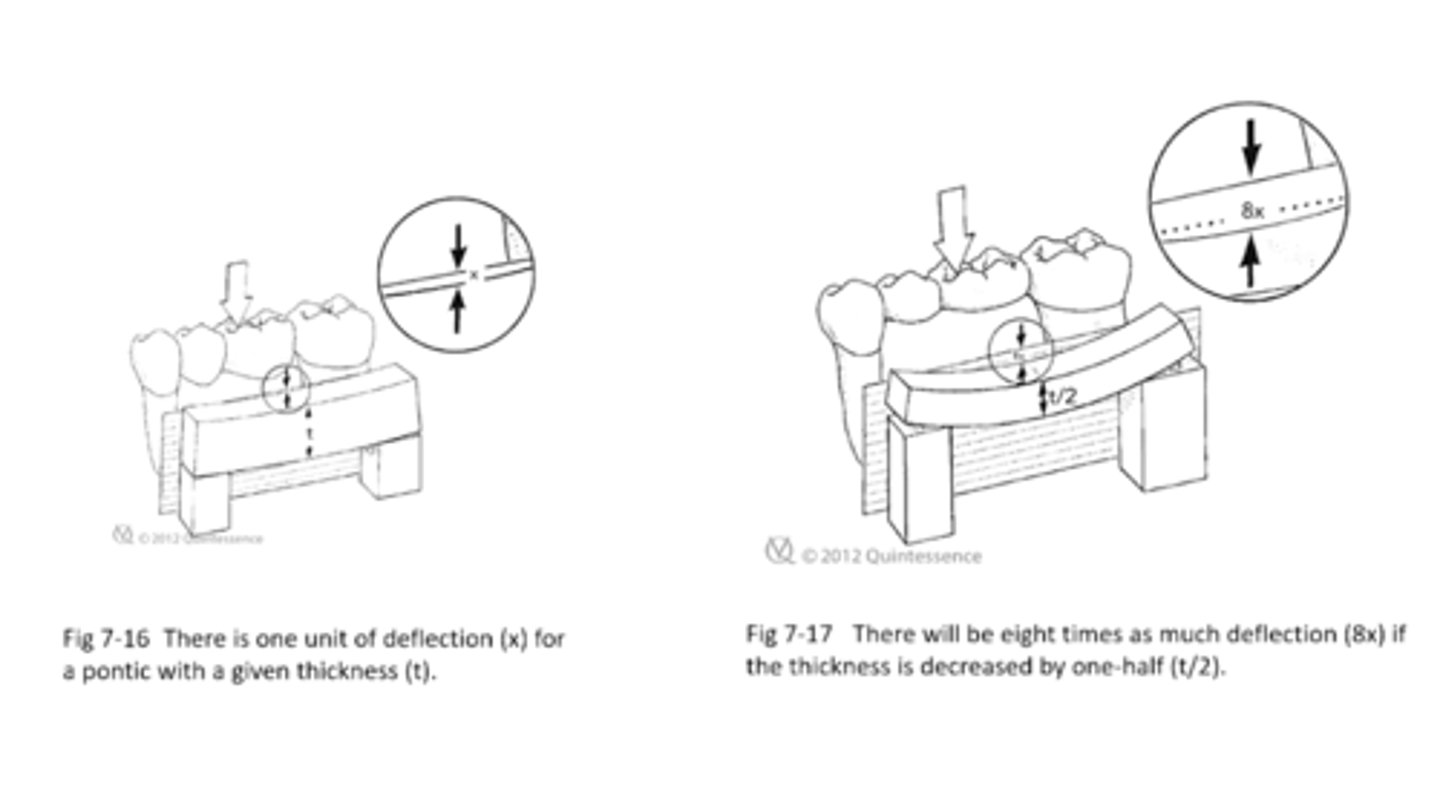
Full-gold vs PFM crown
When would you have a thinner pontic?
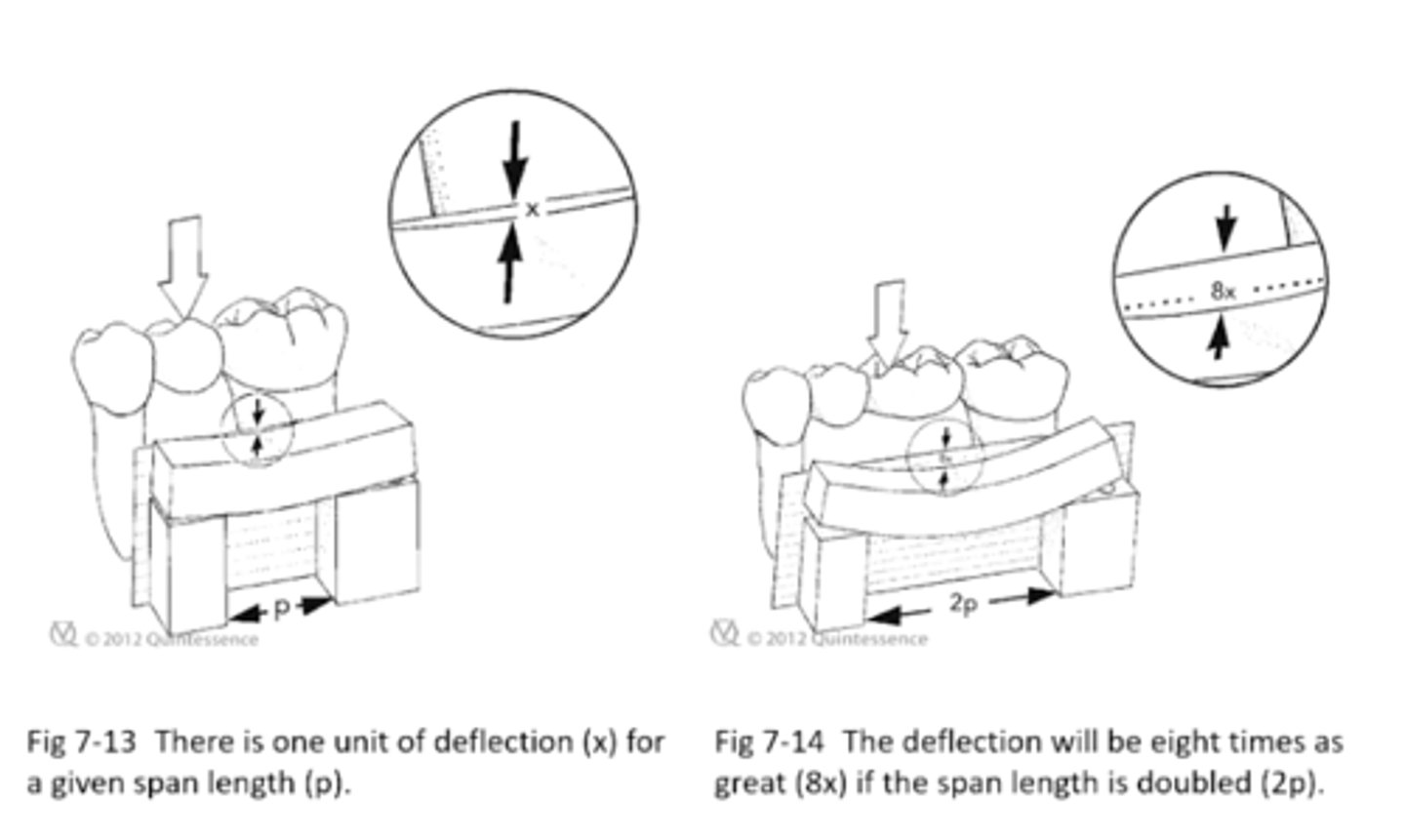
c) 8x
There is _________ times deflection if pontic span length is doubled
a) 2x
b) 4x
c) 8x
d) 16x
e) 27x
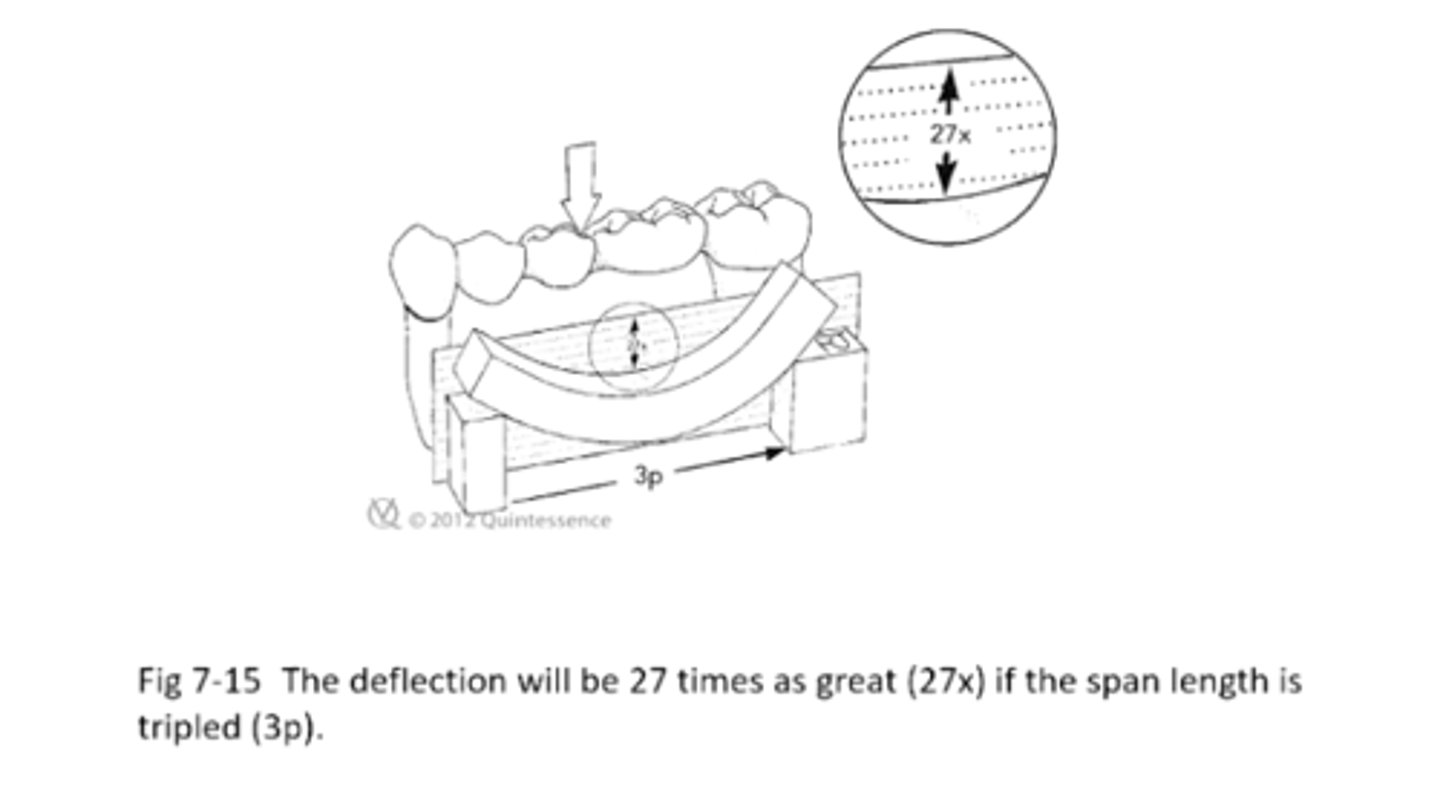
e) 27x
There is _________ times deflection if pontic span length is tripled
a) 2x
b) 4x
c) 8x
d) 16x
e) 27x
Create facial and lingual mechanical grooves to counteract MD torque
What can you do to counteract the mesiodistal torque resulting from the deflection of the metal in bridge?
True
T/F: The retainers on secondary abutments will be placed in tension when the pontics flex, with the primary abutments acting as fulcrums
True
T/F: Forces on the pontic of a cantilever fixed partial denture tend to tip the fixed partial denture or the abutment tooth
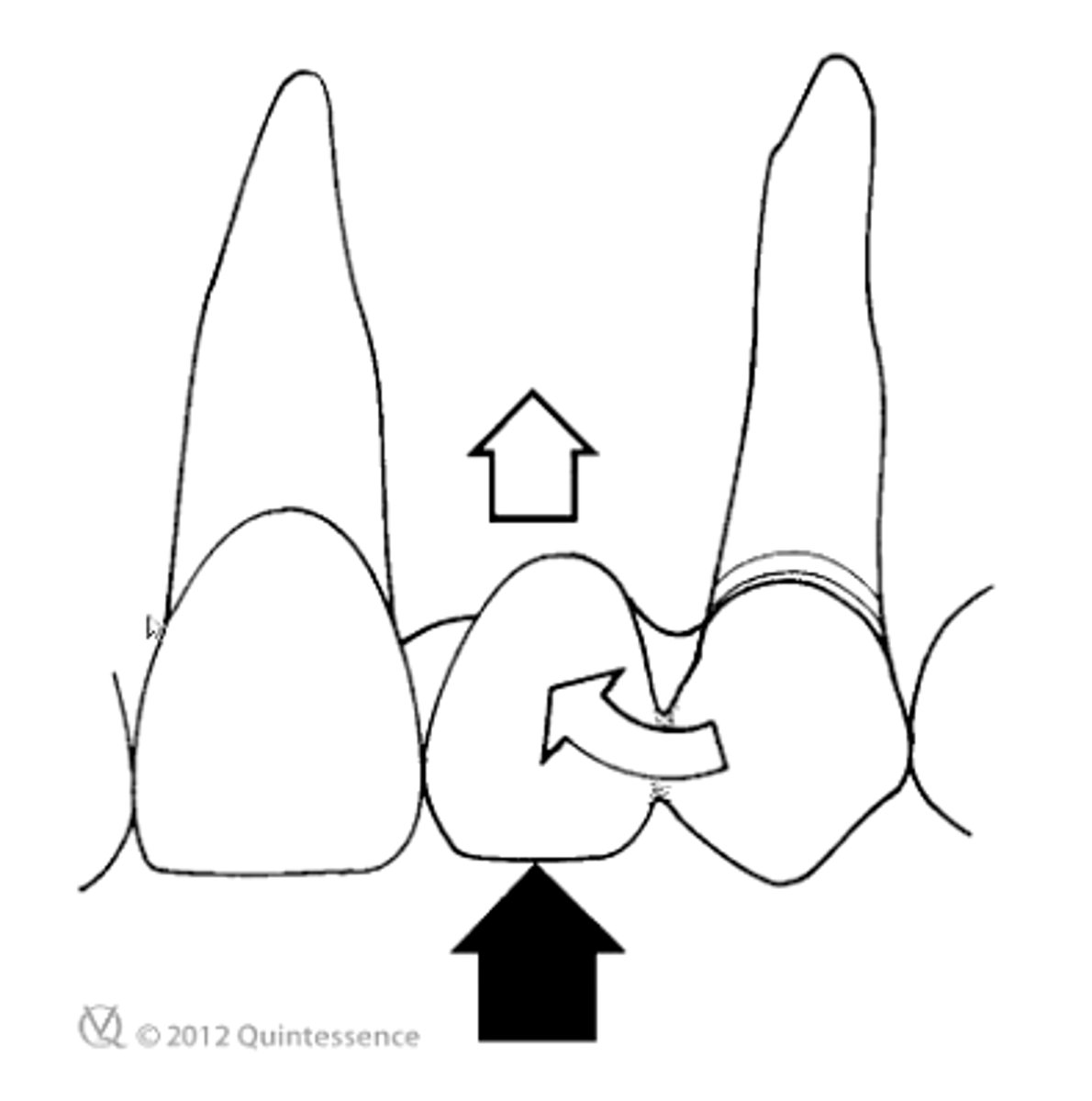
- Crown-root ratio
- Root configuration
If you had to choose between two teeth to determine which would be the cantilever abutment tooth, what parameters should you look at?
- It places a great deal of stress on the mesial abutment
- Instead, you can make the pontic smaller (like premolar size) to minimize stress on abutments
Why shouldn't you place a full-size molar cantilever pontic in the mouth?
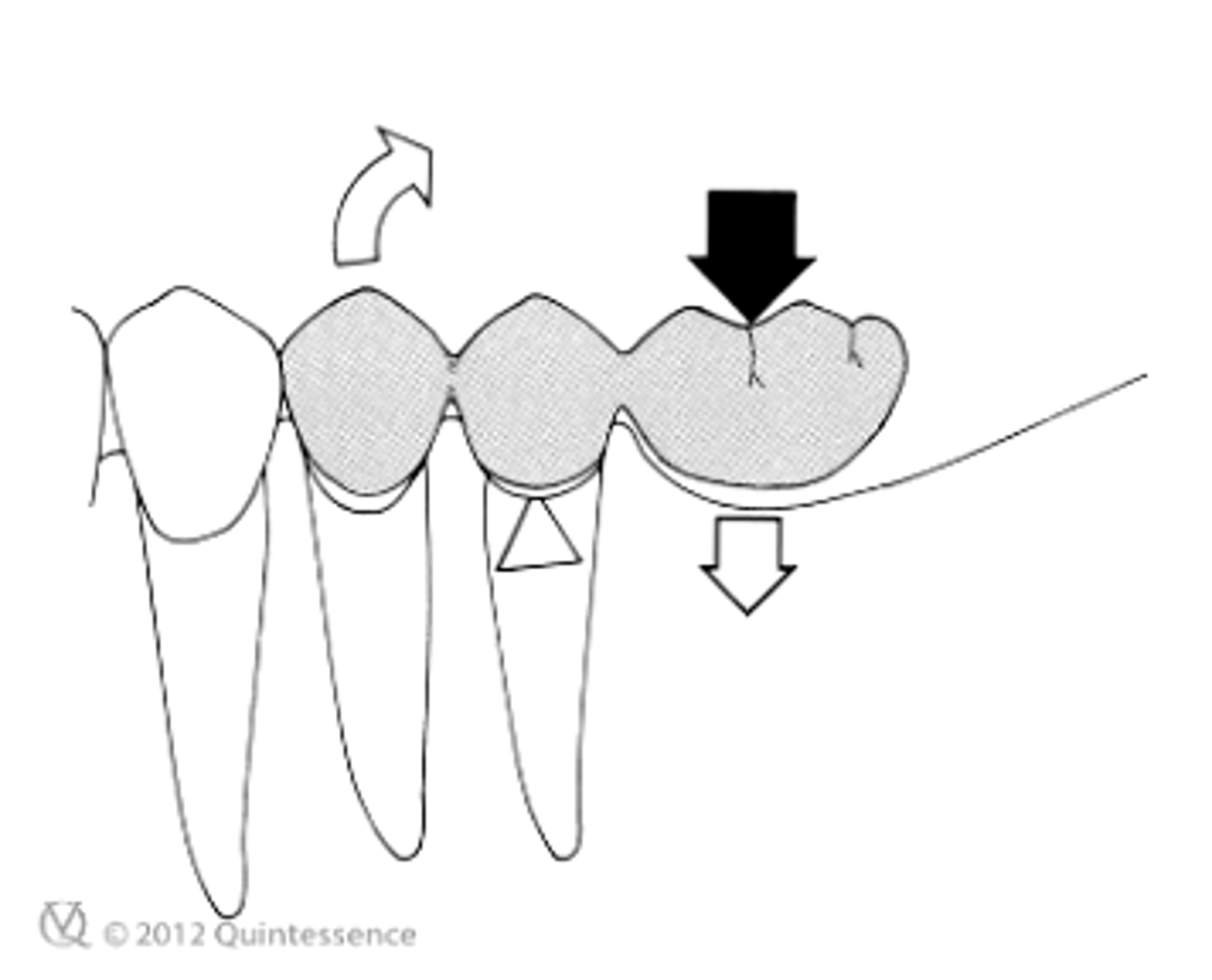
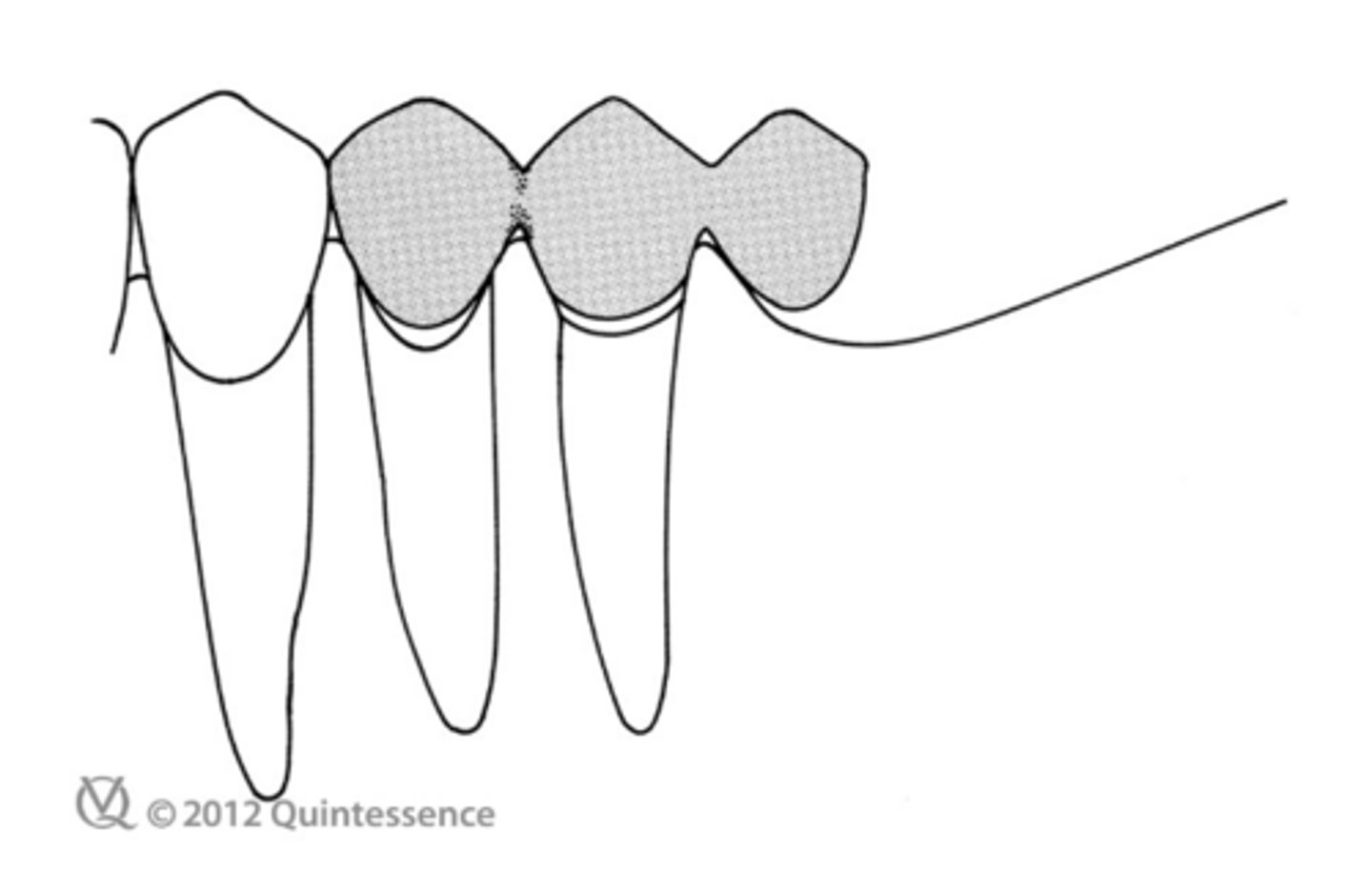
The pontic is the size of a premolar rather than a molar
This shows a cantilever fixed partial denture replacing a mandibular first molar, using both premolars as abutment teeth. How does this cantilever minimize stress on the abutments?
A) Taper or oval arch (left)
- Right is square arch form
Patients needing a 6-unit anterior FPD with a _________ arch form will have a longer cantilever arm from the canine line
a) taper or oval arch
b) square arch
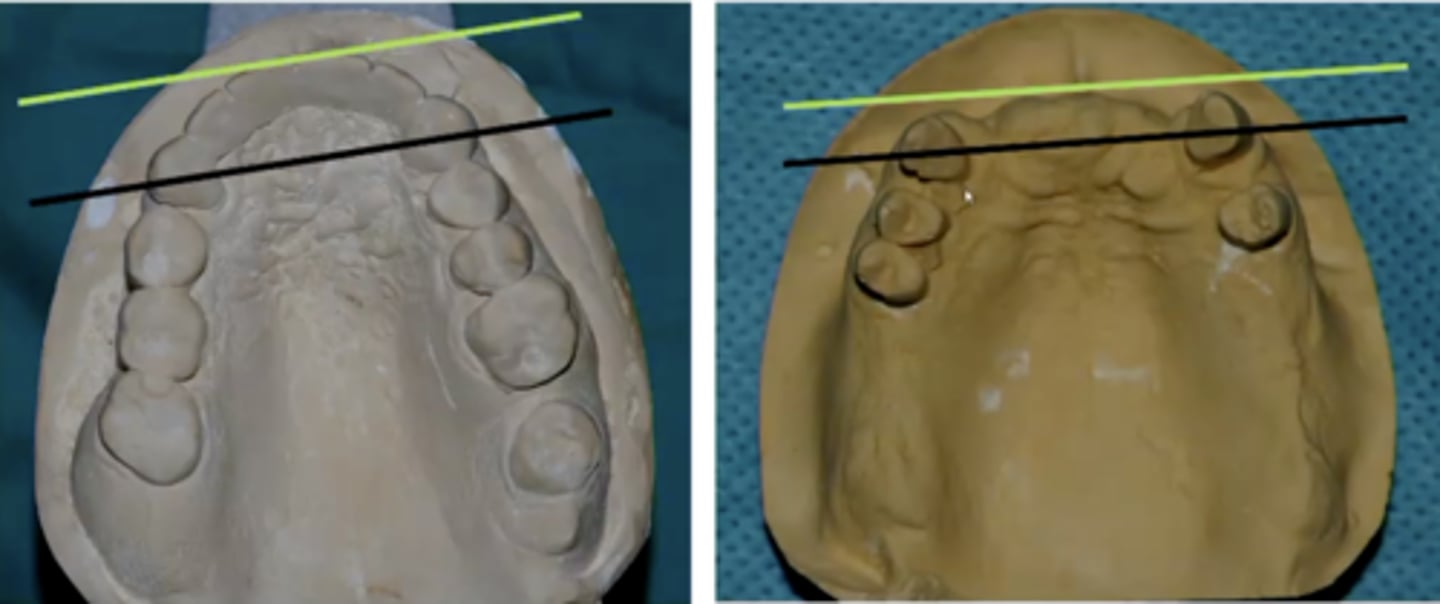
Shorter -- to have less torque to abutment teeth
Is having a short or longer cantilever arm from canine line better?
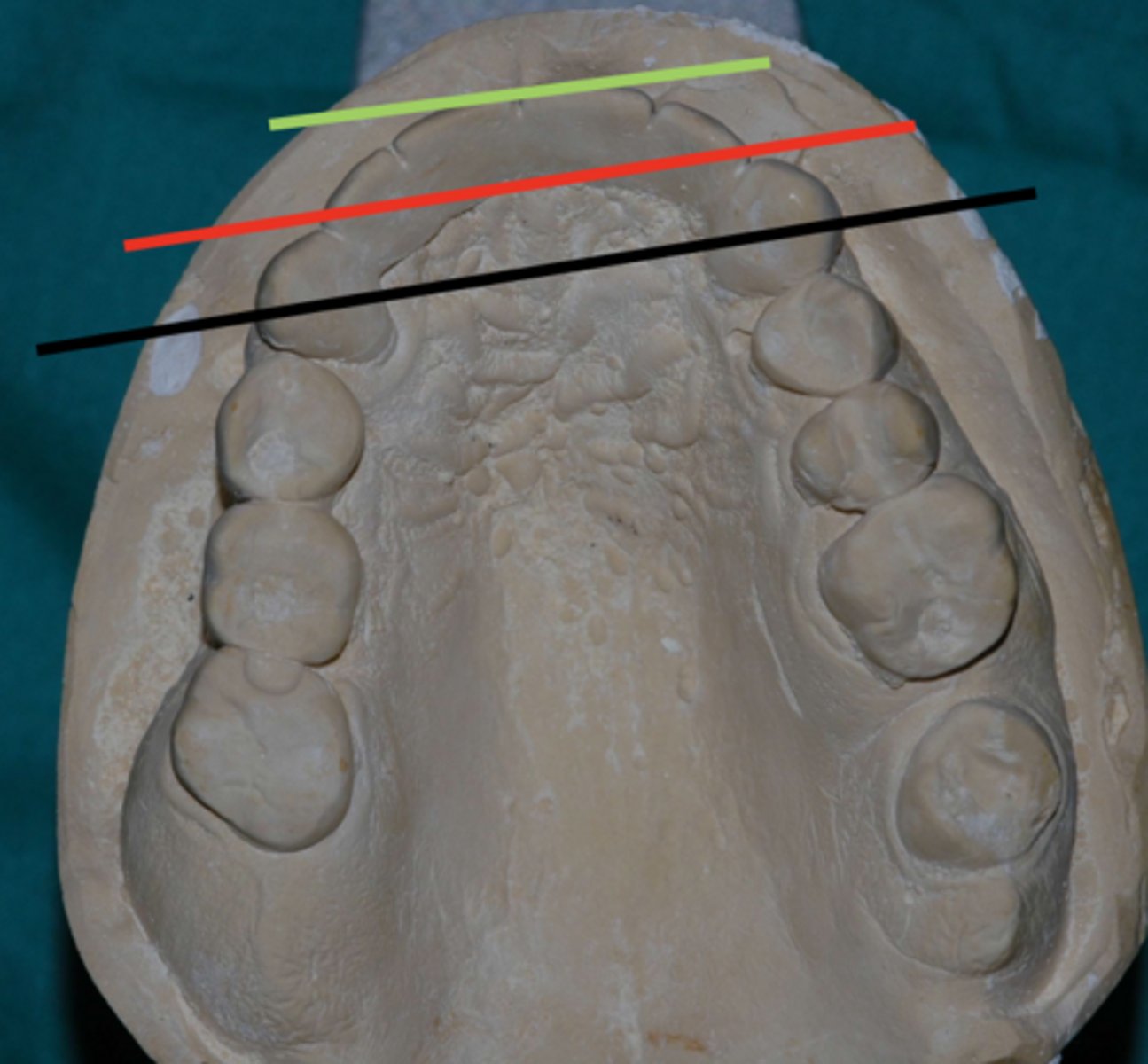
You can place two implants anterior to the canine line so that there is a smaller distance from the fulcrum line and therefore less torque
If you have an oval arch form and require a 6-unit FPD in the anterior region and you have a long cantilever arm from the canine line. What are some ways you can help reduce the amount of torque exerted on the FPD?
Secondary retention (R)
What must extend a distance from the primary interabutment axis equal to the distance that the pontic lever arm (P) extends in the opposite direction?
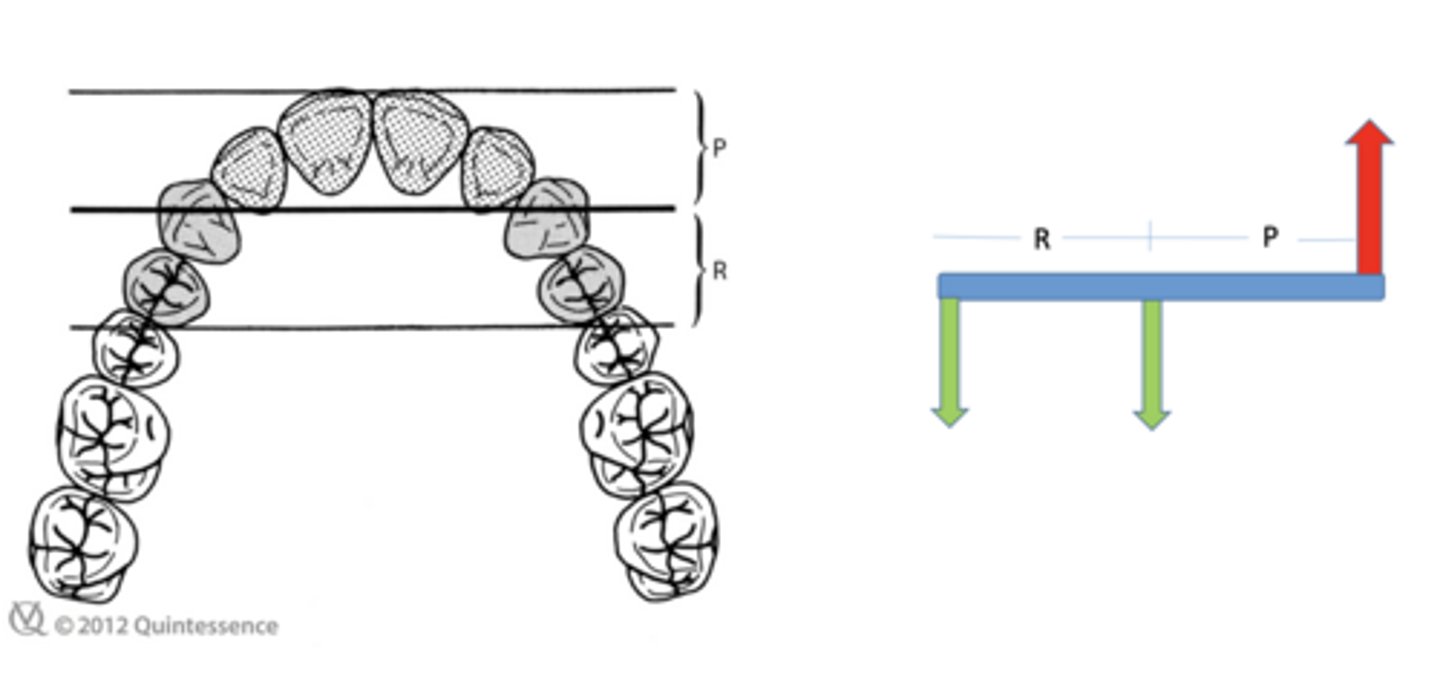
B) Replacing mandibular canine
(A fixed partial denture replacing a maxillary canine is subjected to more damaging stresses than that replacing a mandibular canine because the forces are directed outward and the pontic lies farther outside the interabutment axis)
Which has a better prognosis?
A) Replacing maxillary canine
B) Replacing mandibular canine
Forces are directed inward and the pontic is closer to the interabutment axis
Why is the prognosis of replacing mandibular canine better?
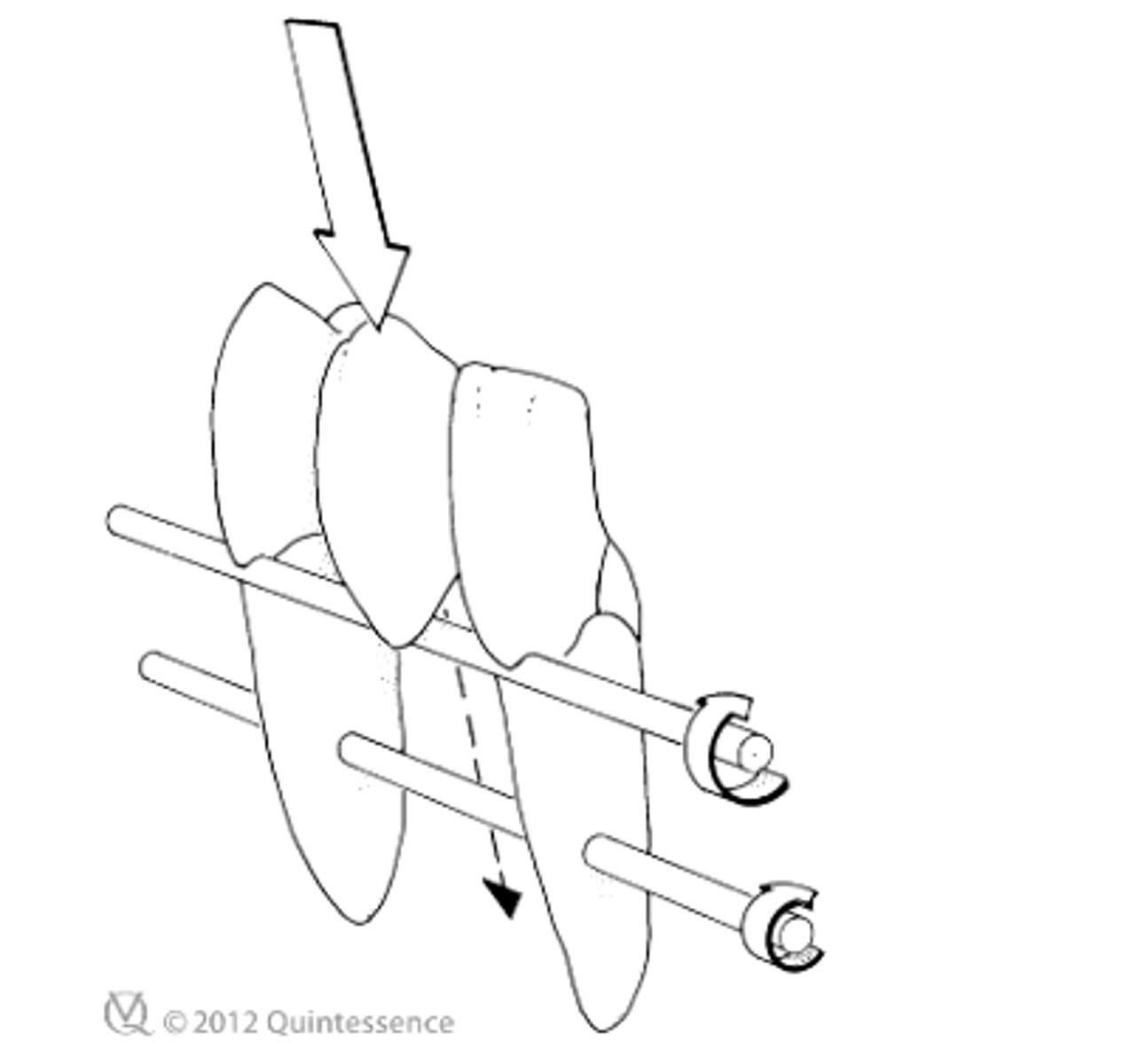
Forces are directed outward, and the pontic lies farther outside the interabutment axis
Why is the prognosis of replacing maxillary canine worse?
Teeth
Tooth position and alignment are maintained in part by the interaction between ________
True
T/F: When a tooth is removed or lost, adjacent teeth often migrate into the vacated space.
True
(Occlusion is properly restored by correction of the occlusal plane in conjunction with placement of a fixed partial denture)
T/F: If a fixed partial denture is fabricated without first re-establishing the occlusal plane, an occlusal interference may be created
Mesially -- there is a discrepancy between its long axis and that of a premolar
It is hard to place a 3 unit bridge if the mandibular molar tilts _________
Because the tooth distal to the fixed partial denture intrudes on the path of insertion
Why will this FPD not seat?
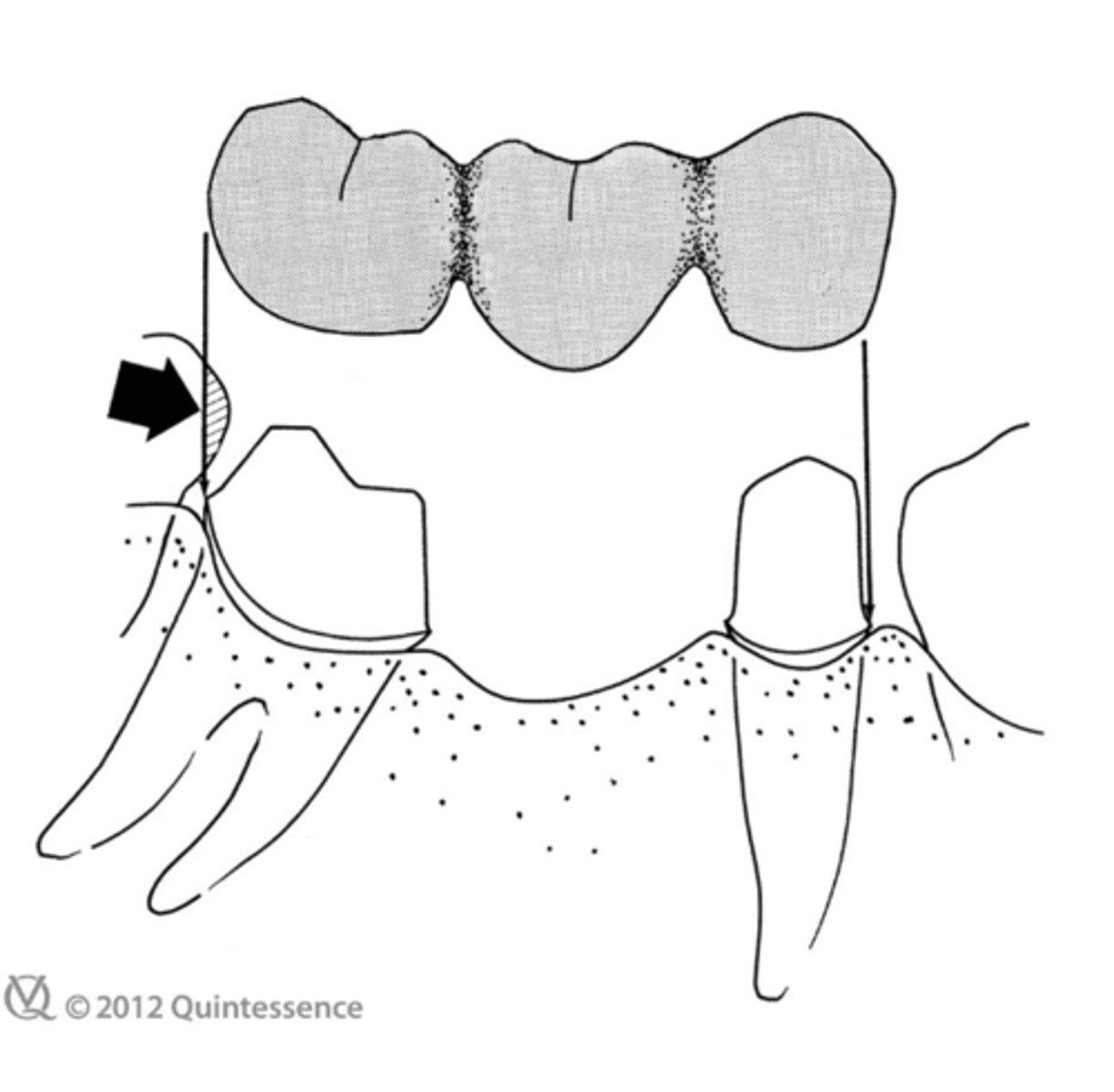
Every time you distalize the molar, you have to check the VDO and make any occlusal adjustments to establish a proper VDO
You can orthodontically upright a tilted molar from its mesial position. What will you have to consider when doing orthodontic treatment?
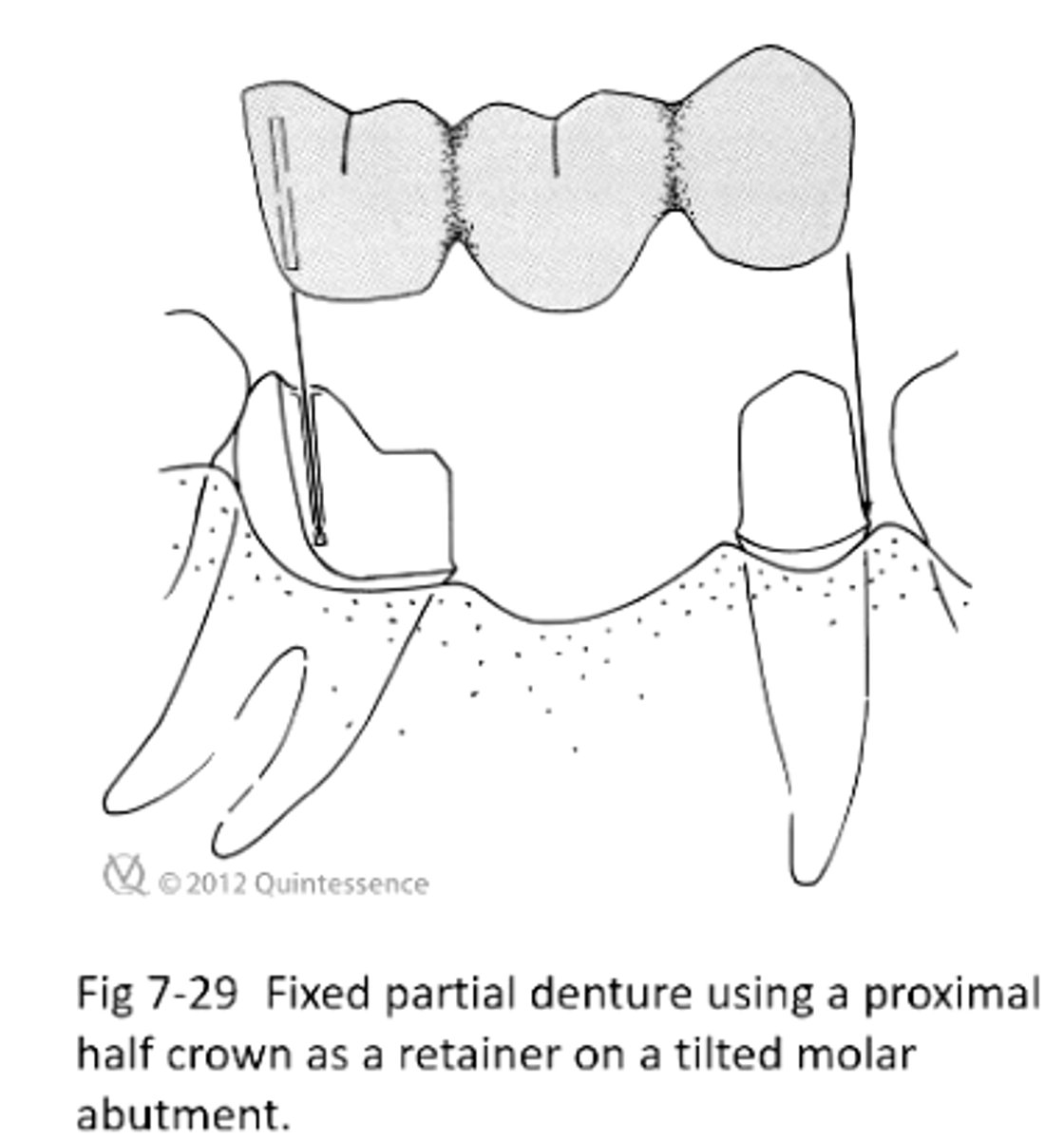
You can create a finish line to insert a proximal half crown as a retainer
What is another way you can compensate for a mesially tilted molar if you want to make a 3 unit bridge?
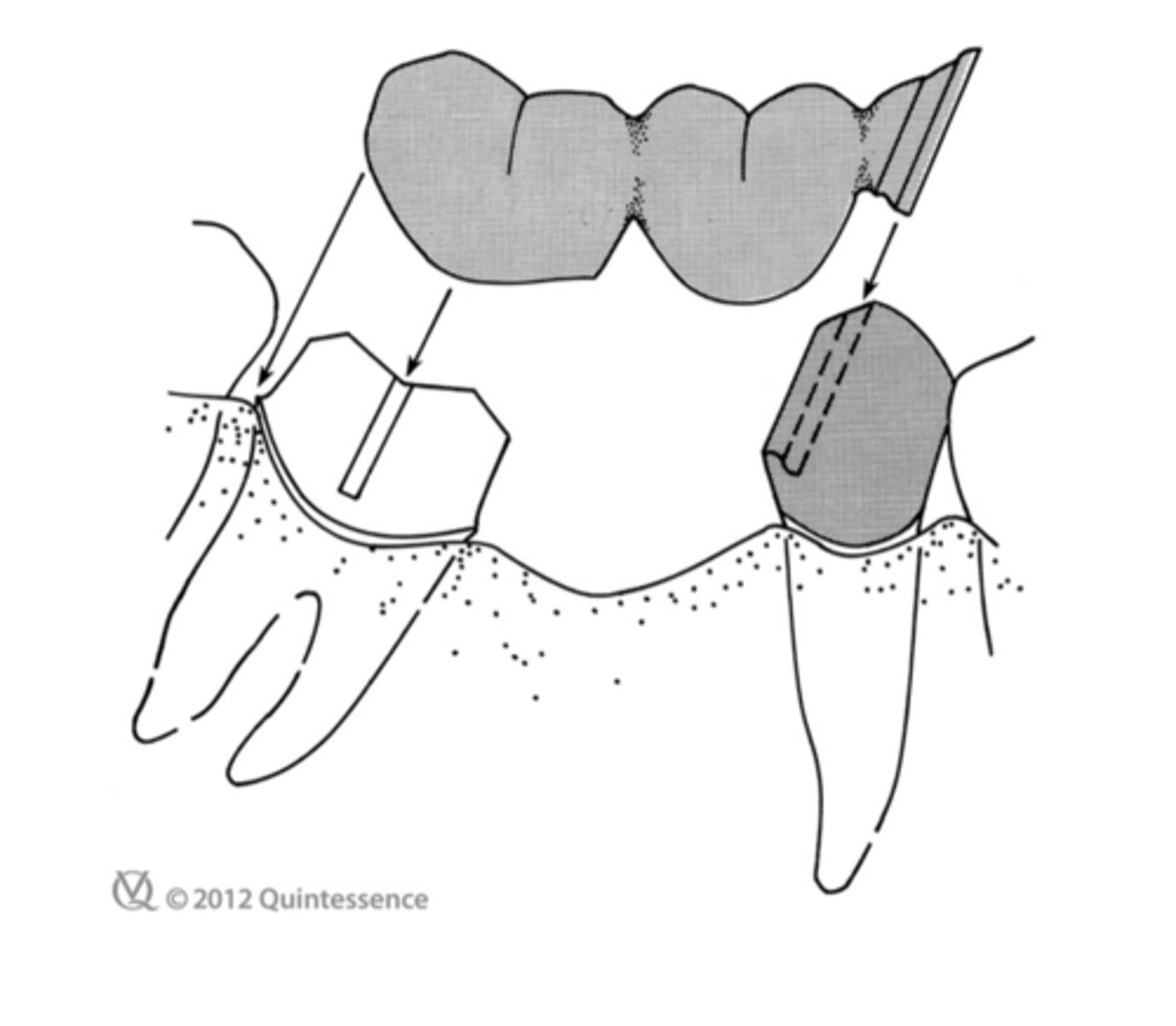
A nonrigid connector
What is on the distal aspect of the premolar retainer that compensates for the inclination of the tilted molar?
A) Maxilla
Intermediate (pier) abutments are usually done on the _________
A) Maxilla
B) Mandible
intermediate (pier) abutment
Define the following:
A non-rigid connector on the middle abutment to isolate forces to the segment of the FPD to which it is applied
Intermediate (Pier) Abutment
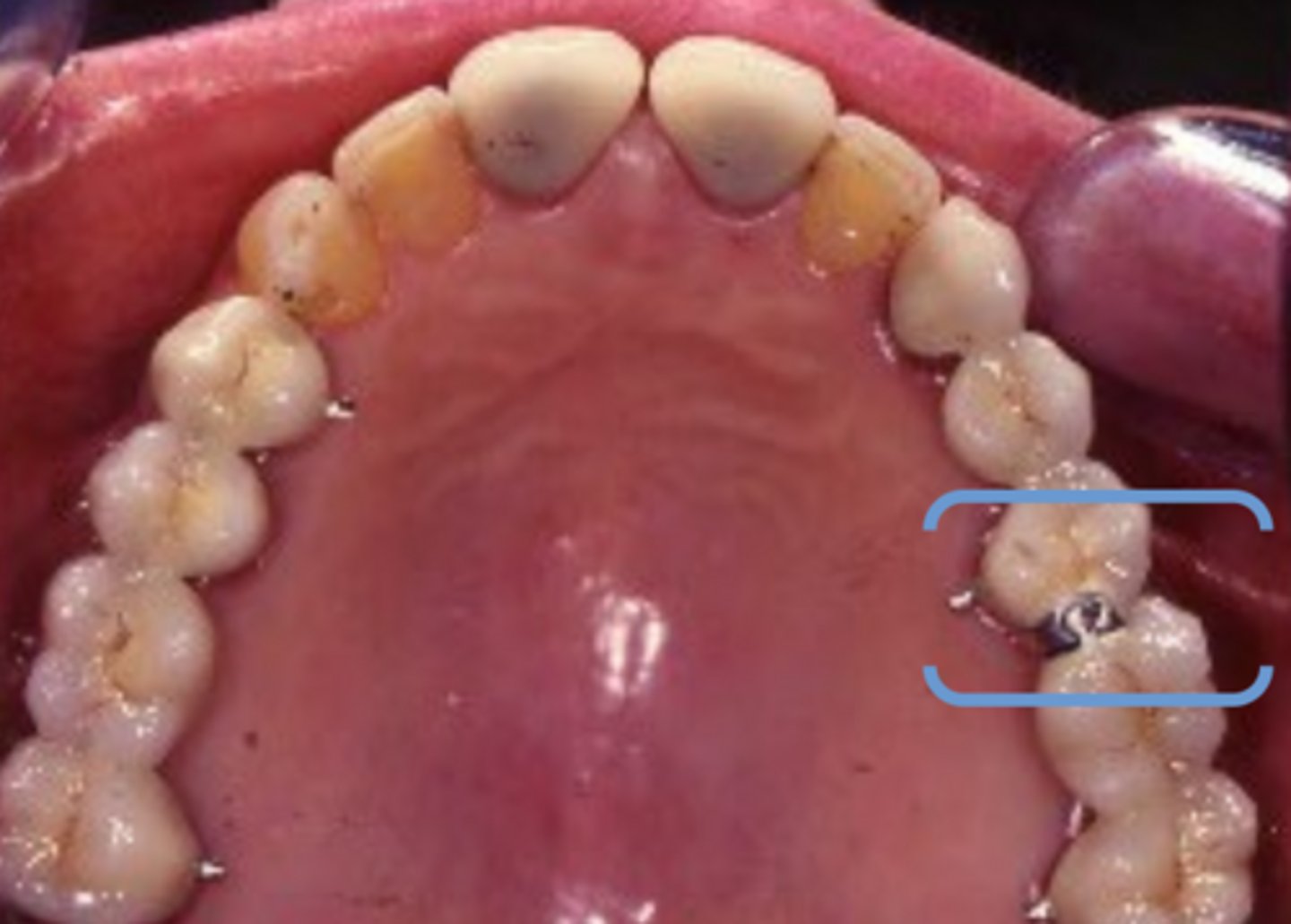
What is indicated in the blue brackets?