Lecture 21 - Gymnosperms
 Call Kai
 Learn
Learn Practice Test
 Spaced Repetition
 Match
Match Flashcards
 Knowt Play
1/34

There's no tags or description
Looks like no tags are added yet.
Name | Mastery | Learn | Test | Matching | Spaced | Call with Kai |
|---|
No analytics yet
Send a link to your students to track their progress
35 Terms
examples of gymnosperms
pine trees, firs, larches, junipers/cedars, redwood trees, bald cypress trees, and yew trees
redwood tree variations
Sequoia sempervirens and Sequoiadendron giganteum
yew tree reproductive structures
resemble fruits (berries) but are not fruits; derived from cone structures
gymnosperm evolutionary characteristics
share same characteristics as SLVPs, but don’t need water for fertilization and have seeds (LACK FRUITS)
only in Angiosperms
fruit
the seed coat
encloses embryo and nutritive tissues
endosperm
nutritive tissues
is the seed a GP or a SP
SP (all land plants are SP)
what material is the SP embryo embedded in?
In SLVPs, embryo is connected via placenta tissue to GP; while there is no placenta tissue in a mature seed, tissue surrounding the SP embryo is gametophyte tissue
how is the embryo formed?
if the embryo is SP, it is formed by fusion of gametes (fertilization) while results in a gamete.
where are gametes formed?
In SLVPs, archegonia and antheridia of GPs;
In seed plants, GP is extremely reduced.
Is GP bisexual?
all seed plants are heterosproous (can be either male or female)
gymnosperm seed anatomy
seeds grow on the surface of a scale in a cone (ex. pine cone)
ovuliferous scales
seed-bearing scales; seed develops from an ovule
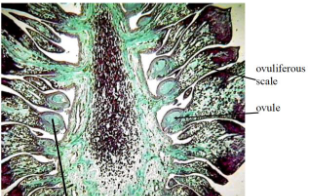
“gymnosperm”
“naked seed,” sit uncovered on the scale of a cone
pinus
female cone
seed
a mature ovule containing an embryo; embryo + stored food (GP) + seed coat
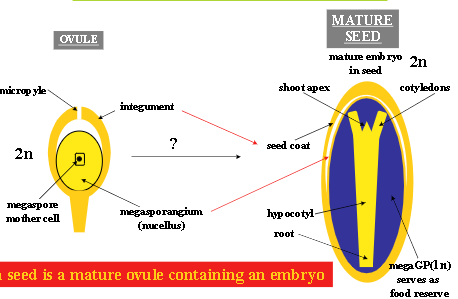
what does a seed consist of?
embryo embedded in nutritive endosperm tissue, which is encapsulated by the seed coat.
in simple terms…an embryo together with stored food packaged in a seed coat
what is the endosperm derived from?
gametophytic tissue
seed coat advantages
able to withstand adverse environmental conditions and represents a dormancy state
what is a seed derived from?
ovule; ovule develops into a seed
ovule (PART OF SP)
An immature ovule before meiosis consists of nucellus (= megasporangium) + megaspore mother cell + integuments.
seed plant life cycle
sporic meiosis
meiosis in ovule
formation of spores and gametophytes
integuments
develop into the seed coat
megaspore mother cell
produces a spore that will produce the megagametophyte (“mother” of the megaspore); diploid cell that will undergo meiosis to form four spores of which one is the ‘megaspore’
ovule AFTER meiosis
nucellus, gametophyte, and integuments
ALL spores
haploid and formed by meiosis
what about the other 3 spores?
They will disintegrate leaving only the megaspore behind.
megaspore
megaspore of gymnosperms will develop into the (mega-) gametophyte
how is reproduction different in SLVPs?
the (mega-)sporangium contains 'sporogenous tissue' with
multiple cells that undergo meiosis and produce multiple spores.
GYMNOSPERMS ONLY HAVE ONE CELL THAT UNDERGO MEIOSIS
spores in SLVPs
dispersal unit, released after meiosis
spores in gymnosperms
megaspore never leaves the megasporangium
advantages of seeds
fertilization independent of water, increases survival, can serve as dormancy state, growth of embryo is supported by food reserves stored in seed, dispersal using wind and animals is more effective than spores.
male GP in seed plants
transferred bodily to the female GP where it grows a pollen tube to bring the immotile sperm to the egg cell