LING: lesson 8 (non-Sinitic lang in China)
 Call Kai
 Learn
Learn Practice Test
 Spaced Repetition
 Match
Match Flashcards
 Knowt Play
1/27

There's no tags or description
Looks like no tags are added yet.
Name | Mastery | Learn | Test | Matching | Spaced | Call with Kai |
|---|
No analytics yet
Send a link to your students to track their progress
28 Terms
What is a language family?
a group of genetically related languages: share a linguistic kinship by virtue of having developed a common ancestor
proto-language → intermediate proto-language → daughter language
What is a language isolate?
a language with no known relatives
e.g. Ainu language
general geographic distribution of non-Sinitic languages in China
North & northwest:
Turkic (Xinjiang, Gansu, Qinghai)
Mongolic (Inner Mongolia,Qinghai, Gansu, part of the northeast)
Northeast:
Tungusic (also in Xinjiang)
Korean (Jilin, Liaoning, Heilongjiang)
South & southwest:
Kra-Dai (Guangxi, Guizhou, Yunan, Hainan)
Hmong-Mien (Guizhou, Hunan, Guangxi, Yunnan)
Yunnan & borderlands with mainland Southeast Asia:
Austroasiatic, connected to the broader mainland Southeast Asian linguistic area
Taiwan:
Austronesian (indigenous languages in Taiwan), extending into Island
Southeast Aisa, the Pacific, and Madagascar.
West & southwest:
Sino-Tibetan (Qinghai, Sichuan, Yunnan, parts of Guizhou, etc.
Sporadically spread: Indo-European, such as Tajik and Russian in the northwest and
northeast
What about Kra-Dai, Tai-Kadai, and Zhuangdong?
Kra-Dai and Tai-Kadai are outside of the Sino-Tibetan family (similarities are explained by old contact and borrowing)
Zhuangdong: similarities hint to potential genetic relationship
What is the debate on Altaic about?
60s: the Altaic hypothesis: Turkic, Mongol, and Tungusic languages can be grouped together in the Altaic language family
BUT critiques: similarities in typology (SOV, case marking, vowel harmony,….) are because of contact NOT genetic relationship
most recent: Transeurasian hypothesis: replaces Altaic and adds Korean end Japanese in this family → not widely accepted though
Debate on the classification of Koreanic:
Altaic hypothesis/ transeurasian hypothesis
Korea-Japonic hypothesis
Korean as a language isolate
Tibetic language distribution:
Tibet autonomous region
Qinghai
Gansu
Sichuan
Yunnan
Nepal
Bhutan
India
Pakistan
= linguistic Tibet
Writing system of Tibetan
syllabic writing system: syllable and phrase boundaries are marked, but there are no word boundaries
writing system did not change alongside phonetic change
Tibetan has a very important Buddhist textual tradition
Morphology of Tibetan:
case-marking system
aspect marking system
Case-marking system om Tibetan
absolutive: unmarked
agentive/ ergative: marks the agent of transitive verbs
instrumental: marks the instrument
genitive
dative
ablative
associative
aspect marking in Tibetan

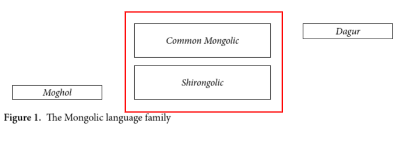
Mongolic language family
Mongolian writing systems:
Mongol script (11Th -12th c.): on the basis of Semitic alphabet
Written Oirat / “Clear Script”(1648): based on Written Mongol
“Old Script”: now used in Inner Mongolia, as decoration in Outer Mongolia.
Romanized “Buryat” (1930)
Cyrillic Buryat (1937)
Cyrillic Kalmuck (1930s)
Cyrillic Khalkha (1940s): Khalkha Mongolian as the standard spoken variety of the Republic of Mongolia
“New script”: now used in Outer Mongolia.
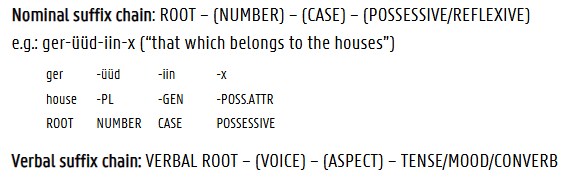
Mongolian agglutinative morphology
forms words by stringing together morphemes, each representing a grammatical meaning
Mongolian word order:
clause level: SOV
relative clause: prenominal and verb final
noun-phrase: modifier-head order (genitive/ adjective/ relative clause before noun)
case-marking/ postpositions: rather than prepositions
vowel harmony in Mongolian:
phonological process whereby vowels within a phonological domain must agree in one or more phonological features (height, backness, ATR, roundness,…)
→ suffix-vowels change according to vowels in the stem

Zhuang classification
Kra-Dai/ Tai-Kadai family
language contact and influence on Zhuang
long and intense contact with Chinese varieties and other languages of southern China and mainland SE Asia
→ typological similarities (SVO word order, tonal, monosyllabic)
great impact from migration
language corridor
writing system of Zhuang
borrowed standard Chinese graphs
new characters made out of Chinese graphic elements, radicals, phonetic graphs
never subject to standardization → variation
1957: alphabetical script based on Latin script
Zhuang word-order
clause level: SVO
noun-phrase: head-modifier order
preposition: few, most are derived from verbs and behave like coverbs
Wutunhua basics
ca. 4000 speakers
Tongren County, Huangnan Autonomous Prefecture, Qianghai
high degree of lexical and grammatical mixing: basic voc Sinitic, morphology and syntax have influences from Tibetic and Mongolic
Amdo Sprachbund Wutunhua
compromises 15-19 languages spoken in the Upper Yellow River Basin of Western China, in Eastern Qinghai and Southern Gansu Provinces
Four language families: Sinitic, Tibetic, Mongolic, and Turkic
Northwest Mandarin & Amdo Tibetan as dominant regional languages and lingua francas
Mongolic and Turkic languages spoken at a more local level
Many contact features of Wutun are also observed in other Sinitic languages of the region, and it is not always obvious whether the source language for these features is Tibetic or Mongolic because they share a number of morpho-syntactic features
genesis of Wutunhua
consensus: product of mixed marriages between partners from different linguistic groups, and long-term community bilingualism
mixed marriage between (two views):
Chinese soldiers sent to the area from other parts of China and local Tibetan and Mongolian women; Chen (1986) claims the similarities between the vowel systems of Wutun and the Old Nanjing dialect.
Local narratives: Tibetan soldiers settled in the Tongren area during the expansion of Tibetan empire during King Songtsen Fampo (605 - 650) and married local Chinese and Mongolian women
Wutun speakers adopted Tibetan Buddhism and use Amdo Tibetan as their lingua franca
lexical and grammatical features Wutunhua shares with other varieties of Mandarin
Basic vocabulary and grammatical forms
205 words in a 235-word list (based on Swadesh 200-word list) are always expressed by words of Sinitic origin (Janhunen et al. 2008)
Most grammatical morphemes of Wutun have their origins in Mandarin Chinese
Standard Negation
Negative prefixes: be- (negative particle bù 不) / mi- (negative particle méi 没) / bai-(prohibitive particle bié 別)
Verb-complement constructions
grammatical systems that display a blend of Chinese and Tibetan strategies in Wutunhua
Word order of the noun phrase
Demonstratives and adjectives can either preced the noun as in Sinitic or follow the noun as in Tibetic;
Aspect marking: possible to have multiple aspect marking
primary markers: perfective –lio (Sinitic origin), progressive –di (Sinitic origin), patient-oriented resultative –ma (unknown origin), prospective –zhe (Sinitic origin);
secondary markers: incompletive –la (Amdo Tibetan origin), completive –gu (Sinitic origin), agent-oriented resultative –she
Wutunhua grammatical features borrowed from Amdo Tibetan
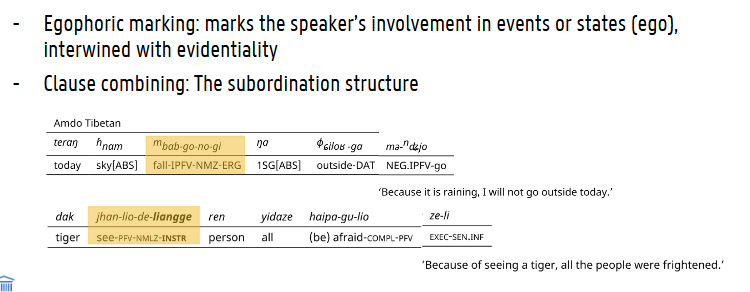
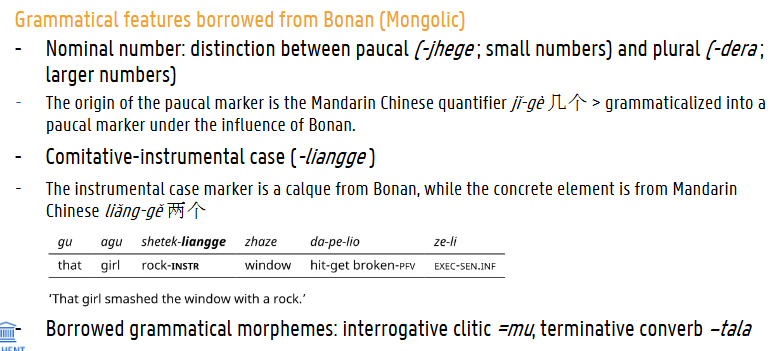
Wutunhua grammatical features borrowed from Mongolic
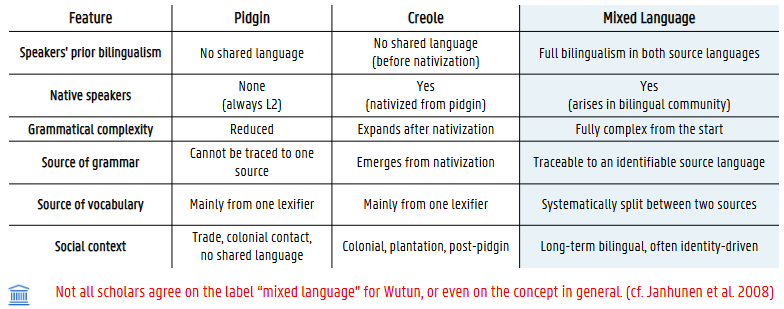
Contact Languages: Pidgins / Creoles / Mixed Languages & Where Wutun Hua Fits