GW BGZ 2024 Case 8 - Fit, fitter, fittest: family van Deursen goes active
 Call Kai
 Learn
Learn Practice Test
 Spaced Repetition
 Match
Match Flashcards
 Knowt Play
1/38

There's no tags or description
Looks like no tags are added yet.
Name | Mastery | Learn | Test | Matching | Spaced | Call with Kai |
|---|
No analytics yet
Send a link to your students to track their progress
39 Terms
What is physical fitness?
Physical fitness is the ability to perform daily activities efficiently without excessive fatigue and with enough energy for leisure and emergencies.
It includes:
Health-related fitness
Performance-related fitness
Physical fitness differs from:
Physical activity = any movement increasing energy expenditure
Exercise = planned physical activity
What are the health-related fitness components?
Health-related fitness focuses on overall health, daily functioning, and disease prevention:
Cardiorespiratory Endurance
Ability of the heart and lungs to supply oxygen during prolonged activity
Body Composition
Ratio of fat mass to lean mass
Muscular Strength
Maximum force a muscle or muscle group can produce
Very slow lift
Flexibility
Range of motion at joints
Muscular endurance
The ability of muscles to perform repeated contractions over time
What are the performance-related fitness components?
Performance-related fitness focuses on athletic ability and skill performance:
Isometric Strength
Ability to exert force without movement
Power
Ability to generate force quickly (strength + speed)
Speed / Agility
Speed: rapid movement
Agility: quick direction changes
Balance
Ability to maintain stability
Arm–Eye Coordination
Ability to synchronize visual input with movement
Reaction time
How quickly you respond to a stimulus
What are examples of exercises for health-related fitness components?
Cardiorespiratory Endurance
Running
Cycling
Swimming
Brisk walking
Rowing
Body Composition
Circuit training
Running + healthy nutrition
Resistance training
HIIT workouts
Muscular Strength
Heavy squats
Deadlifts
Bench press
Leg press
Very slow heavy lifts
Flexibility
Stretching routines
Yoga
Pilates
Dynamic stretches
Hamstring stretches
Muscular Endurance
Push-ups
Sit-ups
Planks
Bodyweight squats
Light-weight high-repetition training
What are examples of exercises for performance-related fitness components?
Isometric Strength
Wall sit
Plank hold
Isometric squat hold
Static lunge hold
Power
Box jumps
Sprint starts
Olympic lifts
Medicine ball throws
Jump squats
Speed / Agility
Sprint drills
Shuttle runs
Ladder drills
Cone drills
Zig-zag running
Balance
Single-leg stands
Balance board exercises
Yoga poses
Bosu-ball training
Arm–Eye Coordination
Catching drills
Tennis
Table tennis
Basketball passing drills
Reaction Time
Reaction ball drills
Sprint start practice
Goalkeeper drills
Partner clap/catch games
Why and how is physical fitness measured?
To assess:
Health
Performance
Functional ability
Disease risk
Rehabilitation progress
Different tests measure different fitness components.
The selection of tests depends on:
The component being evaluated
The purpose of testing (health screening, athletic performance, rehabilitation, epidemiology)
The population (children, adults, elderly, athletes, patients)
Validity, reliability, feasibility, and safety of the test
Field tests are practical, low-cost methods used in schools, communities, and large populations. Important qualities of these tests are objectivity, reliability, validity, and standardization. Big groups
Laboratory tests are conducted in a controlled environment, mostly within a lab, where conditions can be monitored and standardized. They often use specialized equipment for higher precision. Little groups
How can you measure body composition?
BMI
Skinfold thickness testing
Waist circumference and WHR
BIA
DEXA
Hydrostatic weighing
What is BMI?
BMI estimates body fat using height and weight.
Formula:
BMI=Body Mass (kg)/Height2(m2)
Categories:
<18.5 = underweight
18.5–24.9 = normal
25–29.9 = overweight
≥30 = obesity
The values are different for children.
What is skinfold thickness testing?
Measures subcutaneous fat using calipers.
Common measurement sites
Triceps
Subscapular
Suprailiac
Abdomen
Thigh
Chest
Midaxillary
Principle
Subcutaneous fat correlates with total body fat.
What is waist circumference and WHR?
Measures abdominal obesity and cardiometabolic risk.
WHR formula:
WHR=Waist Circumference/Hip Circumference
Interpretation
Higher values indicate greater abdominal fat distribution and increased health risk.
Common risk cutoffs:
Men: WHR > 0.90
Women: WHR > 0.85
What is Bioelectrical Impedance Analysis (BIA)?
BIA estimates body fat using electrical conductivity.
Lean tissue conducts electricity better than fat.
Bioelectrical Impedance Analysis (BIA) is a quick, noninvasive method used to estimate body composition. It works by sending a safe, imperceptible electrical current through the body.
What is DEXA?
Golden standard.
A DEXA (Dual-Energy X-ray Absorptiometry) body composition scan is a quick, non-invasive imaging test that accurately measures your exact ratio of fat, lean muscle and bone density.
DEXA measures:
Fat mass
Lean mass
Bone density
What is hydrostatic weighing?
Based on the fact that a person with more body fat will weigh less underwater because fat is less dense than water, while muscle and bone are denser and sink more.
How It Works
The person is weighed on land.
They are then submerged in water and weighed again while exhaling as much air as possible.
The difference between land weight and underwater weight determines body volume.
Body density is calculated: Body Density=Body Mass/Body Volume
Body fat percentage is estimated using equations such as the Siri equation: %Body Fat=(495/Body Density)−450
How can you measure cardiorespiratory fitness?
CPET
Åstrand Test
Borg RPE scale
Cooper 12-minute run test
Shuttle test
6-minute walk test
3-minute step test
1.5 mile walk test
Equation
What is VO2max and the Fick equation?
VO₂max is the maximal amount of oxygen consumed during intense exercise.
CO = VO2/CaO2-CvO2
VO2= Q×(a−vO2 difference)VO_2=Q\times(a-vO_2\ difference)VO2=Q×(a−vO2 difference)
Where:
CO: Cardiac Output (L/min).
VO2: Oxygen consumption/uptake (mL/min). Often estimated using a metabolic cart or by multiplying (125 mL/min/m^2) by body surface area.
CaO2: Oxygen content of arterial blood (mL of O2) per dL of blood).
CvO2: Oxygen content of mixed venous blood (mL of O2 per dL of blood).
VO₂max reflects integrated cardiovascular and muscular function.
What is CPET?
Gold standard assessment.
Measures
VO₂max
Ventilation
Heart rate
Respiratory exchange ratio
Anaerobic threshold
Equipment
Treadmill or cycle ergometer
Gas analysis system
What is the Åstrand test?
The Åstrand test is a submaximal cycling test used to estimate cardiorespiratory fitness and VO₂max (maximal oxygen uptake).
Purpose
Measures aerobic fitness and the efficiency of the cardiovascular and respiratory systems during exercise.
Procedure
Participant cycles on a cycle ergometer for 6 minutes
Constant cadence: usually 50 rpm
Workload is adjusted according to sex and fitness level
Heart rate is measured during exercise
VO₂max is estimated using workload and heart rate tables/nomograms
Physiological principle
Heart rate increases linearly with oxygen consumption during submaximal exercise.
What is the Borg RPE scale?
A subjective scale measuring exercise intensity.
Common scales:
6–20
0–10
What are the field tests for cardiorespiratory fitness?
Cooper 12-Minute Run
Distance covered in 12 minutes estimates aerobic fitness.
Shuttle Run / Beep Test
A running test with increasing pace until exhaustion.
6-minute walk test
Measures functional aerobic capacity.
Often used in: elderly, cardiac patients and pulmonary rehabilitation
3-Minute Step Test
Measures cardiovascular endurance using heart-rate recovery after stepping exercise.
Step up and down on a bench (usually 12 inches / 30 cm high) → standard cadence: 24 steps/min → duration: 3 minutes
Immediately after finishing, recovery heart rate is measured for 1 minute
1.5-Mile Walk/Run Test
Subject walks or runs 1.5 miles as fast as possible
Total completion time is recorded
Heart rate may also be measured
Estimation equation
VO2 max=88.02−(0.1656×Body Weight)−(2.76×Time)−(0.0638×Heart Rate)+(3.716×Sex)
Where:
Weight = kg
Time = minutes
Heart rate = bpm
Sex: male = 1, female = 0
How can you measure muscular strength?
1RM
Isometric dynamometry
Biodex machine
Electromyography
Manual muscle testing
Grip strength
What is a 1RM test?
Measures maximal weight lifted once.
Examples
Bench press
Leg press
Squat
Advantages
Gold standard dynamic strength measure
Limitations
Injury risk
Requires experience
Less suitable for elderly or patients
What is isometric dynamometry?
Measures muscle strength during a static contraction where the joint angle and muscle length remain constant
What is the Biodex machine?
The Biodex Medical Systems machine is an isokinetic dynamometer used to measure muscle strength, power, and endurance.
Controls movement speed throughout the range of motion
Measures:
Torque
Peak force
Power
Fatigue
Commonly used for:
Knee and shoulder testing
Rehabilitation
Sports performance
What is electromyography (EMG)?
Electromyography measures electrical activity produced by skeletal muscles.
Types Surface EMG
Electrodes placed on skin
Noninvasive
Needle EMG
Needle electrode inserted into muscle
More precise but invasive
Uses
Analyze muscle activation
Detect neuromuscular disorders
Study movement patterns
Evaluate rehabilitation progress
What is manual muscle testing (MMT)?
A clinical method used to assess muscle strength manually against resistance.
Procedure
Examiner applies resistance while patient contracts muscle
Strength graded on a scale from 0–5
What is grip strength testing?
Measures hand and forearm strength using a dynamometer.
Used to assess:
Functional ability
Frailty
Overall strength
What is the peak leg extension test?
The peak leg extension test measures maximal lower-body muscular strength, especially quadriceps strength.
Results are expressed in:
Newton meters (Nm)
Procedure
Participant performs maximal knee extension against resistance
A dynamometer measures peak torque/force
Interpretation
Higher Nm = greater muscular strength.
How can you measure muscular endurance?
Simple tests performed outside the laboratory to assess muscular strength and endurance.
Common Examples
Push-up test
Sit-up test
Pull-up test
Vertical jump test
Medicine ball throw
Purpose
Evaluate:
Functional fitness
Muscular endurance
Athletic performance
How can you measure flexibility? (field tests)
Sit-and-reach test
Measures flexibility of the:
Hamstrings
Lower back
Procedure
Subject sits with legs extended
Feet placed against a sit-and-reach box
Reach forward as far as possible
Shoulder flexibility test
Assesses shoulder joint and upper-body flexibility.
Common Method: Back Scratch Test Procedure
One hand reaches over the shoulder
Other hand reaches behind the back upward
Distance between fingers measured
Interpretation
Fingers overlapping = good flexibility
Large gap = reduced shoulder flexibility
Trunk rotation test
Measures rotational flexibility of the trunk and spine.
Procedure
Subject rotates trunk while seated or standing
Rotation angle or distance measured
Toe-touch test
Measures hamstring and lower back flexibility.
Procedure
Subject bends forward attempting to touch toes
Distance from fingertips to floor recorded
How can you measure flexibility? (laboratory tests)
Goniometry
Measures joint angle and range of motion using a goniometer.
Commonly Measured Joints: shoulder, knee, hip, elbow and ankle
Flexometer / Inclinometer
Measures spinal and joint movement angles electronically or mechanically.
Uses
Spine flexibility
Trunk motion analysis
Electrogoniometry
Electronic measurement of continuous joint movement during activity.
Features
Real-time ROM recording
Dynamic flexibility analysis
What are the different tests for cardiorespiratory fitness?
Test | Type | Measures | Advantages | Limitations |
|---|---|---|---|---|
CPET | Laboratory | VO₂max | Gold standard | Expensive |
Bruce treadmill test | Laboratory | Aerobic capacity | Diagnostic value | Maximal effort |
Cycle ergometer test | Laboratory | VO₂max | Safer | Lower VO₂max |
Cooper 12-min run | Field | Endurance | Simple | Requires motivation |
Shuttle run/beep test | Field | Aerobic power | Large groups | Coordination required |
6-minute walk test | Field | Functional capacity | Clinical use | Submaximal |
What are the different tests for body composition?
Test | Measures | Advantages | Limitations |
|---|---|---|---|
BMI | Weight relative to height | Simple | No fat/muscle distinction |
Waist circumference | Abdominal fat | Predicts cardiometabolic risk | Limited detail |
Skinfolds | Subcutaneous fat | Cheap | Tester dependent |
BIA | Fat percentage | Fast | Hydration sensitive |
DEXA | Fat/lean/bone mass | Highly accurate | Expensive |
Hydrostatic weighing | Body density | Accurate | Difficult procedure |
What are the different tests for muscular strength?
Test | Muscle group | Notes |
|---|---|---|
Handgrip dynamometry | Forearm/hand | Strong predictor of mortality |
1RM bench press | Upper body | Maximal dynamic strength |
1RM squat/leg press | Lower body | Athletic performance |
Leg extension dynamometry | Quadriceps | Used in the case |
Isokinetic dynamometry | Multiple | Precise laboratory assessment |
What are the different tests for muscular endurance?
Test | Measures |
|---|---|
Push-up test | Upper-body endurance |
Sit-up/curl-up test | Abdominal endurance |
Plank test | Core endurance |
Chair stand test | Functional endurance |
What are the different tests for flexibility?
Test | Region assessed |
|---|---|
Sit-and-reach | Hamstrings/lower back |
Shoulder flexibility test | Shoulder girdle |
Goniometry | Specific joint ROM |
Trunk rotation test | Spinal mobility |
How are reference values for fitness tests determined?
Researchers test a large representative population using the same standardized protocol.
They calculate:
Mean
Standard deviation
Percentiles
Results are grouped into categories such as:
Poor
Average
Excellent
For example:
A VO₂max test performed on a treadmill cannot be directly compared with a cycle ergometer test without accounting for protocol differences.
Strength measured with different joint angles or equipment may produce different values.
Flexibility scores vary depending on warm-up and stretching before testing.
→ Calculate back to the most neutral point, where other factors are accounted for. For VO2 max, you can value it as ml/min/kg, where the difference in weight is accounted for
Also, different methods of standardizing can be used:
Mean: mean score of a group can help standardize individual scores. Comparing individual against the group mean can indicate a relative performance
Raw score vs scaled score:
Raw is the actual measured value before adjustment
Scaled is after adjusting the raw score to account for influencing factors, making the comparison more meaningful
For the CPET it is more meaningful to value VO2 max on the lean body mass instead of total body weight → improves a more accurate reflection of aerobic capacity by accounting for muscle mass rather than fat mass.
How does sex influence physical fitness?
Men generally have:
Larger hearts
Greater blood volume
Higher hemoglobin levels
Larger lungs
This produces:
Higher stroke volume
Greater oxygen delivery
Higher aerobic capacity
Women generally have:
Smaller heart size
Lower hemoglobin concentration
Smaller lungs and airways
Higher body fat percentage
Effects:
Lower oxygen-carrying capacity
Lower absolute VO2 max
Lower maximal aerobic performance
However:
Women may have similar relative endurance performance when adjusted for body size
Often better fatigue resistance in some endurance tasks
How does age influence physical fitness?
Aging reduces most fitness components due to changes in the cardiovascular, respiratory, and muscular systems.
↓ VO₂max due to lower HRmax, stroke volume, and cardiac output
↓ Lung elasticity and oxygen exchange
↓ Lactate clearance and mitochondrial function
Sarcopenia → loss of muscle mass and strength (starts ~40 yrs)
↓ Flexibility from stiffer joints/connective tissue
↑ Fat mass and ↓ lean body mass
↓ Bone density with aging
Training can slow many of these declines.
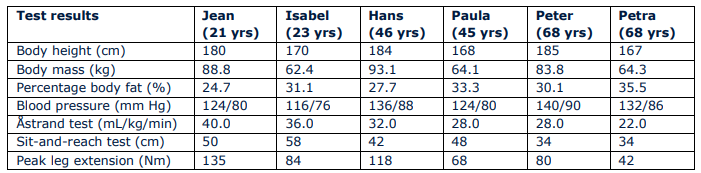
Explain the main findings in the fitness case.
Aerobic fitness declines with age, but Peter (68 yrs) had the same Åstrand score as Paula (45 yrs), suggesting good fitness for his age.
Men generally showed higher strength and aerobic capacity due to greater muscle mass and stroke volume.
Women showed higher body fat percentages and better flexibility.
Blood pressure increased with age; Peter had the highest BP (140/90).
Flexibility and strength declined in older participants due to aging and sarcopenia.
Peter maintained relatively good strength and aerobic fitness despite aging, likely from better training status/activity.