thalamus
 Call Kai
 Learn
Learn Practice Test
 Spaced Repetition
 Match
Match Flashcards
 Knowt Play
1/57

There's no tags or description
Looks like no tags are added yet.
Name | Mastery | Learn | Test | Matching | Spaced | Call with Kai | Chat |
|---|
No analytics yet
Send a link to your students to track their progress
58 Terms
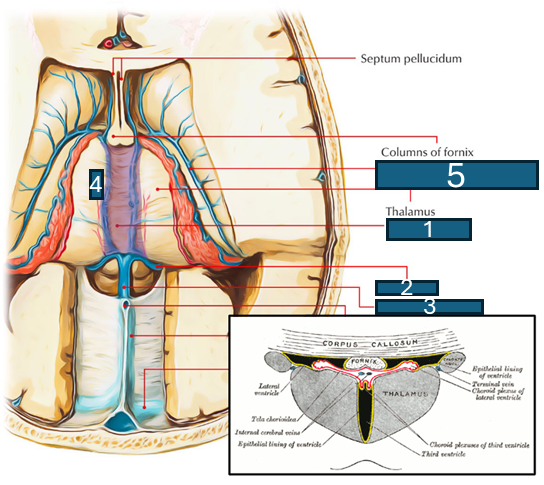
tela choroidea, choroid plexus, III, internal cerebral veins
regions of meningeal pia that adhere to underlying ependyma. gives rise to ____ ____ in all ventricles. two leaves form roof of ____. houses the _____ _____ ____
specific nuclei
reciprocally connected with specific cortical areas - maintenance of spatial organization of inputs - information rich
non-specific nuclei
diffuse and multimodal sensory inputs, diffuse and largely non-reciprocal innervation of cortex, strong reticular input
VPL
input from spinothalamic and DCML tracts - somatosensory for limbs and trunk - somatotopy preserved
pain and temperature
____ ___ _____ information has diffuse projections throughout thalamus, particularly VPL and medial/midline groups, some information also reaches cortex without going through thalamus
postcentral gyrus (S1)
output of VPL
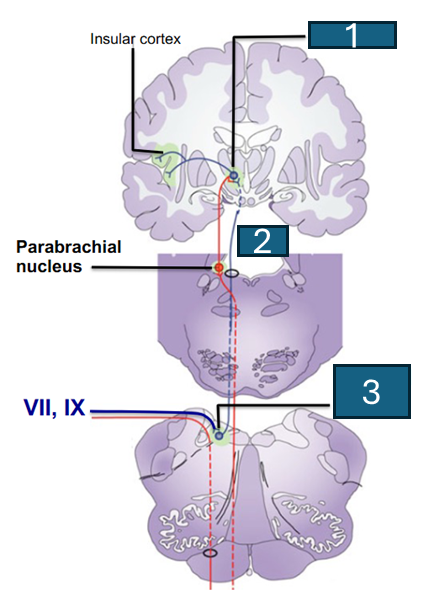
VPM, parvicellular, taste, NTS
input from trigeminothalamic system - somatotopy preserved - medial (______) portion receives _____ information from ____
dorsal longitudinal fasciculus
tract for taste information between NTS and VPMpc
postcentral gyrus (S1) and anterior insula
outputs of VPM and VPMpc
LGN, contralateral
receives visual input via optic tract representing ______ visual field, arranged in 6 crude laminae
V1, calcarine, cuneus, lingual
LGN output - on bands of _____ fissure, which is between what two gyri?
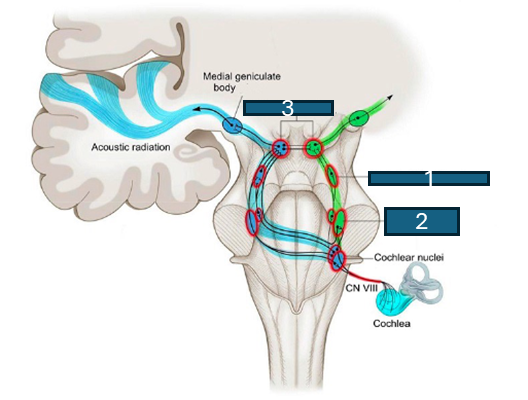
MGN, inferior colliculus
receives auditory input from ______ _____ - tonotopy preserved
A1, Heschl’s, sublenticular
MGN output: ____ in _____ gyrus. connected via auditory radiations (_______ part of internal capsule)
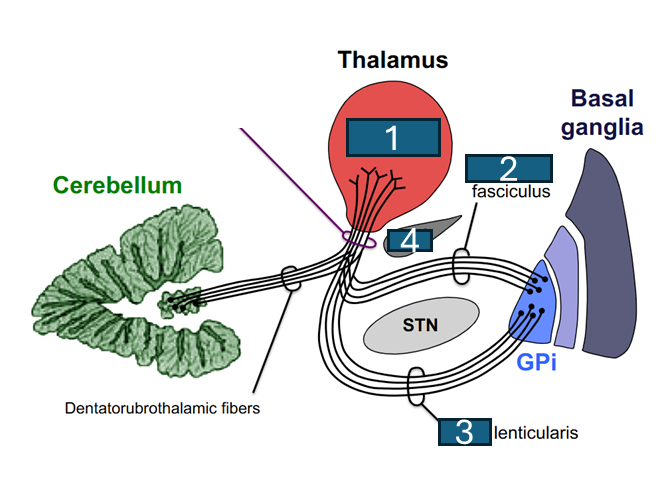
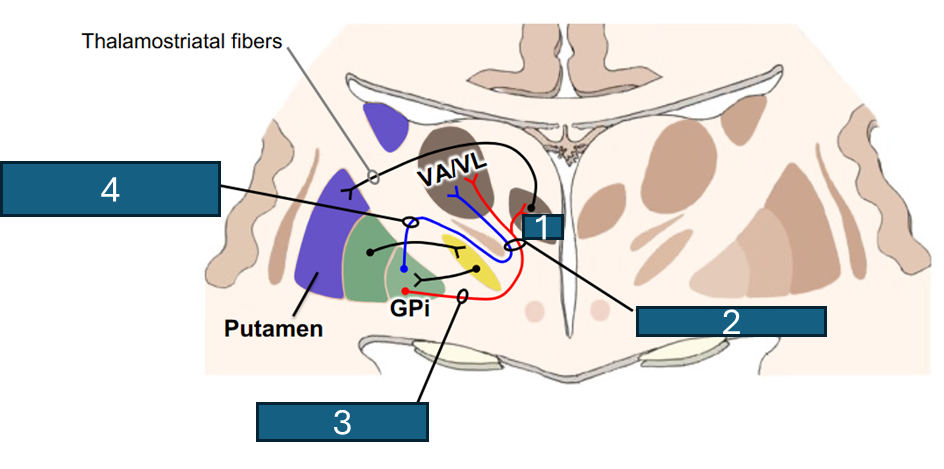
VA, thalamic fasciculus, SNr
receives inhibitory input from ipsilateral basal ganglia via ______ _____. lateral GPi, medial ____
VL, dentatorubrothalamic, thalamic fasciculus
receives input from basal ganglia and crossed output of cerebellar deep nuclei (________ pathway) via _____ _____
zona incerta
thalamic fasciculus is between the thalamus and the _____ _____
VA
outputs are premotor cortex and frontal eye fields
VL
output is M1 in precentral gyrus
contra, ipsi
basal ganglia disease is ____-lateral and cerebellar disease is ____-lateral
MD
most developed thalamic nucleus in humans, inputs from amygdala, olfactory cortex, ventral pallidum
MD
projects to PFC and limbic system
MD
lesions here result in apathy, memory changes, and difficulty in switching tasks (perseveration)
pulvinar
facilitates complex integration of stimuli across sensory domains
pulvinar
inputs from retina, superior colliculus, and indirectly from spinothalamic
LP
acts in concert with pulvinar
pulvinar
lesions affect visual perception, pain perception, and language processing
anterior
input from hippocampus via fornix and mammillary bodies via mammillothalamic tract
anterior
reciprocally connected with cingulate cortex
LD, parietal, retrosplenial
acts in concert with anterior thalamus, but is specifically connected with ____ and ____ cortex
spatial, context, memory, AUD, Korsakoff, vitamin B
anterior, LD, mammillary bodies, fornix, mammillothalamic tract, cingulate and retrosplenial cortices —> neural system for _____ and _____-dependent _______
degenerative changes in anterior and mammillary bodies found in chronic _____ —> ______ syndrome (due to _____ __ deficiency)
amnesia, confabulation, apathy
three signs of Korsakoff syndrome/Wernicke encephalopathy
midline
receive pain-related information from PAG, ascending arousal cholinergic inputs, and monoaminergic (NA, 5-HT) inputs
midline
output - diffuse to cortex and striatum, reciprocally connected with SCN, may be involved in general cortical arousal
intralaminar group/CM
non-reciprocal input from motor cortex, strong cholinergic input from AAS
output to striatum
CM, intralaminar
lesions here, the largest of the ______ group, lead to unilateral motor neglect
thought to be involved in attention to motor tasks
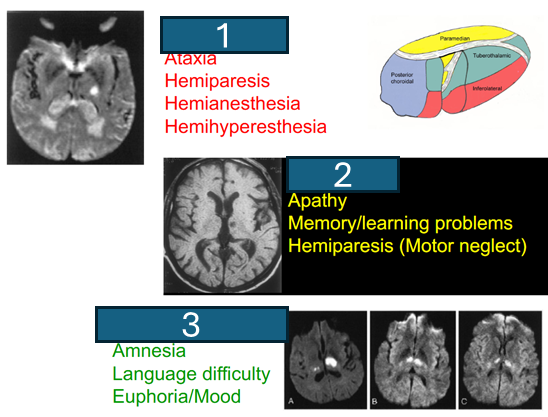
paramedian, Percheron
blood supply to medial thalamus, can be a variant artery of ______ in which one vessel irrigates both halves
posterior choroidal
blood supply to posterior thalamus
inferolateral
blood supply to lateral thalamus
tuberothalamic
blood supply to dorsolateral thalamus
inferolateral
infarct —> ataxia, hemiparesis, hemianesthesia, hemihyperesthesia
paramedian
infarct —> apathy, memory/learning problems, hemiparesis
tuberothalamic
infarct —> amnesia, language difficulty, euphoria/mood
inferolateral, Deferine-Roussy, hyperesthesia
various signs and symptoms in patients with central thalamic pain - usually secondary to vascular etiology involving _____ perforators
hemiataxia, hemitremor, hemichorea, hemianesthesia 2 point touch, exaggerated pain and temperature
what it is called (2 names)
tela choroidea, basal vein, Galen, ICV, thalamostriate
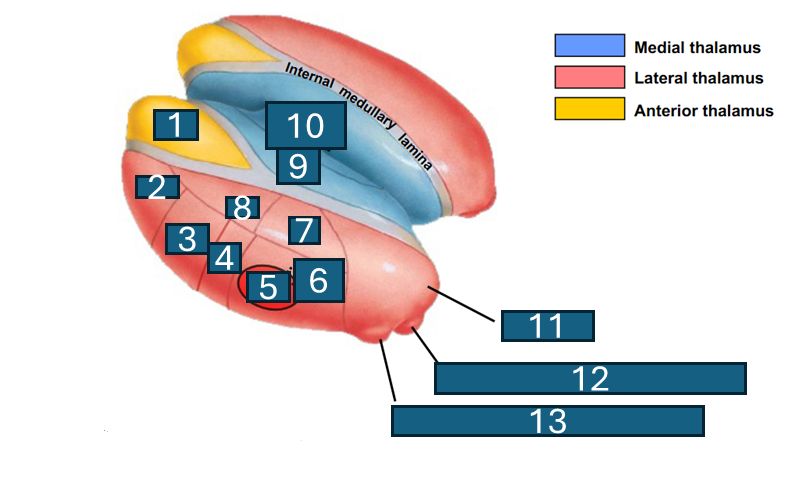
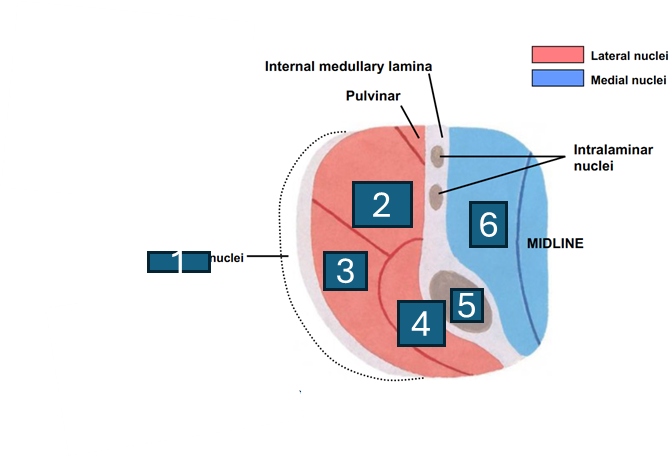
anterior, VA, VL, VPi, VPL, VPM, LP, LD, MD, midline, pulvinar, MGN, LGN
VPMpc, DLF, rostral NTS
VA/VL, lenticular, ansa, zona incerta
lateral lemniscus, superior olive, inferior colliculi
reticular, LP, VPL, VPM, CM, MD
fornix, pulvinar, mgn, lgn, hippocampus
fornix, MD, LP, CM, VPM, VPMpc, VPL
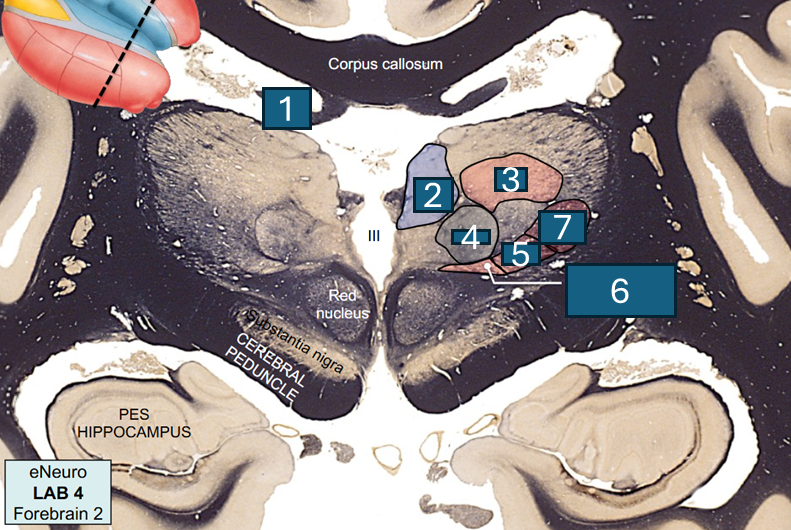
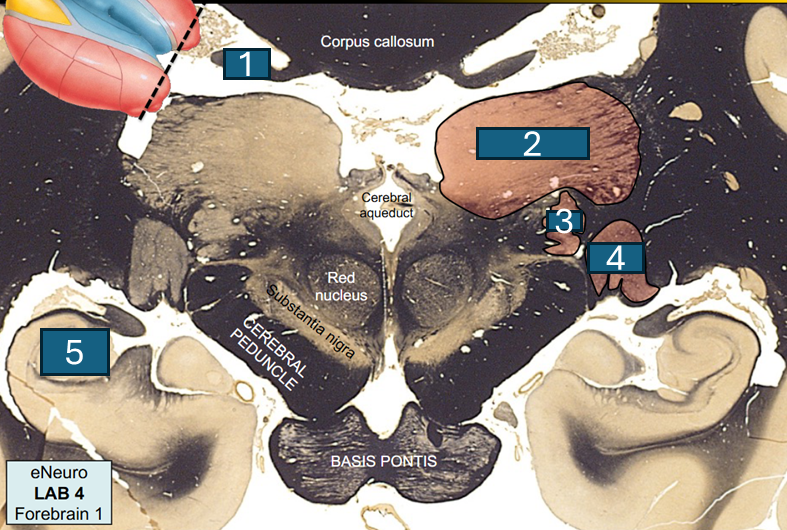
corpus callosum, midline, MD, LD, VL, internal capsule, amygdala, putamen
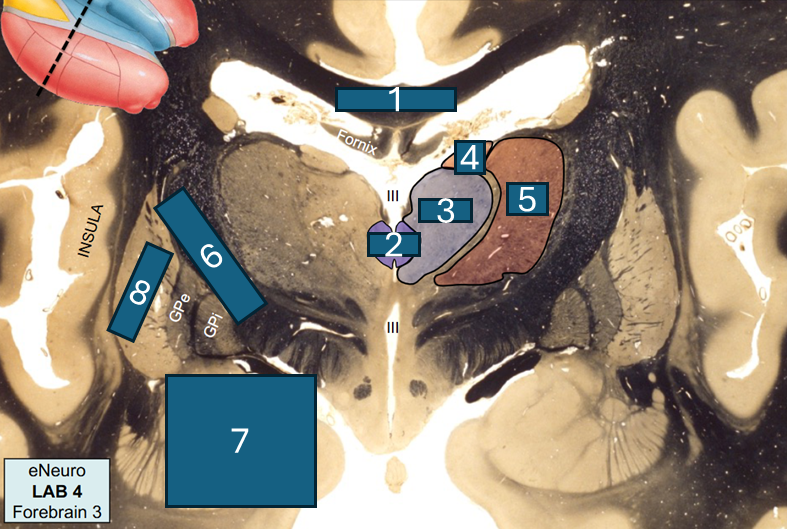
NAc, globus pallidus, AN, VA, anterior commissure
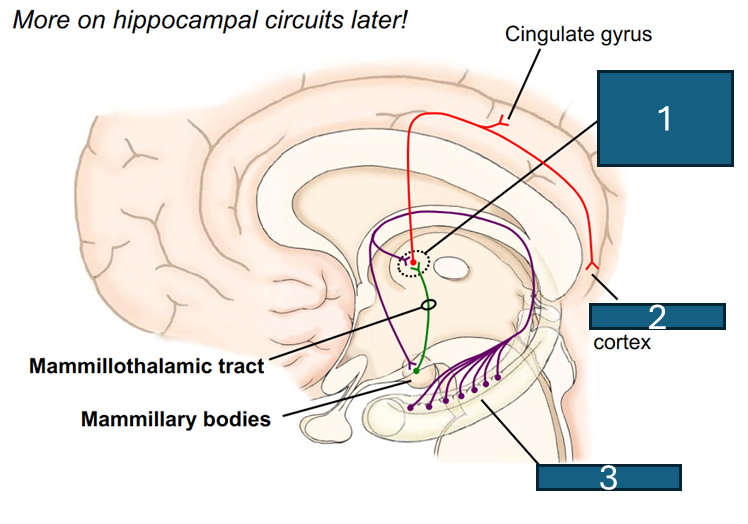
anterior thalamus, retrosplenial, hippocampus
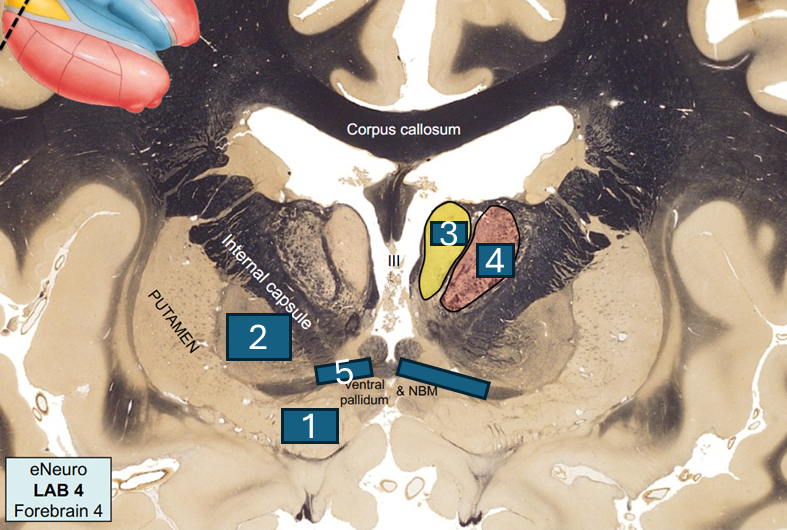
CM, thalamic fasciculus, ansa lenticularis, lenticular fasciculus
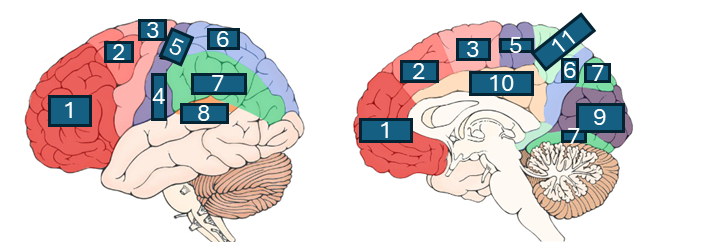
MD, VA, VL, VPM, VPL, LP, pulvinar, MGN, LGN, anterior, LD
posterior choroidal, paramedian, tuberothalamic, inferolateral
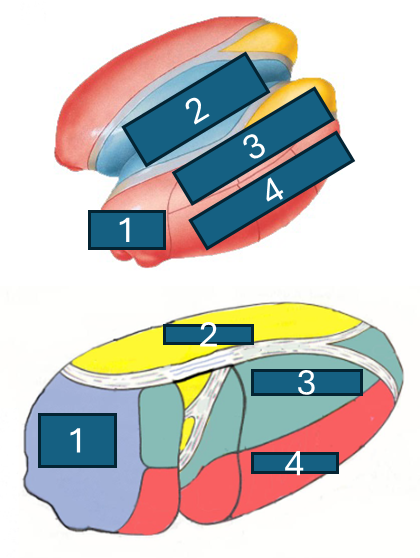
inferolateral, paramedian, tuberothalamic