Genetic Material and Cell Signaling Flashcards
 Call Kai
 Learn
Learn Practice Test
 Spaced Repetition
 Match
Match Flashcards
 Knowt Play
1/73

Earn XP
Description and Tags
Flashcards covering key concepts in genetics, DNA structure, replication, expression, and cell signaling, structured for quick study.
Name | Mastery | Learn | Test | Matching | Spaced | Call with Kai |
|---|
No analytics yet
Send a link to your students to track their progress
74 Terms
How is genetic material organized in the nucleus?
DNA, nucleosomes, chromatin, chromosomes (condensed in mitosis)
What is DNA made of?
Nucleotides = phosphate + deoxyribose sugar + nitrogen base
What does antiparallel mean?
DNA strands run opposite directions (5’→3’ and 3’→5’)
What is noncoding DNA?
introns, repetitive sequences and regulatory regions that do not code for proteins
How do you find a complementary strand?
Tight, Off. Loose, On
What is chromatins structure
Loosely packed DNA
What is a chromosome?
Condensed DNA (visible in mitosis)
chromatin contains what
proteins + dna
What is a replication origin?
Site where DNA replication begins
What is a telomere?
Repetitive DNA at chromosome ends (protects DNA)
What are sister chromatids?
Identical copies of a chromosome
How is chromatin structure altered?
Chromatin remodeling + histone modification
How are DNA strands held together?
Hydrogen bonds between bases
___ melts faster than _____ because AT contains only 2 hydrogen bonds, while GC contains 3
AT, GC
What is a nucleosome?
DNA wrapped around histone proteins
Which DNA is transcriptionally active?
Euchromatin
What did Griffith prove with his experiment?
He discovered transformation — that genetic information can be transferred between bacteria, turning harmless cells into harmful ones.
What is a Barr body?
Inactive X chromosome in a females nucleus ensuring only one X is active
What is semiconservative replication?
Each new DNA has one old strand + one new strand
helicase _____, primase _________, and ligase ___________
unwinds, primes RNA, joins okazaki fragments
What is telomerase?
Enzyme that extends telomeres
What is depurination?
Loss of A or G base in dna
What is deamination?
Cytosine turns into uracil
What are thymine dimers?
UV-caused covalent bonds between T bases
__________ repair fixes errors in one DNA strand.
Mismatch
What is homologous recombination?
Accurate repair using sister chromatid
What is nonhomologous end joining?
Quick repair but error-prone
What happens if repair fails?
Diseases like cancer
When can nonhomologous end joining occur?
Any stage (but less accurate)
What are the steps of PCR?
Denaturation, annealing, extension
template strands are used to make _____ . the coding strand is the same as _____
RNA, RNA T → U
DNA is ____ stranded and has ______. RNA is ______ stranded and has _____.
double, deoxyribose. single, ribose
What is the difference between RNA polymerase and DNA polymerase?
RNA polymerase doesn’t need primer
Coding RNA includes ______. Noncoding RNA includes _______.
mRNA. tRNA, rRNA.
transcription in prokaryotes happens in the _______ while transcription in eukaryotes happens in the ______
cytoplasm, nucleus
What modifications does eukaryotic mRNA undergo?
5′ cap added (protects mRNA + helps ribosome bind), Poly-A tail added (stability + export from nucleus),
Splicing (removal of introns, joining exons)
What is gene expressions flow to get the final product? (protein)
going from DNA to RNA to protein
what is alternative splicing?
Different combinations of exons are joined to make different mRNAs after introns are spliced out
genetic code can be considered redundant because multiple __________ code for the same __________.
codons, amino acid
codons code for ________ and anticodons code for ____________
mRNA, tRNA
What is 'charged' tRNA?
tRNA attached to an amino acid
What is the function of ribosomes?
Makes proteins
What are the steps of translation?
Initiation, elongation, termination
What are initiation factors and release factors?
Start translation, stop translation
How do you predict codon and anticodon?
Use base pairing rules
Why is cell signaling important?
Respond to environment + coordinate functions
the type of cell signaling that includes paracrine signaling and synaptic signaling
local signaling
What are the steps of the signaling pathway?
Reception → transduction → response
Why do cells respond differently to signals?
Different receptors/proteins
What are major receptor types?
GPCR, RTK, intracellular
intracellular receptors have _______ signals, while surface receptors have ________ signals
hydrophobic signals, hydrophilic
What is signal amplification?
Small signal → large response
Why is it necessary to turn off signaling?
Prevent overactivation
What is an example of turning off signaling?
Dephosphorylation or ligand removal
What is the Ras pathway?
RTK → Ras → MAP kinase → gene expression
What happens if signaling mutates?
Can cause cancer/uncontrolled growth
What did Hershey and Chase prove?
They proved that DNA is the genetic material, not protein, using bacteriophages labeled with radioactive DNA and protein.
endocrine signaling is an example of what type of signaling
long distance signaling
the notch receptor pathway is an example of what type of signaling
direct contact
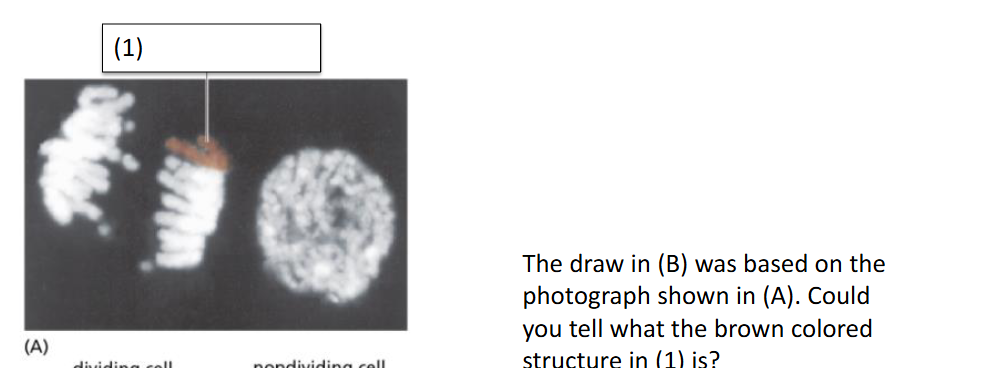
What is the brown structure (1) in a dividing cell image?
A condensed chromosome
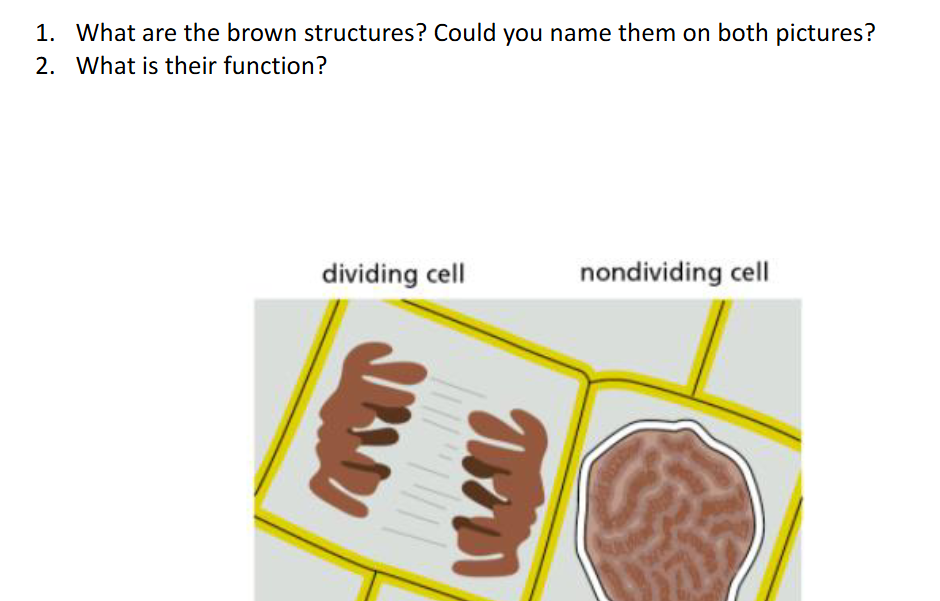
1. What are the brown structures? Name them in both pictures:
2. What is their function?
Dividing cell: Chromosomes (condensed DNA, clearly visible)
Nondividing cell: Chromatin (loose, uncondensed DNA)
they both store and transmit DNA
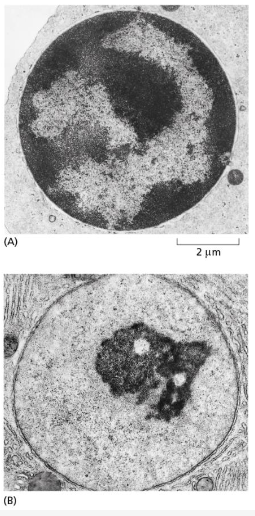
which cell is transcribing more of its genes and why?
B because its lighter, meaning its not condensed, meaning transcription is active
One nucleosome is composed by
eight histone proteins, 2X H2A, H2B, H3 and H4
Who discovered the double-helix structure of DNA?
James Watson, Francis Crick and Wilkins and Franklin
Could you predict which of these DNA sequences will most
likely be part of replication origins?
A. 5’-ATTAAGTAAAACTTAA-3’
B. 5’-GGCGCGCTGCCCGAC-3
A because A-T are weaker than G-C
Telomerase is fully active in ________ cells because they ________, while it is not active in neurons because they ________.
actively dividing (stem), replicate DNA repeatedly and need to maintain telomeres, do not divide.
what would you expect from a eukaryote lacking telomerase?
a reduction of chromosome lengths in gametes
True or false, Neither Okazaki fragments, nor telomeres are found in prokaryotic DNA
true
it wouldn’t be better if dna polymerase III made no mistakes because it would likely __________ and require more energy. small mutations are _______ for genetic variation
slow replication, require more energy. beneficial.
when does homologous recombination most often occur?
shortly after a cells dna has been replicated before cell division because a sister chromatid is available as a template
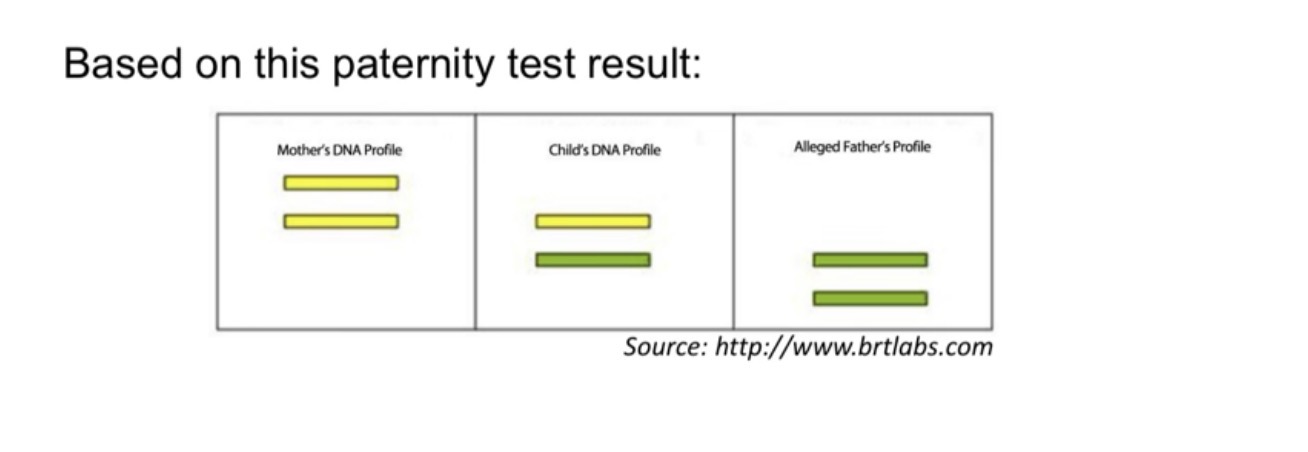
based on this paternity test result:
paternity is not excluded
How does a ribosome know where to start and stop protein synthesis
Specific Codons in an mRNA
true or false, The ligands that bind intracellular receptors can be hydrophobic and a gas.
true
Testosterone is a ________ ________.
hydrophobic lipid.
it is a steroid hormone that can diffuse through membranes