Chap 11 - Decision Making
 Call Kai
 Learn
Learn Practice Test
 Spaced Repetition
 Match
Match Flashcards
 Knowt Play
1/22

There's no tags or description
Looks like no tags are added yet.
Name | Mastery | Learn | Test | Matching | Spaced | Call with Kai |
|---|
No analytics yet
Send a link to your students to track their progress
23 Terms
Decision making
The process of developing a commitment to some course of action
Problem
A perceived gap between an existing state and a desired state
Well-structured problem
A problem for which the existing state is clear, the desired state is clear, and how to get from one state to the other is fairly obvious
Program
A standardized way of solving a problem
Ill structured problem
A problem for which the existing and desired states are unclear and the method of getting to the desired state is unknown
Perfect rationality
A decision strategy that is completely informed. perfectly logical, and oriented toward economic gain
Bounded rationality
A decision strategy that relies on limited information and that reflects time constraints and political considerations
Framing
Aspects of the presentation of information about a problem that are assumed by decision makers
Cognitive biases
Tendencies to acquire and process information in an error prone way
Why use groups?
Decision quality
Decision acceptance and commitment
Diffusion of responsibility
Groups make higher quality decisions than individuals
Diffusion of responsibility
The ability of group members to share the burden of the negative consequences of a poor decision
Why is decision quality improved in groups?
Groups are more vigilant
Groups can generate more ideas than individuals can
Groups can evaluate ideas better than individuals can (due to checks)
How do groups make higher quality decisions than individuals?
Group members differ in relevant skills and abilities, as long as they do not differ so much that conflict occurs
Memory for facts is an important issue
Individual judgements can be combined by weighting them to reflect the expertise of various members
Disadvantages of group decision making
Time
Conflict
Domination
Groupthink
Groupthink
The capacity for group pressure to damage the mental efficiency, reality testing, and moral judgment of decision making groups
Groupthink symptoms
Illusion of invulnerability (members are overconfident and willing to assume great risks so they ignore obvious danger signals)
Rationalization
Illusion of morality
Stereotypes of outsides
Pressure for conformity
Self censorship
Illusion of unanimity
Mindguards (members may adopt the role of “protecting” the group from info that goes against its decision)
Devil’s advocate
A person appointed to identify and challenge the weaknesses of a proposed plan or strategy
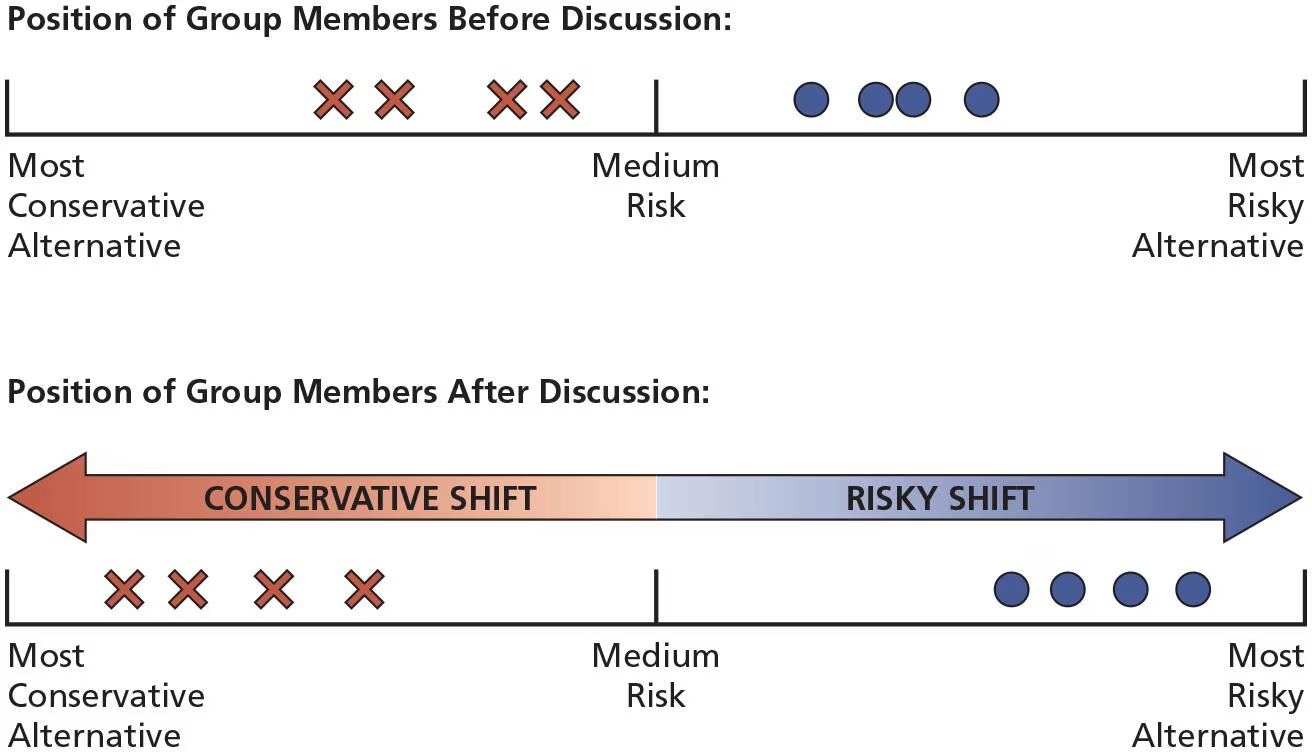
Risky shift
The tendency for groups to make riskier decisions than the average risk initially advocated by their individual members
The dynamics of risky and conservative shifts for two groups
Group discussion generates ideas and arguments that individual members have not considered before (this info naturally favours the members’ initial tendency toward risk or toward conservatism)
Group members try to present themselves as basically similar to other members but “even better”
Evidence based management
Making decisions through the conscientious, explicit, and judicious use of the best available evidence from multiple sources
Crowdsourcing
Outsourcing aspects of a decision process to a large collection of people
Analytics
Finding meaningful patterns in large datasets
Big data
Copious amounts of information that are often collected in real time and can come from a wide variety of sources, particularly digital