Psychology
 Call Kai
 Learn
Learn Practice Test
 Spaced Repetition
 Match
Match Flashcards
 Knowt Play
1/48

Earn XP
Description and Tags
Chapters 13,14, 15, 16
Name | Mastery | Learn | Test | Matching | Spaced | Call with Kai |
|---|
No analytics yet
Send a link to your students to track their progress
49 Terms
in a prisoner's dilemma, mutual cooperation leads to ________benefit to ______ cooperator(s)
moderate; both
What is Groupthink?
A decision-making process in highly cohesive groups where the desire for harmony and agreement overrides realistic evaluation of alternatives, often leading to poor decisions.
Agreement becomes more important than being right.
What is Altruism?
Behavior that is intended to help another person without expectation of personal reward, and sometimes at personal cost.
Helping others even when it costs you.
What is deindividuation?
A psychological state in which individuals lose self-awareness and self-restraint in group situations, leading to impulsive or antisocial behavior.
“Lost in the crowd.”
Common triggers:
Anonymity
Large groups
Darkness or uniforms
Heightened arousal
Classic examples:
Riots, online trolling, mob behavior
What is Kin selection?
The evolutionary tendency to help genetic relatives survive and reproduce, even at a personal cost, because they share your genes.
Helping family helps your genes survive.
People are more likely to help close relatives than strangers.
_____ is the tendency for group discussions to focus on info that all members share.
Common knowledge effect
What is common knowledge effect?
Information that is known by all members of a group and that everyone knows is shared among them.
What is Social loafing?
The tendency for individuals to put in less effort when working in a group than when working alone.
what is group polarization?
The tendency for a group’s initial attitudes or opinions to become more extreme after group discussion.
What is diffusion of responsibility??
the tendency to feel diminished responsibility for one’s actions when surrounded by others who are acting the same way.
what is the bystander effect?
the tendency for people to be less likely to help a stranger in an emergency situation when other bystanders are present.
In 2017, almost _____ Canadians had experienced at least one end of a marriage or common-law relationship.
3 in 20
Compare Passionate love with Companionate love
passionate love
an experience involving feelings of euphoria, intimacy, and intense sexual attraction
begins to cool within a few months
companionate love
an experience involving affection, trust, and concern for a partner’s well-being
can grow slowly yet steadily over years
social factors, such as the frequency with which one is approached with sexual intentions and the higher reputational costs associated with sex, _____ women's sexual selectivity.
increase
Which three factors are related to our attraction to good genes?
Symmetry: Facial and bodily symmetry signals healthy development and resistance to disease, making it a cue to genetic fitness.
Body Shape: Certain body proportions (such as waist-to-hip ratio) are associated with fertility and reproductive health.
females - increased estrogen —> hour-glass shape
males - increased testosterone —> triangle shape
Age: Younger age is linked to greater reproductive potential and likelihood of producing healthy offspring
what is the fundamental attribution error?
the tendency to ignore a person's situation and to focus on that person's disposition(personality) as an explanatory cause of behaviour.
what is behavioural confirmation?
The tendency for people to behave in ways that confirm others’ expectations about them.
What is cognitive dissonance?
A state of psychological discomfort that occurs when a person holds conflicting beliefs, attitudes, or behaviors, motivating them to change one of them to reduce the discomfort.
“I did something that doesn’t match my beliefs — now I need to justify it.”
Classic examples
Hazing / tough initiation:
Someone goes through a painful initiation, then convinces themselves the group is amazing to justify the effort.Spending money:
You buy something expensive that turns out disappointing, but you tell yourself it was a great purchase.Health behavior:
A smoker knows smoking is harmful but rationalizes it (“My grandfather smoked and lived to 90”).
What does cortisol do?
A hormone released by the adrenal glands during stress that helps mobilize energy, increase blood sugar, and prepare the body to respond to challenges.
the body’s main stress hormone.
Chronic high cortisol levels are associated with:
Weakened immune system
Weight gain (especially abdominal)
High blood pressure
Cardiovascular disease
Memory and concentration problems
Short-term cortisol is helpful; long-term cortisol is harmful.
What causes burnout?
high stress + high responsibility + emotional exhaustion
A state of emotional, physical, and mental exhaustion caused by prolonged stress, often characterized by fatigue, cynicism, and reduced effectiveness at work.
What is an archetype??
A universal, symbolic pattern or image that appears across cultures and represents common human experiences or roles.
The hero, the caregiver, the wise elder, the villain.
what is catharsis?
The release of strong emotions through expression, leading to emotional relief.
Crying, venting, or expressing anger in a safe way.
What is reframing?
To change the way you interpret a situation in order to see it in a more positive or manageable light.
Instead of thinking “This is a disaster,” thinking “This is a challenge I can handle.”
what is a mantra?
A word or phrase that is repeated to focus the mind, promote calmness, or reinforce positive thinking.
Repeat a phrase to steady your mind.
what is malingering?
The deliberate faking or exaggeration of physical or psychological symptoms for external gain.
Faking illness for a reward.
what is group therapy?
organized around a shared issue or goal — in this case, anger management — so members can:
Learn from each other’s experiences
Practice coping strategies together
Provide mutual support and accountability
Explain the psychodynamic approach to therapy
explores childhood events
encourages individuals to use the understanding gained from the exploration to develop insight into their psychological problems
What are MAOI’s?
an antidepressent intoduced in 50’s
commonly called iproniazid - originally used to treat tuberculosis
prevent monoamine oxidase from breaking down neurotransmitters such as:
norepinephrine
serotonin
dopamine
Describe deep-brain stimulation (DBS)
treatment in which a battery-powered device implanted in the brain delivers electrical stimulation to reduce symptoms of disorders like Parkinson’s disease.
What does RDoC stand for?
Research Domain Criteria
Explain the RDoC model
research domain criteria
A research framework developed to classify mental disorders based on underlying psychological and biological systems rather than traditional diagnostic categories.
focuses on brain systems and behavior, not labels like depression or anxiety.
The core constructs emphasized in RDoC
Biological (genes, brain circuits)
Cognitive (thinking, attention, memory)
Behavioral (observable actions)
What is DSM?
Diagnostic and Statistical Manual of Mental Disorders
The official handbook used by mental health professionals to diagnose and classify psychological disorders based on standardized criteria.
Explain Generalized Anxiety Disorder (GAD)
persistent, excessive anxiety and worry without a specific trigger, often accompanied by restlessness, sleep problems, and difficulty concentrating.
What is social phobia?
aka social anxiety disorder
intense fear of embarrassment or negative evaluation in social situations, leading to avoidance of those situations.
Describe the hippocampus in relation to PTSD
Smaller hippocampus → greater risk for PTSD
The hippocampus is a brain structure involved in:
Memory formation
Processing fear and stress
Regulating the stress response
which neurotransmitters are linked to depression, as shown by the effectiveness of medications that raise their levels?
serotonin and norepinephrine
What is the Diathesis-stress model??
Suggests a person may be predisposed to a psychological disorder that remains unexpressed until triggered by stress
diathesis = internal predesposition
brain structure, hormones, early learning, memory bias, genes
stress = the external trigger
abuse
onset of physical illness
traumatic even
loss
inheritable but may not be triggered
a person may not inherit a diathesis, yet, given the right circumstances, may come to suffer from a psychological disorder
What are psycological disorders caused by??
Three things
biological factors
genes
brain structure
hormones
Psychological factors
learning
perceptions
memory
Social factors
support
environment
culture
COmpare the 4 depressive disorders
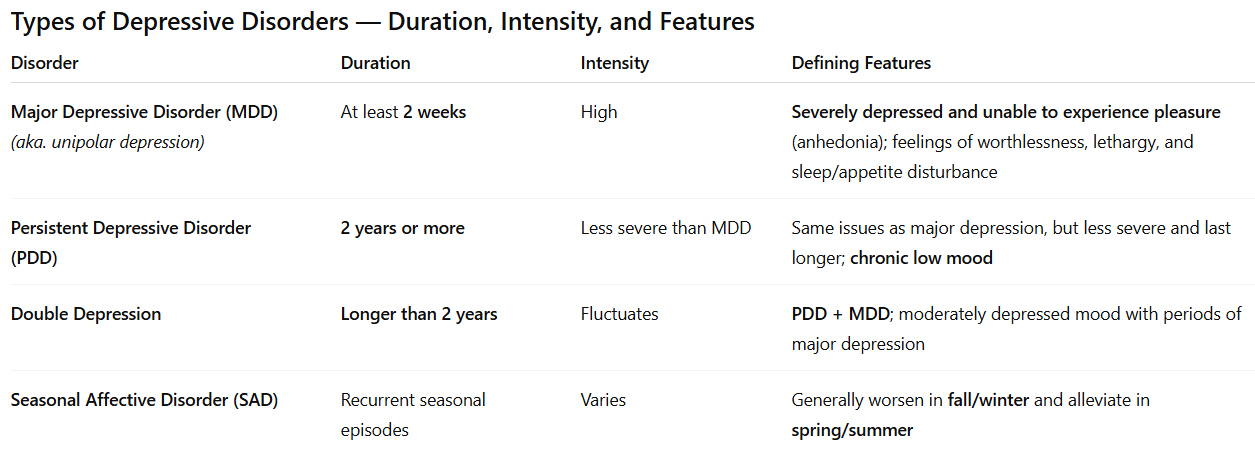
List the 4 depressive disorders
Major Depressive disorder (unipolar depression)
Persistent depressive disorder
double depression
seasonal affective disorder (SAD)
How many people in canada and the US meet the criteria for depression at some point in their life??
1 in 9
Explain Cognitive Dissonance and provide examples
occurs when beliefs and behaviors conflict, and people are motivated to reduce the discomfort by changing their thoughts, behaviors, or justifications.
Core idea:
People are motivated to maintain consistency between their thoughts and actions.
When inconsistency occurs, it creates tension or anxiety.
Individuals try to reduce this discomfort.
Ways people reduce cognitive dissonance:
Change behavior (e.g., quit smoking)
Change beliefs/attitudes (e.g., decide smoking is not very harmful)
Rationalize or justify behavior (e.g., “Many people smoke and live long lives”)
examples
knowing smoking is bad —> smoking anyway because Gramps lived to 95
hazing/rituals to join fraternities or other groups
purchasing an item because it’s has personal value vs. valuing an item because you paid for it
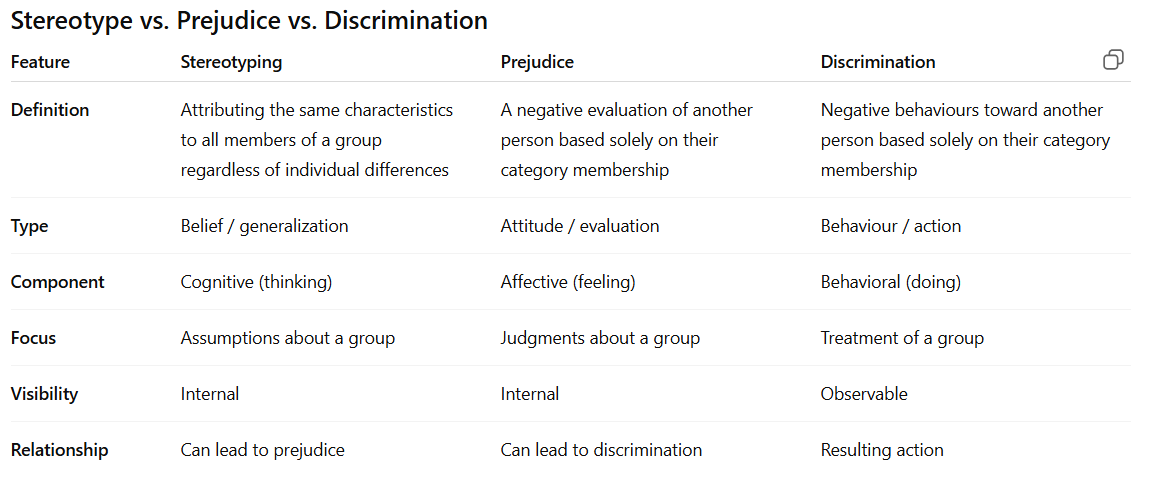
Compare stereotype, prejudice and discrimination
Memory hook:
Stereotype thinks → Prejudice feels → Discrimination acts
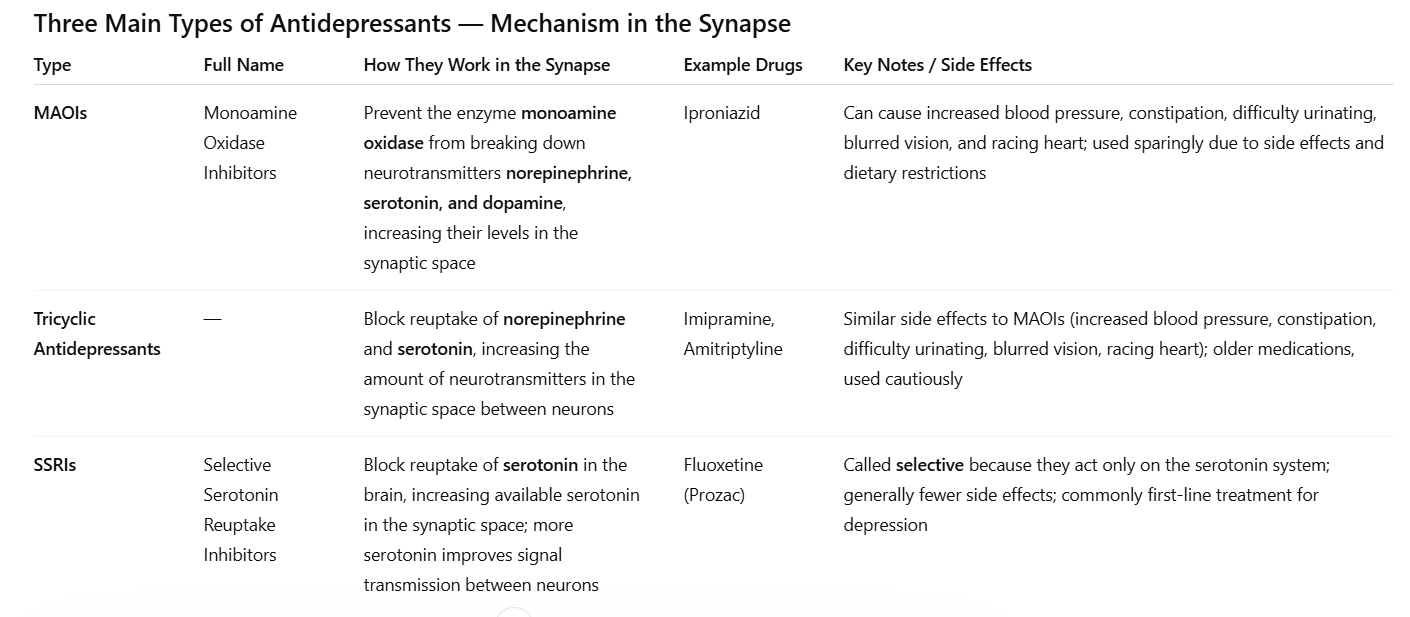
Describe the three main antidepressants and how they work in the synapse
MAOIs - inhibit breakdown of norepinephrine, serotonin, and dopamine
Tricyclic antidepressants - block reuptake of serotonin and norepinephrine
SSRIs - block reuptake of serotonin
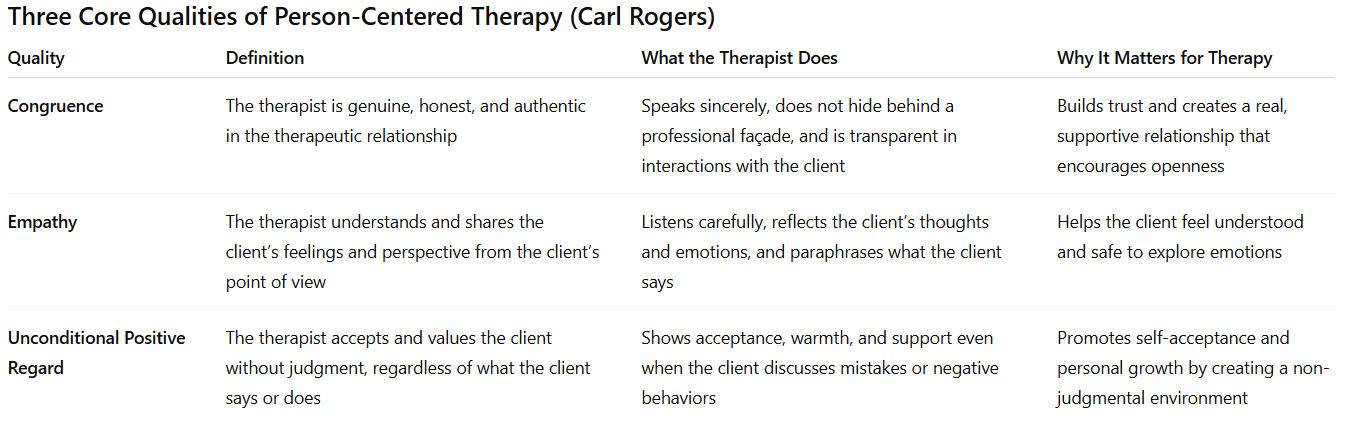
Explain the core qualities of person-centered therapy. (three points)
What is burnout?
state of physical, emotional, and mental exhaustion resulting from long-term involvement in an emotionally demanding situation and accompanied by lowered performance and motivation
particular problem in the helping professions: teachers, nurses, doctors, police, EMS
overwhelming exhaustions, detachment from job, sense of ineffectiveness and lack of accomplishment
higher rates of depression and anxiety
often become disgruntled employees who revel in coworkers’ failures and ignore their coworkers’ successes
Burnout is reduced by balance and recovery, not by working more.
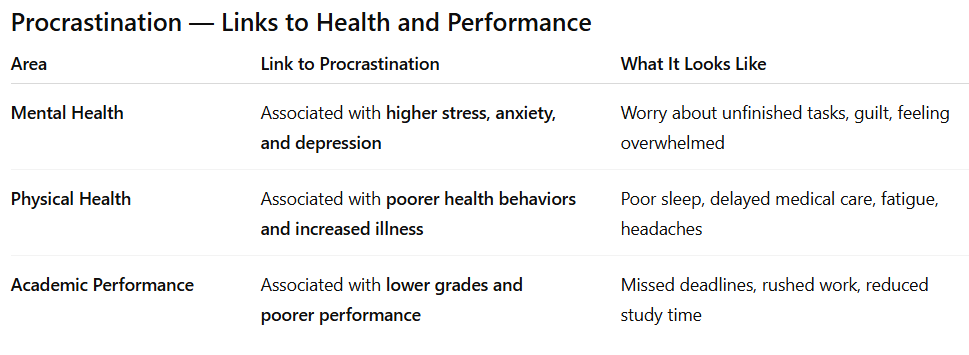
Procrastination—know link to mental health, physical health, and academic performance
Explain Preparedness theory
Preparedness theory proposes that humans are biologically predisposed to develop certain fears more easily because those fears promoted survival throughout evolution.