A-Level Edexcel Physics Waves (Excluding Quantum)
 Call Kai
 Learn
Learn Practice Test
 Spaced Repetition
 Match
Match Flashcards
 Knowt Play
1/65

There's no tags or description
Looks like no tags are added yet.
Name | Mastery | Learn | Test | Matching | Spaced | Call with Kai |
|---|
No analytics yet
Send a link to your students to track their progress
66 Terms
Progressive Wave
- Transfers energy
- Wave shape moves
- Neighbouring points have the same amplitudes
- Neighbouring points have 2πd / λ phase difference
- Has no nodes
Mechanical Waves
Waves that pass through a medium e.g. seismic waves and sound (not light)
Amplitude (A)
Maximum displacement from the equilibrium position (of the particles)
Frequency (f)
Number of complete oscillations per second (number of complete waves formed per second)
Period(T)
Time for one complete wave oscillation (1 complete wave form)
Period = 1/frequency
Wavelength(λ)
Distance between two consecutive points that are in phase on a wave
The Wave Equation
v =fλ
V = Wavespeed (ms-1)
f = Frequency (Hz)
λ = Wavelength (m)
Radians
Used as an alternative unit for measuring angles (57.3 degrees)
- 1 complete circle = 2π radians
- Half a circle = π radians
- 1 complete oscillation = 2π radians
- Half a oscillation = π radians
Calculating Radians
Radians → Degrees = Multiply by 180, divide by π
Degrees → Radians = Multiply by π, divide by 180
Phase Difference
The fraction of a cycle between two coherent waves measured in radians.
- Phase difference = (2xπxd) / λ
- Where d = distance between 2 points
- Where λ = wavelength
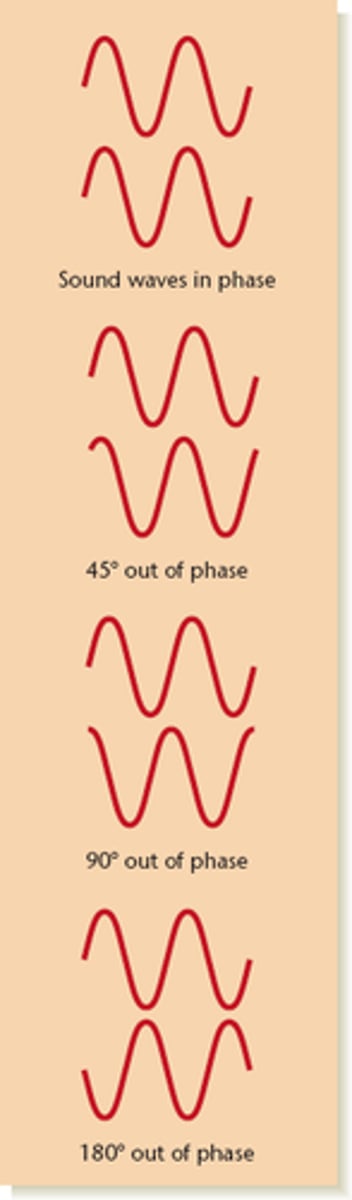
In phase or not?
If a point on a wave is 2π radians ahead of another then it will be on phase, anything that is a factor of this 360 degrees such as 720 degrees is completely in phase. if not a whole number factor of this then it is not in phase, and if it is 180 degrees it is completely out of phase.
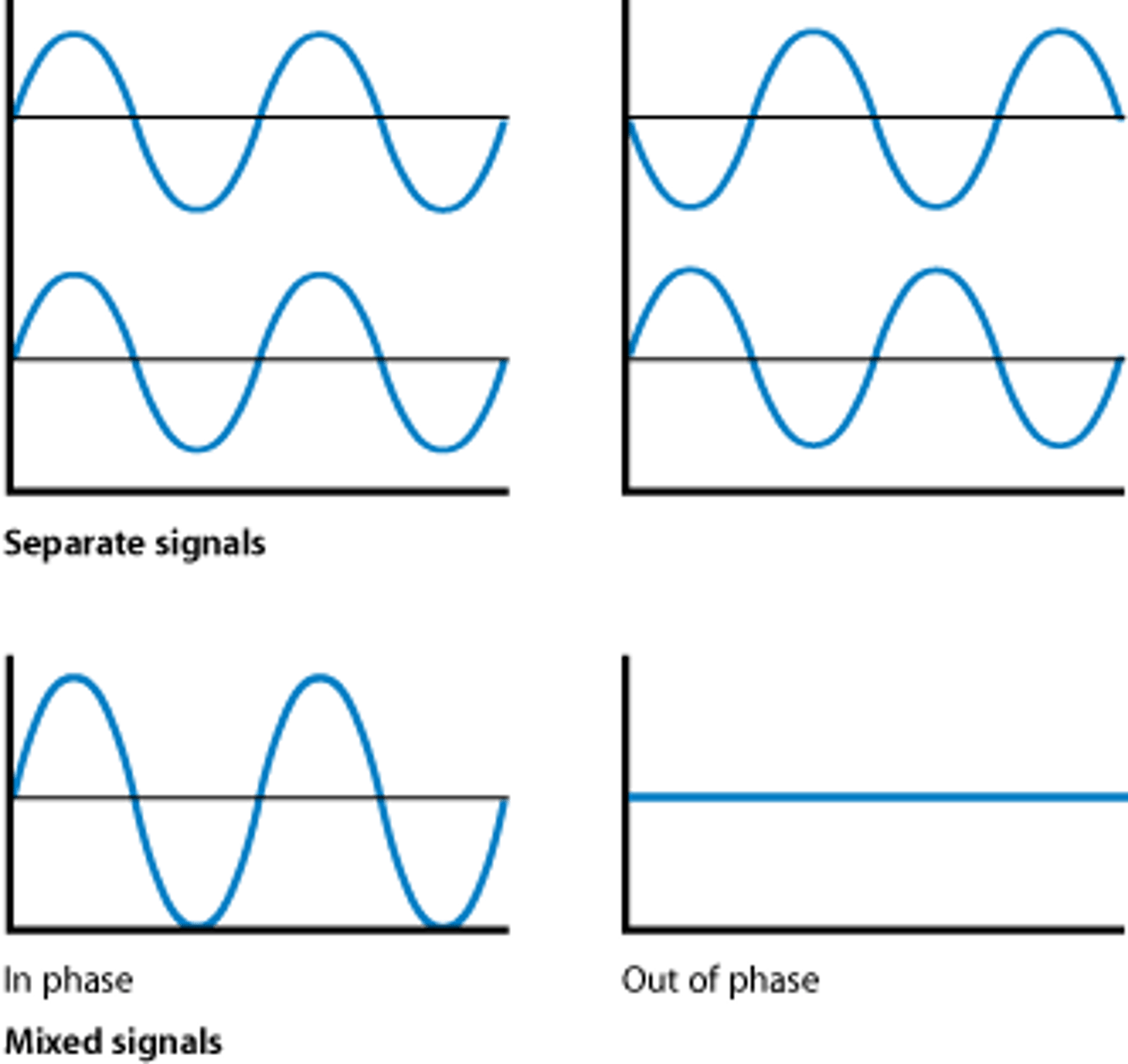
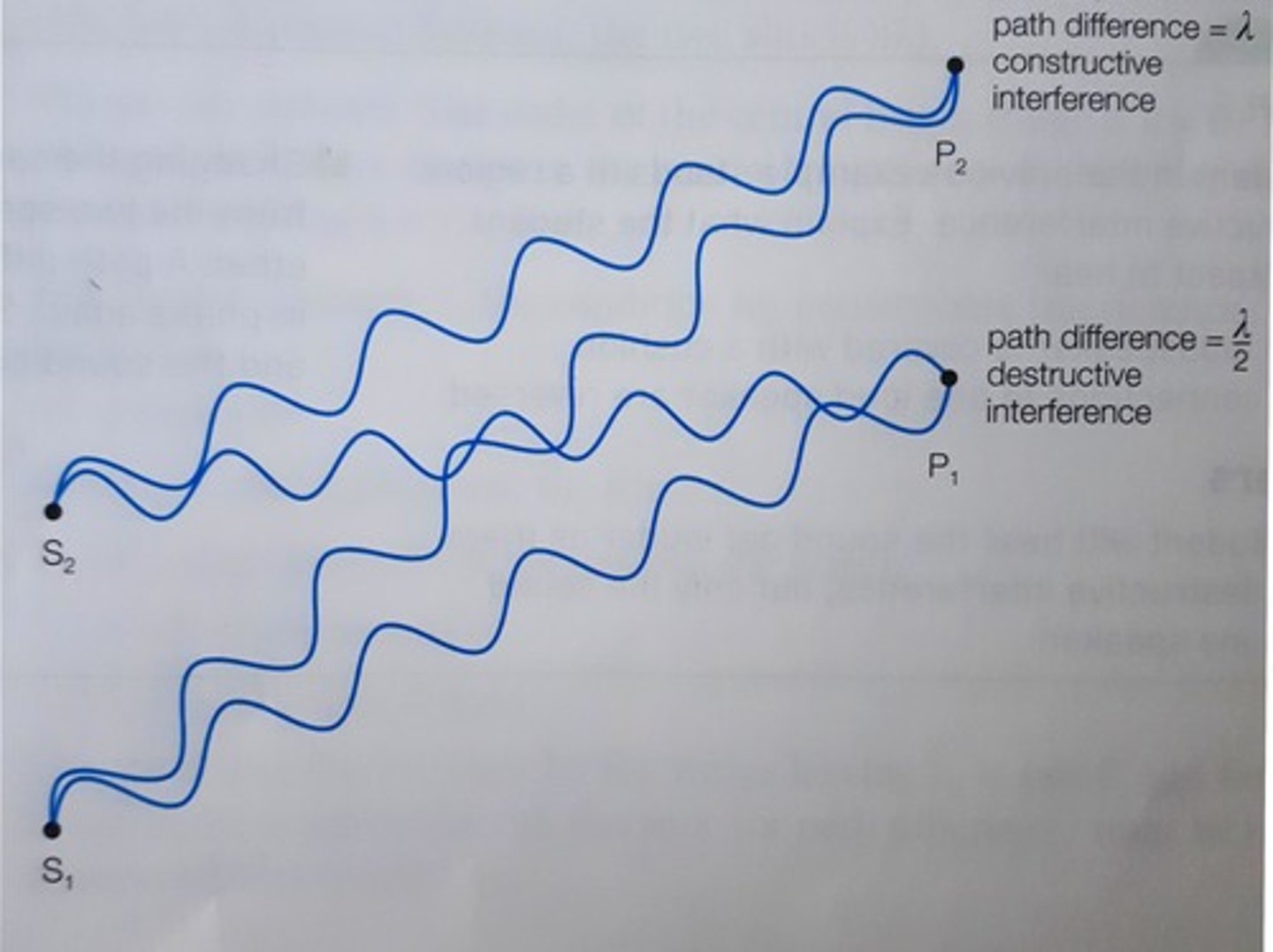
Path difference
difference in distance from two waves to a certain point if there is a whole wavelength path difference (n lamda) then they are completely in phase, (n + 1/2)lamda then it is completely out of phase, anything else is out of phase.
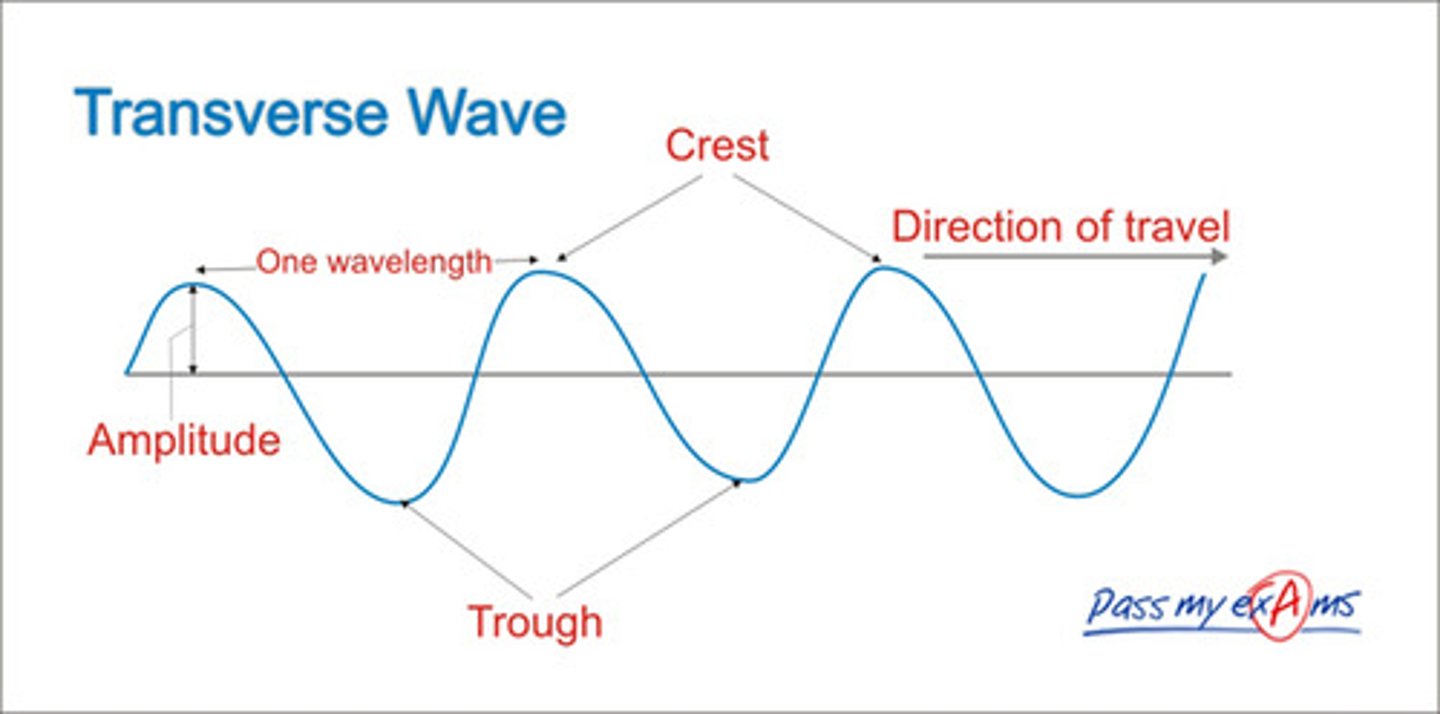
Transverse wave
The particles oscillate perpendicular to the direction of energy transfer (propagation) consisting of particles moving from an equilbrium to peak and troughs.
Longitudinal wave
The particles oscillate parallel to and in the direction of energy transfer (propagation) consisting of particles moving from areas of high density (compression) to low density (rarefactions)
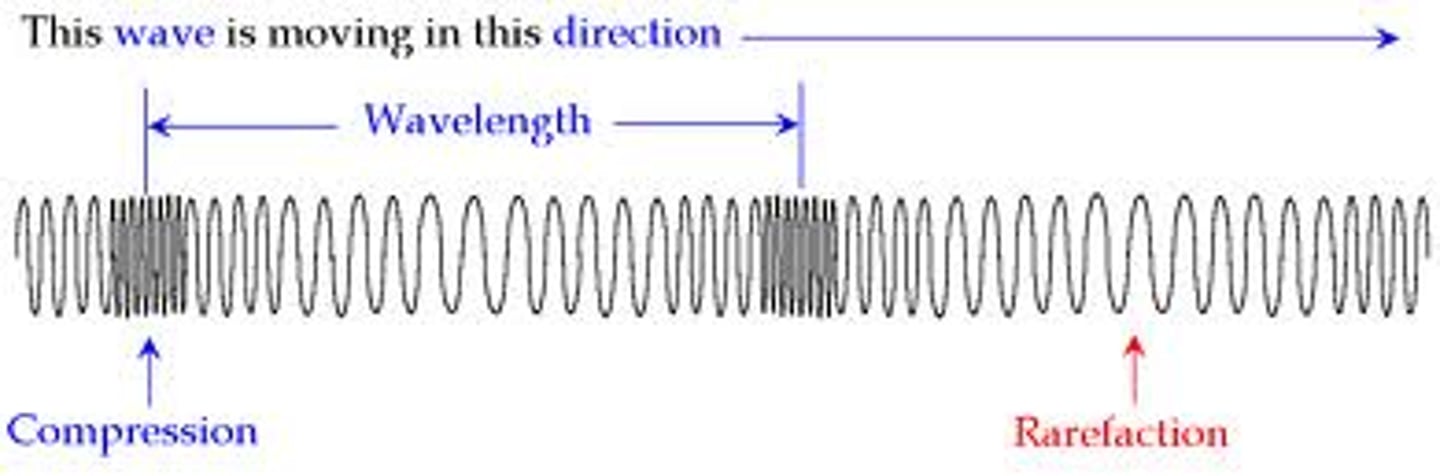
Polarised Wave
The oscillations of a polarised wave are all in a single plane which inlcudes the direction of propagation of the wave.
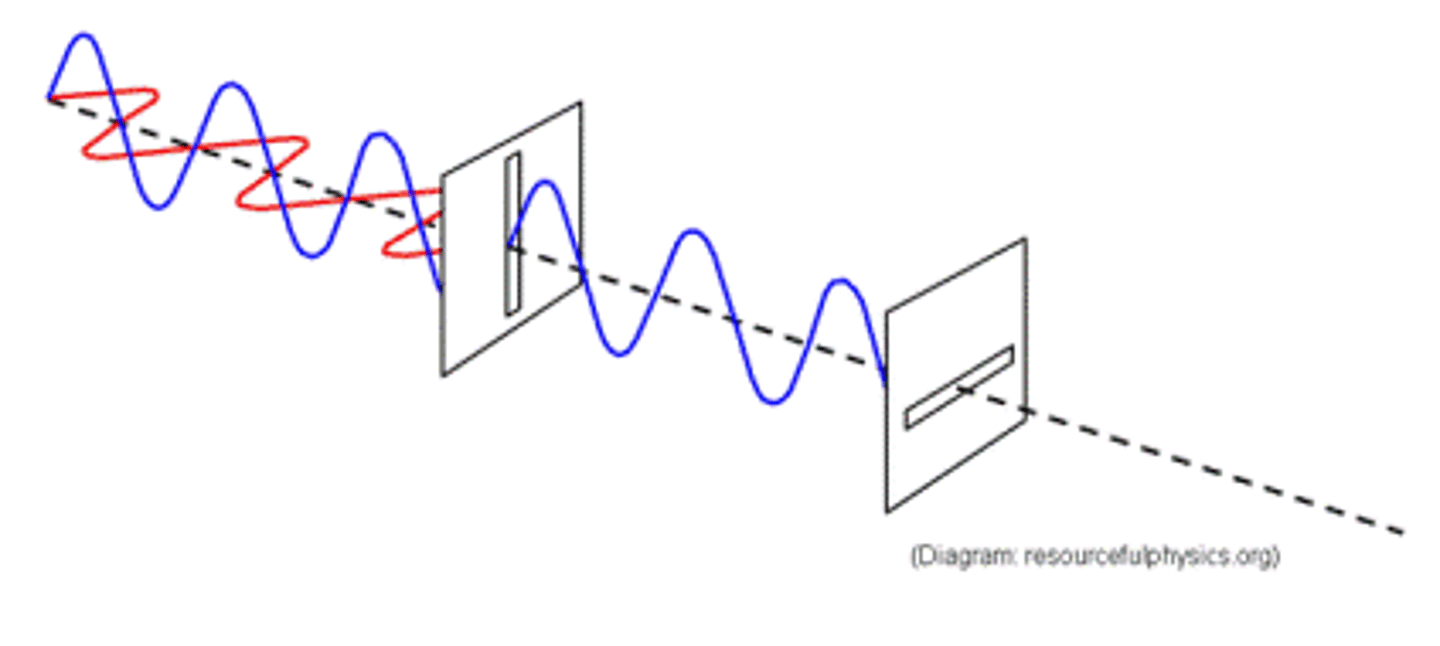
Unpolarised Wave
The oscillations of an unpolarised wave are in many planes.
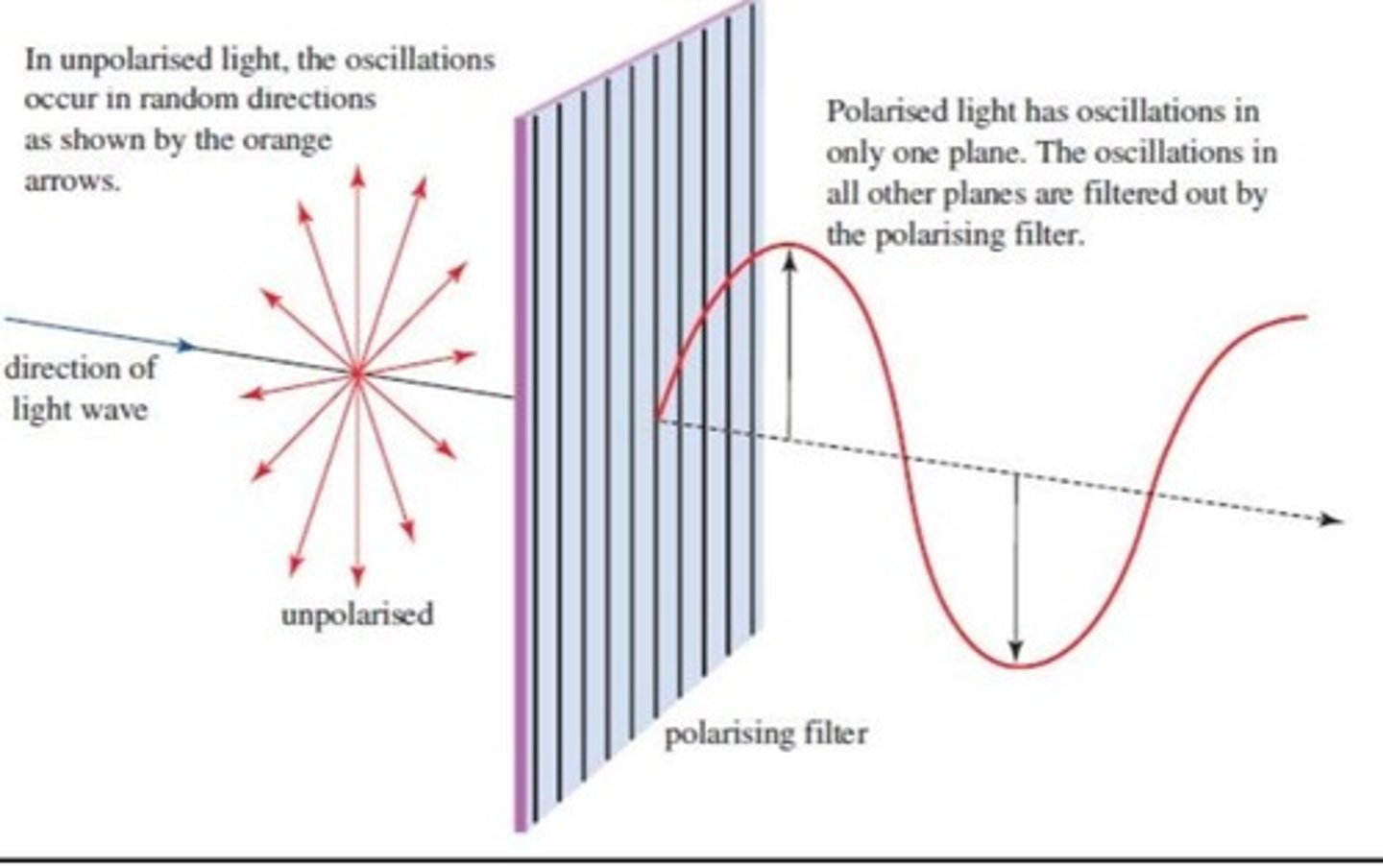
Polarising filter
A polarising filter absorbs the waves that are not in the orientation/plane that it filters light through (some still passes) however it will completely block out light in a plane perpendicular to the filter's plane.
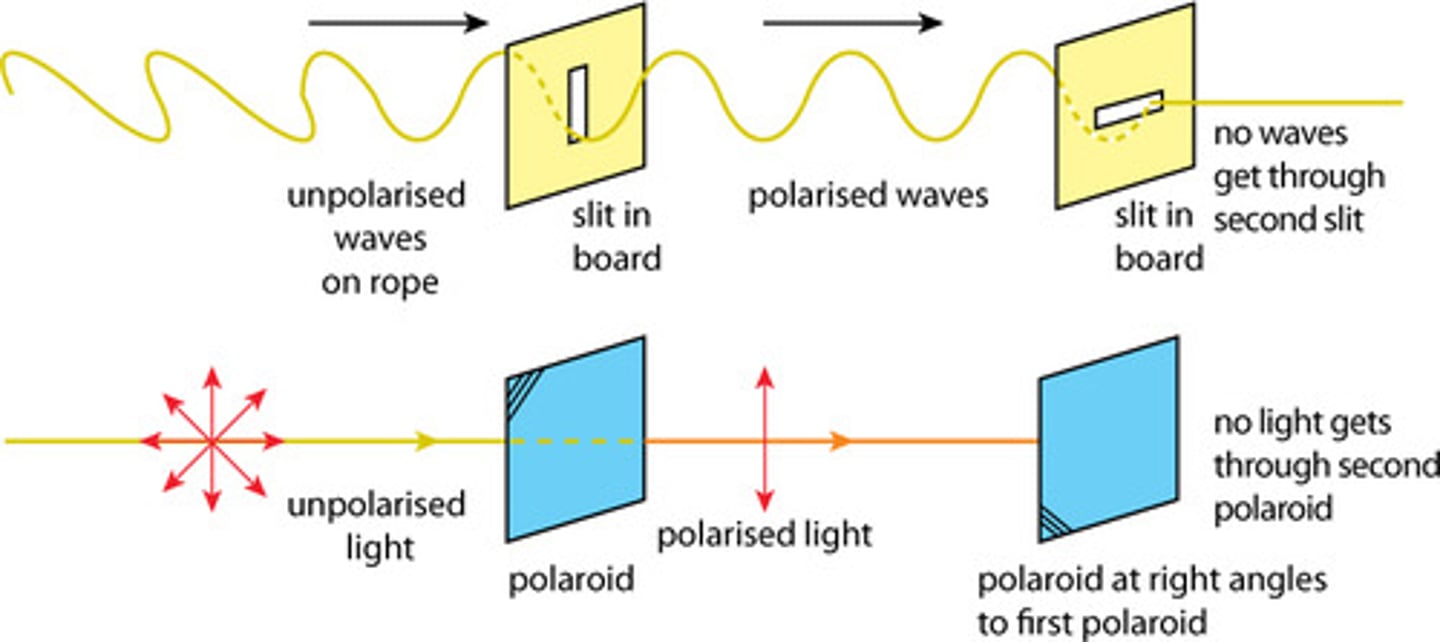
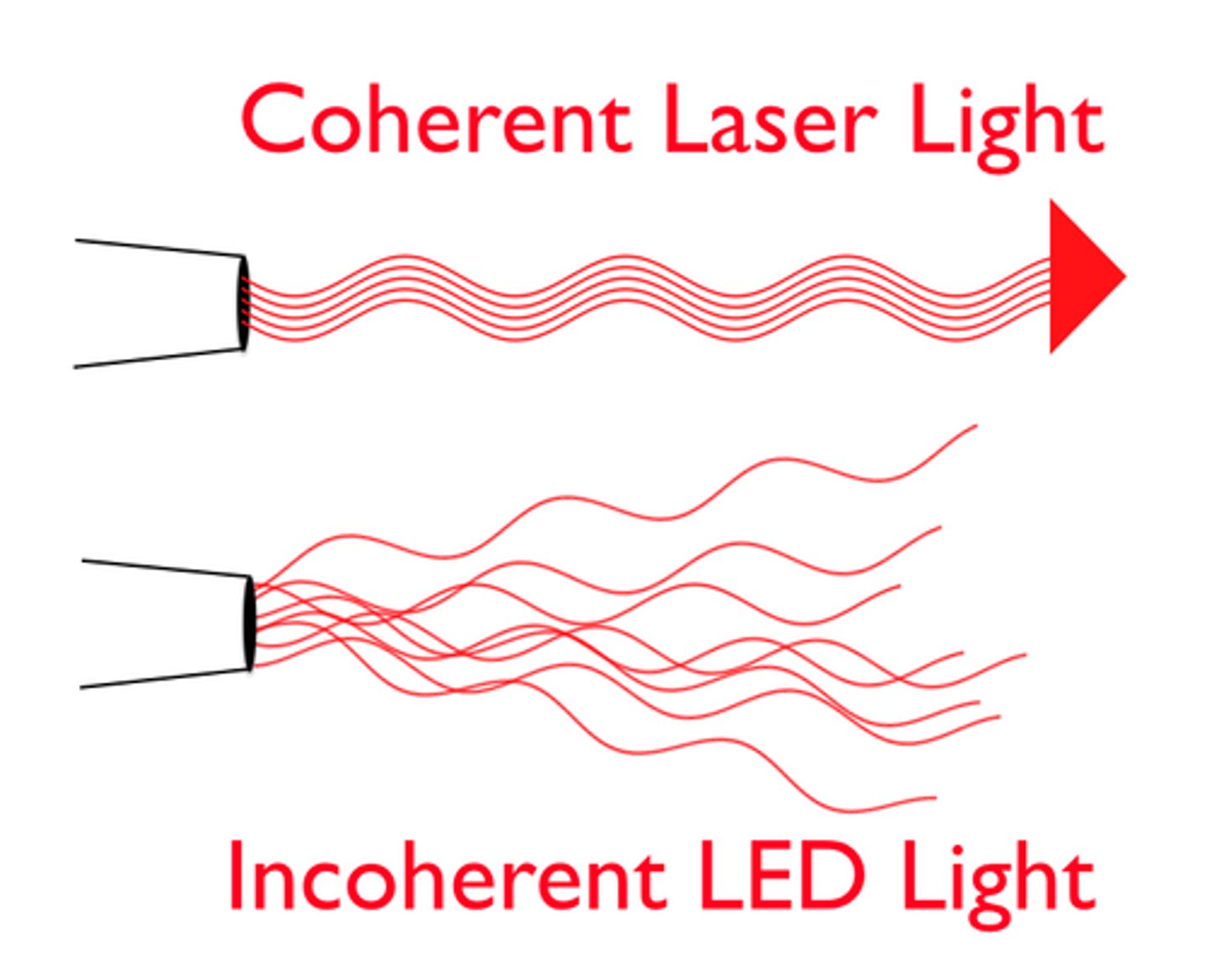
Coherence
Sources are coherent if they maintain a fixed-phase relationship (and are polarised in the same plane) and have the same amplitude and frequency
Sunglasses
Polarised sunglasses help cut out glare. The light that is reflected from these sunglasses at a large angle is horizontally polarised, so the sunglasses have a horizontal polarising filter in the lens, which absorbs this reflected light.
TV Transmission
Terrestrial digital TV signals are polarised. If there are two neighbouring transmitters transmitting the same channel, they can be polarised in different directions to avoid interference. The receiving aerials must be of the same polarisation axis in order to pick up the signals.
EM Spectrum
Created when charged particles oscillate. Made up of a magnetic field and a electric field. The fields are perpendicular to each other. All are transverse waves.
Speed of light
c = 3x10^8
Wave intereference
When two coherent waves pass through each other, points of cancellation and points of reinforcement are created due to an effect called wave superposition.
Principle of Superposition
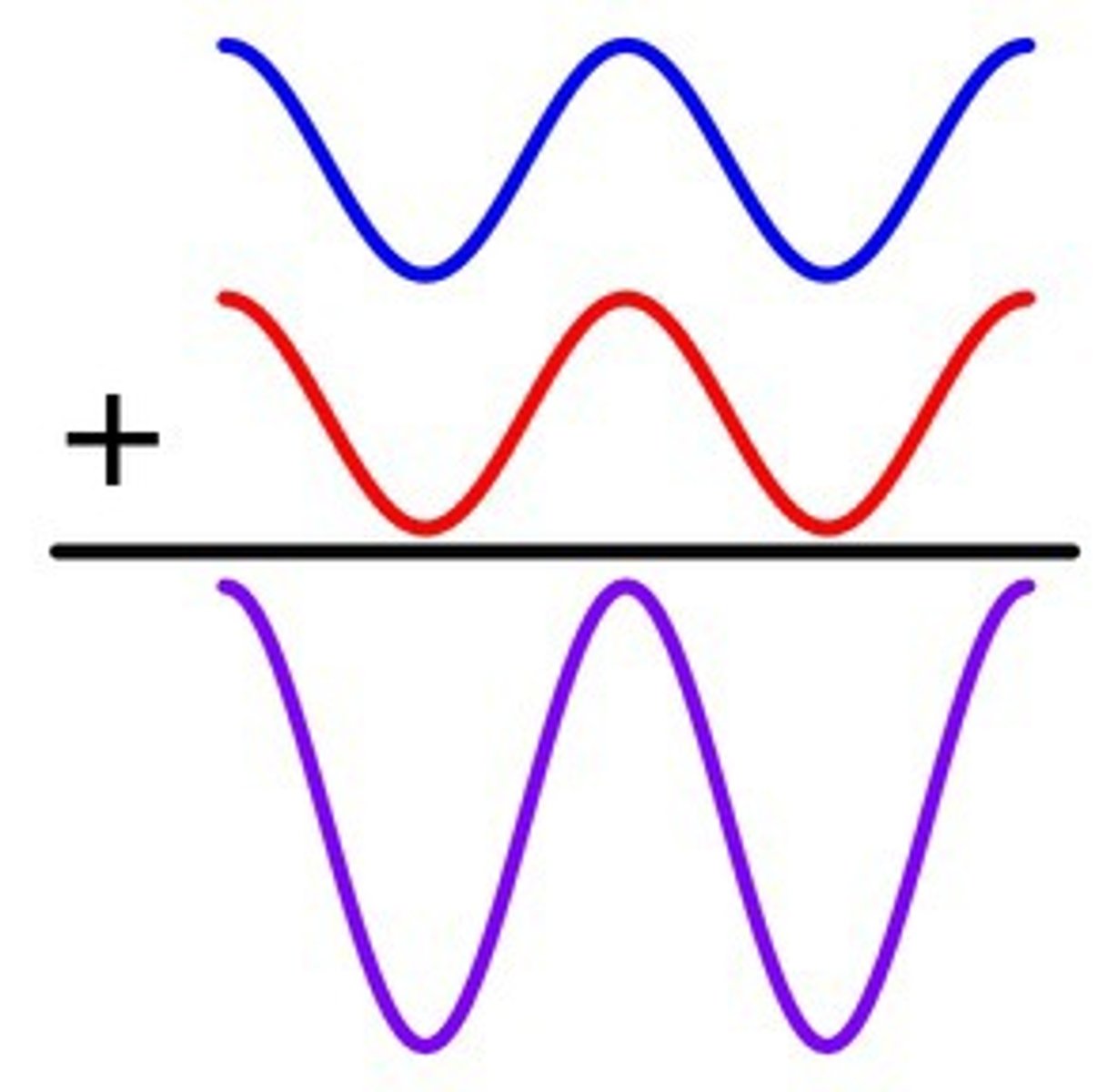
When two coherent waves meet, the total displacement at any point is equal to the sum of the individual displacements at that point.
Superpose
When two waves meet, they can pass through each other. The displacements of the waves are said to superpose as they combine.
Constructive Superposition
The resultant amplitude will be 2a
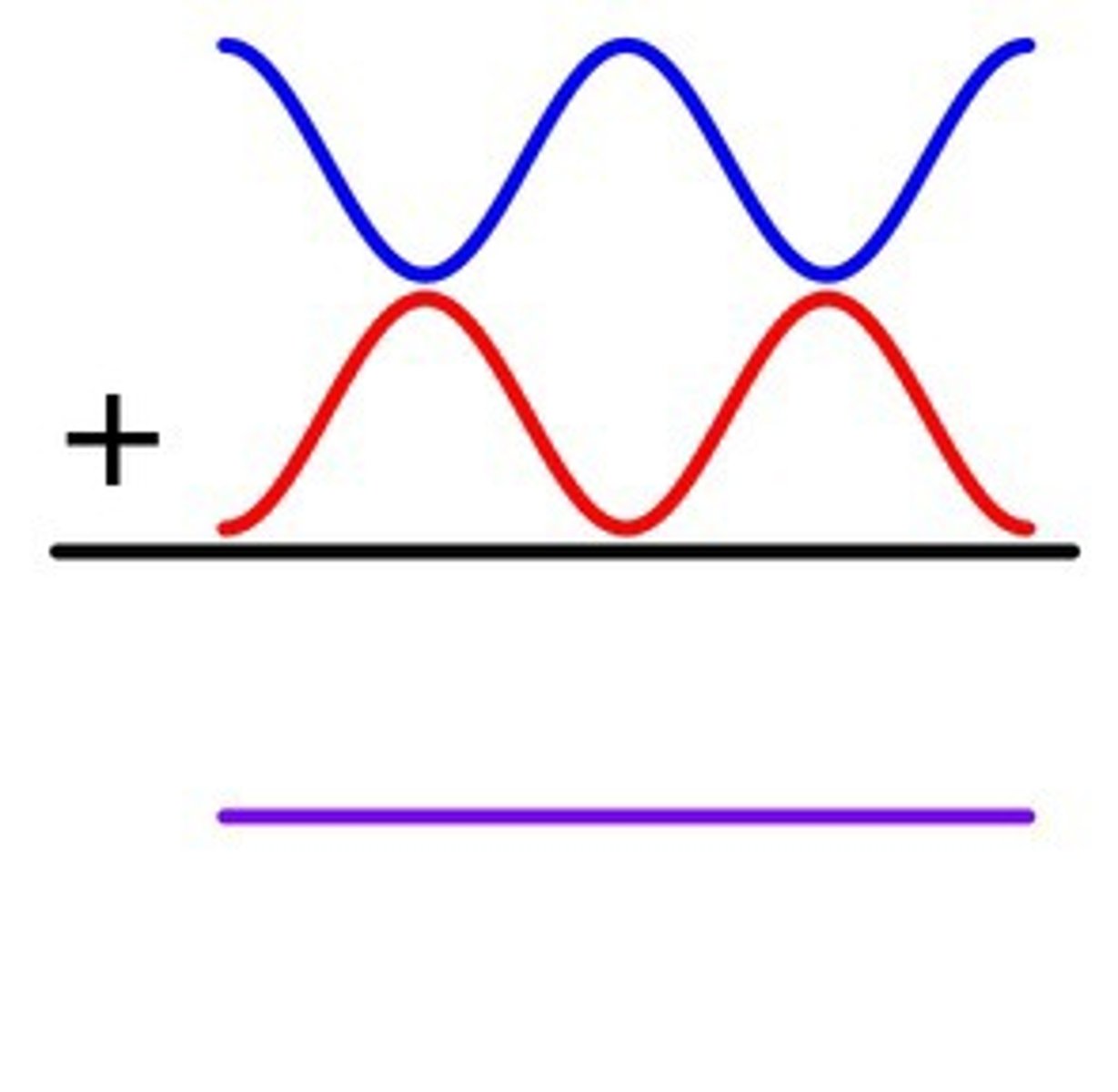
Completely/Perfect Destructive Superposition
The resultant amplitude will be -2a
Intermediate Superpostion
The resultant amplitude will be somewhere between 2a and -2a, there is neither perfectly constructive or perfectly destructive superposition.
Stationary Wave
- Stores energy
- No movement of wave shape from the superposition
- Neighbouring particles have different amplitudes
- Neighbouring points have nπ phase difference
- Has nodes (no amplitude) and antinodes (max amplitude)
How to form a stationary wave
they are set up as a result of the superposition of two waves with the same amplitude and frequency, travelling at the same speed, but in opposite directions.
Either on the end of two strings, or a wave reflecting off a wall and coming back in the same direction it came from.
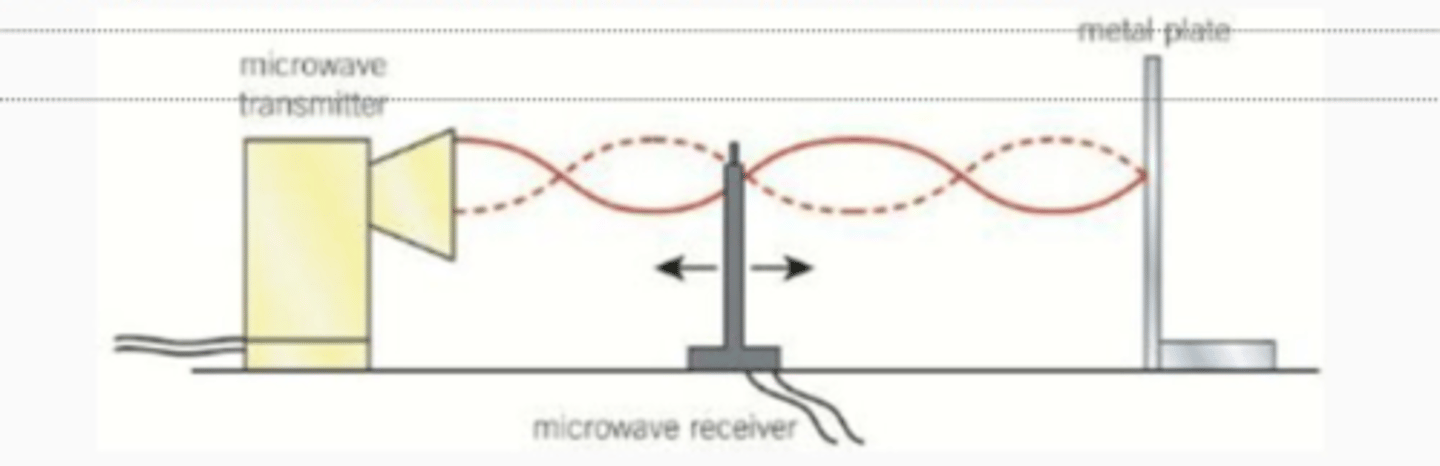
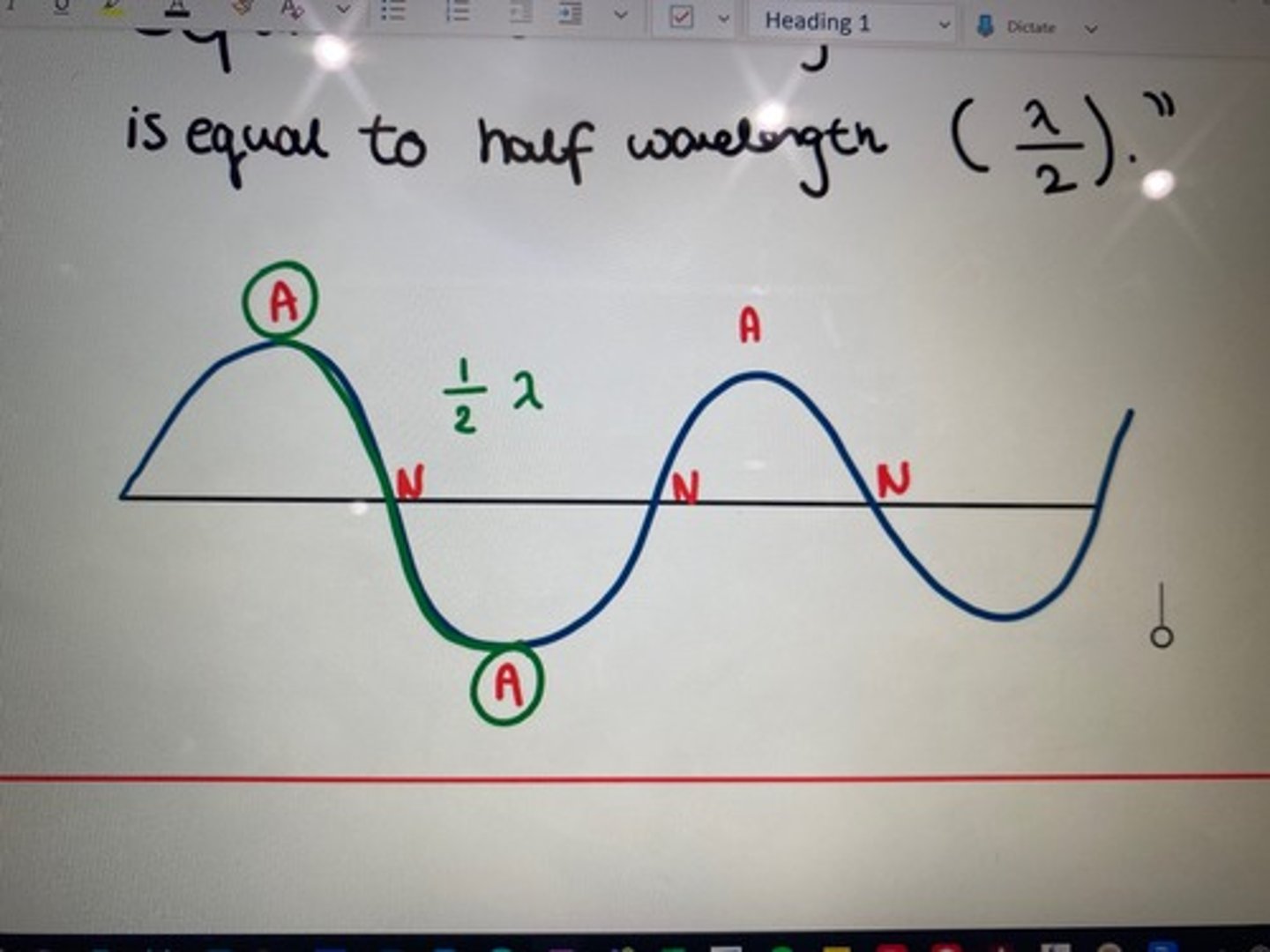
Node
The area of equilibrium of a stationary wave
Anti-Node
The area of maximum displacement of a stationary wave
Internodal Distance
between a set of nodes its π/2 of a wavelength and this is also the case between the set of antinodes. between a set of an adjacent node and antinode it is π/4 of a wavelength
Harmonics
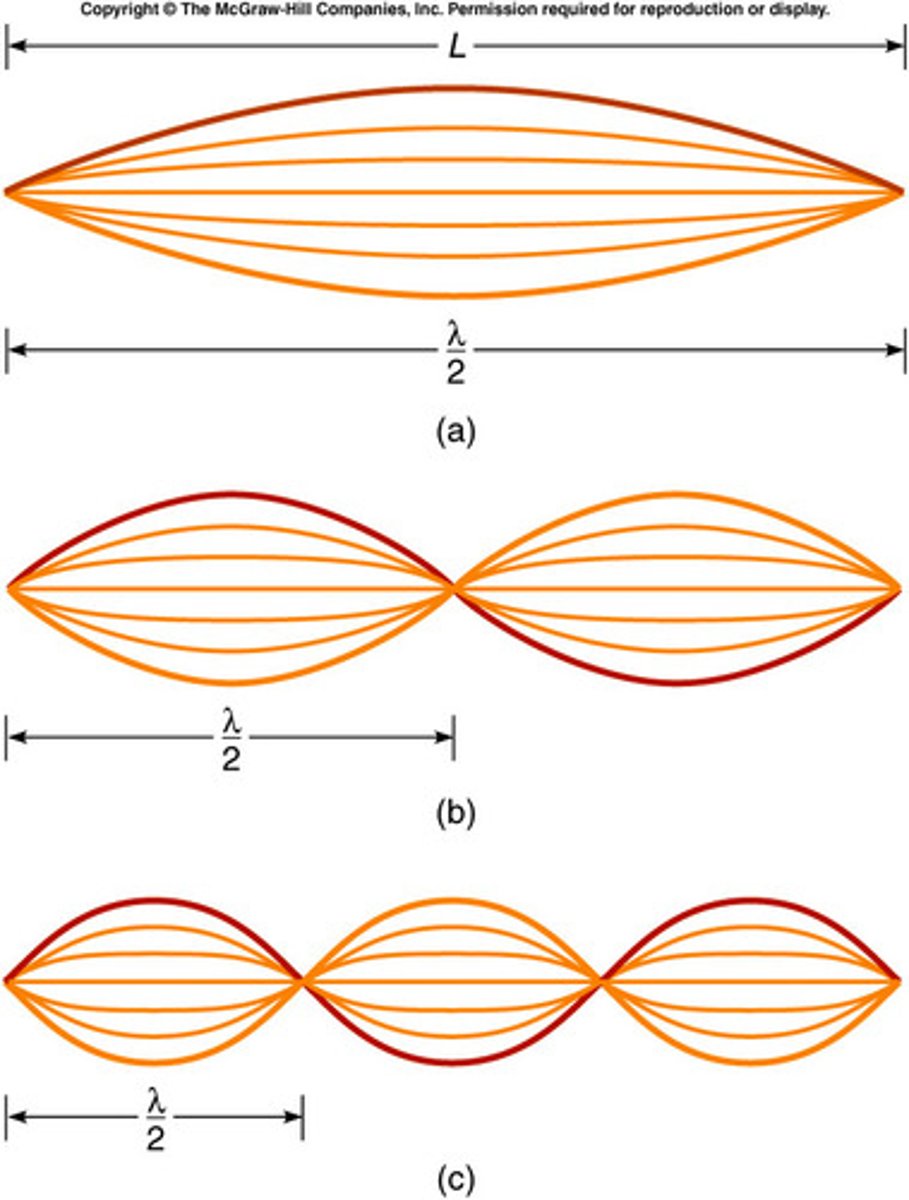
Different frequencies of stationary waves on a string are called harmonics.
The number of the harmonic is equal to the number of anti-nodes on the string.
Length of string = (mλ) / 2
where m = the number of harmonic
First Harmonic
The first fundamental mode of vibration which consists of two nodes and one anti-node
Pitch
A factor about the note of music made corresponds to the frequency of the wave. Uses the new equation
Varying Frequency of a Vibrating String (plus equation)
The frequency of the first harmonic on a vibrating string depends on 3 factors:
- Length of string, L, (m)
- Tension of string, T, (N)
- Mass per unit length of the string, μ, (kg ms-1)
F = (root of T/μ)/2L
Reflection
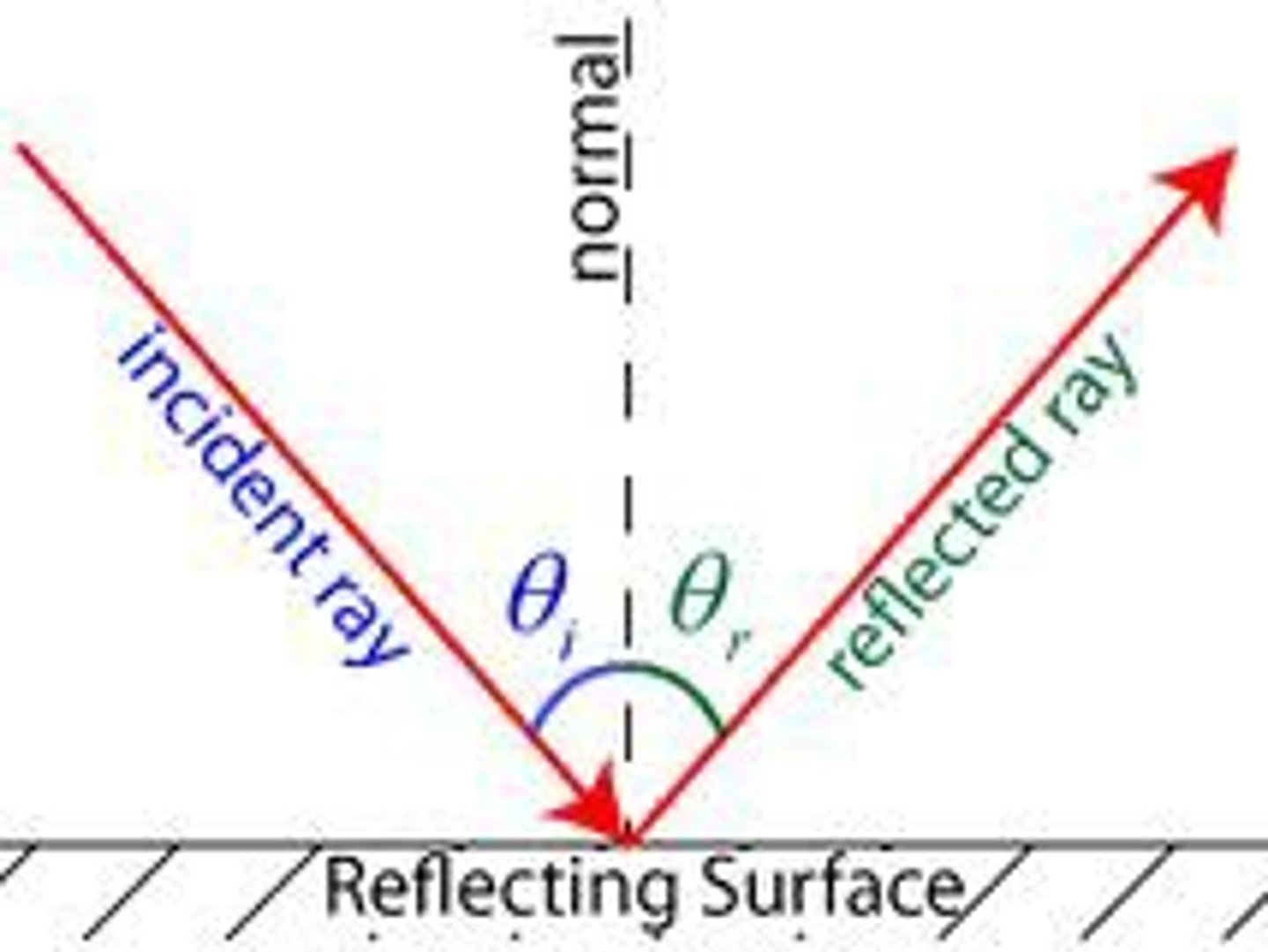
When a wave rebounds off an interface
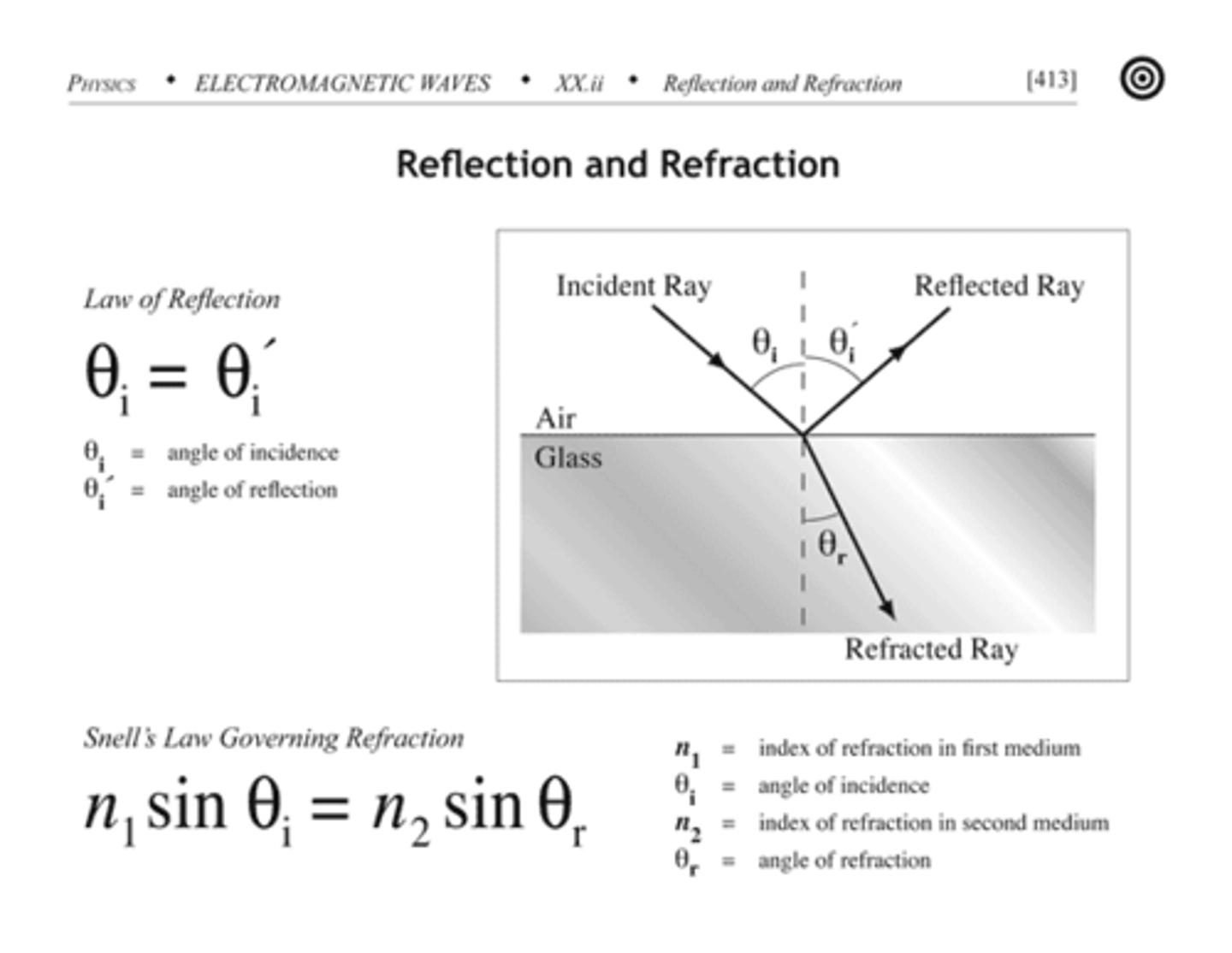
Angle of incidence = Angle of reflection when there is a specular reflection on a smooth surface
When there is a rough surface then reflection is scaterred and random
Refraction
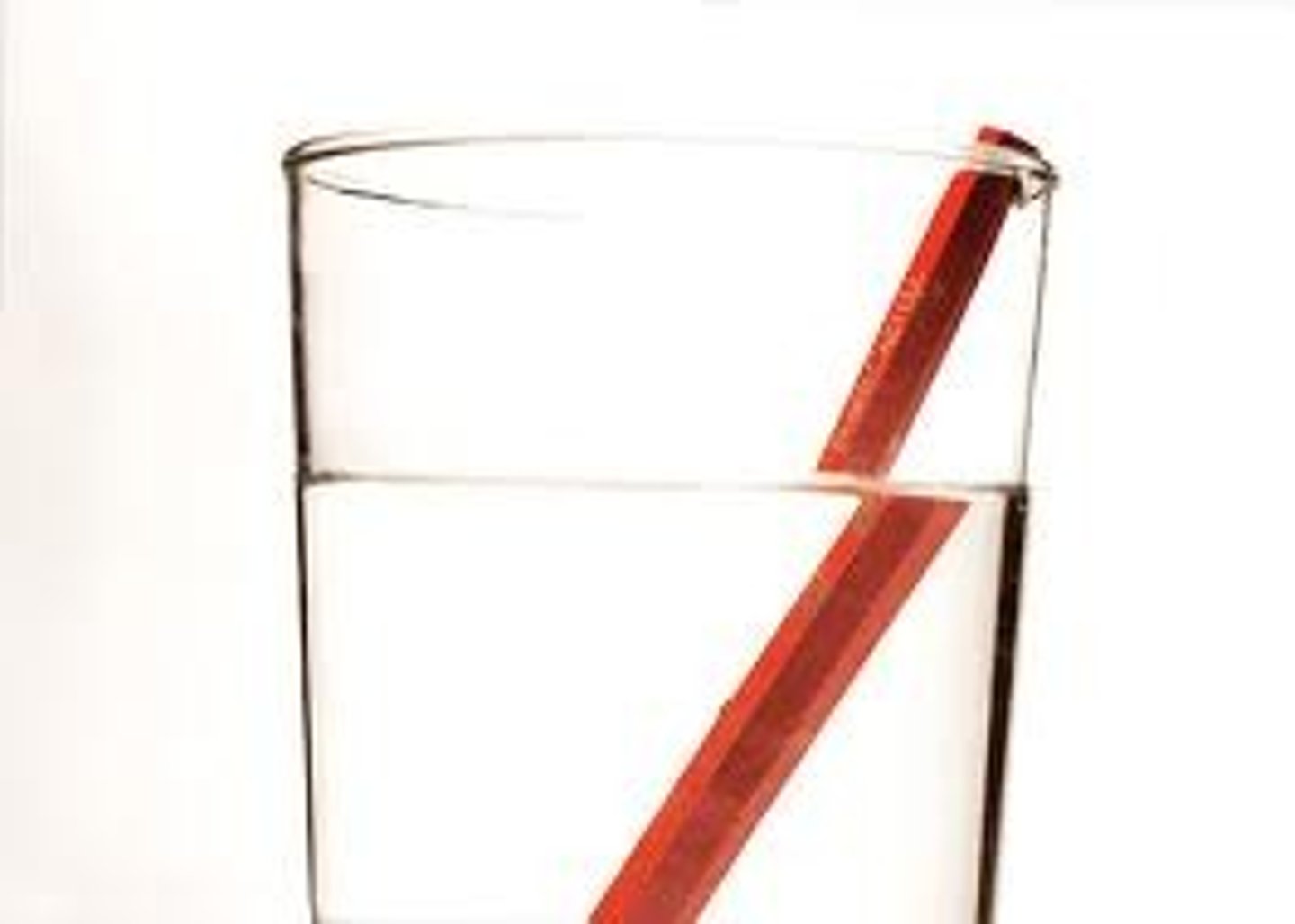
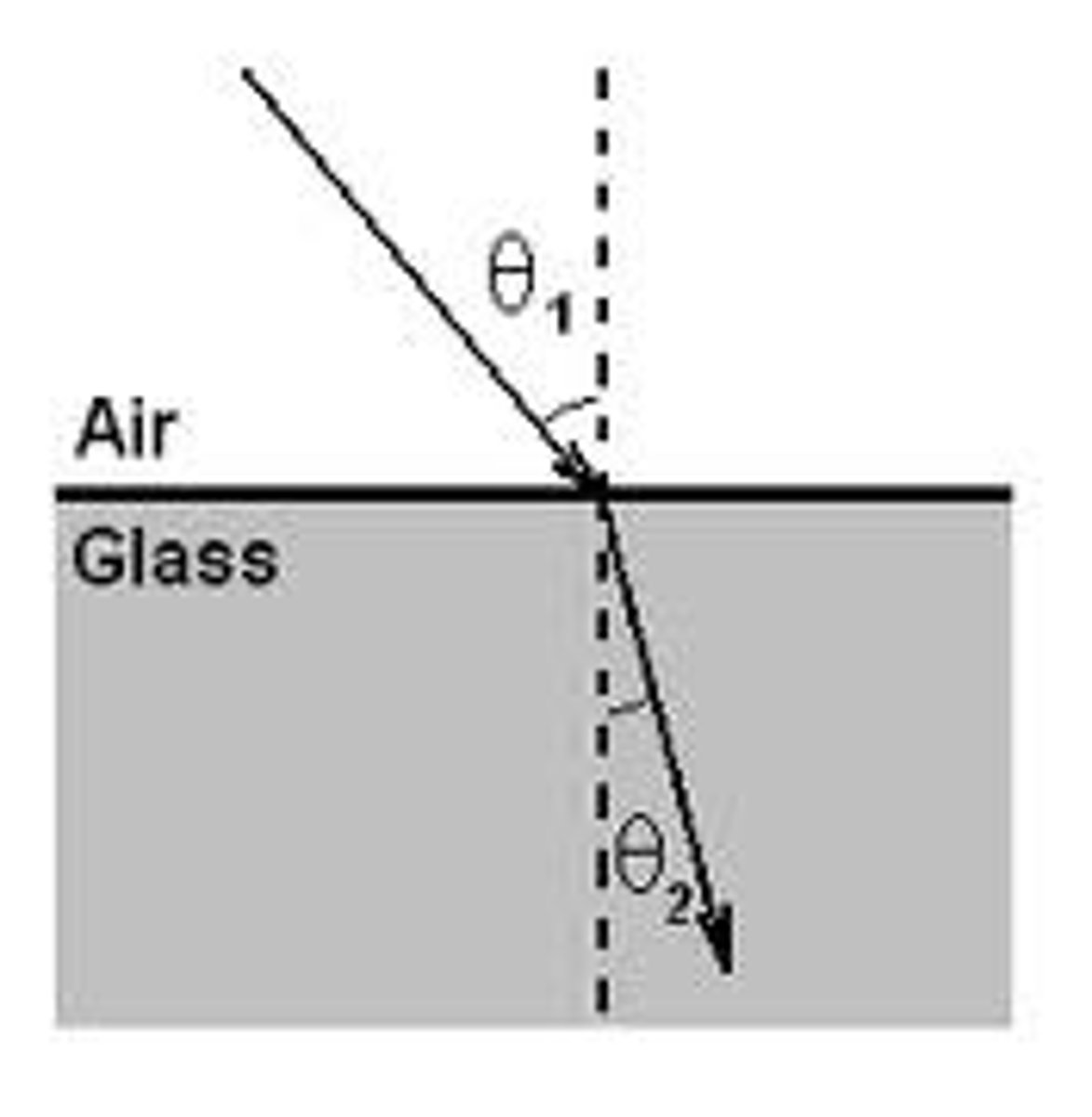
Change in speed of a wave passing into a different medium causing a change in wavelength.
Causes a change of direction of the wave if it is not travelling along the normal.
Refraction through mediums
For light:
Less dense → More dense; Velocity decreases, therefore the angle between the ray and the normal decreases
More dense → Less dense; Velocity increases, therefore the angle between the ray and the normal increases.
For sound it is the opposite due to the way they travel in terms of particles
Refractive Index
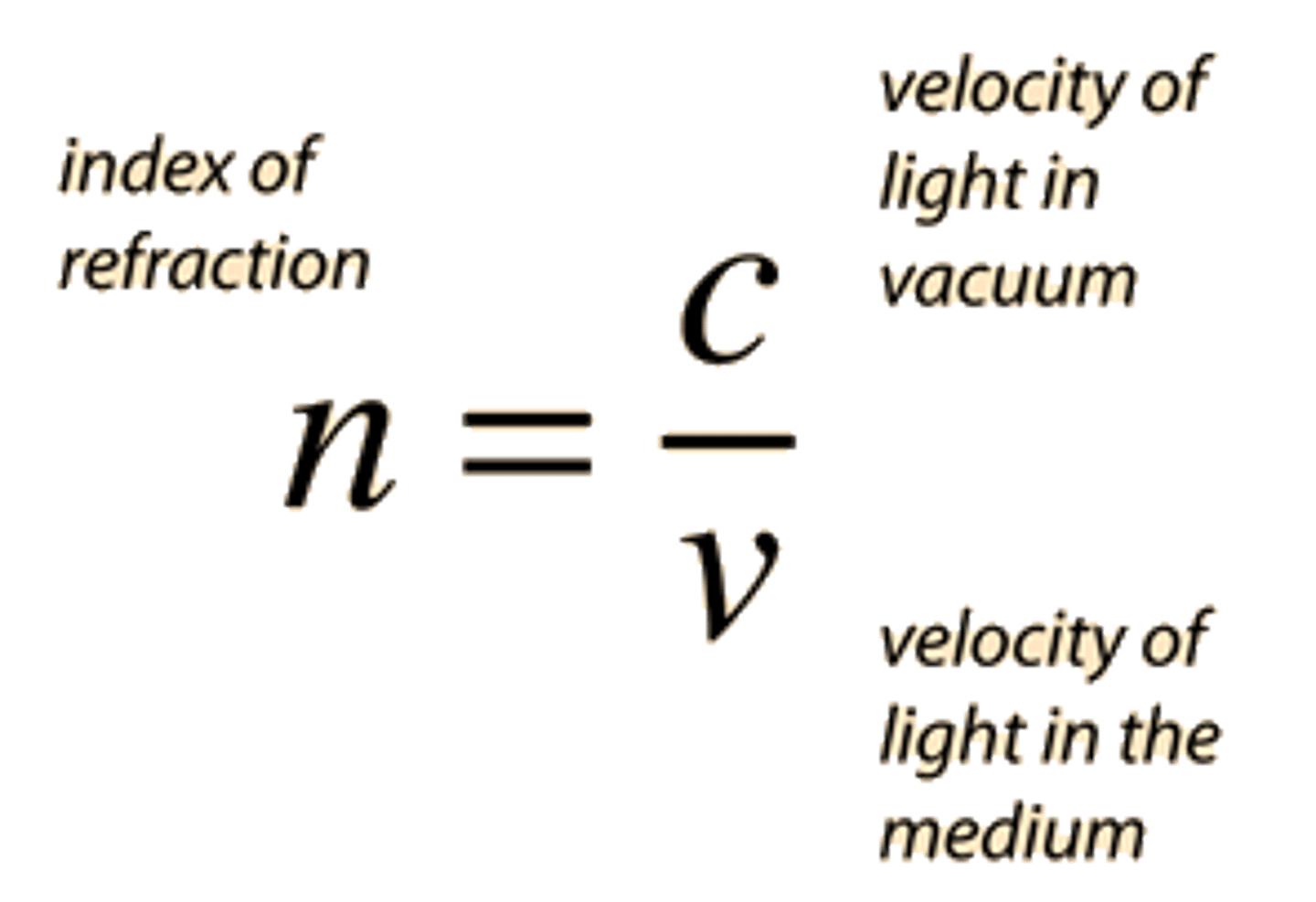
The ratio of the velocity in the air and the velocity of the light in a substance (n = c/v)
refractive index also equals, n= sin i / sin r
Combination of refractive index formulas
n = c/v
Snell's Law
n1sinθ1 = n2sinθ2
Critical Angle
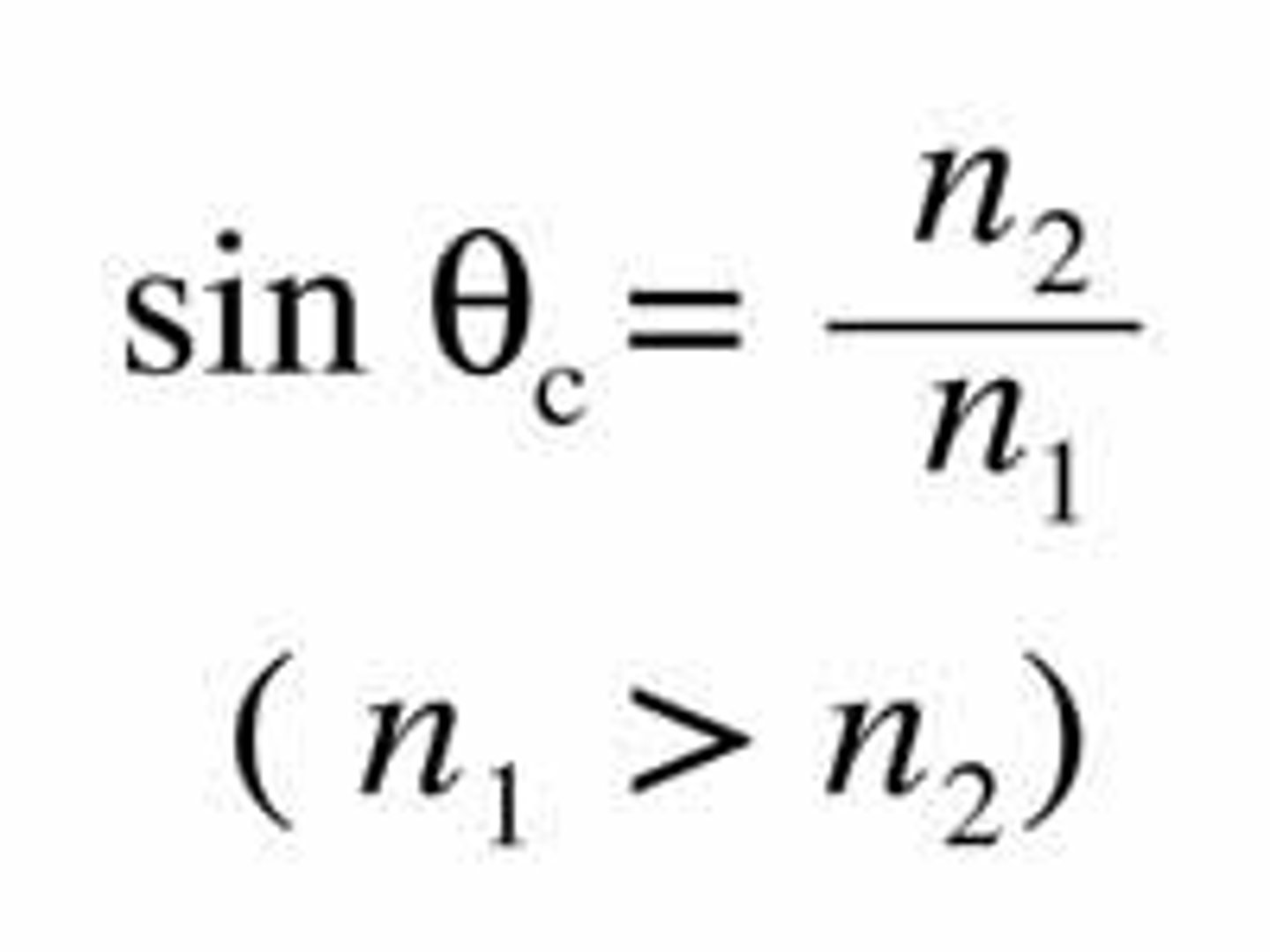
The angle of incidence that cause's the angle of refraction = 90° meaning the light travels across the boundary of the two mediums
Total Internal Reflection (TIR)
If the incident angle exceeds the critical angle, total internal reflection will occur inside the same medium the light entered from.
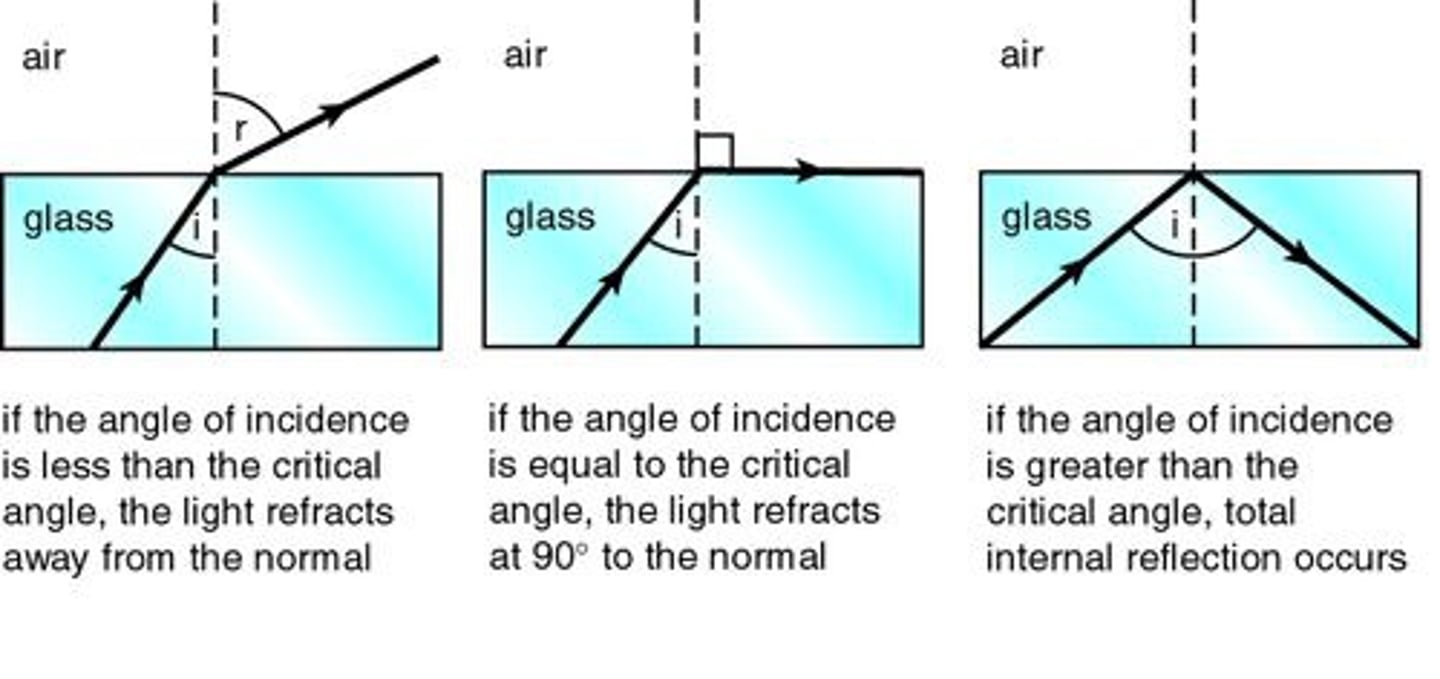
Uses of TIR
Windscreen wipers, where light is received at the critical angle by a sensor, but when there is water the light goes from air to water than to glass, meaning the critical angle changes and the sensor doesn't detect any light indicating a wipe. It is also used in medical endoscopes to form images as well as optical fibres (see below)
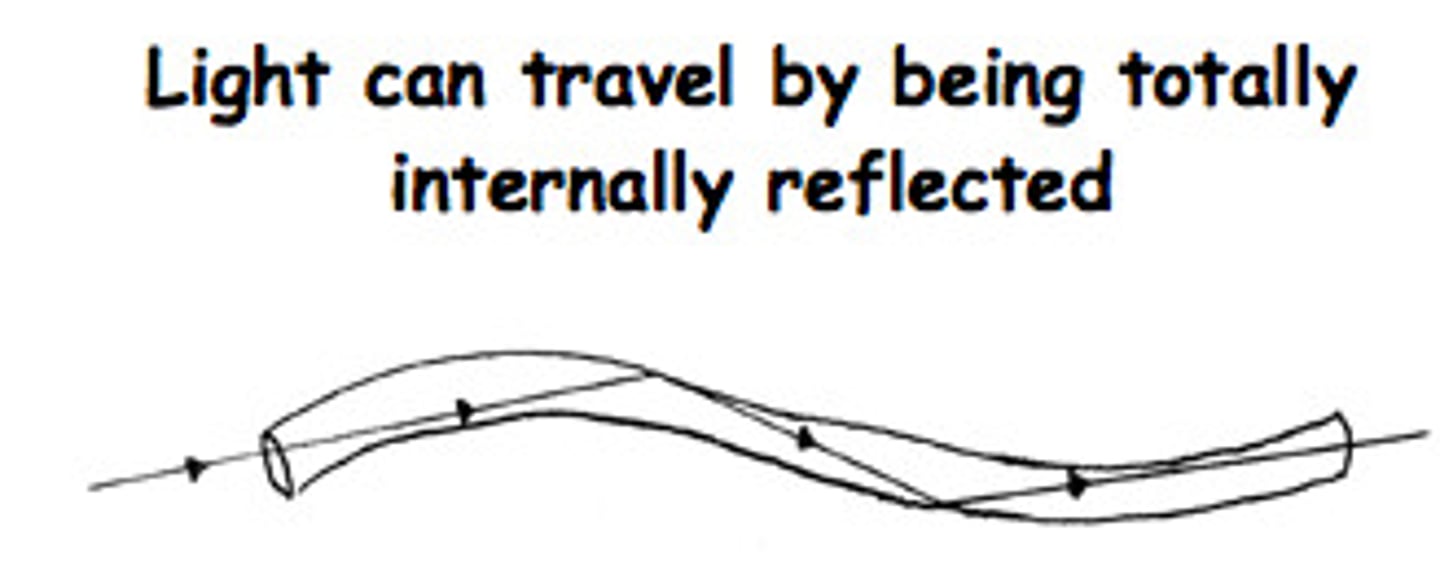
Optical Fibres
Uses the idea of total internal reflection to transmit light along the fibre. This consists of strands of solid glass which makes up the core surrounded by cladding that prevents light from escaping as the cladding has low light refractive index, and protection with a jacket.
Dispersion
Usually in the context of optical fibres, it refers to the spreading of a light pulse as it travels through the fibre (pulse broadening) This can degrade the signal and make it harder to interpret, there are two types which are modal and material.
Modal Dispersion
Light rays enter the fibres at different angles and therefore travel along different paths causing them to arrive at the other end at slightly different lines which can be solved by using monomode fibres with a very narrow core which limits path differences.
Material Dispersion
Different wavelengths of light travel at slightly different speeds in the fibre core, so the solution is to use monochromatic light (single wavelength light) to minimize these speed differences.
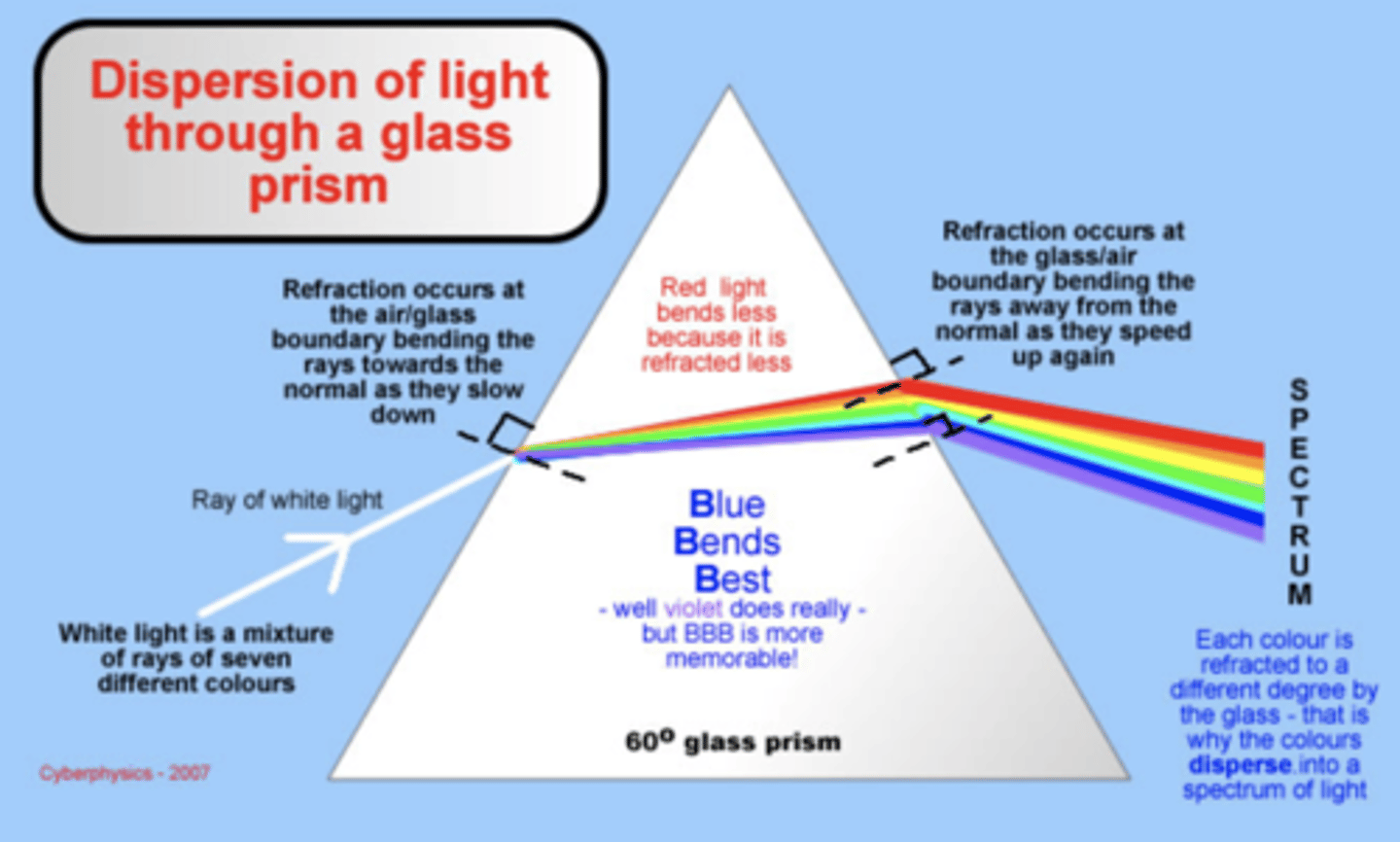
Dispersion (white light)
White light when entering a prism is refracted however since frequency must stay the same and the speed of light in a vacuum is constant. If we keep the angle of incidence constant then the sine of the angle of refraction will be proportional to wavelength in air, smaller wavelengths (violet are further to the normal when they leave) and longer wavelengths (red are closer from the normal when they leave)
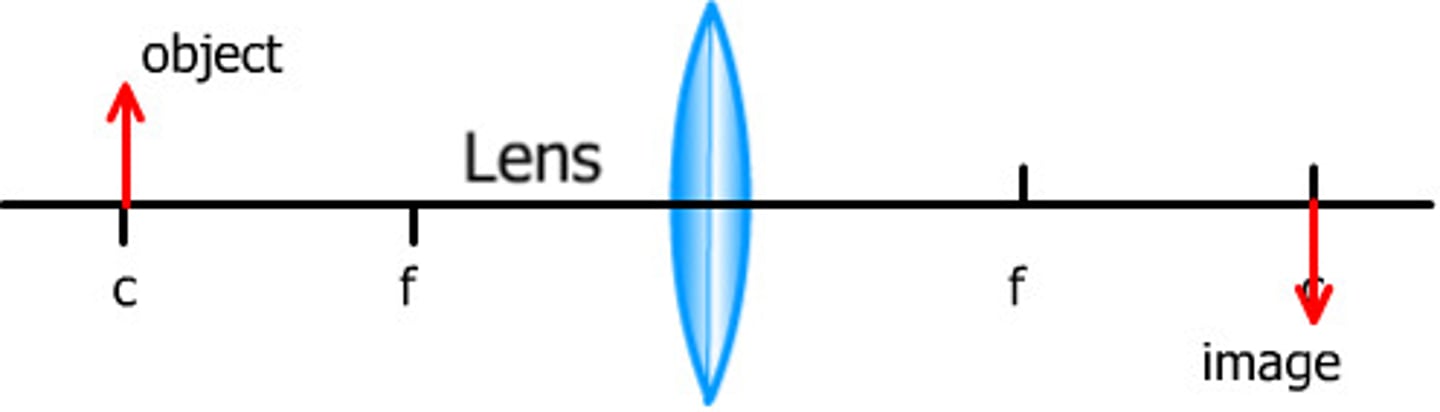
Focal Length, f
Displacement along the principle axis from the optical centre of the lens to the real/virtual focal point
1/f = 1/u +1/v
u is the object distance from the lens, v is the image distance from the lens, and f is the focal length
Power (of a lens), P
Power = 1/ focal length (1/1/f) (1 / (1/u + 1/v)
unit = dioptre (m^-1)
Pt = P1 + P2 +... when thin lenses are directly on each other.
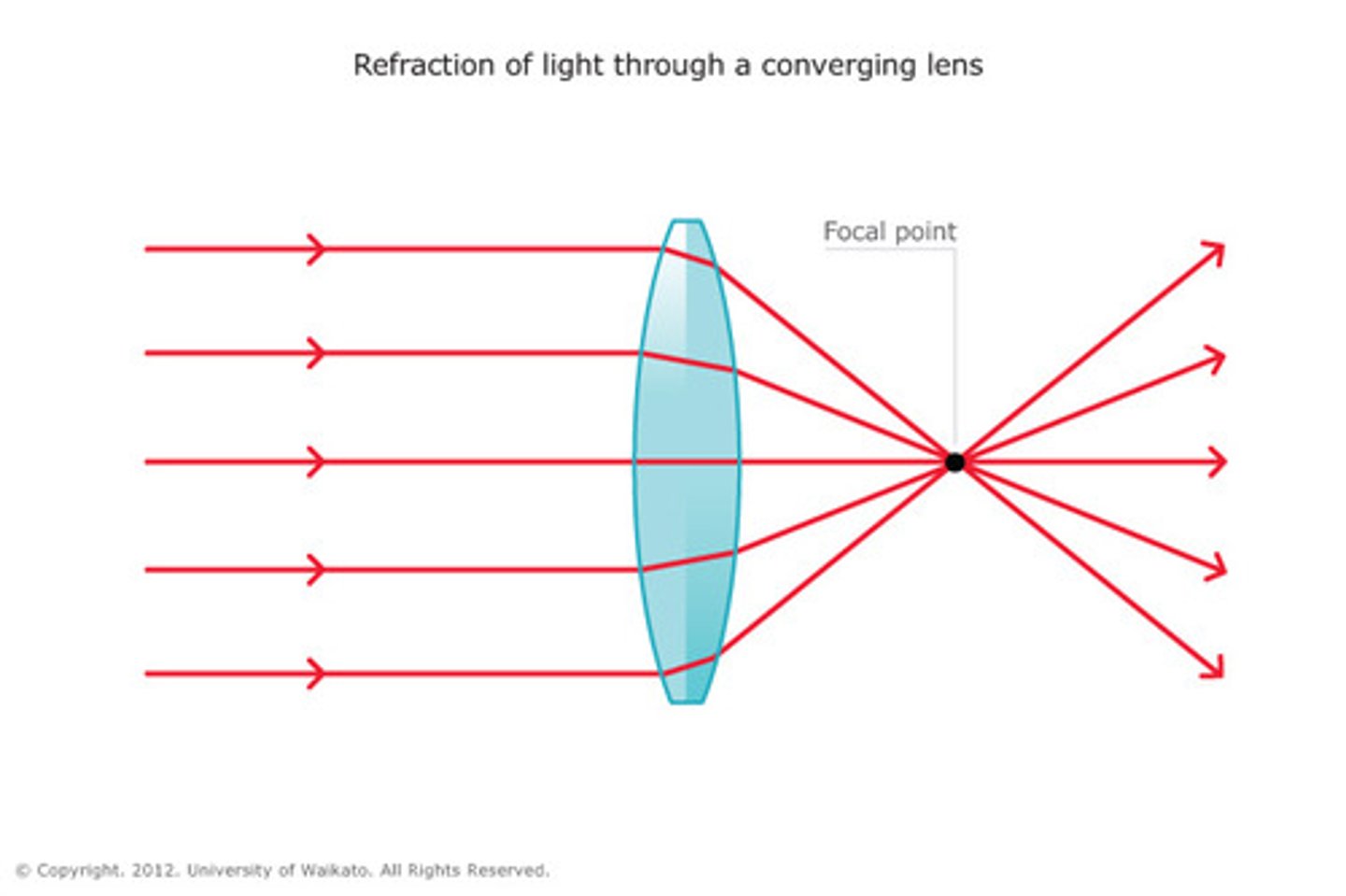
Converging Lens
Parralel rays and are bent inwards to the normal when passing through the lens and converge to meet at a real focal point to form a real inverted image where light rays actually meet. (1 exception where the object is below one focal length away a virtual image is produced e.g. a projector)
Have a positive power and a positive focal length
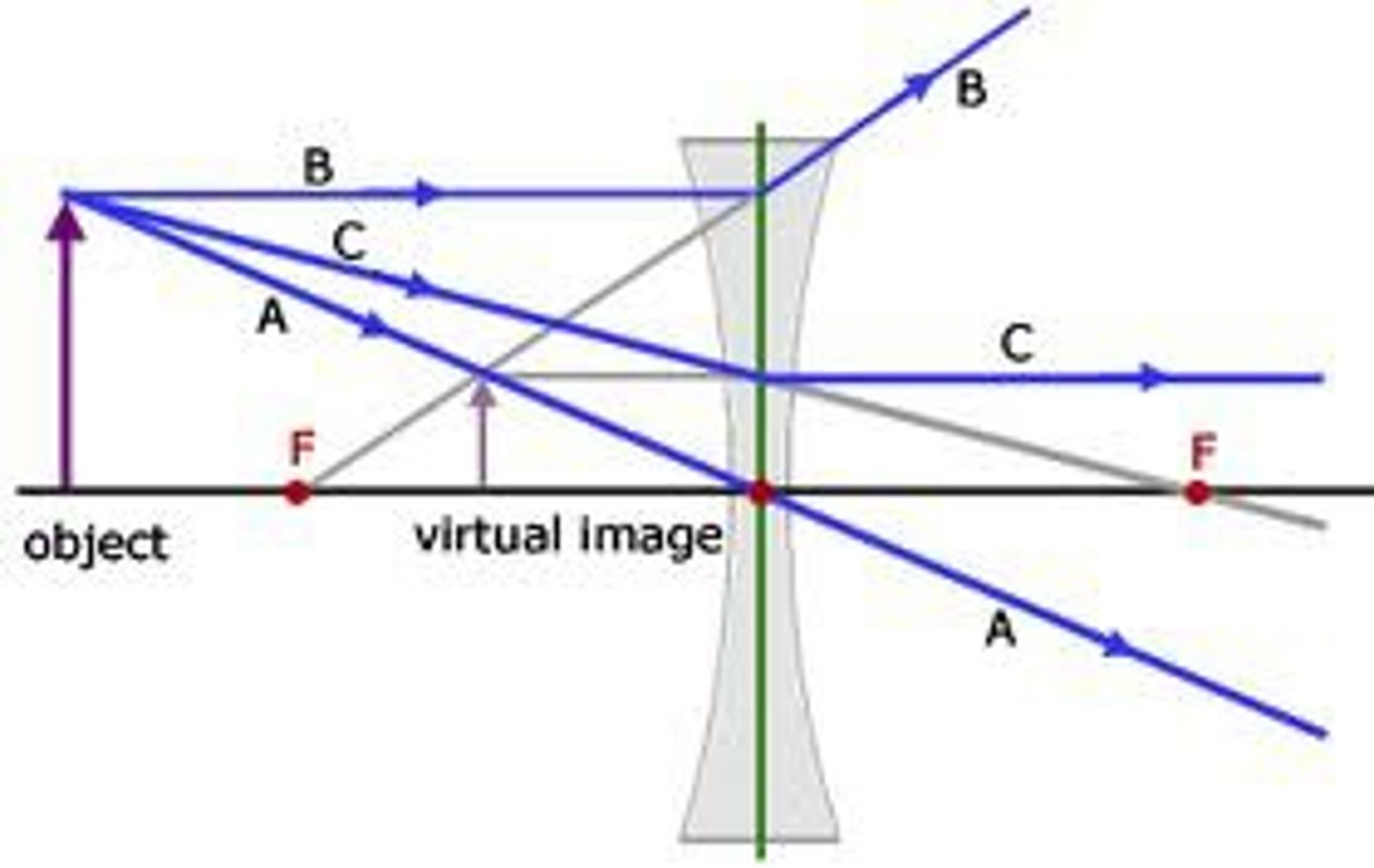
Diverging Lens
Parallel rays are bent outwards from the normal when pass ing through the lens and diverge from a virtual focal point to form a virtual upright image where the light appears to meet for example a magnifying glass. (this is always the case regardless of focal length)
Have a negative power and a negative focal length
Magnification
M= v/u
maginification = image height/object height
which is just the ratio of the heights
Pulse-echo techniques
Pulse of sound ,v, is emitted travels a distance, x, relects off an object and travels back in a time, t.
e.g. echolocation from a boat to the seabed
v = 2x/t
Diffraction
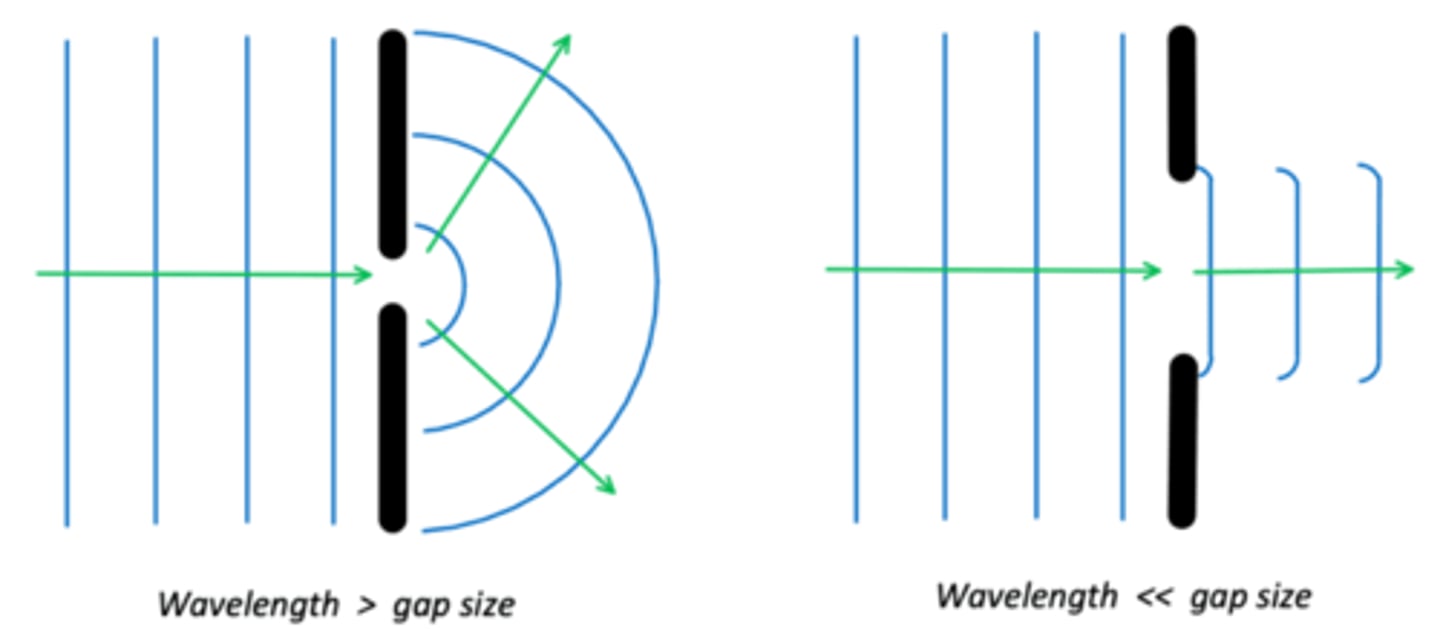
It is the spreading of a wave into the geometric shadow as it passes through a gap or around an edge due to huygens' construction
Factors affecting Diffraction
The amount of diffraction around an obstacle depends on the size comparison between the obstacle and the wavelength of the wave. As the resulting diffraction through a gap is caused by diffraction at each end of the gap the optimum size is when the gap is the same size as the wavelength meaning max diffraction (can be seen through a slit) (also wavelength being bigger than the slit is better than wavelength being smaller)
Diffraction Patterns
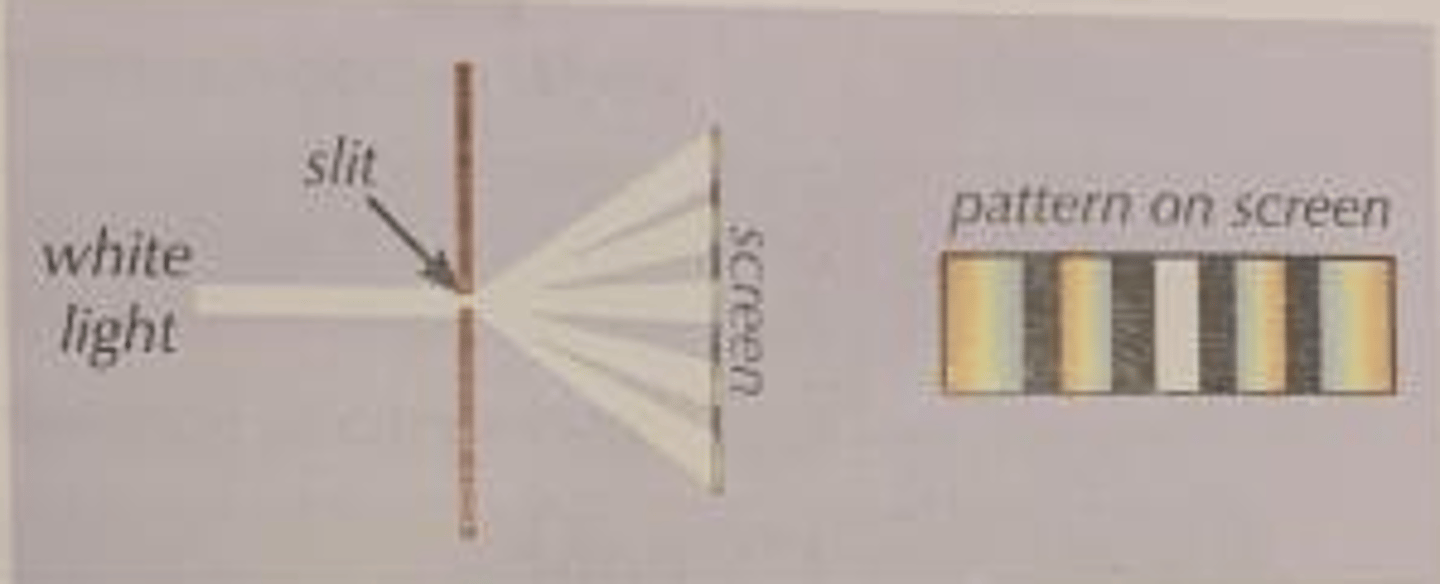
When light passed through a slit the waves that diffract out interact and interfere causing superposition causing areas of maxima and minima where light is brightest and darkest respectfully.
Single Slit: a bright central maximum with less bright maximas in between minimas, where the maxima widens with a narrower slit.
The diffraction grating is what causes these patterns, which then overlap creating a pattern with a mathematically defined space between each slit.
Therefore nλ = d sin∅
n is the order or number of bright spots from the central maximum (the cm is 1) lamda is wavelength, d is the distance between slits otherwise known as the diffraction grating and theta is the angle between the original direction of the wave and the spot of the maxima.
Two Source Interference
Interference caused by the interference of two sources of waves causing a pattern of maximas and minimas due to constructive and destructive interference respectfully
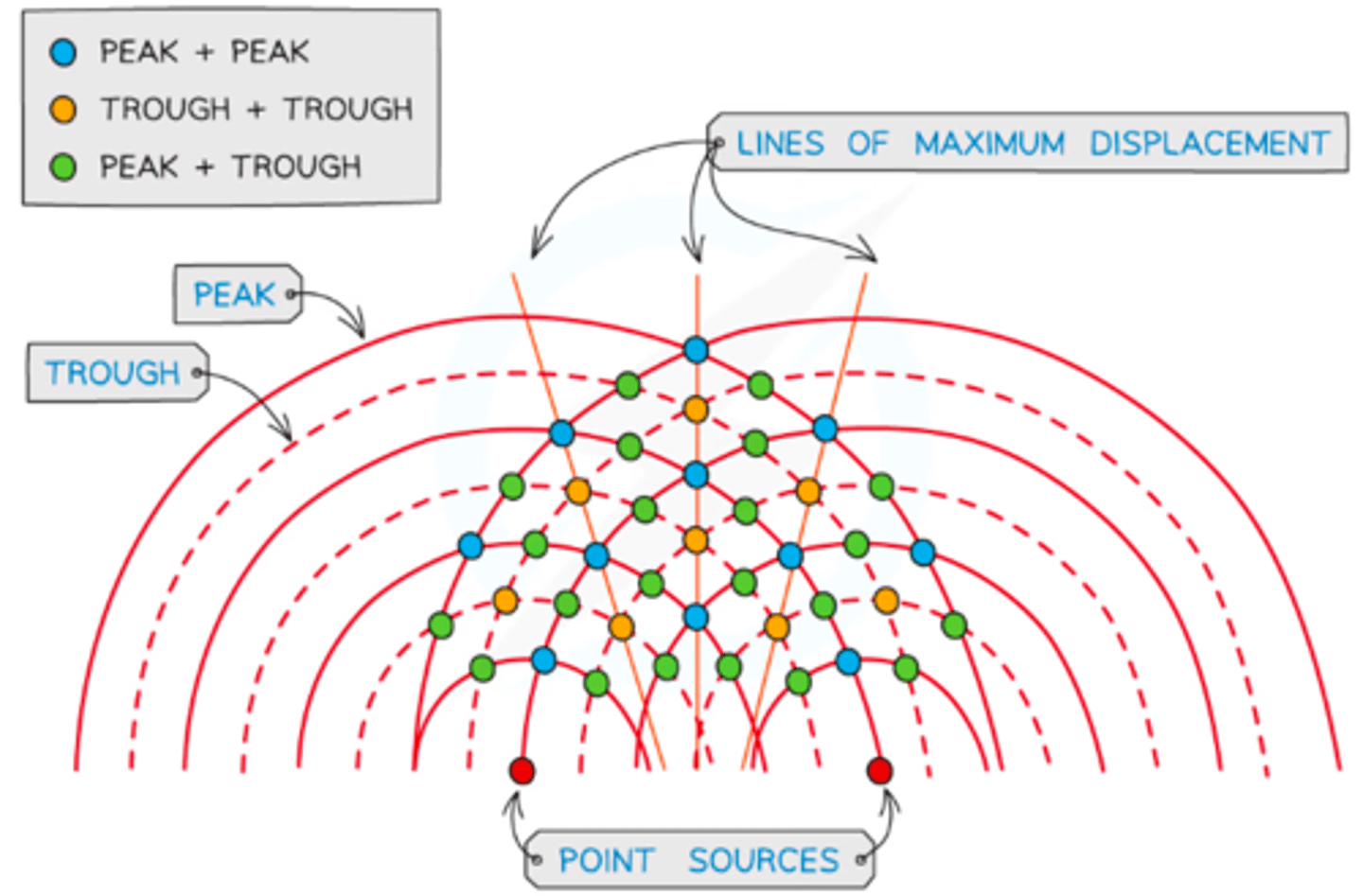
Two Slit Diffraction Pattern
diffraction pattern of two slits of width D that are separated by a distance d is the interference pattern of two point sources showing a standing wave like pattern of antinodes and nodes just seen as maximas and minimas.
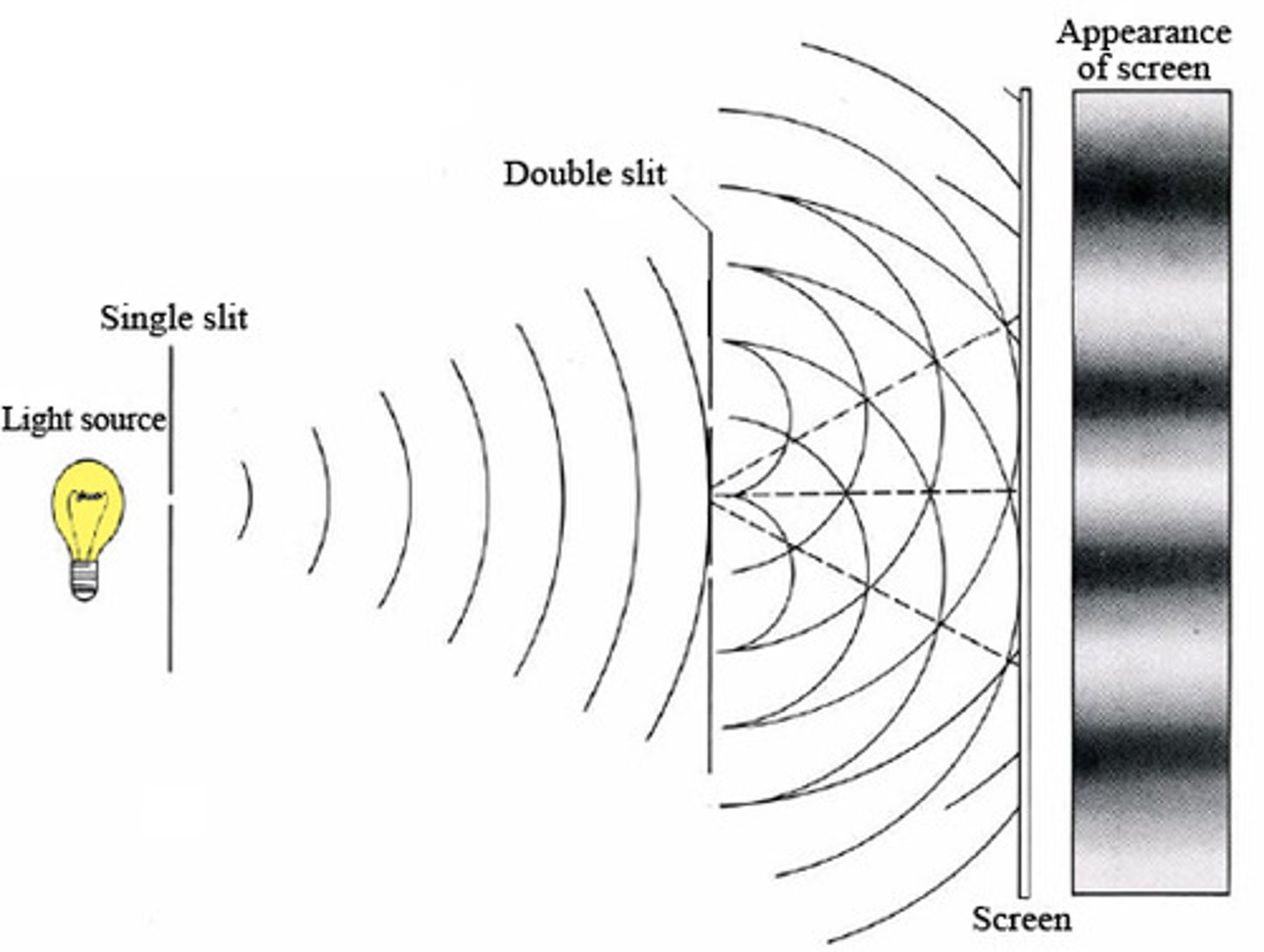
Maxima
Waves meet with 0° phase difference, reulting in constructive superposition occurs producing a point of maximum amplitude
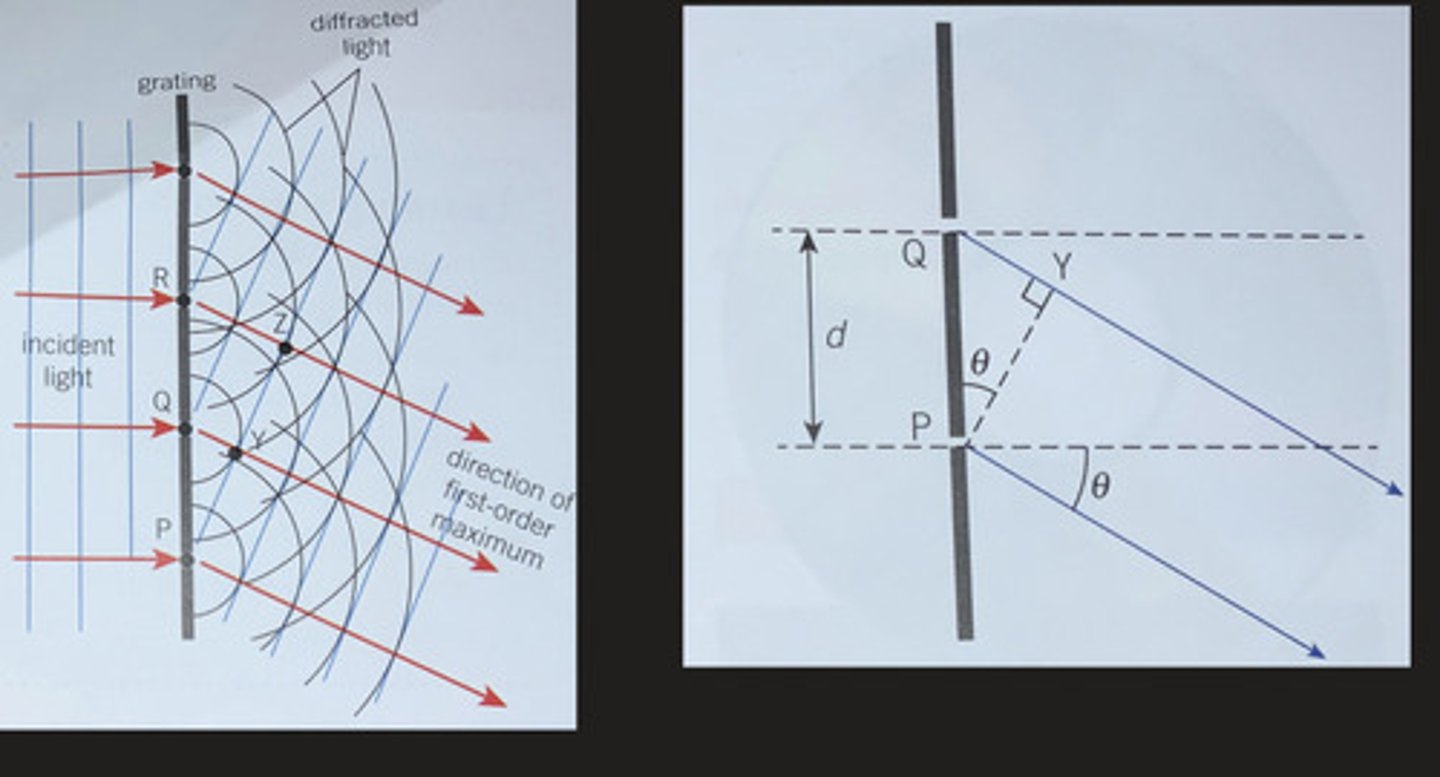
Minima
Waves meet with a 180° phase difference, resulting in destructive superposition occurs producing a point of minimum amplitude
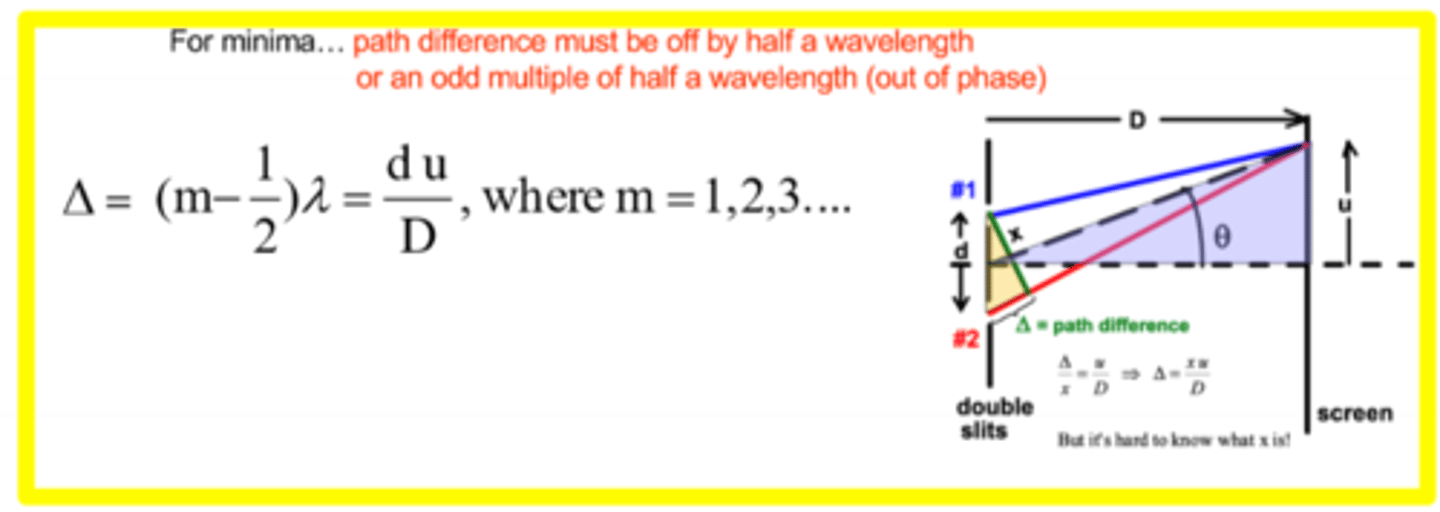
Path difference between slits
path difference = d sin0
Displacement
The distance and direction in which the wave moves