ASTR 121 Albright Final
 Call Kai
 Learn
Learn Practice Test
 Spaced Repetition
 Match
Match Flashcards
 Knowt Play
1/51

There's no tags or description
Looks like no tags are added yet.
Name | Mastery | Learn | Test | Matching | Spaced | Call with Kai |
|---|
No analytics yet
Send a link to your students to track their progress
52 Terms
What is a planetary nebula? How are they formed and what type of stars become planetary nebula?
The expelled outer layers of a low mass star. They form when the star has become a red giant and blows off the outer layers revealing the burned out core.
How were each of these elements formed in our Universe?
H -> Li - formed during first three minutes after Big Bang
Be -> O - fused in the cores of low mass stars (< 8 Solar Masses)
F -> Fe - fused in the cores of high mass stars (>8 Solar Masses)
Fe - made during the first 15 minutes after a supernova
Explain three reasons why it is difficult to study star formation.
- Too dark - form deep within Giant Molecular Clouds
- Too fast - formation time is short, hard to catch in the act
- Too small - individual stars forming are too small to see with current telescopes
Write the formula for Hubble's Law? What does this law say? How did it give rise to the Big Bang Theory?
- v = (Ho)d
- v = (Ho)d. or velocity = (Hubble Constant) x distance
- states that the velocity of a galaxy is directly proportional to it's distance
- if something is x times as far away from us, it goes x times as fast
- since the universe is getting bigger, if you run time backwards it all collapses down to one point, the origin of the universe from this one point is the Big Bang
Why do we think dark matter exists? How much dark matter seems to exist?
The velocity of stars out beyond the edge of the galaxy is higher than it should be indicating there is more mass far out in the galaxy causing the high velocities.. Since it gives off no light, we call it dark matter. There seems to be about six times more dark matter than 'regular' matter in the universe.
Compare and contrast Population I stars and Population II stars. (age, location, metals, orbits)
- Population I - located in the disk of the Milky Way, high metal content, mostly young stars, flat circular orbits around the galaxy, second generation stars
- Population II - located in the central bulge and halo of the Milky Way, low metal content, old stars, spherically distributed around galaxy, first generation stars
Explain why all elements heavier than iron must be formed during a supernova explosion.
Elements heavier than iron require that energy be PUT IN to make them. The only time this 'free' energy is available is right after a supernova explosion.
Explain how astronomers determine what elements are in stars.
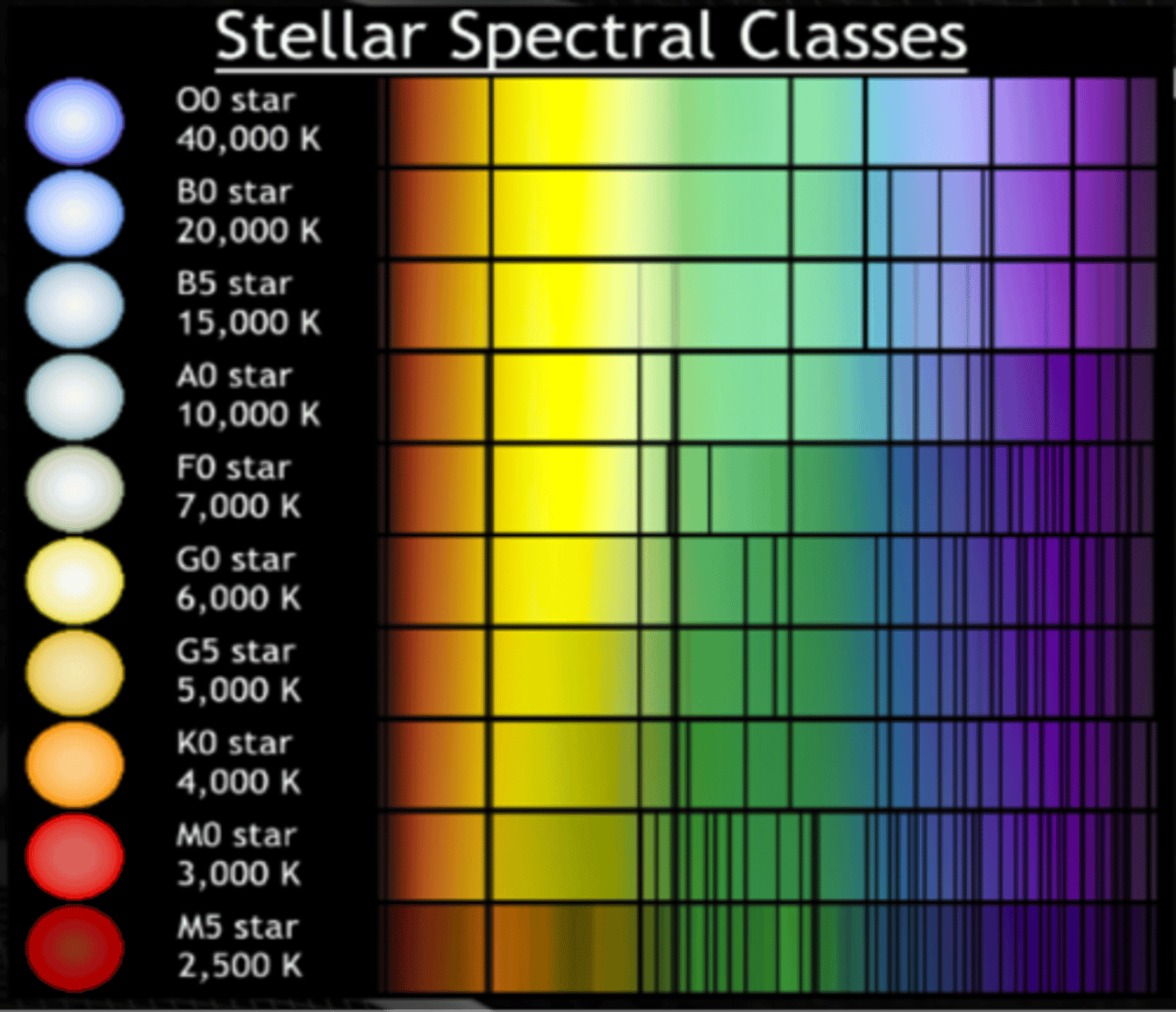
Each element has a unique set of spectral lines, like a fingerprint, astronomers take a spectrum of a star and match the absorption lines to the known lines of all the elements.
Describe and open, closed, and flat universe. Which do astronomers think we live in?
- Open- not enough mass/energy to stop the expansion of the universe; space and time are infinite
- Closed - there is enough mass/energy to stop expansion and cause the universe to recollapse on itself; space and time are finite
- Flat- there is exactly the right amount of mass/energy and the velocity of the universe approach zero in an infinite amount of time.
- We think we live in a flat universe.
What is hydrostatic equilibrium? Why is it important in the Sun? How do we know the Sun is in hydrostatic equilibrium? What happens if the Sun is not in hydrostatic equilibrium?
Hydrostatic equilibrium is when gas pressure is equal to gravity. It is important allows the Sun to hold itself up and we know it is in HE because it staying the same size. If it is not in HE, it will either shrink or expand.
Explain how the Sun gets its energy? Write the nuclear reaction. How does the formula E = mc2 help to explain how stars get their energy?
- The Sun gets it energy through hydrogen fusion, the four hydrogen have more mass than the one helium and the difference in mass is converted into energy by E=mc2. 4H -> He
What causes high mass stars to go supernova? What is left after the supernova explosion?
- The core of a high mass star fuses elements up to iron (most stable element) no further fusion is possible. When the iron core exceeds 1.4 solar masses (Chandra limit) it can no longer hold itself up and it collapses. The outer layers crash down on the core and are ejected outwards. What is left is a neutron star.
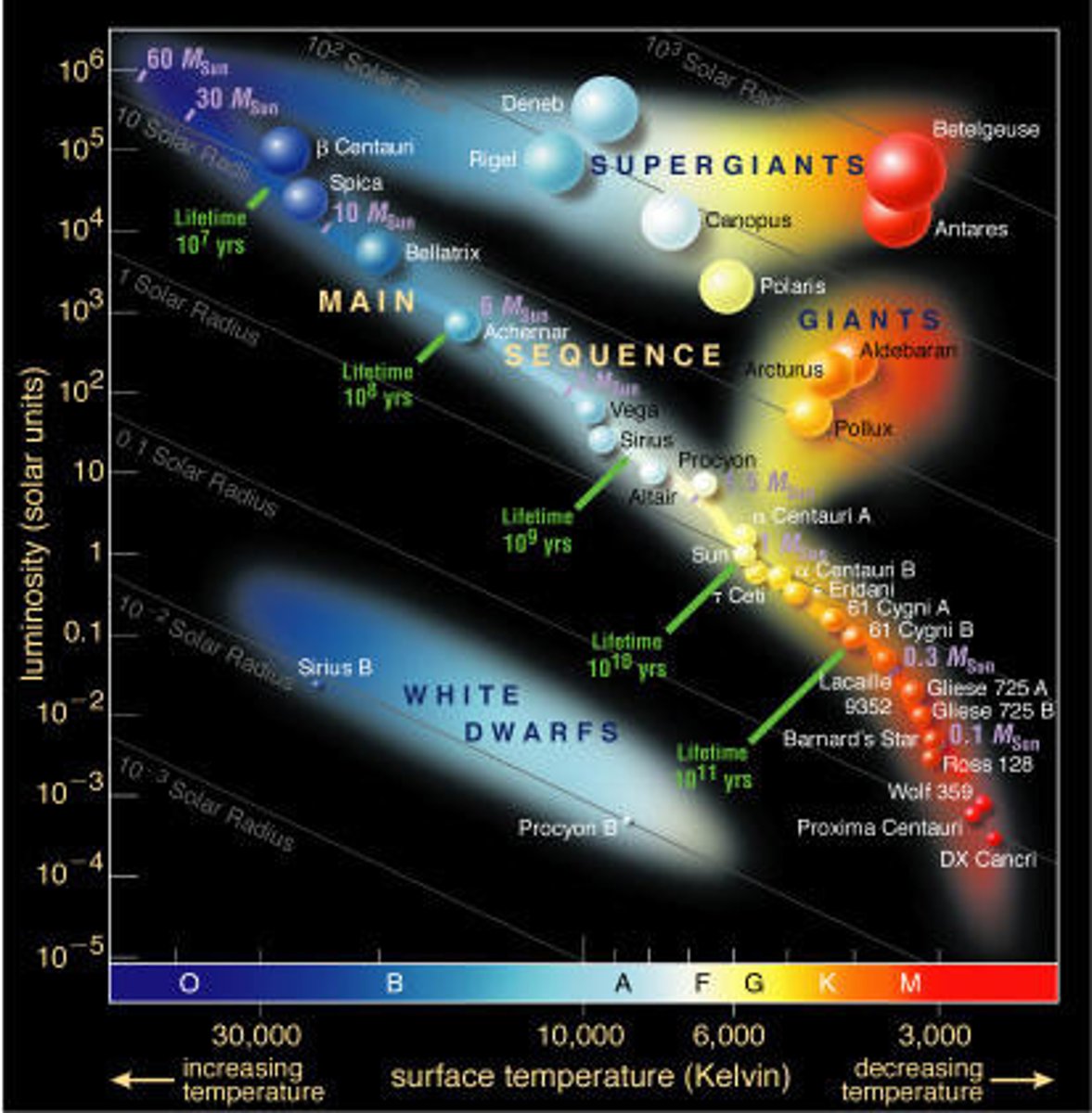
Hertzsprung-Russell diagram
a graph relating the surface temperatures and absolute brightness of stars
What is the event horizon around a black hole? Why is it called 'event horizon'? What is left of a star that becomes a black hole?
- The event horizon is the sphere around a black hole where the escape velocity is equal to the speed of light. It is called that because any 'events' inside the sphere are unknowable to the rest of the universe. The mass collapses forever to zero volume called a singularity.
What is a white dwarf star? What supports the star against gravity?
- A white dwarf is an Earth-size burned out core of a low mass star in the center of a planetary nebula. It is supported by electron degeneracy pressure where the electrons refuse to get into the same energy state and so pushed back against gravity.
white dwarf star
small, hot star that is the leftover center of an older star; has no hydrogen left and cannot generate anymore energy; can shine for billions of years before completely cooling off.
neutron star
the small, dense remains of a high-mass star after a supernova
event horizon
the location around a black hole where the escape velovity equals the speed of light; the boundary of a black hole
escape velocity
The velocity an object must reach to fly beyond a planet's or moon's gravitational pull.
black hole
a region of space having a gravitational field so intense that no matter or radiation can escape.
singularity
A point in which matter is infinitely dense, as in the center of a black hole or the universe at the very beginning.
Chandra Limit (1930)
Maximum possible mass for a white dwarf is 1.4 Mo
E=mc^2
Einstein's equation proposing that energy has mass; This conversion formula describes the amount of energy that is released when we convert matter into energy
hydrostatic equilibrium
the balance of the inward gravitational force and the outward force of gasses from fusion within a star. This balance of forces is what keeps a main sequence star stable and prevents it from collapsing in on itself or expanding
spectral lines
The wavelengths where a specific element can absorb or emit light
Supernova
A gigantic explosion in which a massive star collapses and throws its outer layers into space
dark matter
(cosmology) a hypothetical form of matter that is believed to make up 90 percent of the matter in the universe
matter that does not give off electromagnetic radiation but is quite abundant in the universe
Hubble's Law
proves that the universe is expanding. The farther a galaxy is, the faster it moves away from us. V = H x d
planetary nebula
A huge cloud of gas that is created when the outer layers of a red giant star drift out into space
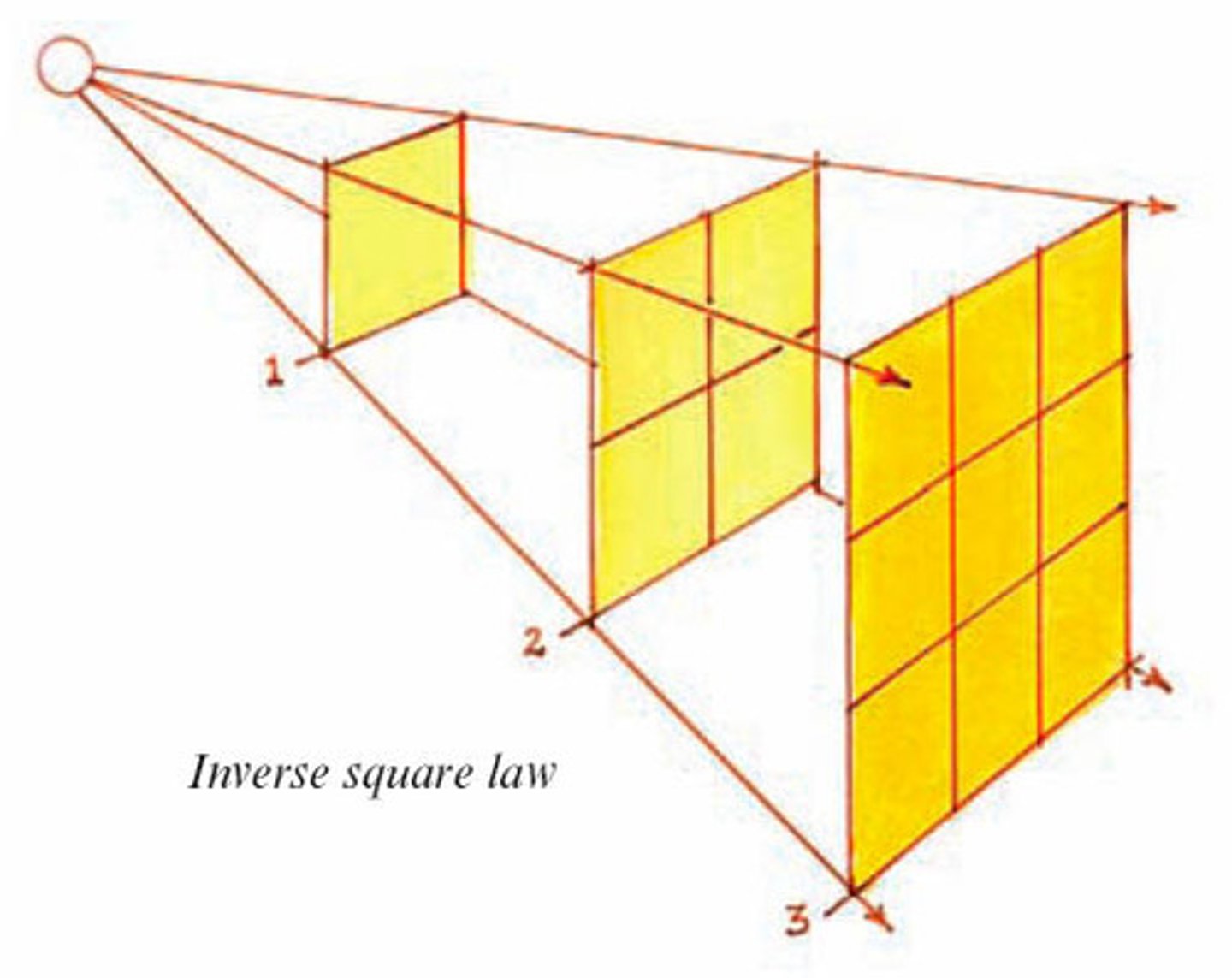
inverse square law
the brightness decreases as the square of the distance from the source
If we move the source twice as far away, itis ¼ as bright
If we move the source three times as faraway, it is 1/9 as bright
If we move it four times as far, it is 1/16 as bright
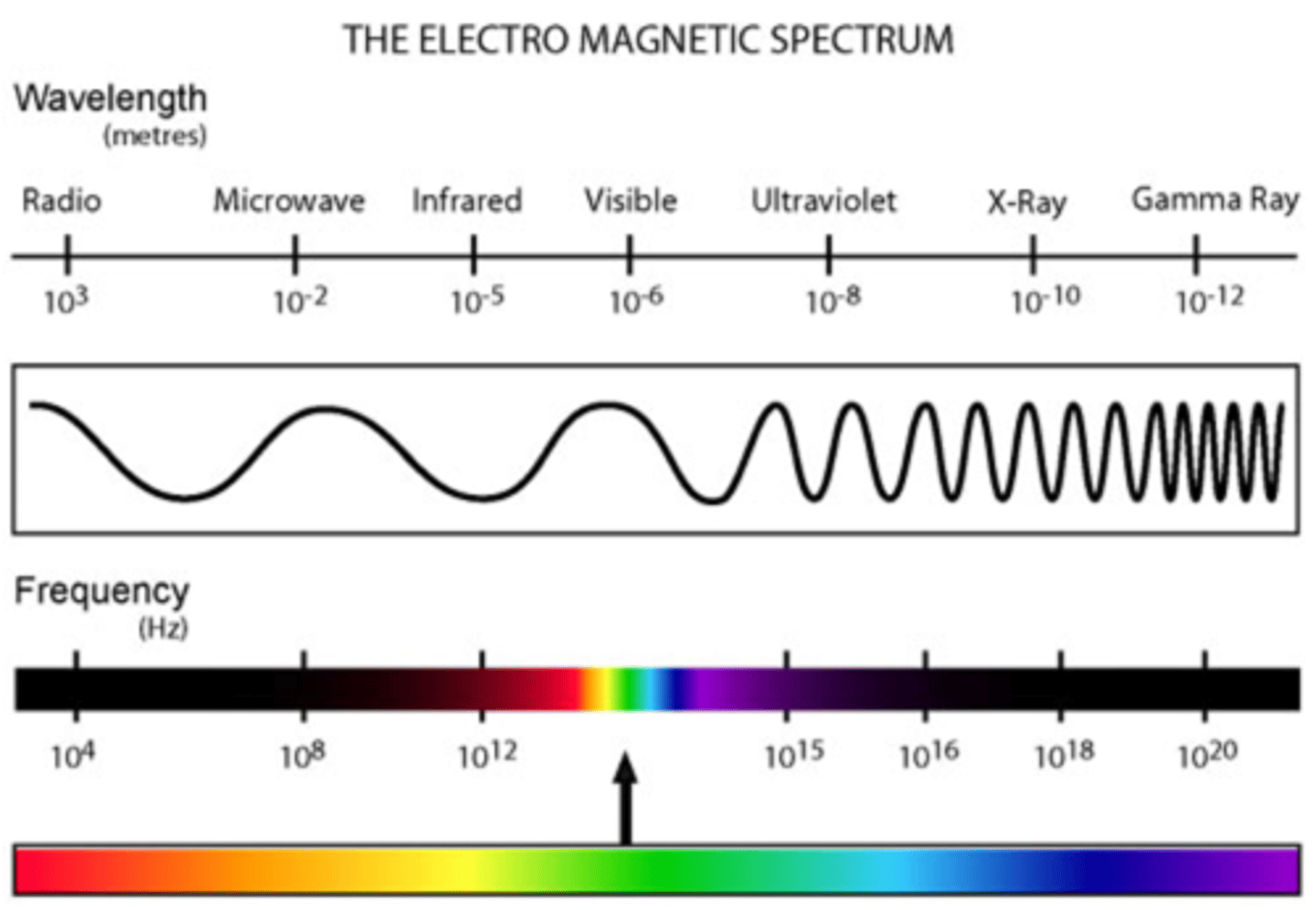
electromagnetic waves
A form of energy that can travel through space.
Doppler shift
change in the apparent frequency of a wave as observer and source move toward or away from each other
red shift
the change in the wavelength of light due to an object moving away from the observer.
blue shift
the displacement of the spectrum to shorter wavelengths in the light coming from distant celestial objects moving toward the observer.
How is energy generated in the sun?
nuclear fusion of hydrogen into helium
nuclear fusion
Fusion reactions are those where light atomic nuclei come together to form heavier atomic nuclei.
Elements in the sun
74% Hydrogen; 25% Helium; <1% everything else
spectral types of stars
(Hottest) O B A F G K M L (Coolest)
- subclasses of 0-9 for each letter with 0 being hottest and 9 being coolest
Lifetime of a star
depends on its mass
The rate of fusion depends strongly on the temperature of the core
• High mass stars have much hotter cores,which means that the rate of fusion is muchhigher (hence their greater luminosity).
• Although high mass stars have more fuel, they burn it more quickly than low mass stars and their lifetimes on the main sequence are shorter.
main-sequence turnoff
The point on a cluster's H-R diagram where its stars turn off from the main sequence; the age of the cluster is equal to the main-sequence lifetime of stars at the main-sequence turnoff point.
red giant
a very large star of high luminosity and low surface temperature. Red giants are thought to be in a late stage of evolution when no hydrogen remains in the core to fuel nuclear fusion.
white dwarf
Stage in which a star has used up its helium and its outer layers escape into space, leaving behind a hot, dense core that contracts
typically, the remaining degenerate star(white dwarf) is about the size of the Earthwith a mass about 1/2 MSun
since white dwarfs are supported bydegenerate electrons, they have theinteresting property that they shrink insize as the mass increases.• A white dwarf with the mass of the Sunis a bit smaller than the Earth.
Nucleosynthesis
(astronomy) the cosmic synthesis of atoms more complex than the hydrogen atom
binding energy
The binding energy is a measure of the force holding the nucleus of an atom together.
- The higher the binding energy, the more tightlybound is the nucleus.
- The most tightly bound nucleus of all is iron-56.
- Elements with atomic masses less than 56 canundergo fusion to form elements that are morestable.
- Elements with atomic masses greater than 56 canundergo fission.
General Relativity Theory
1915-Albert Einstein's theory that space and time are relative to matter. States that massive objects curve or warp space-time.
Size of Milky Way Galaxy
100,000 light years (diameter)
Star Forming Regions
-Stars form in giant molecular clouds, which typically contain several million times
the Sun's mass worth of gas and dust
- The massive molecular clouds arefound in the spiral arms of the Galaxy.- Therefore, it is not surprising that this iswhere we see the young, hot stars in spiralgalaxies since these stars do not live longenough to have moved from their birthplaces.
-The famous "Orion Nebula" and the "Eagle Nebula" are examples
Milky Way star types
The disk is dominated by a few large spiral arms which contain many young,hot stars and appear blue in color. Thebulge contains mostly old evolvedgiants, so it appears yellow in color.
type of galaxy the milky way is
spiral galaxy
Expansion of the Universe
the idea that the space between galaxies or clusters of galaxies is growing with time.
The location of the "Big Bang" is
everywhere
Age of the Universe
13.8 billion years