Gothic Key Images
 Call Kai
 Learn
Learn Practice Test
 Spaced Repetition
 Match
Match Flashcards
 Knowt Play
1/18

There's no tags or description
Looks like no tags are added yet.
Name | Mastery | Learn | Test | Matching | Spaced | Call with Kai |
|---|
No analytics yet
Send a link to your students to track their progress
19 Terms
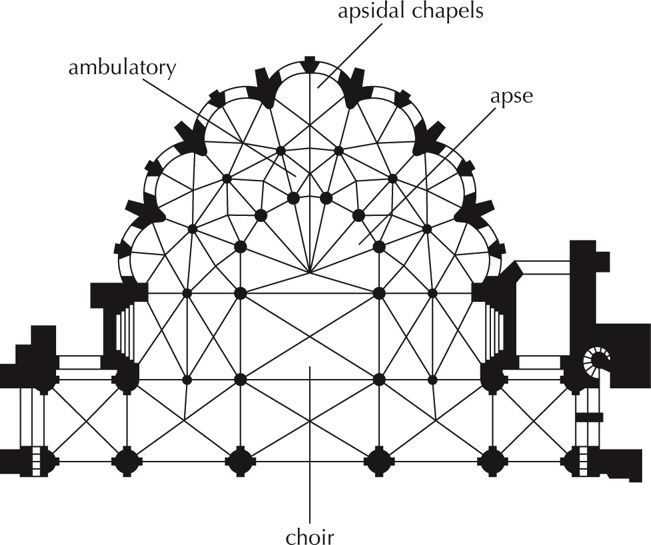
Plan of the choir and ambulatory, abbey church of Saint-Denis, France. 1140–44. Renovated by Abbot Suger. Familiar elements from the Romanesque pilgrimage choir, but the entire plan is held together by a new kind of geometric order. Seven nearly identical wedge-shaped units fan out from the center of the apse. Instead of being in separate apsidioles, the chapels merge to form, in effect, a second ambulatory. We experience this double ambulatory not as a series of individual compartments but as a continuous space, the shape of which is outlined by the network of slender arches, ribs, and columns that sustains the vaults
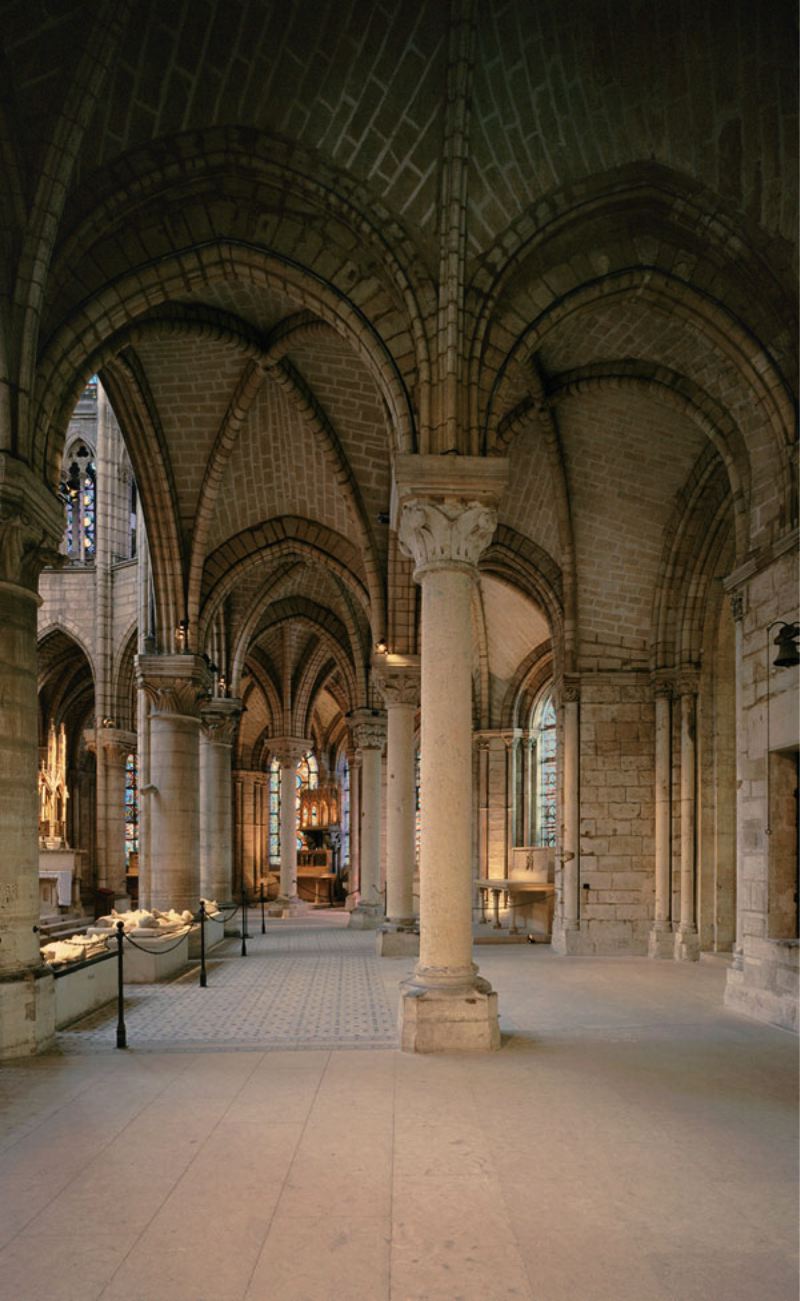
Ambulatory of abbey church of Saint-Denis. The architectural forms seem graceful, almost weightless, compared to the massive solidity of Romanesque architecture.
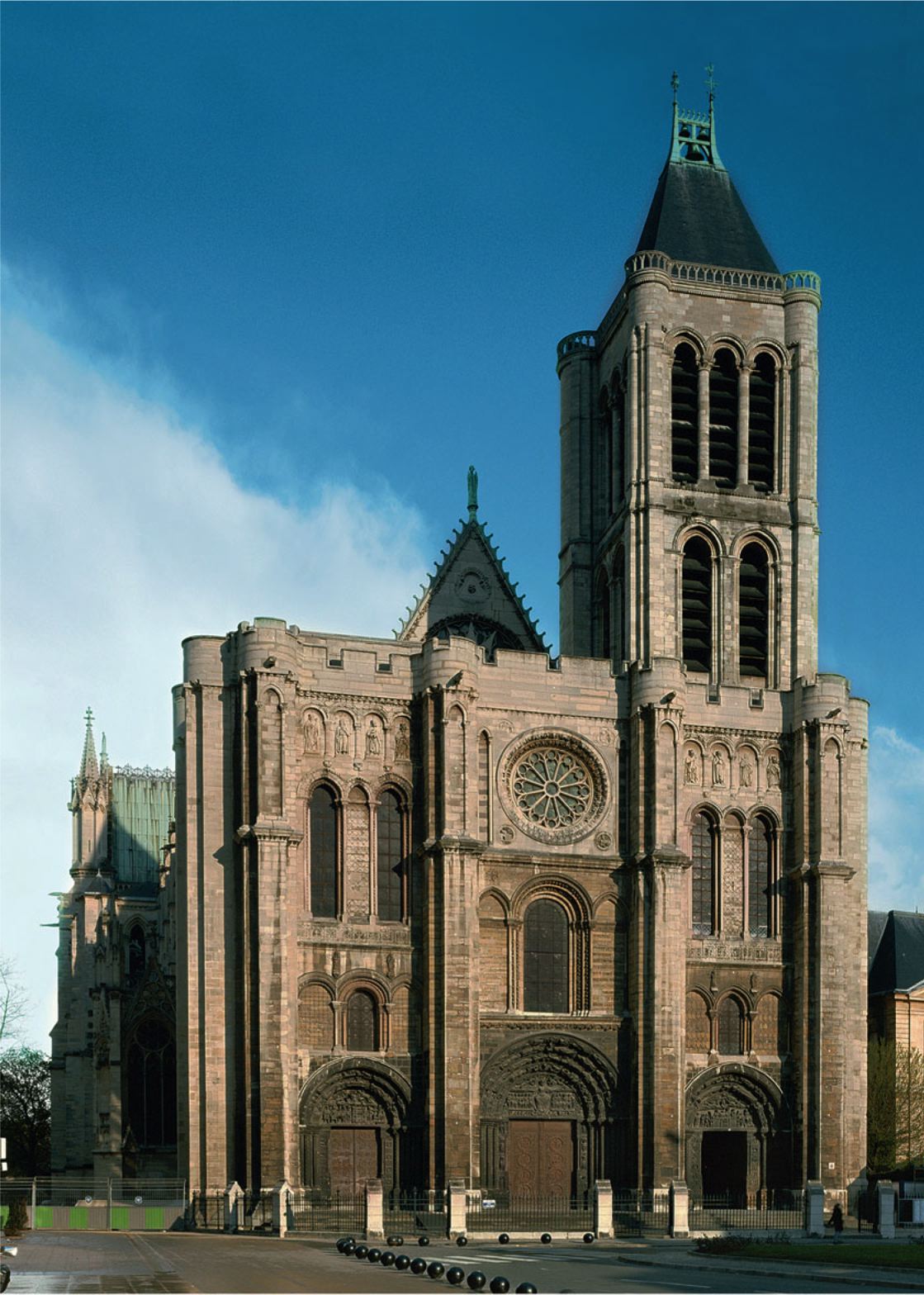
West façade of abbey church of Saint-Denis. ca. 1137–40. A part of Saint-Denis that Abbot Suger rebuilt. Has many Romanesque characteristics (i.e. buttresses), but it is grander.
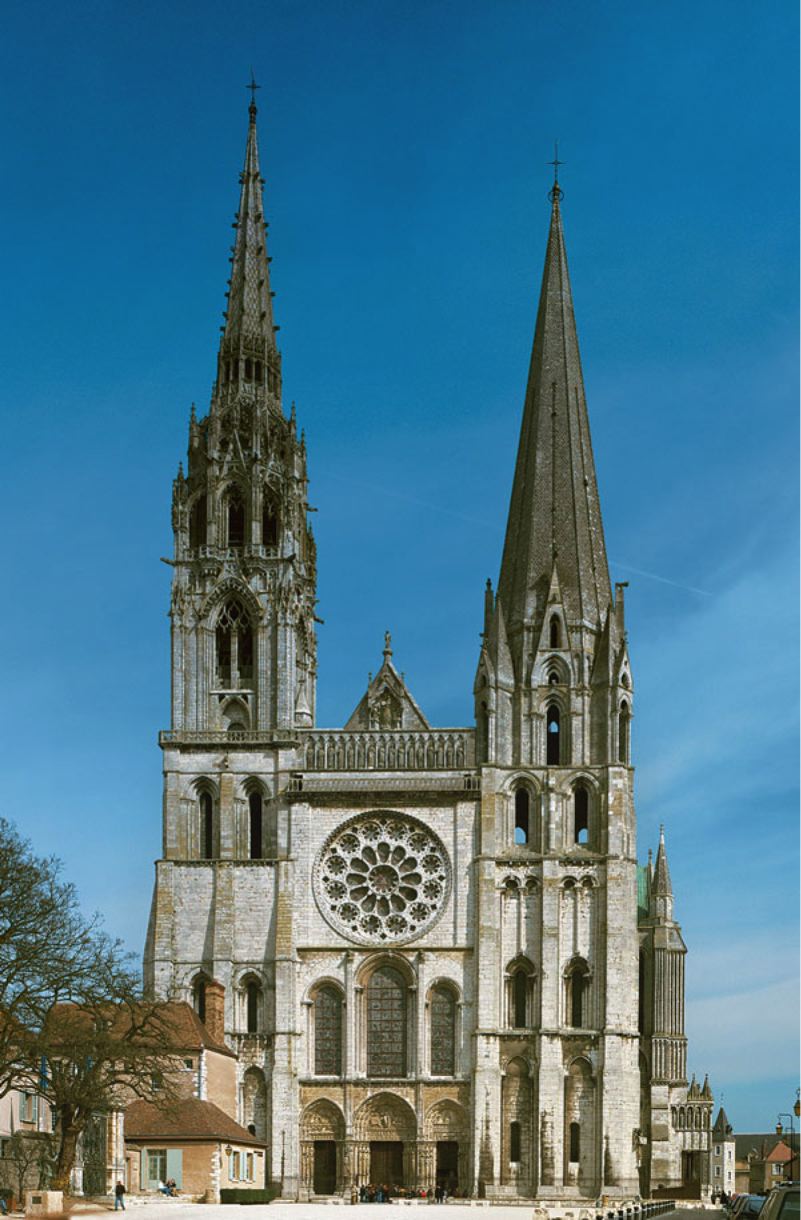
West façade of cathedral of Notre-Dame, Chartres, France. ca. 1145–1220. Reminiscent of Saint-Denis. Because construction proceeded in stages and was never entirely finished, the harmony of the result is evolutionary rather than systematic. For example, the two west towers, though similar, are by no means identical. Moreover, their spires, the tall towers with tapering roofs, are very different.
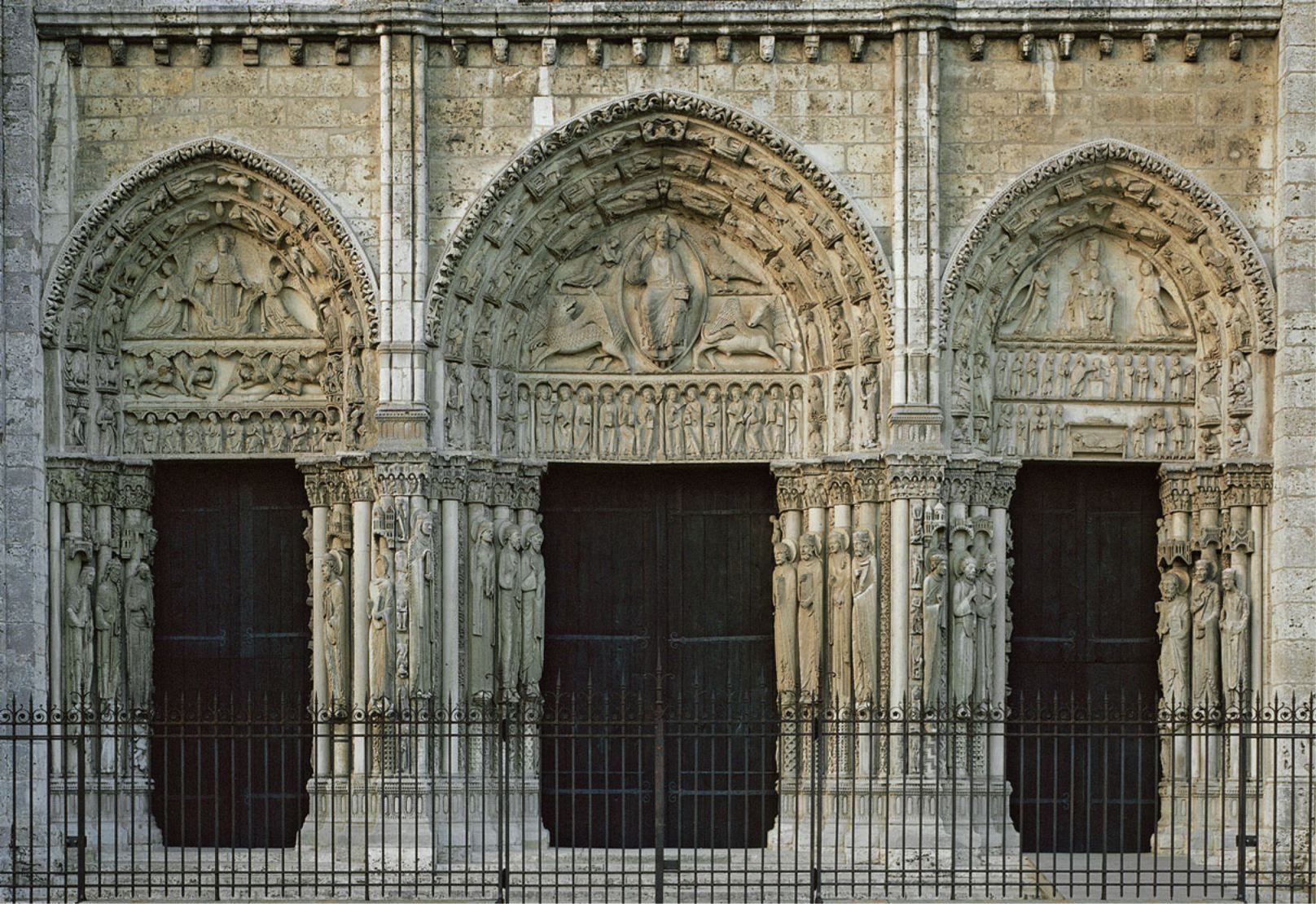
West portal (Royal Portal) of cathedral of Notre-Dame, Chartres. ca. 1145–50. Naturalism appears as if in reaction against the fantastic and demoniacal aspects of Romanesque art, a response that may be seen in the solemn spirit of the figures and their increased physical bulk. The jambs represent the prophets, kings, and queens of the Hebrew Bible. They acclaim the rulers of France as their spiritual descendants, and stress the harmony of spiritual and secular rule, of priests (or bishops) and kings—ideals previously put forward by Abbot Suger. Calm and comforting.
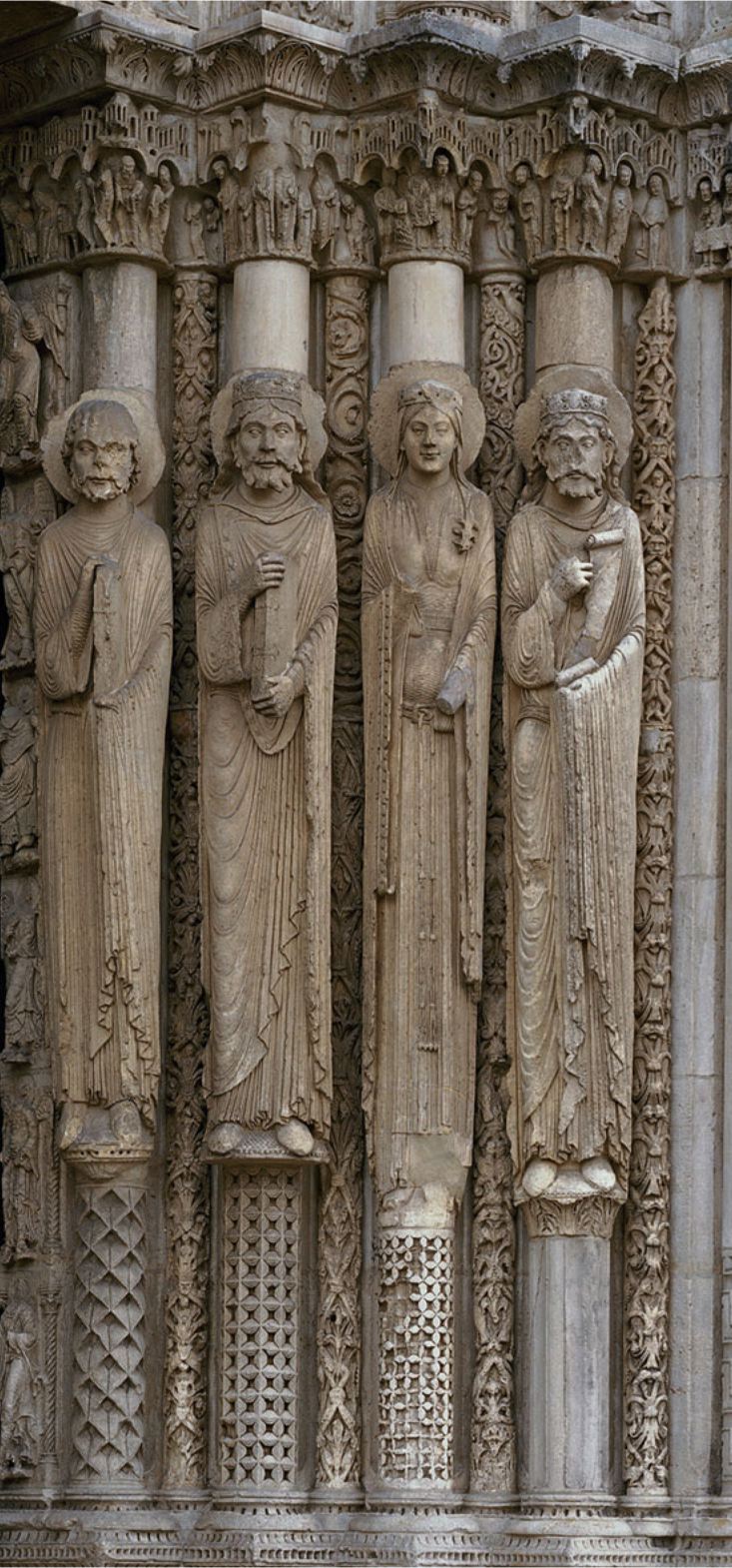
Jamb statues, west portal of cathedral of Notre-Dame, Chartres. The Chartres jambs are so similar to those of the original Saint-Denis portals that the same sculptors must have worked on both buildings.
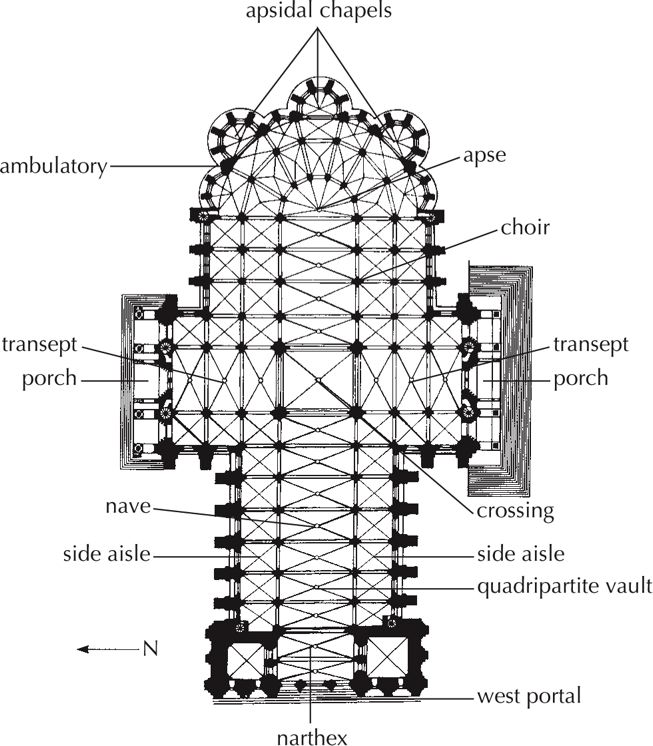
Plan of cathedral of Notre-Dame (as rebuilt after 1194), Chartres. To provide room for large numbers of visitors without disturbing worshipers, there is a wide aisle running the length of the nave and around the transept.
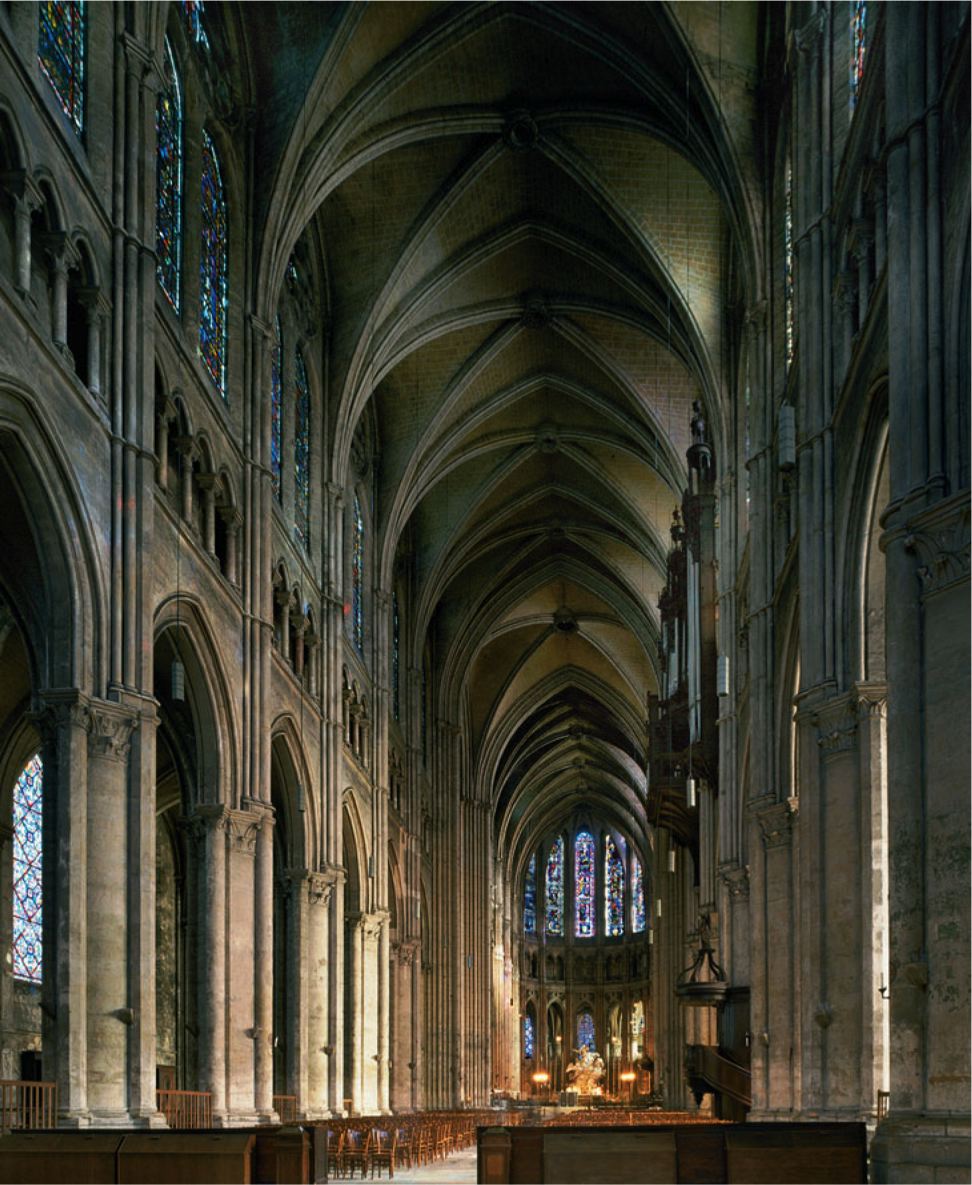
Nave and choir of cathedral of Notre-Dame, Chartres. ca. 1194–1220. The first fully developed example of the mature, or High, Gothic.
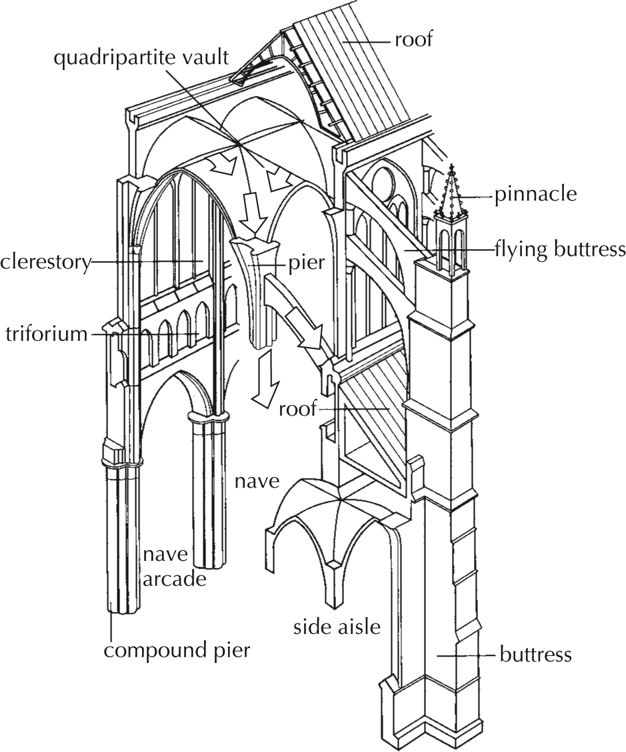
Axonometric projection of a High Gothic cathedral (after Acland). By eliminating the gallery, the designers of Chartres imposed a three-part elevation on the wall
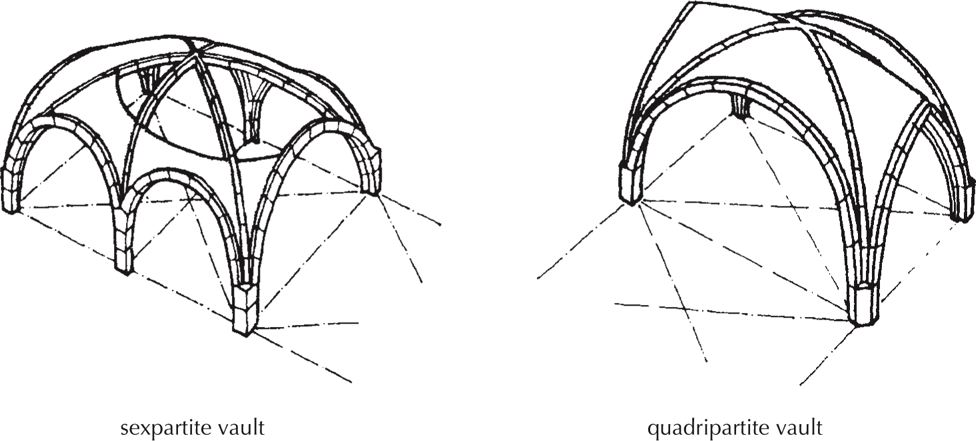
(a) Sexpartite vaulting and (b) quadripartite vaulting. High Gothic art (e.g. Notre-Dame, Chartres) used quadripartite vaulting, while early Gothic (e.g. Saint-Denis) used sexpartite.
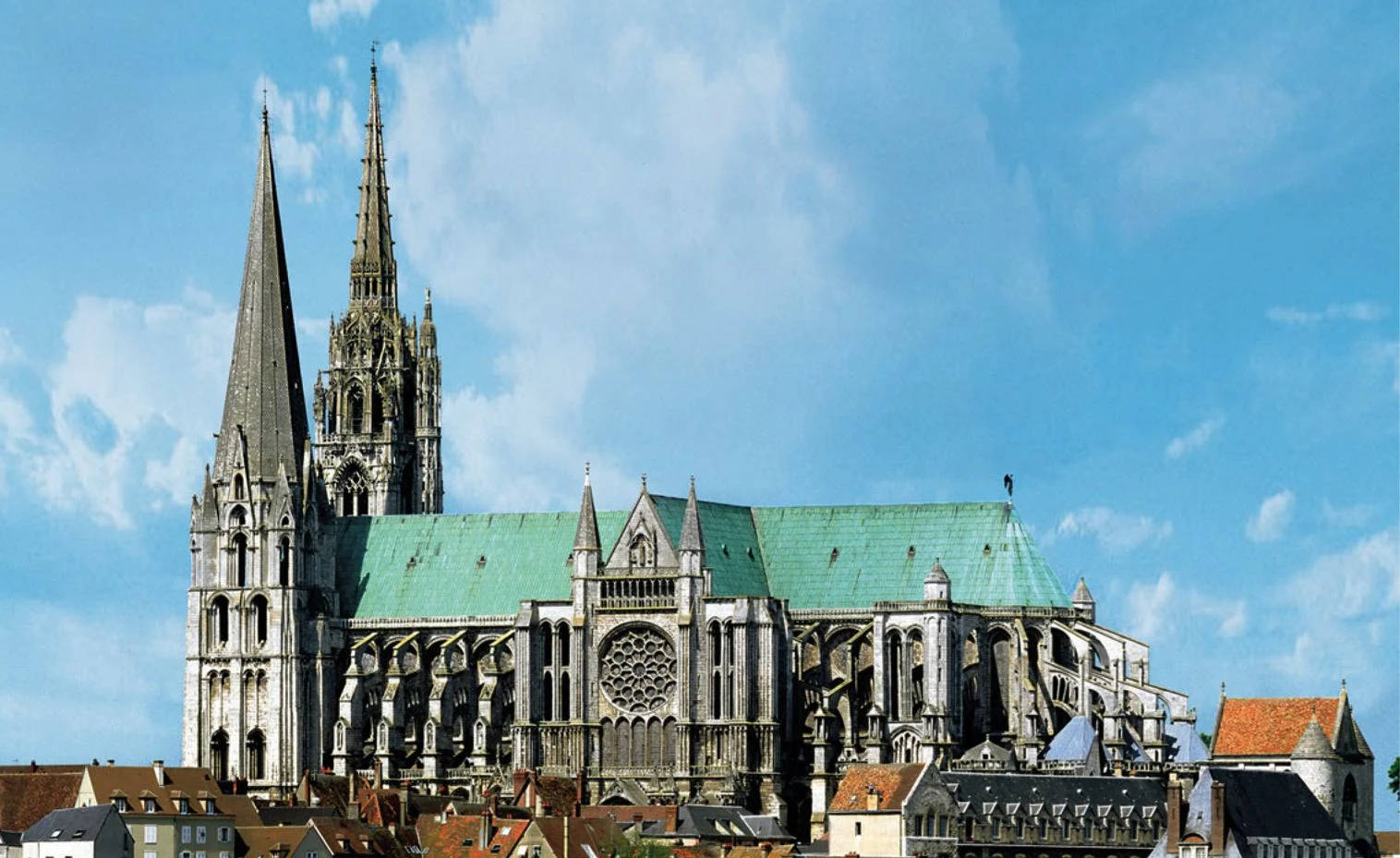
Cathedral of Notre-Dame, Chartres (from the south). Shows flying buttresses.
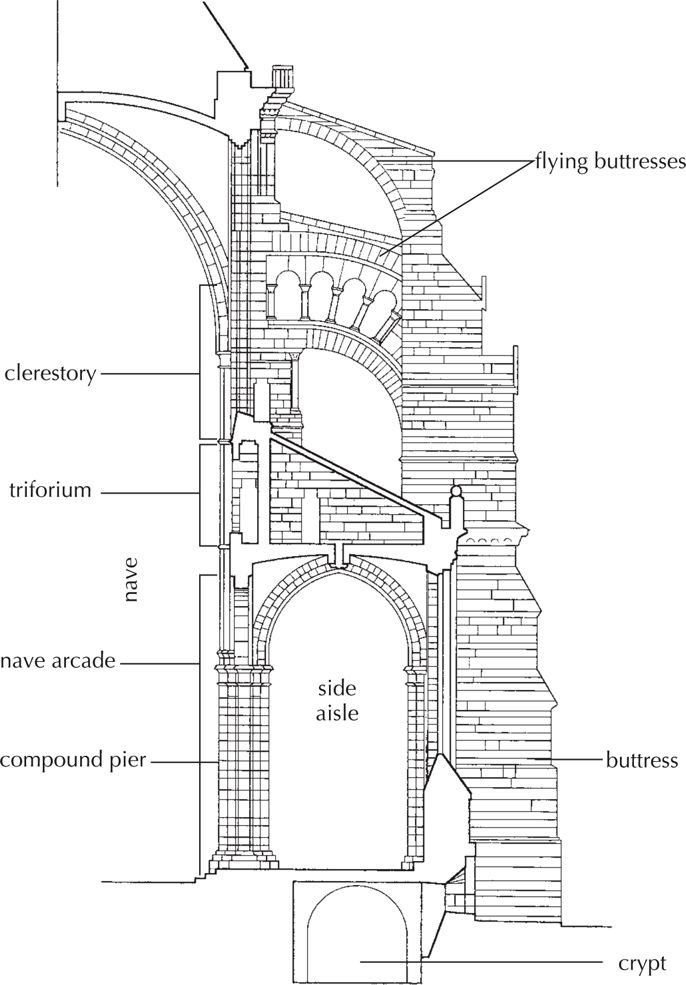
Transverse section of cathedral of Notre-Dame, Chartres (after Acland).
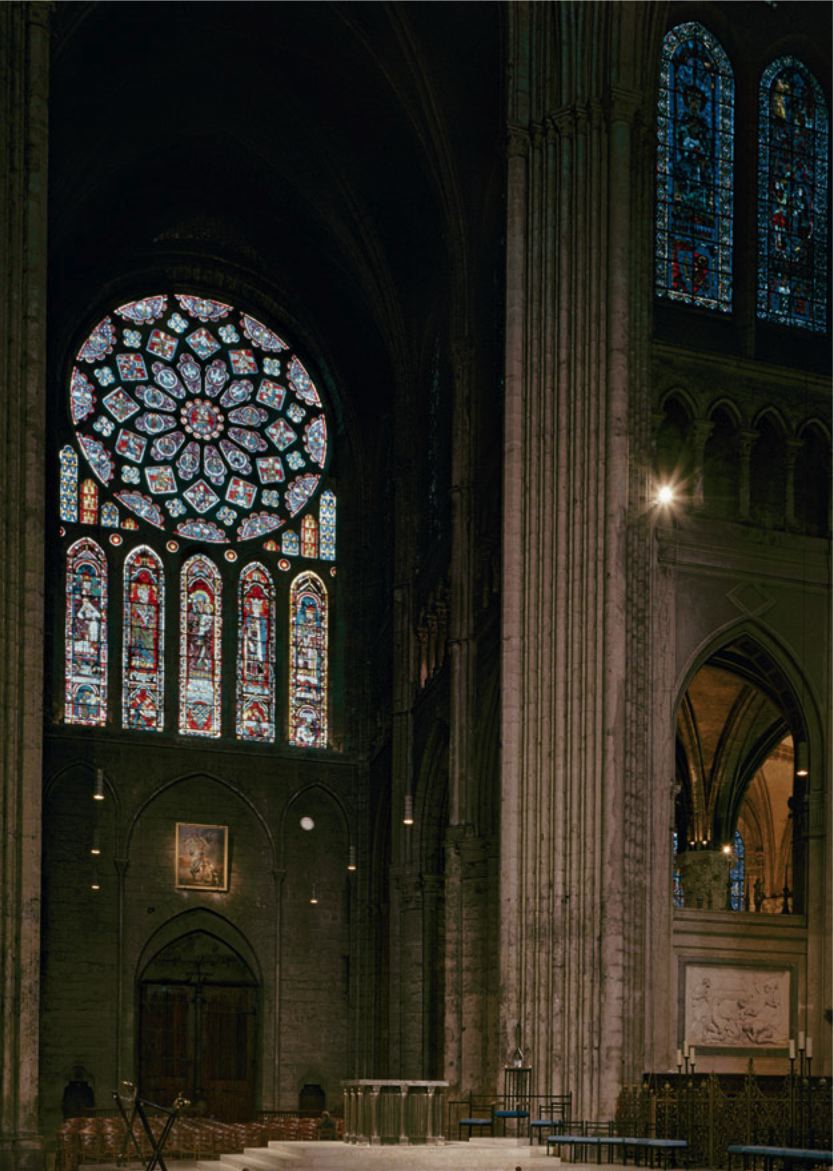
North transept of cathedral of Notre-Dame, Chartres. The windows act mainly as diffusing filters that change the quality of daylight, giving it the poetic and symbolic values so highly praised by Abbot Suger. The sensation of ethereal light dissolves the physical solidity of the church and, hence, the distinction between the temporal and the divine realms. This “miraculous light” creates the intensely mystical experience that lies at the heart of Gothic spirituality.
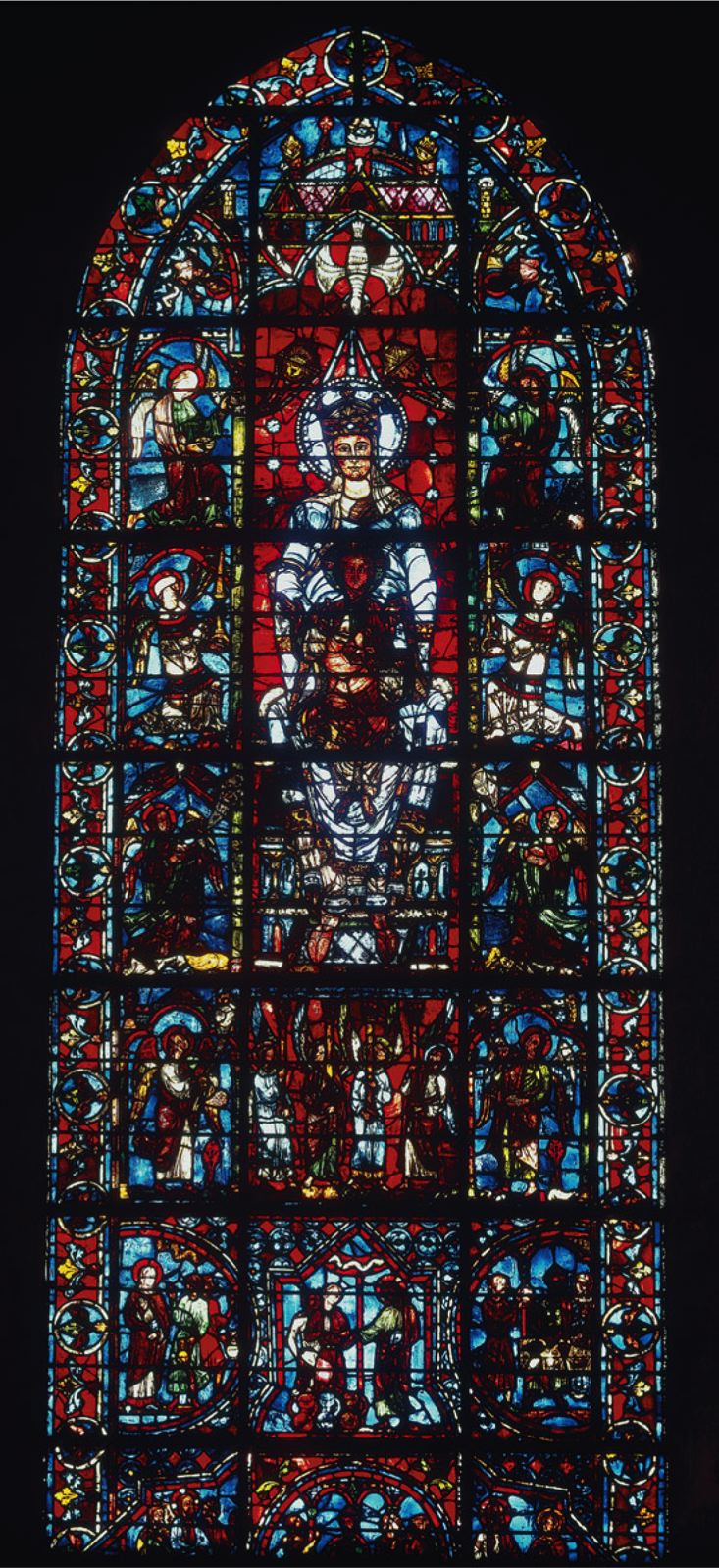
Notre Dame de la Belle Verrière, cathedral of Notre-Dame, Chartres. ca. 1170 (framing panels are 13th century). Stained-glass window. Name literally means “Our Lady of the Beautiful Window.” It was assembled much like a mosaic or a jigsaw puzzle, out of odd-shaped fragments cut to fit the contours of the shapes. This process encourages an abstract, ornamental style, which tends to resist any attempt at three-dimensional effects.
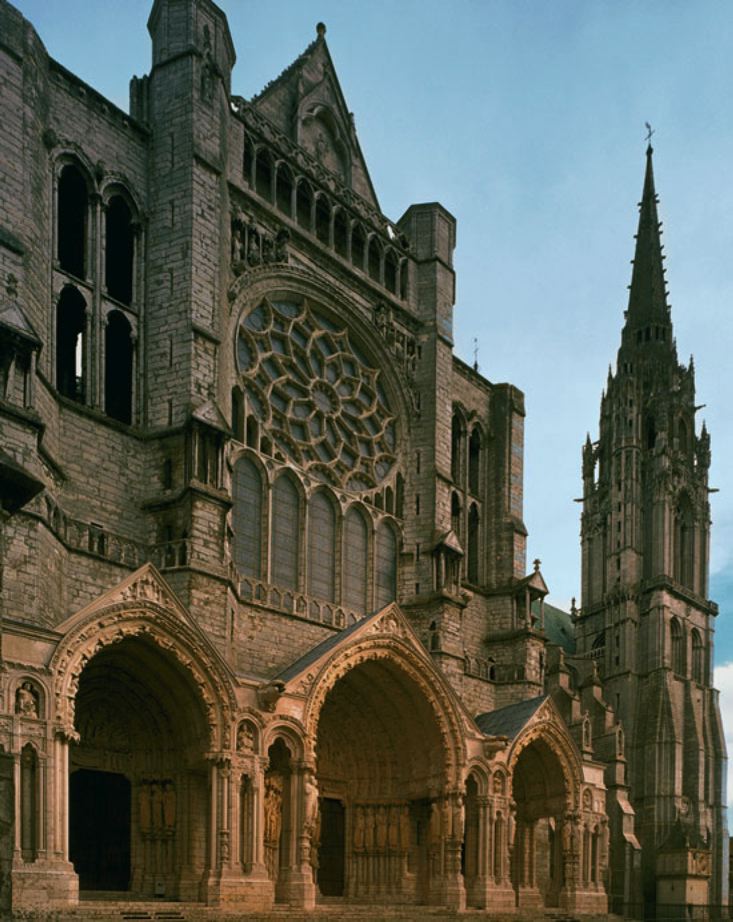
Portals, north transept of cathedral of Notre-Dame, Chartres. ca. 1204–30. Is devoted to the Virgin Mary. The growth of Mariology, as it is known, was linked to a new emphasis on divine love, embraced by the faithful as part of a more human view of Christianity that increased in popularity during the Gothic era. The Cathedral recieved the head of her mother, St. Anne as a relic.
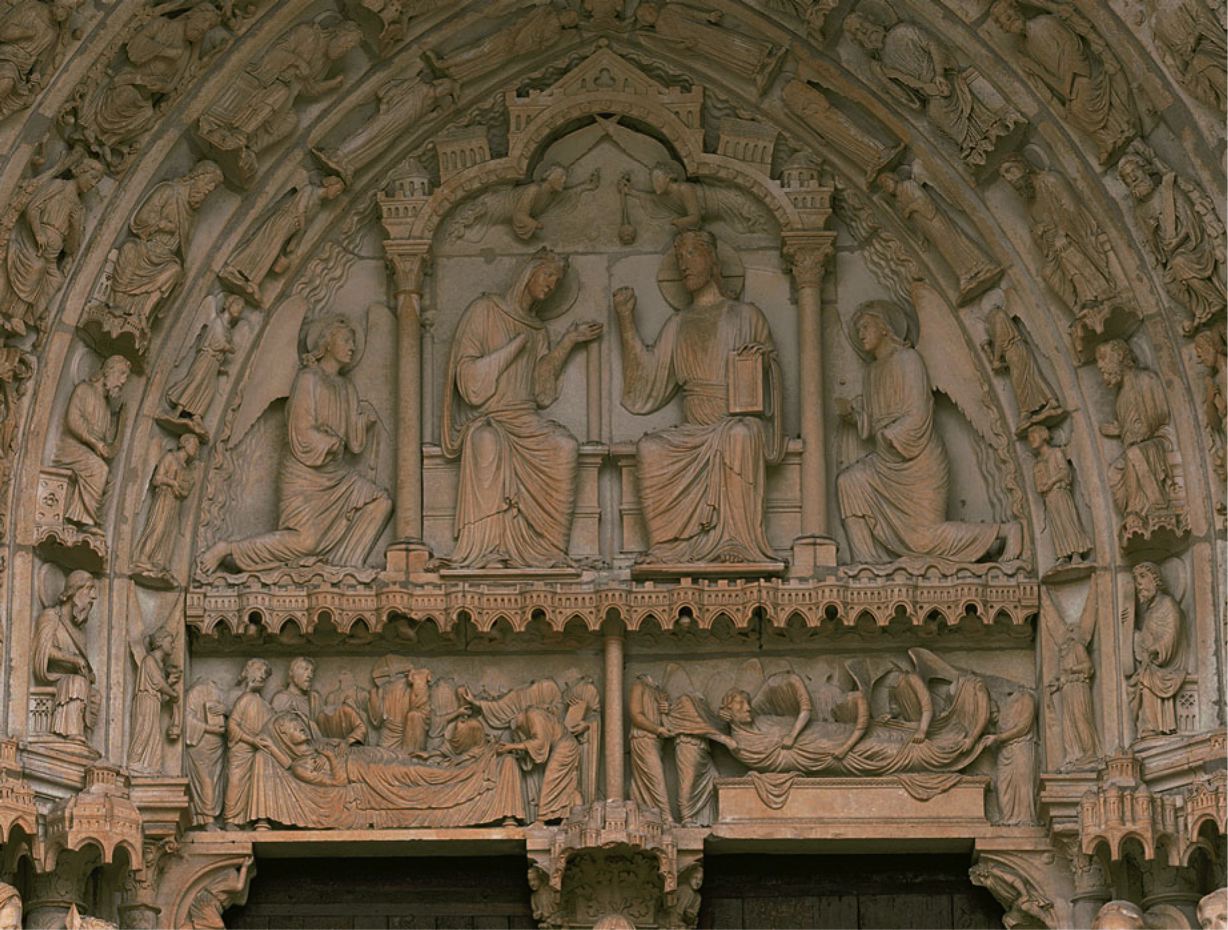
Coronation of the Virgin (tympanum), Dormition and Assumption of the Virgin (lintel), north portal of cathedral of Notre-Dame, Chartres. ca. 1210. Depicts events associated with the Feast of the Assumption, when Mary was transported to Heaven. These events are the Death (Dormition), Assumption, and Coronation of the Virgin, which, along with the Annunciation, became the most frequently portrayed subjects relating to her life. Relies on theological interpretations that identify Mary with the Church as the Bride of Christ and the Gateway to Heaven, in addition to her traditional role as divine intercessor which is a western invention, and not known to the Byzantine world.
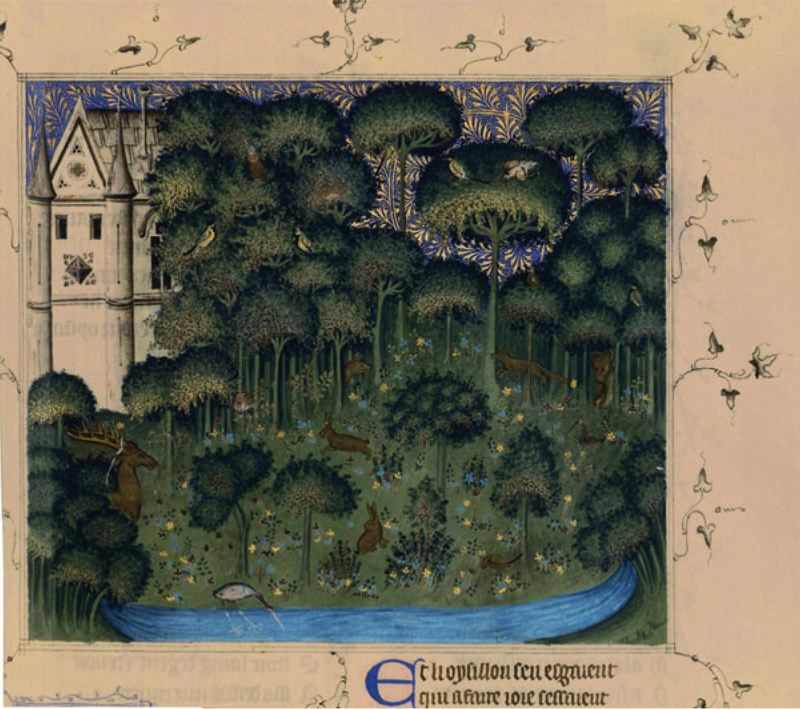
Guillaume de Machaut. The Enchanted Garden, from Le Dit du Lion. 1350–55. Ink, tempera, and gold leaf on vellum. One of the first true European landscapes created to illustrate a passage of the poem. The Dit (literally “spoken”) indicates that it was not meant to be sung; the French poem describes an enchanted garden seen by a lover who is visiting an adjacent castle. The scene accurately illustrates several verses of the poem including the delightful lines:
To make their pleasing melody
Birds are sitting in a tree
One, two, five, and even six I see.
This reflects the important role books played during this period, that is, when they were becoming accessible to a broader public.
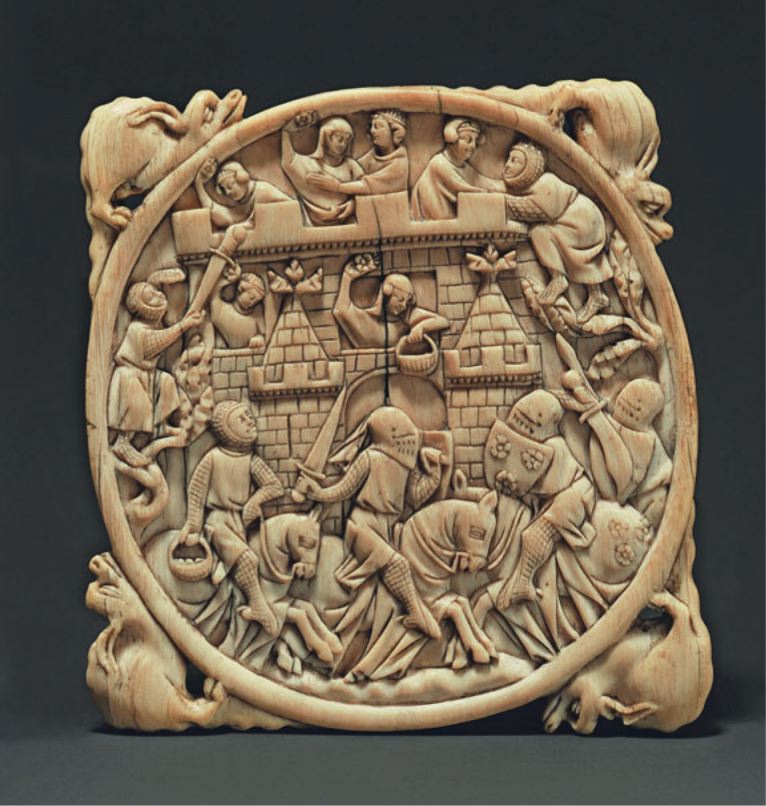
Siege of the Castle of Love. Back of a mirror. ca. 1320–50. Ivory. By conscious design, the battle lacks intensity, since the equestrian at the left is more concerned with the women in the castle, who toss roses at their attackers, than he is with the combat taking place in front of him. At the upper right, a knight scales the castle walls, helped up by a lady within it. On the other side, a soldier climbs a tree in order to surrender his sword to a woman armed with roses. The story is an allegory, with the castle symbolizing women and the attack upon it a form of courtship. Apart of the flamboyant (flamelike) phase of Gothic Architecture.
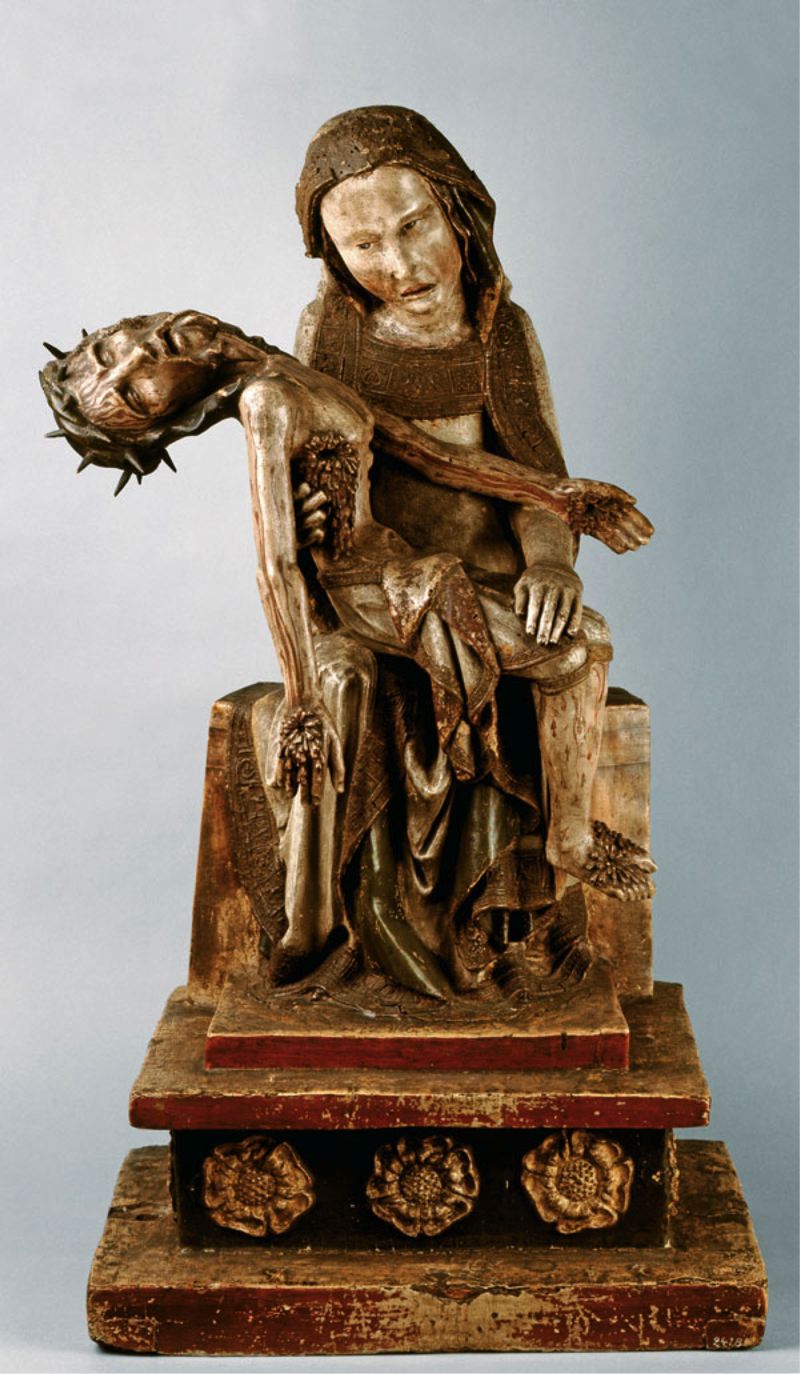
Roettgen Pietà. Early 14th century. Wood. A large cult statue was meant to be placed on an altar. Expresses the emotional fervor of lay religiosity, which emphasized a personal relationship with God as part of the tide of mysticism that swept over fourteenth-century Europe. The purpose of the work is clearly to arouse so overwhelming a sense of horror and pity that the faithful will share in Christ’s suffering and identify with the grief-stricken Mother of God. The ultimate goal of this emotional bond is a spiritual transformation that grasps the central mystery of God in human form through compassion (meaning “to suffer with”)