Basics of investment banking ESADE
 Call Kai
 Learn
Learn Practice Test
 Spaced Repetition
 Match
Match Flashcards
 Knowt Play
1/24

There's no tags or description
Looks like no tags are added yet.
Name | Mastery | Learn | Test | Matching | Spaced | Call with Kai |
|---|
No analytics yet
Send a link to your students to track their progress
25 Terms
Kelly criterion (def & formula)
With p the probability of winning, q = 1-p, and b the return in % in case of win, we can calculate thanks to the Kelly criterion the optimal proportion of your capital to bet/invest to minimize losses —> f* = (bp-q)/b
Present Value formula
PV = CFk / (1+r)^k
DCF (discounted cash flow) formula
DCF = sum of present value of all future cash flows; le plus souvent, on aura CFk = CF0 x (1+g)^k où g est le taux de croissance de l’entreprise et r est le discount rate
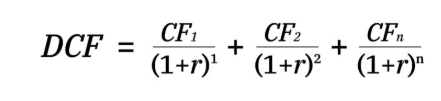
Comment calculer le discount rate r ?
Le WACC (Weighted Average Cost of Capital) est calculé comme suit : WACC=E*re/V+D*rd*(1−T)/V
où : E = valeur des capitaux propres, D = valeur de la dette, V = E + D, re = coût des capitaux propres, rd = coût de la dette, et T = taux d'imposition
Terminal value of an investment ?
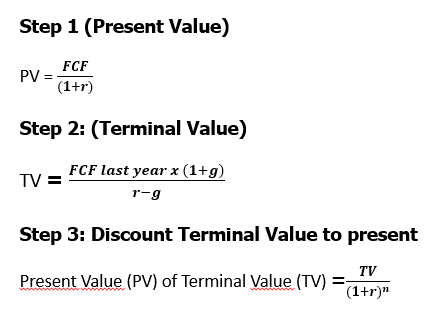
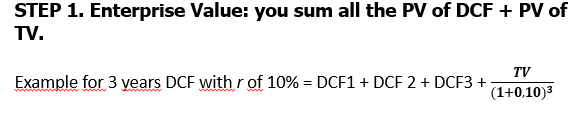
Enterprise value EV formula
Sum of present values of DCF + PV of Terminal Value
Equity value formula
Equity Value = Enterprise Value - Net Debt = EV - (Cash - Debt)
Intrisic share price ISP formula ?
ISP = Equity Value / Oustanding Shares
What are the 3 financial statements ?
Balance sheet (Bilan), Income statement (Compte de résultats), Cash Flow Statement (Tableau de flux de trésorerie) —> You can use them to analyse the financial state of the company
7 steps of the financial analysis of a company ?
MC > EV —> company is positively valued by investors
Total debt / FCF < 5 —> debt is more or less over control
Total revenue is increasing
EV / EBITDA < 20 —> company isn’t too overrated
ROE & ROIC are both over market return (10% in the US) + same for ROA
EPS in increasing
NAV and mNAV —> if mNAV < 1, the company trades at a premium to its underlying assets, else it’s the contrary; ideally it would remain close to 1
Formula NAV, NAV per share, and mNAV ?
NAV = Total Assets - Total Debt
NAV per share = NAV/Outstanding shares
mNAV = MC/NAV
What is Beta ?
It values the risk of a company relatively to the overall market —> for example if beta = 1,5 the stock tends to move 50% more than the market
Levered Beta ? (def + formula)
Levered beta incorporates both operational risk (risk of the business) and the financial risk (risk due to the company’s use of debt) —> see photo for formula

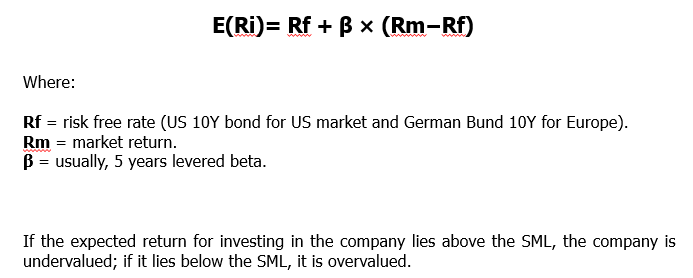
Security market line SML ?
See photo; it represents CAPM, ie the relationship between the 5-years levered beta of an asset and irs potential expected return
If an asset lies above SML, it is undervalued = worth investing in because potential for growth
Gordon Growth Model ? (definition and formula)
Growth Estimated = (EPS forward/P0 current price of share) + g
This gives us the estimated expected return of the company, which we can then compare to CAPM to know if the company is over or undervalued
3 étapes de la création d’une start-up
Idée + Minimum Viable Product
Incubation (valley of death)
Acceleration (from few to many customers)
2 main ways to value a start-up
EV/Revenues —> compare company to its valuation, whether it is an actual capitalization (if public company) or an estimated valuation (if private)
EV/EBITDA —> appropriate for more mature start-ups with positive cash flows and earnings, clear picture of the company’s profitability
6 fundamental aspects to assess a start-up ?
The need = it has to solve a need, and not only a personal interest of yours
The sector has to raise interest
The team (commitment, attitude, skills)
Scalability = is there potential for development & acceleration
Reach VS Magnitude concept ? (inexpensive product for the masses VS expensive product for a niche ?)
Sustainability = fundamental