TH harnessing, componentry, & control pt. 1
 Call Kai
 Learn
Learn Practice Test
 Spaced Repetition
 Match
Match Flashcards
 Knowt Play
1/67

There's no tags or description
Looks like no tags are added yet.
Name | Mastery | Learn | Test | Matching | Spaced | Call with Kai |
|---|
No analytics yet
Send a link to your students to track their progress
68 Terms
hessing
what kind of pad can be added to a harness for axilla comfort?
double ring, BAHA, pads
ways to increase comfort in a TH harness
elastic
kind of material that a chest strap should be made of, to allow breathing
humerus doesn’t have bony lock
why is it typically better to use a lanyard than a pin lock system in TH patients?
lightweight prosthesis
why would you only need a sleeve for suspension?
lateral
to what side will everything in a TH prosthesis want to shift?
lateral suspensory strap
what is 1?
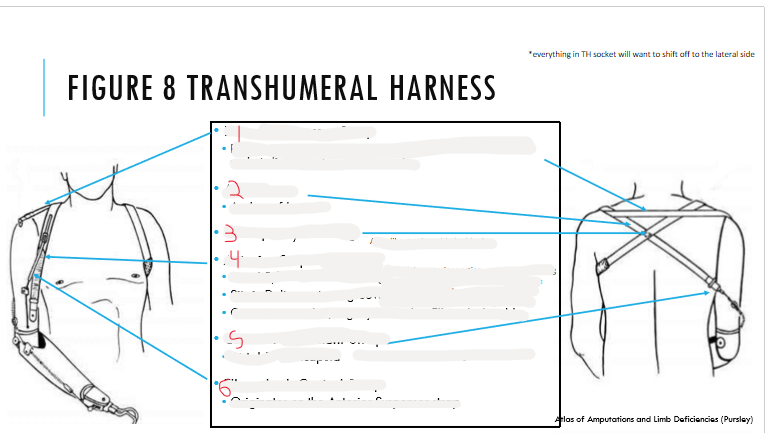
axilla loop
what is 2?
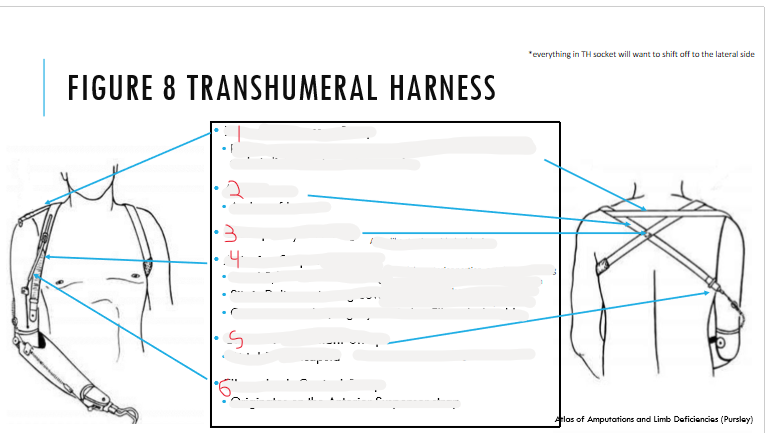
cross-point/NW ring
what is 3?
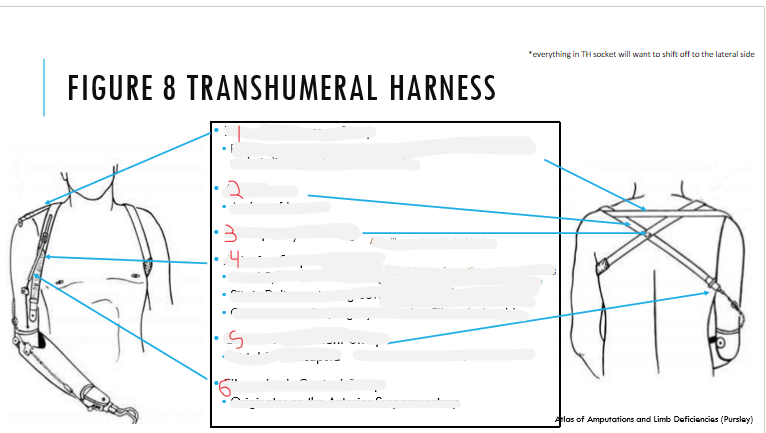
anterior suspensor strap
what is 4?
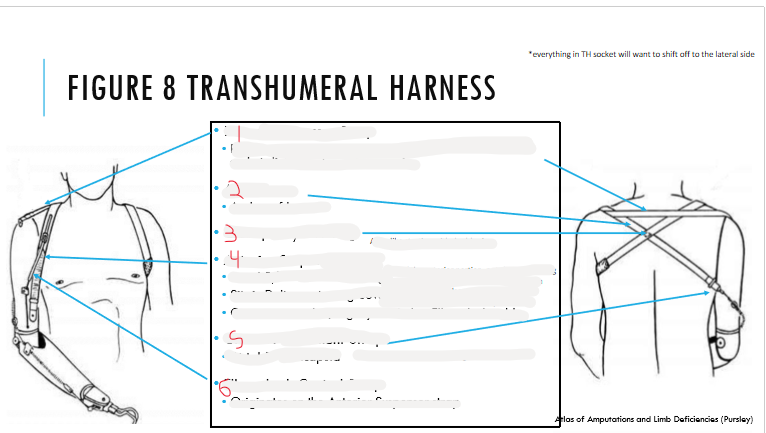
control attachment strap
what is 5?
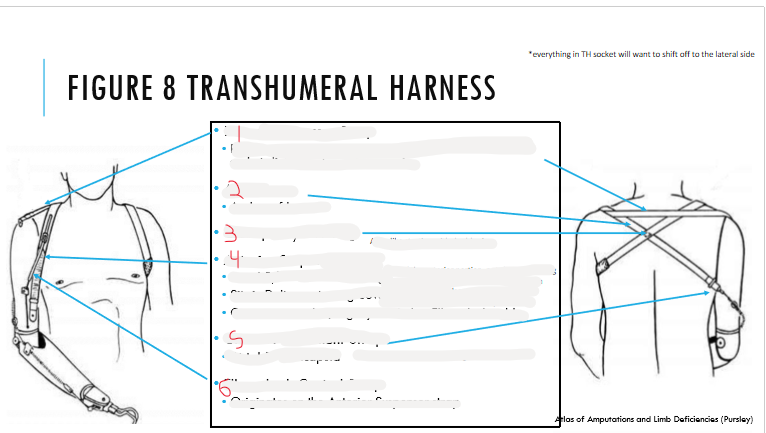
elbow lock control strap
what is 6?
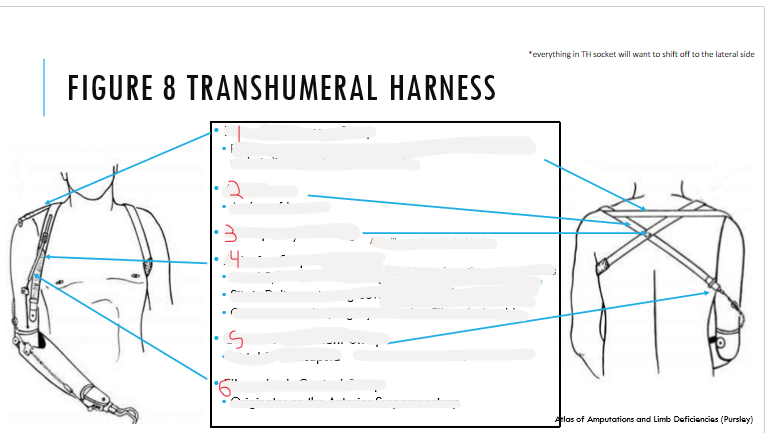
lateral suspensor strap
primary suspensor of TH figure-8 harness
proximal wall of socket, slightly anterior to acromion
position of lateral suspensor strap
anchors harness
function of axilla loop
distal 2/3 of the anterior portion
how much of the anterior suspensor strap should be elastic?
delto-pectoral groove
where should the anterior suspensor strap be positioned?
slightly medial to elbow lock cable
distal attachment point of anterior suspensor strap
distal 1/3 of scapula
position of control attachment strap
anterior suspensor strap
where does the elbow lock control strap originate?
sew non-stretching fabric coins (like dacron) onto it
how to create rigid points on elastic
chest strap
what is 1?
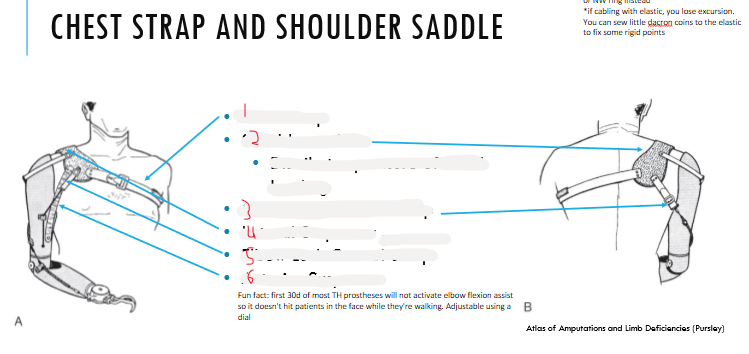
shoulder saddle
what is 2?
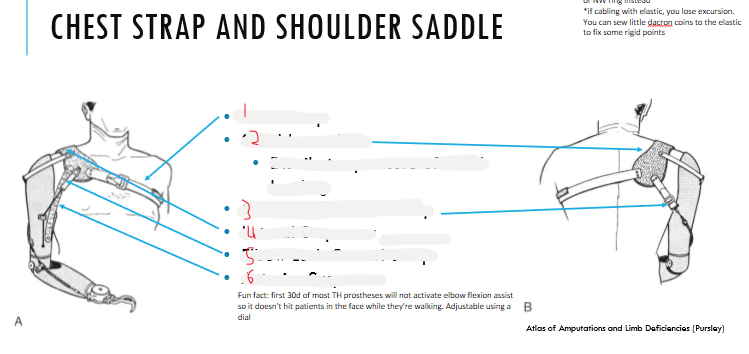
control attachment strap
what is 3?
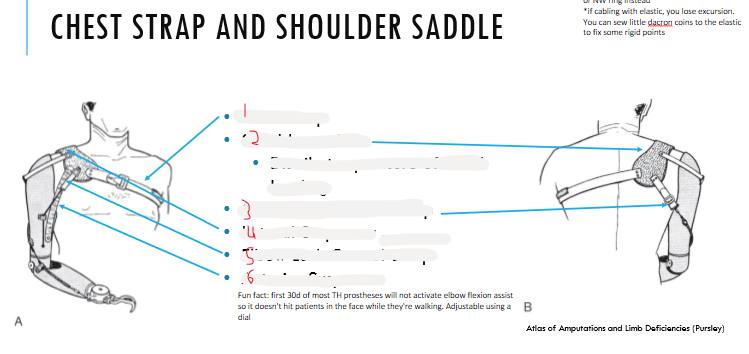
lateral suspensor
what is 4?
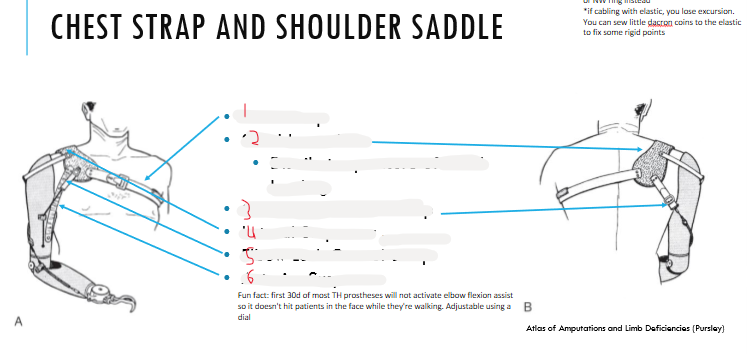
elbow lock control strap
what is 5?
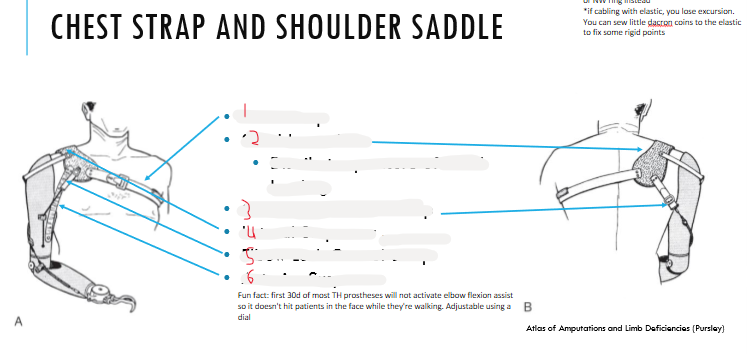
anterior suspensor
what is 6?
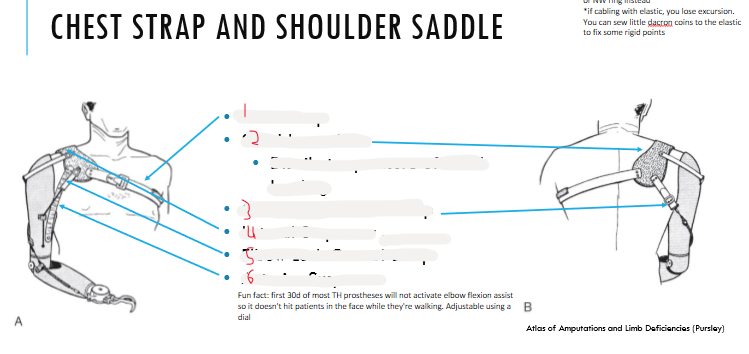
BAHA, NW ring
what can you use instead of a shoulder saddle in a similar-looking set-up with the chest strap?
TH
does sequential activation work best for TH or TR amputation levels?
4 1/2”
how much excursion to simultaneously flex elbow and open TD in a TH prosthesis?
2
how many cables are needed to operate a standard BP TH prosthesis?
fair-lead
which cable/housing system is used primarily in TH prostheses?
split
does the fair-lead cable system have split or joined housing?
cable can flex elbow (when unlocked) and the operate the TD
function of split housing
cyclically locks/unlocks elbow alternately
function of elbow lock control cable
TD activates
once the elbow is fully flexed in a fair-lead system, where does the leftover tension transfer to?
GH flexion, biscapular abduction
control methods for sequential function with dual control
flex
in sequential function system with dual control, you must (flex/extend) the elbow and (lock/unlock) it before using the TD
GH abduction, shoulder depression, GH extension
motion to lock/unlock elbow in fair-lead system
parallel
location of elbow turntable relative to the ground
1 1/2” distal, 1” anterior
bench alignment: location of elbow flexion attachment (lift tab) relatively to epicondyle
neutral
bench alignment: humeral turntable ext/int rotation
slightly medial to elbow lock cable
bench alignment: location of anterior suspensor attachment
1” proximal to cut end of bone, on posterior/lateral aspect
location of baseplate/retainer on socket
add 2nd baseplate/retainer to guide housing
what to do if residuum is short and the housing is moving behind the epicondyle
elbow flexion attachment
what is an EFA?
1/2” proximal to EFA, 1/2” distal clearance when TD is open and fully supinated
bench alignment: distal segment housing length
1/2” clearance between housing segments when in fully elbow flexion, 1/2” housing proximal to base plate and retainer
bench alignment: proximal segment of housing length
1/4” beyond proximal housing when TD is fully pronated and closed, elbow is extended, and elbow turntable is in neutral rotation
bench alignment: cable length
inverse
force and excursion have a (direct/inverse) relationship
more, less
if the EFA is closer to the epicondyle, it takes (more/less) force and (more/less) excursion to operate
more, less
if the EFA is farther from the epicondyle, it takes (more/less) excursion and (more/less) force to operate
force
if the patient has difficulty flexing the elbow, it is probably a (force/excursion) problem
excursion
if a patient has difficulty opening their TD at the mouth, it is probably a (force/excursion) problem
too proximal
how could the forearm lift tab cause a patient to have difficulty flexing their elbow?
too posterior
how could the cable’s location relative to the elbow center cause a patient to have difficulty flexing their elbow?
too heavy
how could the weight of the TD cause a patient to have difficulty flexing their elbow?
too long
how could the length of the forearm cause a patient to have difficulty flexing their elbow?
inefficient
how could the harness cause a patient to have difficulty flexing their elbow?
too distal or anterior
how could the forearm lift tab’s location cause a patient to have difficulty opening their TD at the mouth?
too lose
how could the control strap cause a patient to have difficulty opening their TD at the mouth?
too far toward prosthetic side
how could the NW ring cause a patient to have difficulty opening their TD at the mouth?
too high
how could the proximal base plate cause a patient to have difficulty opening their TD at the mouth?
not on distal 1/3 of scapula
how could the location of the control strap cause a patient to have difficulty opening their TD at the mouth?
too proximal, too short
how could the forearm lift tab position cause a patient to accidentally open the TD during elbow flexion?
not enough rubber bands
how could the TD resistance cause a patient to accidentally open the TD during elbow flexion?
too heavy
how could the weight of the TD cause a patient to accidentally open the TD during elbow flexion?
too long
how could the weight of the forearm cause a patient to accidentally open the TD during elbow flexion?