Stages of the cell cycle and the importance of cell cycle
 Call Kai
 Learn
Learn Practice Test
 Spaced Repetition
 Match
Match Flashcards
 Knowt Play
1/24

There's no tags or description
Looks like no tags are added yet.
Name | Mastery | Learn | Test | Matching | Spaced | Call with Kai |
|---|
No analytics yet
Send a link to your students to track their progress
25 Terms
The Cell Cycle: Stages in growth & division
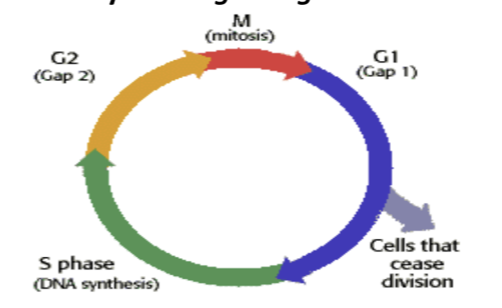
G1 Phase
-First growth stage
-Cell increases in size
-Cell prepares to copy its DNA
S Phase
-Copying of all of DNA’s instructions
-Chromosomes duplicated
G2 Phase
-Between DNA synthesis & mitosis
-Continues growing
-Needed proteins produced
M Phase (Mitosis)
-Cell growth & protein production stop
-Cell’s energy used to make 2 daughter cells
-Called mitosis or karyokinesis (nuclear division)
Cytokinesis (Cell plate forming between the two cells)
-Occurs after chromosomes separate
-Forms two, identical daughter cells
DNA Replication defintion
A process that transforms one DNA molecule into 2 identical copies; enzyme help DNA strands unwind and separates; each DNA strand serves as a template (pattern) for a new, complementary strand to form by matching (pairing) nitrogen bases. As a result, each new DNA molecule contains half of the original molecule
Replication Facts
- DNA has to be copied before a cell divides
- DNA is copied during the S or synthesis phase of interphas
- New cells will need identical DNA strands
Synthesis Phase (S phase)
S phase during interphase of the cell cycle Occurs in the Nucleus of eukaryotes
DNA Replication (in a nut shell)
The process used by cells to copy DNA – enzyme unzips DNA and each side of the ladder acts as a template for the building of the new half. Use the N-base paring rules : A-T ; C-G
When it begins at origins of replication how does it work?
-Two strands open forming Replication Forks (Y-shaped region)
-New strands grow at the forks
As the 2 DNA strands open at the origin, Replication Bubbles form
• Prokaryotes (bacteria) have a single bubble
• Eukaryotic chromosomes have MANY bubbles

Enzyme Helicase (Single-Strand Binding Proteins attach and keep the 2 DNA strands separated and untwisted)
unwinds and separates the 2 DNA strands by breaking the weak hydrogen bonds
Enzyme Topoisomerase
attaches to the 2 forks of the bubble to relieve stress on the DNA molecule as it separates
Before new DNA strands can form….
there must be RNA primers present to start the addition of new nucleotides
Primase is
the enzyme that synthesizes the RNA Primer
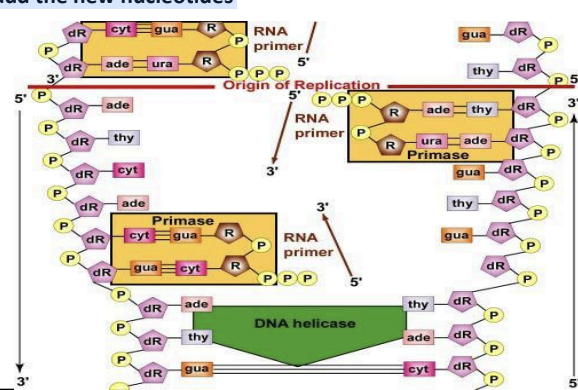
DNA polymerase can….
can then add the new nucleotides
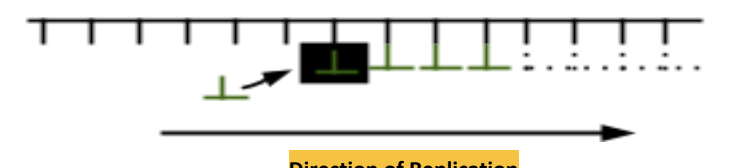
DNA polymerase can….
only add nucleotides to the 3’ end of the DNA. This causes the NEW strand to be built in a 5’ to 3’ direction.
The Leading Strand…
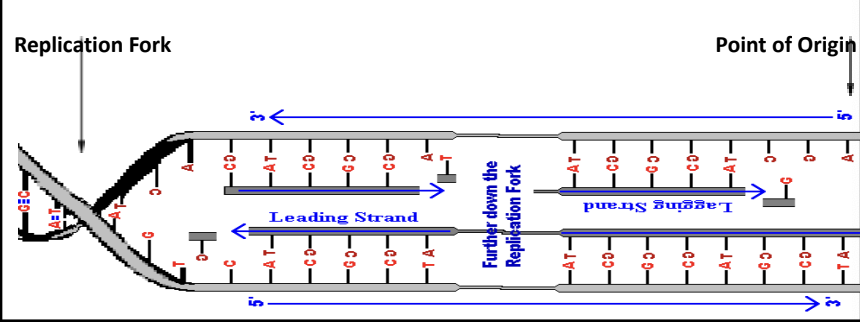
is synthesized as a single strand from the point of origin toward the opening replication fork
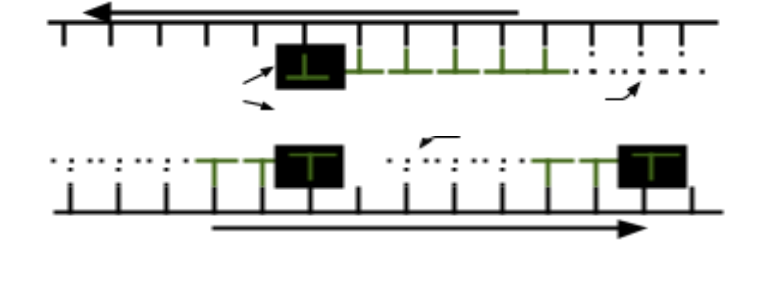
The Lagging Strand…
-Strand is synthesized discontinuously against overall direction of replication
-This strand is made in MANY short segments.
-It is replicated from the replication fork toward the origin
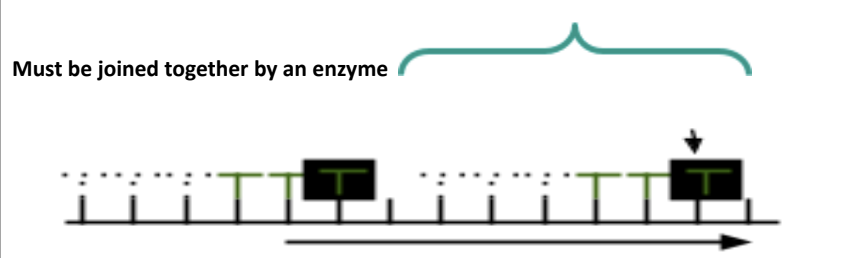
Okazaki Fragments is a…..The enzyme Ligase joins
series of short segments on the lagging strand

The enzyme Ligase joins…
the Okazaki fragments together to make one strand
Replication of Strands

Semiconservative Model of Replication (Watson & Crick)
-The two strands of the parental molecule separate, and each acts as a template for a new complementary strand
-New DNA consists of 1 PARENTAL (original) and 1 NEW strand of DNA