LASER
 Call Kai
 Learn
Learn Practice Test
 Spaced Repetition
 Match
Match Flashcards
 Knowt Play
1/14

There's no tags or description
Looks like no tags are added yet.
Name | Mastery | Learn | Test | Matching | Spaced | Call with Kai |
|---|
No analytics yet
Send a link to your students to track their progress
15 Terms
Translation Matrix

Thin Lens Matrix

Spherical Mirror Matrix

Refractive Surface (n1 to n2)

HeNe (Operation, Uses)
Four level gas laser
Electrical discharge excites helium atoms into higher energy states. These excited helium atoms transfer energy to neon atoms through resonant collisions. These collisions creates a population inversion in the neon gas, making neon the active lasing medium.
HeNe produces continuous wave red visible light, which is highly coherant with a long coherent length.
Used in optical alignement, surveying, interferometry and barcode scanners.
Argon Laser (Operation, Uses)
High current electrical discharge ionizes the argon gas and then further pumping resulting in positive argon ions into higher excited states. Because ioniznig the gas and driving the transitions requires significant energy, argon lasers operate at high temperatures and generally require active water cooling.
They operate on a 4 level scheme, and can lase simultaneously at several discrete wavelengths in the visible spectrum.
Argon lasers have high output power in the visible spectrum, making them crucial as a pump source for continous wave Ti:sapphire lasers
They are used in retinal surgery, forensic detection and high power laser light shows
Femtosecond Pulsed Ti:Sapphire (Operation, Uses)
Sapphire crystal doped with titanium ions.
It relies on vibronic transitions - a strong coupling between the electronic energy states of the Ti ions and the vibrational modes (phonons) of the host crystal. This coupling boradens the energy levels, resulting in an exceptionally wide gain bandwitdth. This massive bandwidth can support a vast number of longitudinal modes. When the phases of these modes are locked together, the laser outputs ultra short pulses.
They are used in ultrafast spectroscopy, multiphoton microscopy, and the study of non linear optical phenominon
Free Electron laser (Operation, Uses)
They generate light using a relativistic beam of electrons
Electron beam is acclerated by a particle accelerator then directed through an undulator which oscillated the electrons to undergo a sinusoida trajectory causing them to emit radiation.
The emitted radiation interacts back upon the electron beam, causing the electrons to form microbunches. These microbunches are spaced by exactly one optical wavelength, forcing them to radiate coherently.
The key characteristic of this laser is that its output wavelength is cnotinously tunabel over a massive range (microwave to Xray) simply by altering the Ek of the electrons or the magnetic field strength.
They are typically used in cutting edge structural biology where they can image proteins and viruses down to the atomic level.
Laser Gyroscope (Operation, Uses)
Closed loop filled with HeNe as the gain media. The cavity supports two laser beams travesing the ring system in opposite directions.
If there is an angular rotation the beams will experience a difference in optical pathlength which then causes a beat in the laser light due to the interference in the cavity which can be used to determinte the angular velocity of the cavity.
They are ciritical roataion sensors in navigation systems, extensively used in aircraft, space craft, submarines and prescision guided systems.
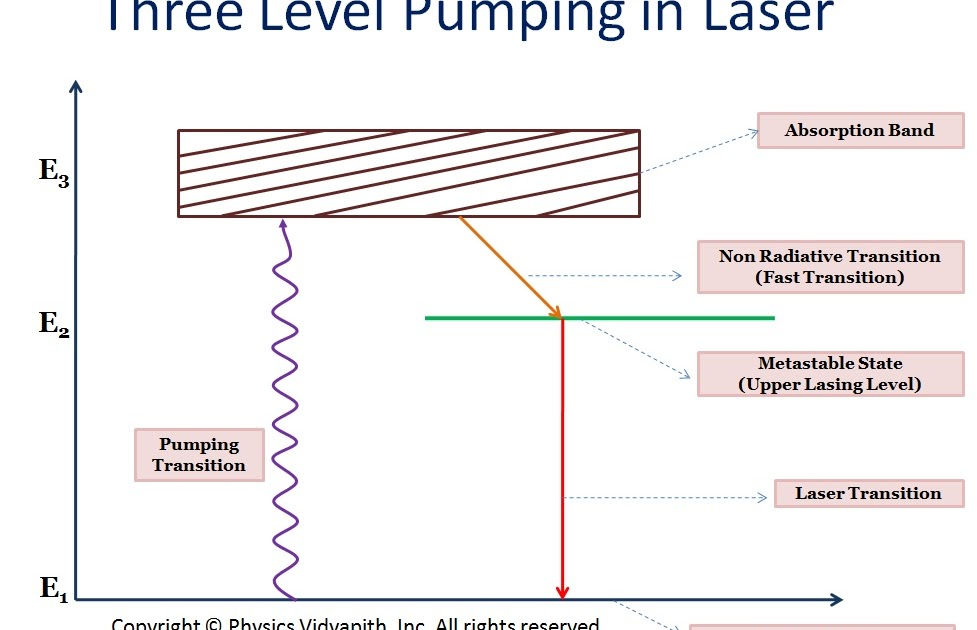
3 Level Laser (Process)
Pumping: energy is pumped into the gain medium, exciting the electrons from the heavily populated ground state to the highest energy level (Pumping band)
Non radiative decay: electrons in the pump band quickly decay down to the meta stable state where they pile up
Lasing: lasing occurs as electrons transition from the upper lasing level back down to the ground state
Challenge:
becuase the lower lasing level is the ground state which is initally completely full. To acheive population inversion you must continually pump more than 50% of the electrons out of the ground stateand into the meta stable state. This requires and enormous amount of energy, meaning 3 level lasers have a very high threshold for lasing and are generally inefficient.
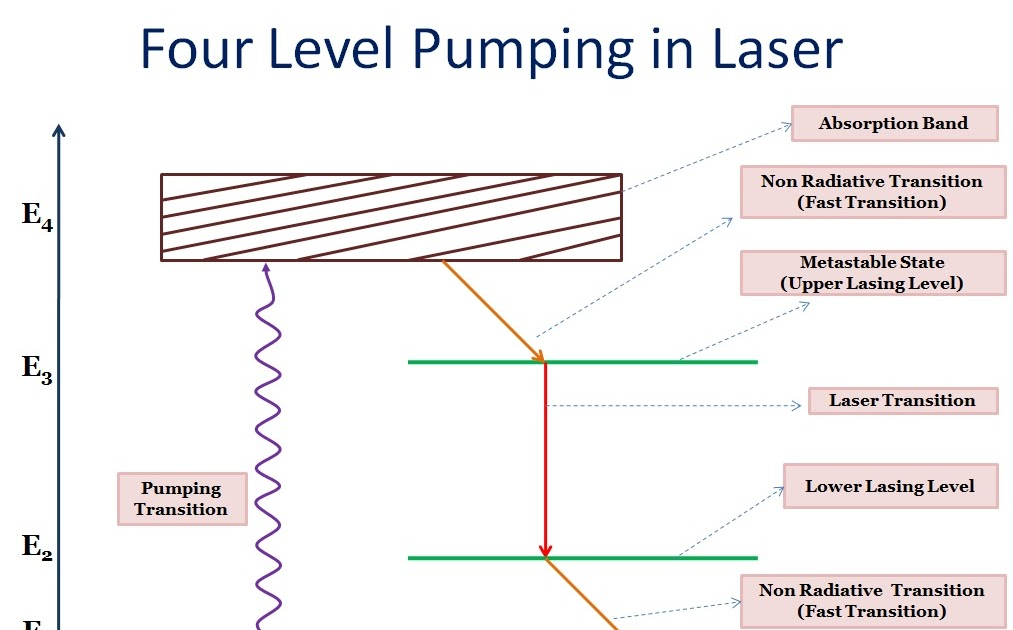
4 Level Laser (Process)
Pumping: electrons are pumped from the ground state up to the pump band
Non radiative decay: electrons quickly drop down from this unstable state to the metastable state where they pile up
Lasin: stimulated emission occurs between the upper metastable state (upper lasing level) to the lower metastable state (lower lasing level)
Non radiative decay: electrons in the lower lasing state decay very quickly back down to the ground state
Advantage:
Because the electrons transition out of the lower lasing level almost instantly, the population of the lower lasing level remains effectively at zero. Therefore, the moment you pump even a few electrons into the upper lasing level you instantly have population inversion.
You dont need to empty out the ground state. Becuase the threshold for inversion is so much lower, 4 level lasers are hihgly efficient and can operate as continous wave more easily than 3 level lasers.
Confocal cavity divergence Vs Planar cavity divergence
The confocal cavity laser is limited by the internal mode structure, which naturally produces a divergent Gaussian beam.
The divergence originates from diffraction. For the Gaussian beam, it is the result of the beam waist being finite in size, which means for smaller beam waist the diveregence is greater
The Planar cavity lasers divergence is limited primarily by the output coupler size which imposs diffraction on the beam
The diveregence originates mostly from the output coupler diffraction, where the beam is clipped by the finite diameter of the output coupler causing the light to spread out as it exits.
Why is populatoin inversion required
According to Einsteins rate equation coefficients, the probability of an incoming photon stimulating the emission of an identical photon from an excited atom is exactly equal to the probability of that photon being absorbed by an atom in the lower energy state. Therefore, if the lower state has more atoms, absorption dominates and the light is attenuated. Only by creating population inversion can the rate of stimulated emission exceed the rate of absorption, resulting in new optical gain and light amplification.
Q-switching Vs Mode locking (explain each)
Q-switching -
By making the cavity lossy while the gain medium is being pumped, we can build a massive population inversion without lasing. The loss of the cavity is then suddenly removed which then suddenly dumps all the built up energy in a short pulse which dumps all the energy in the cavity.
Mode locking -
The longitudinal modes in the cavity have their phases locked together. When these modes are perfectly locked they will constructively interfere to create a continous train of ultra short pulses bouncing back and fourth in the cavity.
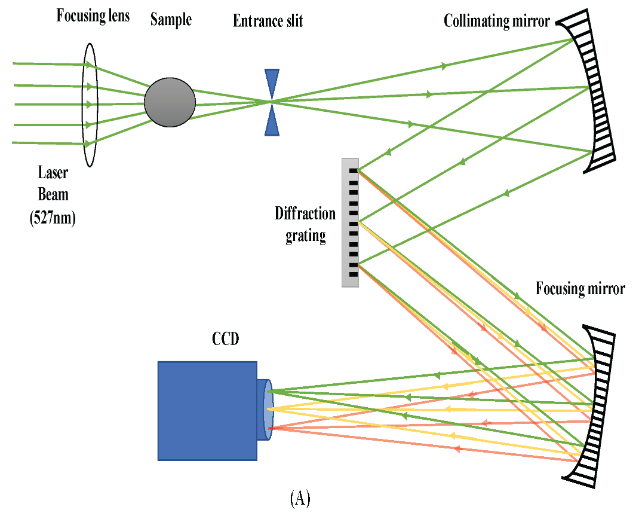
Czerny Turner