Chapter 21: The Chemistry of Carboxylic Acid Derivatives
 Call Kai
 Learn
Learn Practice Test
 Spaced Repetition
 Match
Match Flashcards
 Knowt Play
1/44

There's no tags or description
Looks like no tags are added yet.
Name | Mastery | Learn | Test | Matching | Spaced | Call with Kai |
|---|
No analytics yet
Send a link to your students to track their progress
45 Terms
carboxylic acid derivative
compounds that can be converted to carboxylic acids by hydrolysis
How do you name a carboxylic ester?
alkyl / phenyl alkan-oate
How do you name an acid halide?
replace the -ic ending with -yl followed by the name of the halide
How do you name a nitrile?
drop the -ic or -oic ending and add onitrile;
nitrile carbon counts as part of the chain length
How do you name an amide?
drop the -ic or -oic and add -amide
Amides are classified according to the number of __ on the amide nitrogen (1º, 2º, 3º, etc.).
hydrogens
A nitrogen with two hydrogens is a ____ amide.
primary (1º)
A nitrogen with one hydrogen is a ____ amide.
secondary (2º)
A nitrogen with no hydrogens is a ____ amide.
tertiary (3º)
lactam
cyclic amide
imide
nitrogen analog of anhydride
Which has higher priority in nomenclature, acid or nitrile?
acid
What is the IR spectroscopy for an acid chloride?
1800 cm-1
What is the IR spectroscopy for an amide?
1650 - 1655 cm-1
and at
3100 - 3400 cm-1
What is the IR spectroscopy for a nitrile?
2200 - 2250 cm-1
What is the IR spectroscopy for a ketone, aldehyde, and carboxylic acid?
~ 1700 cm-1
What is the IR spectroscopy for an ester?
1735 - 1745 cm-1
distinguished from COOH, aldehydes, and ketones bc there is not broad peak
What is the 1H NMR for amides?
7.5 - 8.5 ppm
What is the 1H NMR for alpha hydrogens next to carbonyl?
1.9 - 3.0 ppm
What is the 13C NMR for carbonyls and esters?
165 - 180 ppm
What is the 13C NMR for C≡N?
115 - 120 ppm
What is the 13C NMR for aromatic compounds?
100 - 160 ppm
Which is more basic, amides or nitriles?
amides
Nitriles typically undergo ____ rxns.
addition
What is the order of carboxylic acid derivatives in increasing reactivity?
nitriles < amides < esters/thioesters, acids < anhydrides < acid chlorides
What are the two most important factors that influence reactivity?
stability of the starting carboxylic acid
characteristics of the leaving group
Acid chlorides and anhydrides react (rapidly/slowly) with water.
rapidly
saponification
ester hydrolysis in aqueous hydroxide
What does acid-catalyzed hydrolysis of esters require?
an excess of water
draw the mechanism for acid catalyzed hydrolysis of esters
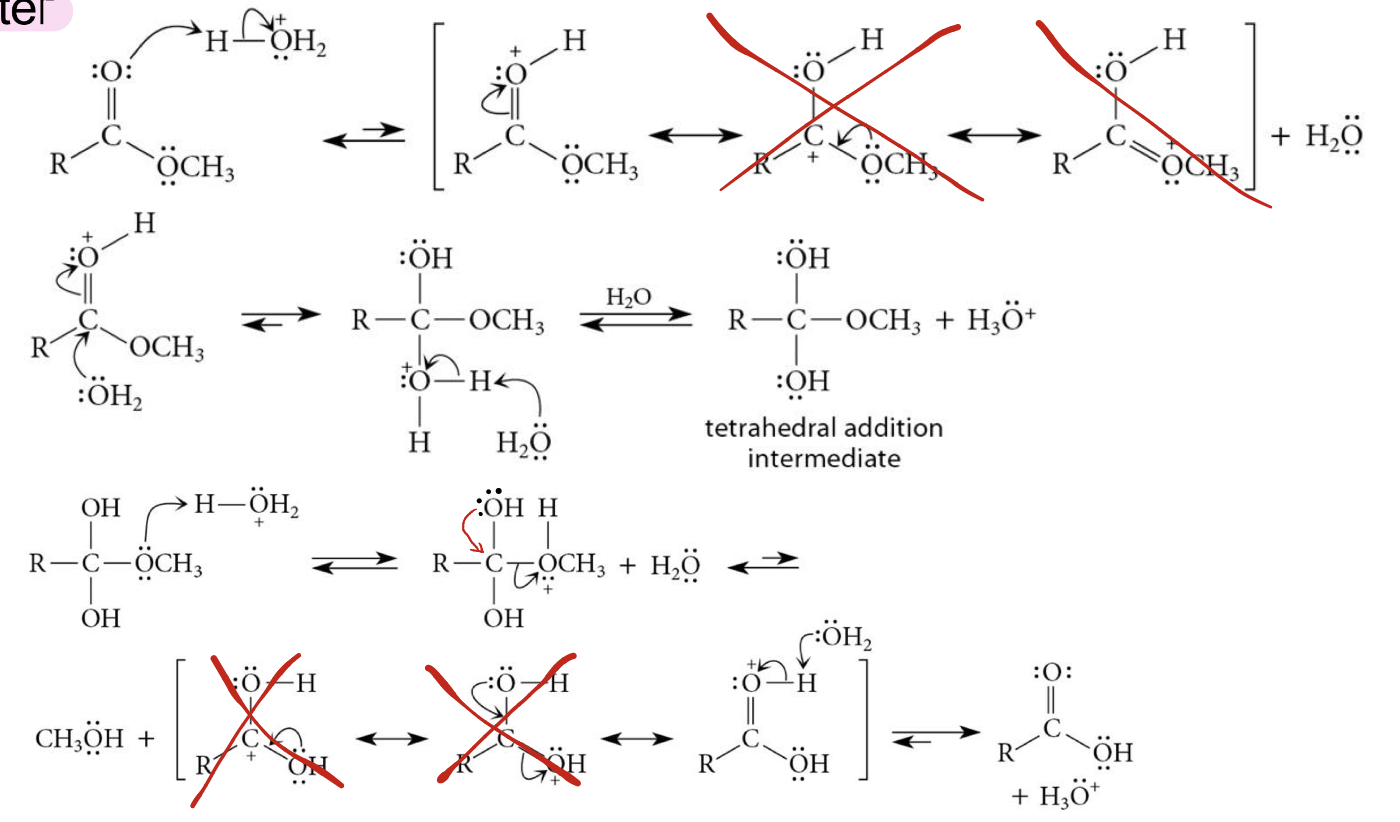
What is the difference between acid- and base-catalyzed hydrolysis of esters?
Acid:
Carbonyl carbon can react with water bc carbonyl O is protonated
Acid catalyzes ester hydrolysis
Reversible
Base:
Carbonyl O is not protonated so a stronger base is needed
Base is not a catalyst, but a reactant
Saponification is irreversible
What reagent is used to hydrolyze amides to carboxylic acids?
heat in acidic or basic solution
What reagent is needed to hydrolyze nitriles to carboxylic acids and ammonia?
heat in strongly acidic or basic solution
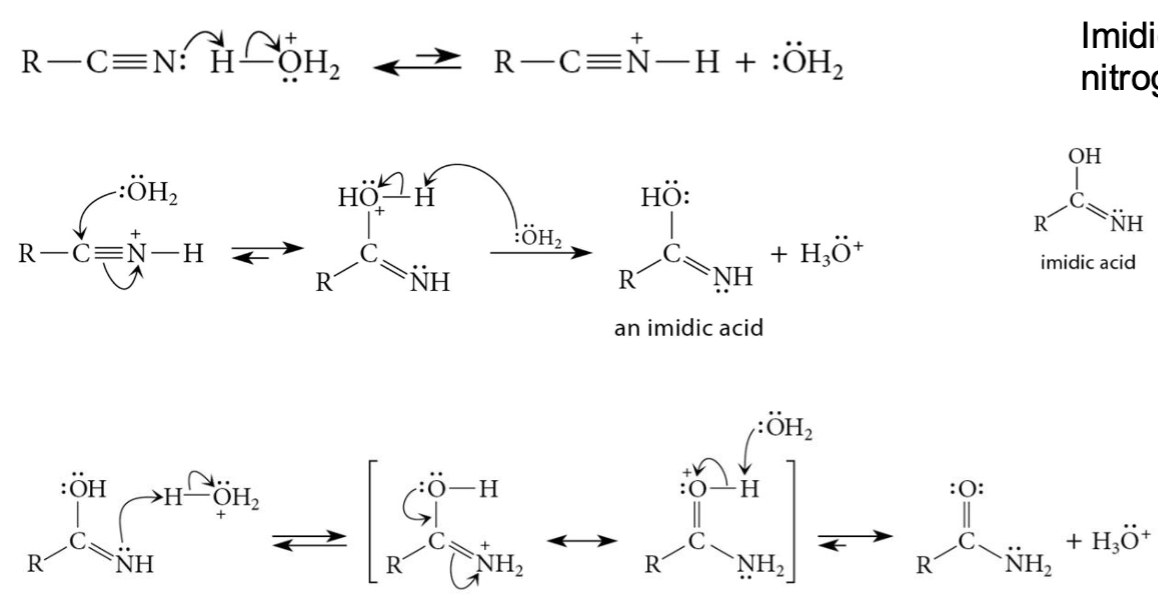
draw the mechanism of hydrolysis of nitriles in acidic conditions
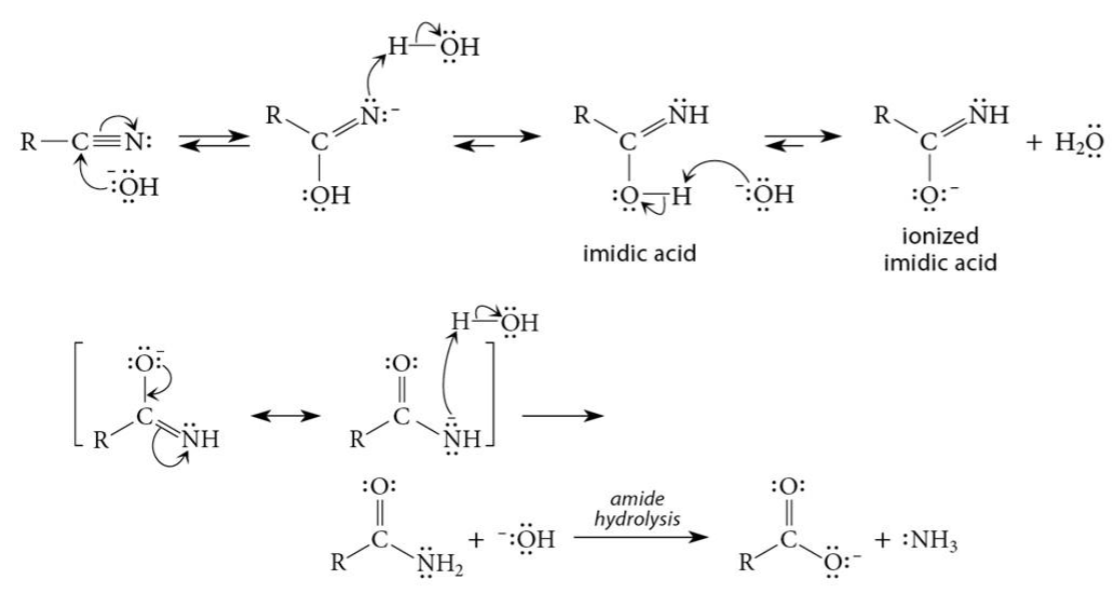
draw the mechanism of hydrolysis of nitriles in basic conditions
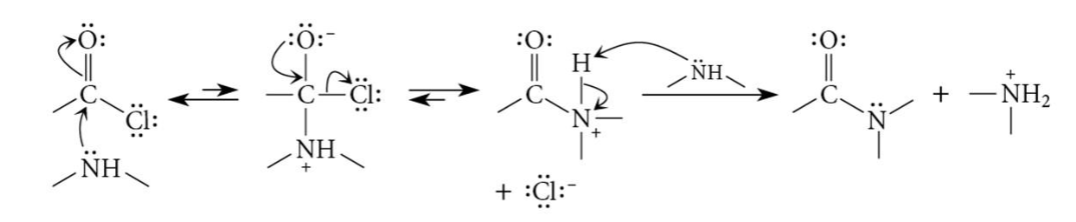
draw the mechanism for reaction of an acid chloride with an amine
Schotten-Baumann technique
rxn is run w acid chloride in a separate layer over an aqueous solution of NaOH
How is an amide formed from an anhydride?
carbon from anhydride forms a bond with the nitrogen and the O from the anhydride leaves and is protonated
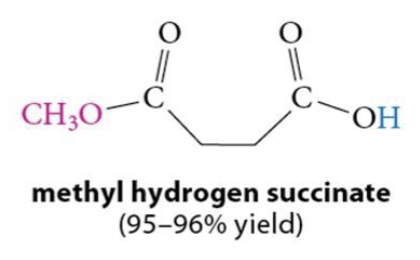
How is an ester formed from an anhydride?
carbon from anhydride forms a bond with the alc oxygen and the O from the anhydride leaves and is protonated
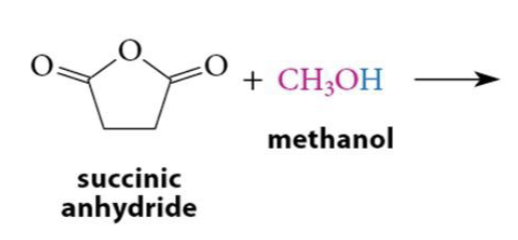
What is the product of this rxn?
What reagent is used to reduce amides to primary amines?
LiAlH4, THF
What reagent is used to reduce nitriles to primary amines?
LiAlH4, THF
or
Raney Ni
Rosenmund reduction
selective catalytic hydrogenation rxn that converts acyl chlorides into aldehydes
What readily reacts with organocuprates (R2CuLi) to form ketones?
acid chlorides
What reagent is used to convert acid chlorides to ketones?
organocuprates (R2CuLi), THF