CM 2215 OSHA 510 Narrowed Down
 Call Kai
 Learn
Learn Practice Test
 Spaced Repetition
 Match
Match Flashcards
 Knowt Play
1/146

There's no tags or description
Looks like no tags are added yet.
Name | Mastery | Learn | Test | Matching | Spaced | Call with Kai |
|---|
No analytics yet
Send a link to your students to track their progress
147 Terms
OSHA's focus four injuries are:
falling
caught in
struck by
electrocuted
OSHA's mission is to save _____________ and prevent __________.
lives, injuries
OSHA's primary method of enforcement of safety regulations is through ___________.
inspections
OSHA was formed because ___________________ were increasing.
injuries and illnesses
OSHA was signed into law by President ________________ in December of _____.
nixon, 1970
In the correct order, what is OSHA's inspection priority? (5)
imminent danger
fatality or hospitalization
worker complaints / referrals
targeted inspections
follow up inspections
The four types of OSHA citations and dollar amounts of fines are
Willful - $134,000
Serious - $13,000
Other than Serious - $13,000
Repeated - $130,000
The general duty clause (section 5(a)(1)) states that the _______________ must provide a workplace free from ______________hazards.
employer, recognized
PPE stands for the
Personal
Protective
Equipment
The effects of workplace injuries and illnesses can include (5)
-lower moral
-increased costs to retrain workers
- slower production rates
- higher turnover
- inc worker's compensation rates
OSHA standards are found in the ____ CFR.
29 (labor)
Part ______ contains recordkeeping standards.
1904
Part _______ contains general industry standards.
1910
Part _______ contains construction industry standards.
1926
A _________ standard applies to all industries
horizontal
A _________ standard applies only to certain industries.
vertical
Direct costs are usually paid by submitting claims to _________ companies.
insurance
An example of a direct cost is ____________.
- medical cost
- repair cost
- damaged equipment
- administrative
Indirect costs are ___________ to identify and quantify
difficult or impossible
Indirect costs are usually paid by the __________.
company
An example of an indirect cost is ____________.
-loss of efficiency
-cost of bringing in new workers
A company's ________ Modification Rate is determined by the company's own record of accidents and losses.
experience
EMR = ____________ losses / _____________ losses
actual, expected
The best method to prevent injuries is to __________________.
prevent hazards (prevention is thought up by architect or engineer)
The second best way to prevent injuries is to ________________.
eliminate the hazard after it is there
The third best way to prevent an injury is to _________________.
control the exposure (how close you will get to the hazard)
The preferred method to control exposure is to __________________.
engineering (designing or building something)
The second best way to control exposure is to ________________.
administrative (coming up with rules to follow)
The least preferred way to control exposure is to _________________.
PPE
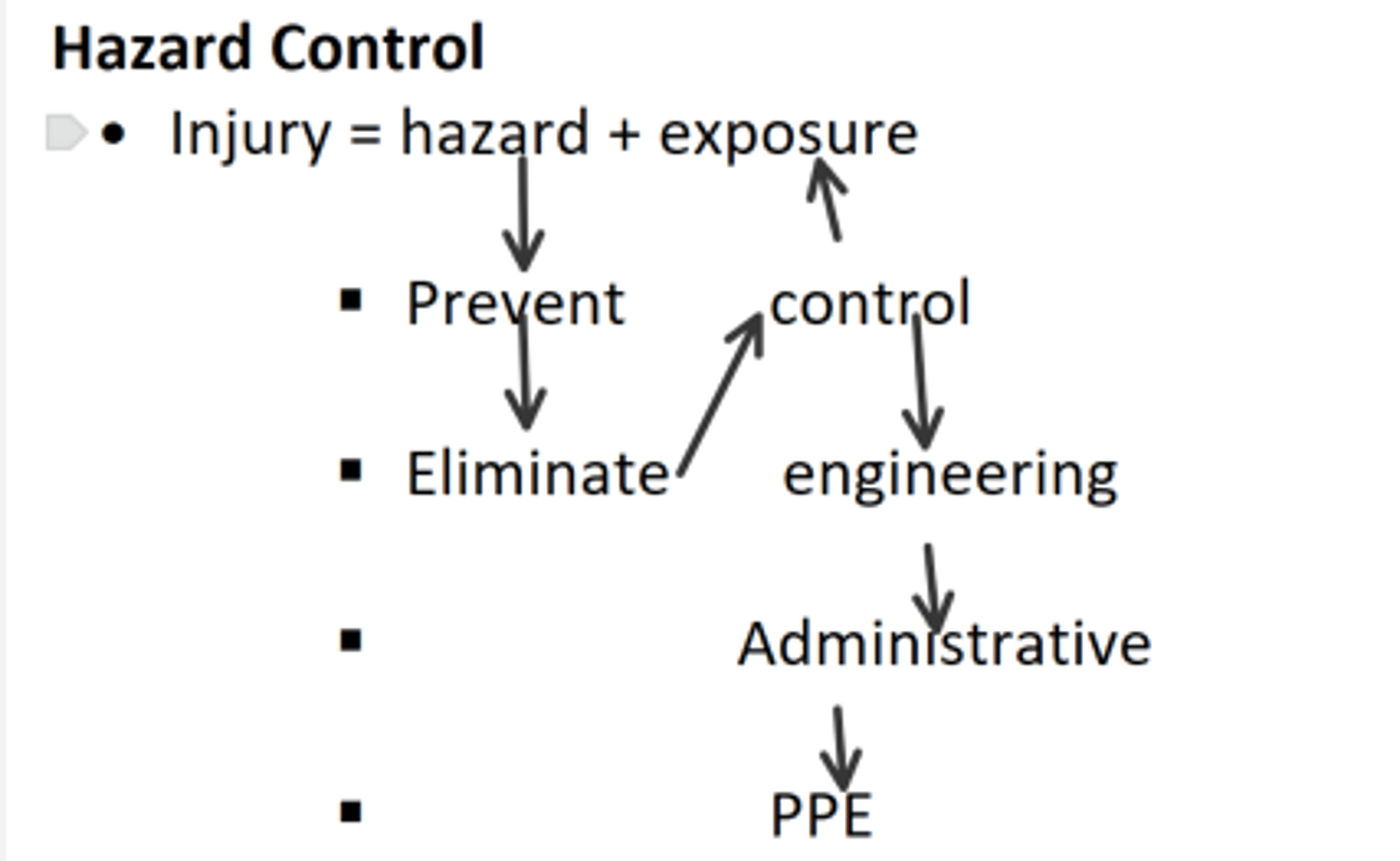
____ + ______ = ________
1______ 3______
2_____ 3a_______
3b_______
3c _______
hazard, exposure, injury
prevent, control
eliminate,
engineering,
administrative,
PPE
Incident Rates allow for a comparative level of injuries between different _____________, _____________, or _______________.
industries, organizations, operations
DART stands for:
Days Away, Restricted, or Transferred
TRIR stands for:
Total
Recordable
Incident
Rate
Employers must provide fall protection when ____________________.
employee is exposed to fall hazards or -falling 6 feet or more
OSHA considers the three types of conventional fall protection to be:
Guardrails
PFAS (personal fall arrest systems)
Safety Nets
A guardrail consists of:
________ rail that must be ______ inches high ±____inches and hold _____lbs.
Top
42"
3"
200 lbs
A guardrail consists of:
________rail that must be halfway and hold ____ lbs.
Mid
150 lbs
A guardrail consists of:
________rail that must be ____inches high and hold ____lbs.
Toe board
4"
50 lbs
A PFAS consists of a:
anchor
body harness
connector/lanyard
PFAS consists of a:
_________ point that can hold _______lbs per worker
anchor
5000
A PFAS anchor must be capable of supporting ______ pounds of force per worker attatched to it
5000
When stopping a fall, a personal fall arrest system shall bring an employee to a complete stop and limit the maximum deceleration distance to ____ feet.
3.5
Personal fall arrest systems, when stopping a fall, shall be rigged such that an employee cannot free fall more than _____ feet or contact any lower level.
6
Safety nets must be as ____ __________to the workers as possible and be ______tested.
close
drop
When mechanical equipment is being used perpendicular to the roof edge, the warning lines cannot be closer than ____ feet.
10
OSHA requires that scaffolding being erected, moved, dismantled or altered be supervised by a ___________ person.
competent
On temporary stairs, handrails (to provide adequate handholds for employees grasping to prevent falling) shall have a minimum clearance of ____ inches between the handrail and walls.
3
A controlled decking zone can only be used as fall protection up to a maximum height of ____ feet.
30
Controlled access warning lines must be at least ______ feet from the edge
15
The three parts of an OSHA inspection are:
opening conference
worksite walkaround
closing conference
is a brief meeting during which the OSHA inspector will explain the purpose of the inspection
opening conference
is the actual inspection.- inspector will take photos, notes, ask questions, and may interview workers
worksite walkaround
-a meeting in which the OSHA inspector will disclose any hazards or violations identified during the course of the inspection-citations and fines are not discussed
closing conference
Only _____________ companies may have a focused OSHA inspection.
construction
When the OSHA CSHO arrives at a site to conduct a focused inspection, they will determine:
-whether there is project coordination by the general contractor.
-whether the projects safety and health program is adequate and the project S&H program meets the requirements of 29 CFR 1926 subpart C.
-whether there is a competent person.
If the CSHO does not find that a company qualifies for a focused inspection , they will receive a ________________ inspection.
comprehensive
The purpose of an OSHA compliance directive (CPL) is to insure________________________.
consistent enforcement of OSHA regulations
The four types of employers in a multi-employer situation are
creating employer
exposing employer
correcting employer
controlling employer
the employer that caused or created a hazardous condition that violates an OSHA standard
creating employer
an employer whose own employees are exposed to the hazard, even if they didn't create the hazard
exposing employer
employer responsible for correcting a hazard
correcting employer
general supervisory authority with power to correct or require others to correct by contract or in practice.
must exercise reasonable care.
controlling employer
1. For an employer to provide a defense against a citation in a multi-employer situation, the employer must show the following.
-the employer did not cause the hazard to exist
.-the employer did not directly control conditions causing the hazard.
-the employer has taken reasonable steps to notify the partys charged with cause and control of the problem
-the employer has taken reasonable steps to keep his/her employees away from the hazard
OSHA defines an excavation as any man-made cut, cavity, trench, or depression in the earth's surface formed by ______removal.
earth
A trench is defined as a narrow underground excavation that is ______ than it is wide
deeper
A trench cannot be wider than _____ feet.
15
Cave-in protection is required for all excavations greater than ____ feet in depth unless they are entirely in solid stable rock.
5
A ladder must be provided every _____ feet for excavations greater than ____ feet in depth.
25
4
Spoil piles, material, and equipment must be kept ____ feet from the excavation.
2
Excavation inspections must be conducted _____ and before start of work
daily
Excavation inspections must be conducted to determine soil _________.
classification
Cave-in protection includes:
sloping
shoring
shielding
benching
___________: Natural solid mineral material that can be excavated with vertical sides
stable rock
Type A: cohesive soils with an unconfined compressive strength of ___ tons per square foot tsf.
1.5
Type B: cohesive soils with an unconfined compressive strength greater than __ tsf but less than 1.5 tsf.
0.5
Type C: cohesive soils with a unconfined compressive strength of ____ tsf or less.
0.5
Type A soil can be sloped at a ratio of 1 / 2 : 1 if the excavation will be open for less than 24 hours and is less than _____ feet in depth.
12
Any excavation more than ____ feet in depth requires a qualified person to design the protection.
20
The classification of soil shall be made based on the results of at least one visual and one _____ analysis conducted by a competent person.
manual
Inspections must be done by a ____________________.
competent person
The four steps in conducting a JSA are:
identify the job
break into key steps
identify the hazards
select the type of controls
A safety audit is ___________ in nature while inspections are qualitative.
quantitative
An audit compares actual performance to a set _______________.
standard
The four modes of entry for most hazards are:
inhalation
ingestion
absorption
injection
Dusts, fumes, & mists are measured in _____________________
weight per unit of volume (mg/m^3)
Gasses and Vapors are measured in ______________________ 1.
volume of contaminant per volume of air sampled (ppm - parts per million)
PEL is a P________________E_____________________L___________________.
Permissible
Exposure
Limit
A TLV is a T_________________L_________________V__________________.
threshold limit value
A TLV-TWA is a T_____W_____A_______ and lasts for ___________.
threshold limit value Time weighted average
8 hour days or 40 hour weeks
A TLV-STEL is a S_____T_____E_____L______ and lasts for ____________.
threshold limit value short term exposure limit
few 15 minutes time period
A TLV-C is a C__________ value and should _________________.
threshold limit value ceiling
never be exceeded
Three reasons for an effective safety and health plan are:
legal obligation
ethical obligation
financial obligation
three reasons for an effective safety and health plan are:
_________ obligation for regulatory compliance
__________ obligation for employees and the community
_________ obligation to control injury costs
legal
ethical
financial
The four main elements of a safety and health plan include:
management leadership and employee involvement
worksite analysis
hazard prevention and control
safety and health training
Louisiana requires the following components for a safety plan:
Management policy statement - signed by executive manager or CEO
Responsibility for safety
Inspection - at least quarterly
Accident investigation
Safety meeting - at least four/year
Safety rules
Training
Recordkeeping
First-aid
Emergency preparedness
Every safety plan should include periodic _________________ for improvement.
evaluation
The maximum travel distance from any point of the protected area to the nearest fire extinguisher shall not exceed ______ feet.
100
All hand and power tools, whether paid for by the employer or employee, shall be ___________
maintained in a safe condition
Whenever practicable, all arc welding and cutting operations shall be __________ to protect employees and other persons working in the vicinity.
shielded
Failure to inspect for oil or grease on regulator fittings, valves, or the cap threads on a cylinder of oxygen can result in ______________.
fire or explosion