L10 Public Key Mathematics
 Call Kai
 Learn
Learn Practice Test
 Spaced Repetition
 Match
Match Flashcards
 Knowt Play
1/3

Earn XP
Description and Tags
Euclidean Algorithm, Extended Euclidean Algorithm. Other PK theorems.
Name | Mastery | Learn | Test | Matching | Spaced | Call with Kai |
|---|
No analytics yet
Send a link to your students to track their progress
4 Terms
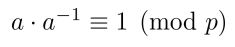
What is modular multiplicative inverse and when does it exist?
The inverse of a mod p is a⁻¹ such that a · a⁻¹ ≡ 1 (mod p).
It exists if and only if gcd(a, p) = 1
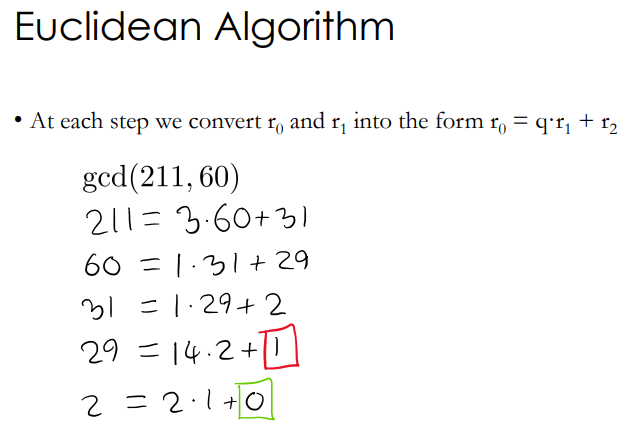
What does the Euclidean Algorithm compute and how does it work?
It computes gcd(r₀, r₁) by repeatedly applying rᵢ = rᵢ₋₂ mod rᵢ₋₁ until the remainder is 0.
The last non-zero remainder is the GCD
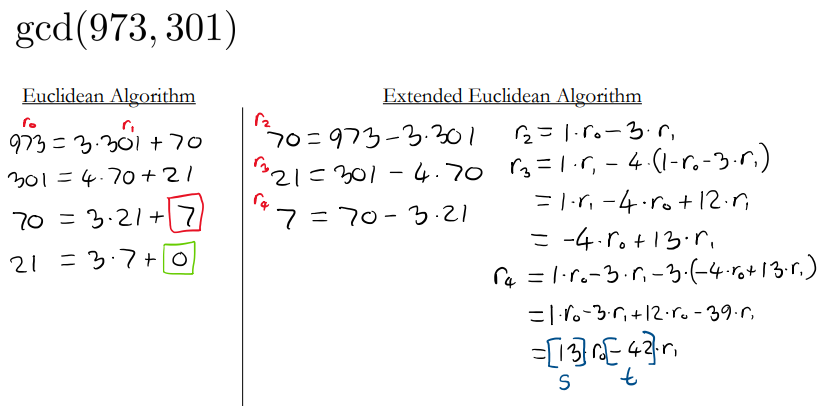
What does the Extended Euclidean Algorithm (EAA) compute?
It computes gcd(r₀, r₁) and additionally finds values s and t such that s·r₀ + t·r₁ = gcd
This directly yields the modular inverse, essential for RSA key generation.
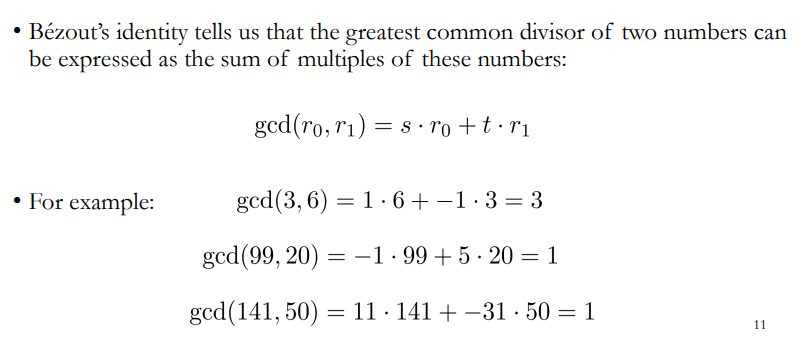
What is Bézout's Identity?
gcd(a, b) can always be expressed as a linear combination: s·a + t·b = gcd(a, b). The EEA finds s and t efficiently.