Biology Unit 10 Evolution IHS Skavaril
 Call Kai
 Learn
Learn Practice Test
 Spaced Repetition
 Match
Match Flashcards
 Knowt Play
1/58

There's no tags or description
Looks like no tags are added yet.
Name | Mastery | Learn | Test | Matching | Spaced | Call with Kai | Chat |
|---|
No analytics yet
Send a link to your students to track their progress
59 Terms
(Clock terms) Earth’s history
Earth forms at
00:00
(Clock terms) Earth’s history
1st single celled life emerges
04:00
(Clock terms) Earth’s history
Multicellular life emerges
20:00
(Clock terms) Earth’s history
Land plants appear
22:24
(Clock terms) Earth’s history
Mammals appear
23:39
(Clock terms) Earth’s history
Modern humans appear
23:58:43
What did Darwin find out about fossils on his voyage
Fossils of sea animals high in the Andes Mountains
Fossils of extinct animals that resemble modern animals
Geologic Processes
Geologic processes can add up to great changes over a long period of time
Variation
Differences in a physical trait among organisms in the same species
Basis for natural selection
E.g. = variation in jaguar jaws/teeth sizes
What is variation caused by
Sexual reproduction and mutations
Adaptation
A variation/characteristic that allows an organism to better survive in its environment for longer and produce more offspring
Can lead to a genetic change in a population over time
E.g. = larger jaws/teeth in jaguars → ones can eat shelled reptiles → new source of food → survives longer
Is a TRAIT an organism has, NOT an action an organism does
Artificial Selection
Humans change a species by breeding it for certain traits
Intrasexual Selection
Male competition
Males battle for a female/mate
Males tend to have bright color → attracts females
Females are more muted so they won’t attract predators
Intersexual Selection
Female choice
Between male & female
Heritability
The ability of a trait to be passed down
Natural Selection
Organisms better adapt to their environment tend to survive and produce more offspring
4 main principles to natural selection
Variation
Overproduction
Adaptation
Descent with modification
Overproduction
More offspring are produced than survive
Those best fit would survive
E.g. = not enough resources to support overpopulation → jaguars who have an extra food source (see adaptation) would be the best to survive as they have an additional source of resources
Descent with modification
Adaptations become more common characteristics in the population
E.g. = long jaws/teeth jaguars survive better → long jaws/teeth are heritable traits → said characteristics become more common in population
Fitness
Measure of survival
Ability to produce more offspring
Selective Pressures
Anything that changes the behavior and fitness of living organisms within a given environment
Competition
Predation
Disease
Climate
Humans
DRIVING FORCE OF EVOLUTION AND NATURAL SELECTION; limits the amount of organisms that can survive and reproduce
Biotic & abiotic pressures
Fossils
Preserved remains of a living thing
Shows how species change over time
E.g. aminite
Biogeography
Geographical distribution of organism
Shows how species change over time
E.g. camels
Embryology
Study embryos and development
Similarities indicate a common ancestor
E.g. = humans (gill slits, like fishes, in very early stages as an embryo)
Homologous Structures (Anatomy)
Body parts that have different function but same structure
Similarities indicate a common ancestor
E.g. = bat wing & human arm → same bone structure but one used to fly, etc.
Analogous Structures (Anatomy)
Body parts that have same function but different structure
Similar selective pressures → same functions to be beneficial
Different in structure → distant common ancestor
E.g. = bat vs butterfly vs bird wing → all wings to fly but different bone structure
Vestigial Structures (Anatomy)
Body part with little or no function
Shows how species change over time
E.g. = appendix
DNA Sequencing
Comparing DNA sequence of different species
Similarities indicate a common ancestor
Less differences = closer the common ancestor
Protein Sequencing
Comparing amino acids of different species
Similarities indicate a common ancestor
Less differences = closer the common ancestor
Divergent Evolution
Different selective pressures acting on similar organisms
Convergent Evolution
Similar selective pressures acting on different organisms
Gene Pool
Collection of every allele for every gene in a population
Allele Frequency
Measures how often an allele shows up in a population
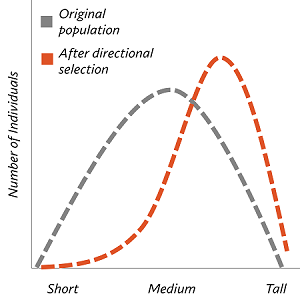
Direction Selection
Some kind of pressure made ___ trait unfavorable
Graph can shift forward or backward depending on situation
Variation in species did not change
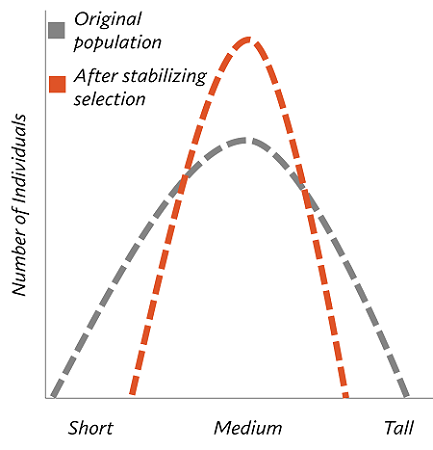
Stabilizing Selection
Selections are against extremes of ___ traits
Being one end of the extreme is bad
Being in the middle ground is good
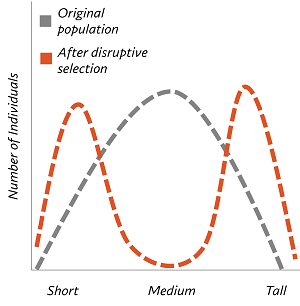
Disruptive Selection
Selections are against the mean/middle
Middle ground is bad
Being an extreme is good
The most likely selective pressure to lead to a new species
Gene Flow
Random movement from one population to
another
No big change in population
Genetic Drift
Shift in genetic variation from random change
Bottleneck Effect
Reduction in genetic variation due to a random event
E.g. humans, natural disasters
Founder Effect
A few individuals (often isolated & small groups) from a larger population start a new population with a different allele frequency than the original population
Reduces genetic variation
Species
A way to organize organisms based on characteristic
Most specialized form of division
Speciation
Formation of a new species
The 2 conditions needed for speciation to occur
Open niche
Isolation
Open Niche
Niche = spot/job in an ecosystem
Isolation
Population must become isolated to speciate; takes time
Reproductive Isolation
Members of different populations cannot have fertile offspring
Behavorial Isolation
Organisms adapted different mating behaviors
Geographic Isolation
Different species are separated by a physical barrier
Temporal Isolation
Different population have different mating seasons
4 outcomes of speciation
Common ancestors
Extinction
Divergent evolution
Convergent evolution
L.U.C.A
Last Universal Common Ancestor
First speciation event to take place
L.U.C.A was a single celled organism
Carcinisation
Everything is turning into a crab
Cladogram
Model of the relationship between species
3 parts of a cladogram
Branches
Derived characters
Nodes
Branches
Represents unique evolution/history of one species
The longer the branch, the further back in the past the common ancestor occured
Derived characters
Indicates adaptation used to separate species
Often labelled with specific characeristics
Nodes
Intersection of the lines on a cladogram
Represents common ancestors
Contributions of Charles Darwin to science
Wrote out and supported the Theory of Evolution by Natural Selection
Traveled the world on the HMS Beagle, collecting specimens and making observations
Co-evolution
When two species affect the phenotypes of each other
Can lead to symbiosis (ecological relationship between organisms) with both species benefitting or an evolutionary arms race