Lab Prac 2 - Final Info
 Call Kai
 Learn
Learn Practice Test
 Spaced Repetition
 Match
Match Flashcards
 Knowt Play
1/6

There's no tags or description
Looks like no tags are added yet.
Name | Mastery | Learn | Test | Matching | Spaced | Call with Kai |
|---|
No analytics yet
Send a link to your students to track their progress
7 Terms
What is the 4 criteria for the vertical jump test?
Standing Reach Measurement: Establishing the baseline height by marking the maximum reach with feet flat on the ground.
Stationary Jump: Jumping from a static position (no running start) using both feet.
Maximum Effort Marking: Marking the highest point reached on a wall or apparatus at the peak of the jump.
Best of Multiple Trials: Performing the test (usually 3 times) and recording the best score, measuring the difference between peak jump height and standing reach
What test would you administer to an elderly sedentary woman? Explain why.
The 1 mile walk 12, the 12 minute run test, the Queen’s College Step test or the 6 minute walk test?
I would have her do the 6 minute walk test. This is because she is both older and not physically active. The 6 minute walk test is both a short duration and low intensity. This would enable the elderly woman to complete the test without putting her at risk for injury.
How does BP change with active vs passive recovery?
After exercise, blood pressure decreases (postexercise hypotension) due to vasodilation of blood vessels. When exercise stops, the muscle pump is lost, causing blood to pool in the extremities. This leads to a reduction in venous return, stroke volume, and cardiac output, which further lowers blood pressure. Active recovery is recommended because it maintains muscle pump activity, helping support venous return and preventing a large drop in blood pressure after exercise
What are the effects of dehydration vs overhydration on the BIA?
Bioelectrical Impedance Analysis (BIA) estimates body composition by sending a small, nonharmful electrical current through the body and measuring the resistance (impedance) to electrical flow. Fat-free tissue (muscle, organs, water) is a good conductor because it contains more water. Fat tissue is a poor conductor because it contains less water. Because of this difference in conductivity, BIA can estimate percent body fat (%BF) . However, results can be influenced by hydration status, since changes in body water affect electrical conductivity and can alter the % body fat estimate.
Overhydration = lower estimated Body fat lower
Dehydration = higher estimated body fat higher
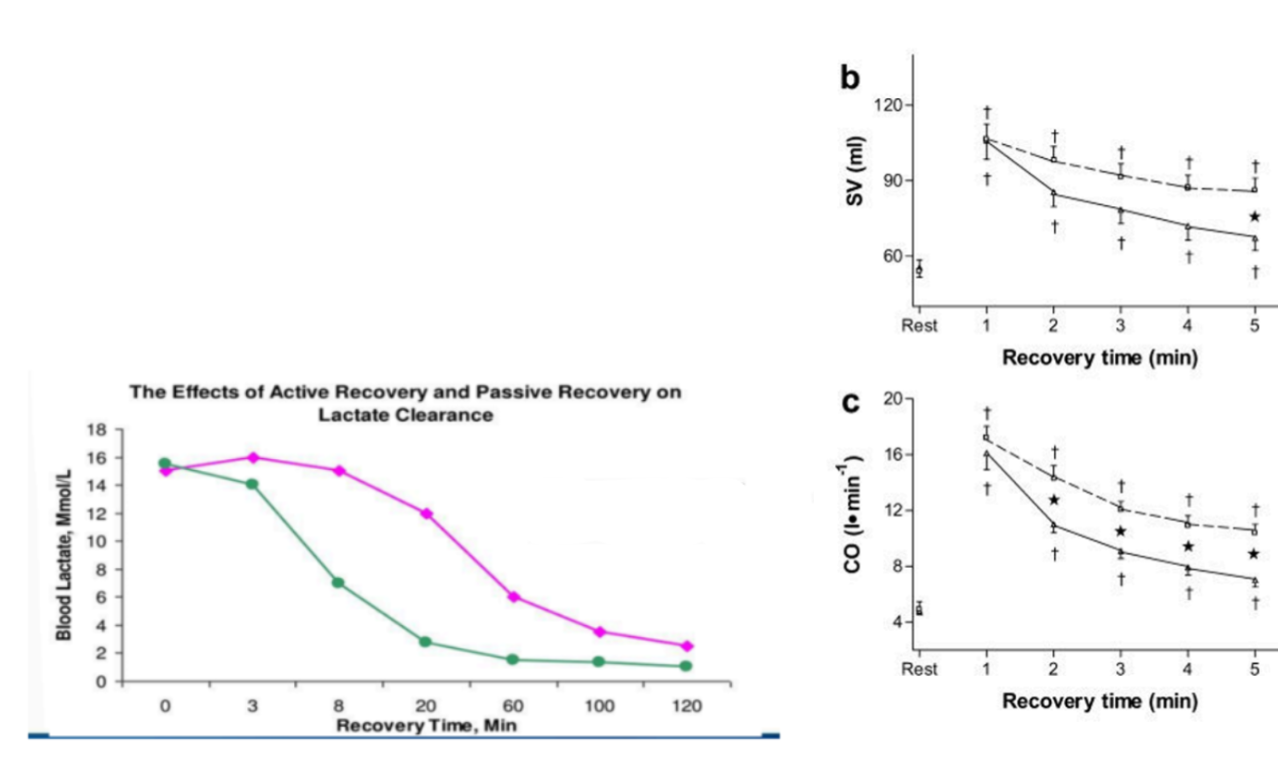
Label which line represents active vs passive recovery
Pink is passive and green is active
Dashed line with open squares = active recovery
Solid line with triangles = passive recovery.
During active recovery, light movement keeps venous return and circulation elevated, so stroke volume (SV) and cardiac output (CO) stay higher during recovery.
In the graphs, the dashed line remains consistently higher than the solid line across recovery time, which matches the expected response for active recovery.
What kind of system does the Wingate test?
The test evaluates the performance of the ATP-PCr and anaerobic glycolysis energy system.
Which muscular system (power, endurance or strength) is being used for each activity:
Plank
Throwing
Handgrip
Baseball pitching
Vertical Jump
Pushup
Climb Stairs
Wingate
Plank: Muscular Endurance
Throwing: Muscular Power
Handgrip: Muscular Strength
Baseball pitching: Muscular Power
Vertical Jump: Muscular power
Pushup: Muscular Endurance
Climb Stairs: Muscular power
Wingate: Muscular Power