AP World History Unit 8: Cold War, Decolonization, and Modern Conflicts
 Call Kai
 Learn
Learn Practice Test
 Spaced Repetition
 Match
Match Flashcards
 Knowt Play
1/99

There's no tags or description
Looks like no tags are added yet.
Name | Mastery | Learn | Test | Matching | Spaced | Call with Kai |
|---|
No analytics yet
Send a link to your students to track their progress
100 Terms
What was the purpose of the Tehran Conference in 1943?
Allies agreed on a strategy for WWII, with Russia attacking from the east and the US and Britain from the west.
What key decision was made at the Yalta Conference in 1945?
Allies discussed post-WWII Europe, with FDR wanting free elections and Stalin seeking control over Eastern Europe.
What was the outcome of the Potsdam Conference in 1945?
Allies discussed peace in Europe, leading to tensions as Stalin refused to leave Eastern Europe and Germany was split into four sections.
What organization was created after WWII to replace the failed League of Nations?
The United Nations.
What two superpowers emerged after WWII?
The United States and the Soviet Union.
What was the primary ideological conflict during the Cold War?
Capitalism vs. Communism.
What does the term 'Iron Curtain' refer to?
Winston Churchill's metaphor for the division between Western capitalist democracies and Eastern communist authoritarianism.
What was NATO and when was it formed?
North Atlantic Treaty Organization, formed in 1949 to support member nations and prevent the spread of communism.
What was the Arms Race during the Cold War?
The stockpiling and mass production of nuclear weapons by the US and USSR.
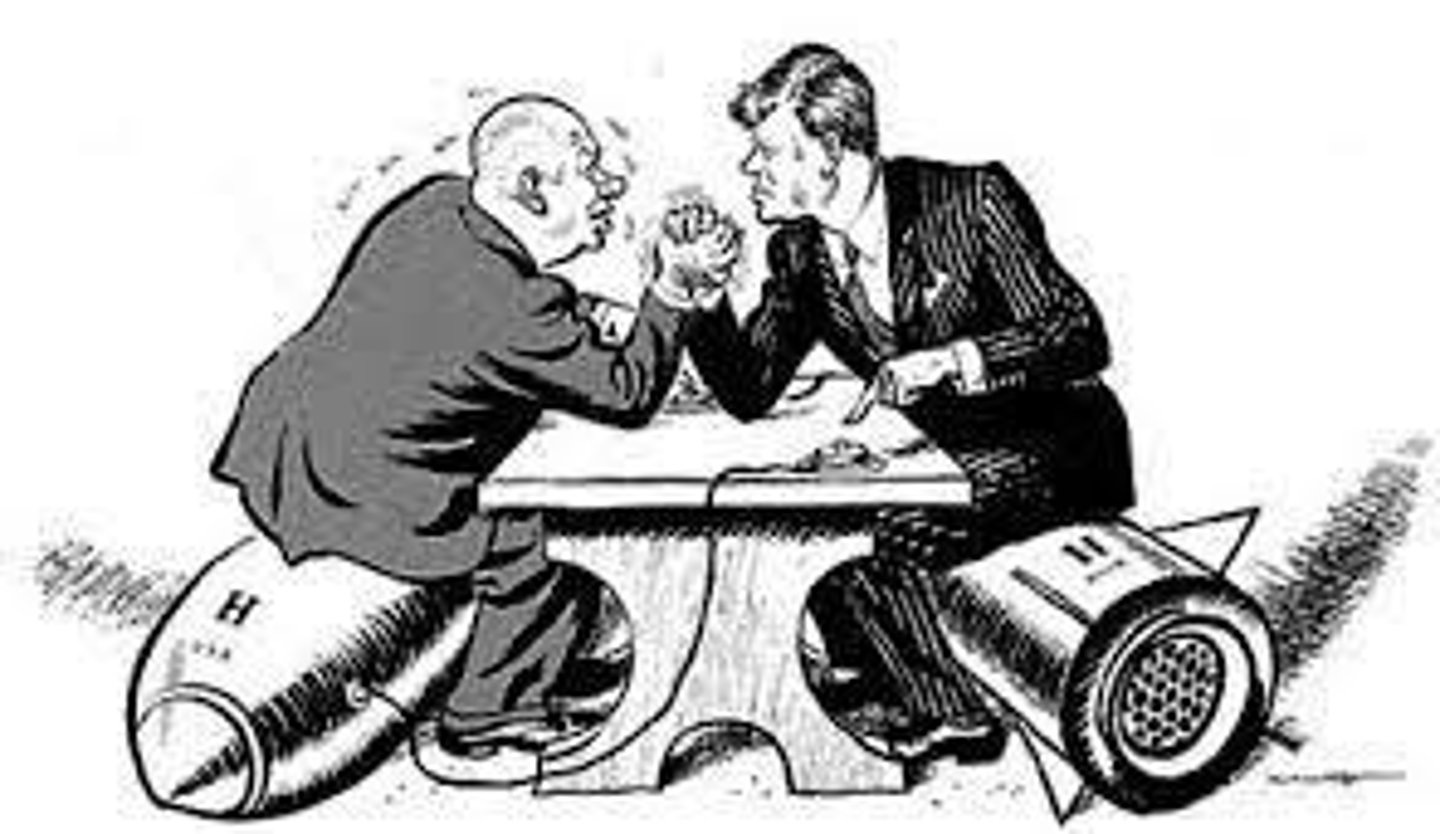
What is the Domino Theory?
The idea that the spread of communism would lead to the fall of one government after another until it reached the US.
What was the Truman Doctrine?
A promise by the US to support countries resisting communism, particularly in Greece and Turkey.
What does 'Mutually Assured Destruction' mean?
The concept that if one country launches a nuclear attack, the other will retaliate, leading to total destruction for both.
What was the Marshall Plan?
A US initiative offering $12 billion to European nations to rebuild their economies after WWII.
What was the Space Race?
The competition between the US and USSR to achieve significant milestones in space exploration.
What was the Warsaw Pact?
A military alliance of the USSR and Eastern European communist countries formed in 1955.
What was Sputnik 1?
The first satellite launched into space by the USSR in 1957.
What was the significance of the Bandung Conference?
A meeting where delegates from 29 countries condemned colonialism and sought to avoid alignment with superpowers.
What were Proxy Wars?
Conflicts where major powers supported opposing sides but did not directly engage in combat.
What led to the Vietnam War?
The civil war in Vietnam following WWII, where North Vietnam became communist and South Vietnam was supported by the US.
What was the Berlin Blockade?
An attempt by the USSR to control all of Berlin by blocking access to the western zones.
What was the Berlin Airlift?
An operation where Allies flew supplies into West Berlin during the USSR's blockade.
What was the outcome of the Vietnam War?
Vietnam was reunified under communist control after the US withdrew in 1973.
Who was the first man in space?
Yuri Gagarin from the USSR in 1961.
Who was the first US man in space?
John Glenn Jr. in 1962.
What was Apollo 11 known for?
It was the mission that landed the first humans on the Moon in 1969.
What was the Bay of Pigs Crisis?
A failed invasion of Cuba by Cuban exiles, supported by the US government, aimed at overthrowing Fidel Castro in 1961.
What event symbolized the end of the Cold War?
The fall of the Berlin Wall in 1989.
What was the significance of the Berlin Wall?
It prevented citizens of East Germany from migrating to the West and symbolized the division of Europe during the Cold War.
What were the main outcomes of the Korean War?
The war ended in a stalemate with Korea remaining divided along the 38th parallel and resulted in approximately 4 million casualties.
What sparked the Cuban Missile Crisis?
The USSR's installation of nuclear missiles in Cuba in response to US missiles in Turkey.
What was the result of the Cuban Missile Crisis?
The US and USSR reached an agreement where the USSR would remove missiles from Cuba in exchange for the US removing missiles from Turkey.
What was the purpose of the Test Ban Treaty of 1963?
To outlaw nuclear weapons testing above ground, underwater, and in space to limit radiation exposure.
What does the term 'Detente' refer to?
A period of relaxed tensions between the US and USSR during the 1960s and 1970s.
What was the Strategic Arms Limitation Treaty (SALT)?
An agreement between the US and USSR in 1972 that froze the number of intercontinental ballistic missiles (ICBMs) each country could have.
What led to the end of Detente?
The USSR's invasion of Afghanistan in 1979, which prompted the US to halt grain shipments to the USSR.
What were the main reforms introduced by Gorbachev?
Perestroika (economic restructuring) and Glasnost (political openness).
What was the impact of the Cold War on society and culture in the US?
Increased fear of communism, the rise of science fiction, and a pervasive nuclear threat.
What was the significance of the Intermediate-Range Nuclear Forces Treaty (INF)?
It restricted the creation and use of intermediate-range nuclear weapons and signaled a thawing of Cold War tensions.
What was the role of the Red Scare during the Cold War?
It heightened suspicion of communists and led to a societal witch-hunt against perceived communist sympathizers.
How did the Cold War influence literature and film?
It inspired works like '1984' by George Orwell and films like 'Invasion of the Body Snatchers' that reflected societal fears.
What was the outcome of the Soviet-Afghan War?
The USSR withdrew in 1989, leading to a weakened economy and leadership in the USSR.
Who was Vasili Arkhipov?
A Soviet naval officer credited with preventing a nuclear war during the Cuban Missile Crisis by refusing to launch a nuclear torpedo.
What was the impact of the Cuban Missile Crisis on US-USSR relations?
It led to the establishment of a direct communication line (Hot Line) between the US and USSR to prevent future crises.
What were the consequences of Gorbachev's policies in Eastern Europe?
They led to democratic reform movements and the eventual fall of communist regimes in Eastern European countries.
What was the significance of the Berlin Wall's fall in 1989?
It marked the symbolic end of the Cold War and led to the reunification of Germany.
What was the economic condition of the USSR leading to its collapse?
The USSR faced an economic crisis exacerbated by the arms race and military expenditures.
What was the cultural impact of the nuclear threat during the Cold War?
It fostered a culture of fear and led to civil defense measures like 'duck and cover' drills.
What was the main reason for the US's involvement in the Korean War?
To prevent the spread of communism in Asia following the division of Korea after WWII.
What was the outcome of the Cold War?
The collapse of the USSR and the end of communist rule in Eastern Europe.
What was the role of the CIA in the Bay of Pigs Crisis?
The CIA trained Cuban exiles to invade Cuba and attempt to assassinate Fidel Castro.
What was the significance of the 'Hot Line' established after the Cuban Missile Crisis?
It allowed for direct communication between US and USSR leaders to prevent misunderstandings that could lead to nuclear war.
What was the Non-Aligned Movement?
A movement where countries fought against the dominance of the US and USSR during the Cold War and sought independence from colonialism.
What are the two main types of resistance to colonization?
Nonviolent resistance and violent resistance.
What is an example of nonviolent resistance?
Civil disobedience, as seen with leaders like Mohandas Gandhi and Martin Luther King, Jr.
What is an example of violent resistance?
Groups like the Irish Republican Army (IRA) and the Shining Path in Peru.
What significant event occurred in Ghana in 1957?
Ghana became the first country in sub-Saharan Africa to gain independence from Britain.
What role did WWII play in decolonization?
WWII weakened Britain, making it unable to suppress independence movements effectively.
What was the outcome of the Partition of India in 1947?
India was divided into two independent countries: India (Hindus) and Pakistan (Muslims), leading to mass migration and violence.
What was the Algerian War for Independence?
A conflict (1954-1962) where the National Liberation Front (FLN) used guerrilla tactics against French forces to gain independence.
What was the significance of the Suez Crisis in 1956?
It highlighted the importance of the Suez Canal and Egypt's desire to assert independence from colonial powers.
Who was Gamal Abdel Nasser?
The leader who overthrew the king of Egypt in 1952 and established the Republic of Egypt, promoting Pan-Arabism.
What was the role of the Organization of African Unity (OAU)?
Founded by Kwame Nkrumah in 1963, it aimed to promote unity and cooperation among African nations.
What was the Quiet Revolution in Quebec?
A movement in the 1960s aimed at changing social and political policies to separate from British-controlled Canada.
What was the impact of the Royal Indian Navy Revolt in 1946?
It contributed to the weakening of British control in India and the push for independence.
What was the significance of the Anglo-Egyptian treaty of 1936?
It allowed Egypt more independence while still permitting British military presence to protect the Suez Canal.
What was the impact of the civil war in Algeria post-independence?
It led to a single-party state and significant internal conflict after the FLN lost an election in 1991.
What was the role of Ho Chi Minh in Vietnam?
He led the resistance against French colonial rule and later against the US-backed South during the Vietnam War.
What were the main factors leading to self-determination in Africa after WWII?
The weakening of colonial powers like Britain and the rise of nationalist leaders.
What was the significance of Kashmir in the India-Pakistan conflict?
It is a disputed territory claimed by both countries, leading to ongoing tensions and conflict.
What was the role of student protests in the decolonization movement?
Student protests, such as those in France in 1968, played a crucial role in advocating for independence and social change.
What was the impact of the Non-Aligned Movement on global politics?
It provided a platform for countries to assert their independence and resist the influence of superpowers during the Cold War.
What was the outcome of the 1995 referendum in Quebec?
It narrowly failed to make Quebec independent from Canada.
What was the significance of the FLN in Algeria?
The FLN was the leading group in the Algerian War for Independence, using guerrilla tactics against French colonial forces.
What were the consequences of the decolonization process in Africa?
It led to the establishment of new nations, often accompanied by conflict and struggles for power.
What was the main goal of Pan-Africanism?
To promote unity and solidarity among African nations and people of African descent globally.
How did the Cold War influence decolonization?
The rivalry between the US and USSR encouraged countries to seek independence and align with neither superpower.
What event did Nasser's seizure of the canal in 1956 lead to?
Britain and France occupied the territory around the canal, Israel invaded Egypt, and the US and USSR opposed their actions.
What was the Khmer Rouge?
A Communist guerrilla group that overthrew the government of Cambodia.
What was the outcome of Pol Pot's leadership in Cambodia?
1/4 of the population died from purges or starvation.
What significant event occurred in Cambodia in 1977?
Vietnamese troops invaded and helped overthrow Pol Pot.
What did the 1991 UN Agreement in Cambodia lead to?
Free elections and the creation of a democratic Cambodia.
What was the Balfour Declaration?
It designated Palestine as a 'national home' for those of Jewish faith while promising rights to non-Jews.
What was the Zionist Movement?
A movement in the 1890s aimed at creating a separate stable region for those of Jewish descent.
What was the outcome of the Six Day War in 1967?
Israel gained control of the Gaza Strip, West Bank, East Jerusalem, and Golan Heights.
What were the Camp David Accords?
A peace agreement fostered by President Jimmy Carter between Israel and Egypt in 1979.
What was the Chinese Civil War?
A conflict between Nationalists and Communists for control of China, leading to the establishment of the People's Republic of China in 1949.
What was the Great Leap Forward?
A campaign initiated by Mao Zedong in 1958 to reorganize land into government-controlled communes, leading to extreme starvation.
What was the Iranian Revolution of 1979?
The overthrow of Shah Pahlavi and the establishment of a theocracy focused on shariah law.
What was the White Revolution in Iran?
A series of reforms led by Shah Pahlavi that were bloodless and aimed at modernization.
What was the Cultural Revolution in China?
A campaign initiated in 1966 to restore the popularity of communism after the Great Leap Forward, involving propaganda and purges.
What were the effects of land reform in Vietnam?
Communists won support by promising peasants more land.
What happened in Guatemala regarding land reform?
Land reform threatened foreign companies like the United Fruit Company, leading to the overthrow of the government.
What were the mixed results of land reform in India?
New reforms aimed to protect renters and farmers but had varying success.
What was the impact of the US and Britain on Iran's leadership post-WWII?
They overthrew Mohammad Mosaddegh, reinstating Shah Pahlavi.
What was the role of the Red Guards during the Cultural Revolution?
They were responsible for identifying and punishing those not conforming to communist ideals.
What were the two factions that Palestine split into?
Fatah and Hamas.
What was the outcome of the Yom Kippur War in 1973?
Egypt and Syria attacked Israel, which defended itself against the surprise invasion.
What did the UN do regarding the Suez Canal?
Negotiated an agreement that made the canal an international waterway under Egypt's sovereignty.
What was the significance of the 1958 Great Leap Forward?
It led to extreme starvation and resistance among peasants due to failed agricultural policies.
What was the main goal of Mao Zedong's policies?
To implement Soviet-style policies focusing on industrialization and land reform.