Week 3+ - Taylor series
 Call Kai
 Learn
Learn Practice Test
 Spaced Repetition
 Match
Match Flashcards
 Knowt Play
1/8

Earn XP
Description and Tags
Flashcards on Taylor series for multivariable calculus and matrices module (prt 1/A) University of York
Name | Mastery | Learn | Test | Matching | Spaced | Call with Kai |
|---|
No analytics yet
Send a link to your students to track their progress
9 Terms
Taylor series definition
A smooth function f(x) can be represented as an infinite sum (Taylor series) about the point x=x0
f(x)=n=0∑∞n!f(n)(x0)(x−x0)n
What is the Maclaurin series?
A Taylor series based at x0=0
What is the Maclaurin series of an exponential function ex or exp(x).
exp(x)=n=0∑∞n!xn
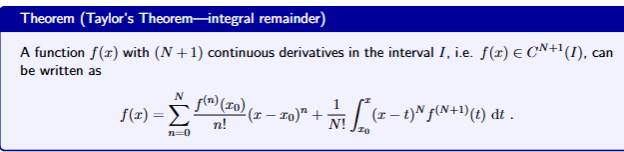
Taylor’s theorem - integral remainder
A function f(x) with (N+1) continuous derivatives in the interval I, f(x)∈CN+1(I) can be written as
f\left(x\right)=\sum_{n=0}^{N}\frac{f^{\left(n\right)}\left(x_0\right)}{n!}\left(x-x_0\right)^{n}+\frac{1}{N!}\int_{x_0}^{x}\left(x-t\right)^{N}f^{\left(N+1\right)}\left(t\right)\differentialD t
What is the formula for Nth order Taylor polynomial?
PN(x)=n=0∑Nn!f(n)(x0)(x−x0)n
Formula for integral remainder of Taylor Series
R_{N}\left(x\right)=\frac{1}{N!}\int_{x_0}^{x}\left(x-t\right)^{N}f^{\left(N+1\right)}\left(t\right)\differentialD t
where RN is the Nth term remainder of f(x).
Taylor’s theorem - derivative remainder/Lagrange
A function f(x) with (N+1) continuous derivatives in the interval I, f(x)∈CN+1(I) can be written as
f(x)=∑n=0Nn!f(n)(x0)(x−x0)n+(N+1)!(x−x0)N+1f(N+1)(c) for some value x0≤c≤x .
Mean value theorem for integration
\int_{a}^{b}g\left(x\right)h\left(x\right)\differentialD x=g\left(x_0\right)\int_{a}^{b}h\left(x\right)\differentialD x
Convergence of Taylor series
consider the derivative form of the remainder term when