MICRO LAB- Biochemistry of Gram Positives
 Call Kai
 Learn
Learn Practice Test
 Spaced Repetition
 Match
Match Flashcards
 Knowt Play
1/8

There's no tags or description
Looks like no tags are added yet.
Name | Mastery | Learn | Test | Matching | Spaced | Call with Kai |
|---|
No analytics yet
Send a link to your students to track their progress
9 Terms
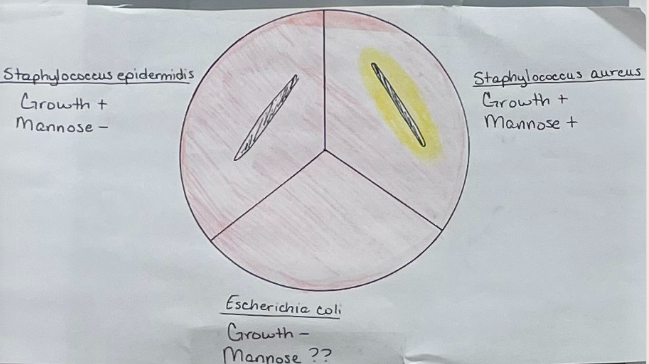
Mannitol Salt Agar
Selective and Differentual
selective agents: 7.5% NaCl (table salt) selects for Staphylococcus bacteria
Differential Agents: Phenol Red turns yellow under acidic conditions
Mannitol ————→ Acid end products
Mannitol Salt Agar
Medium: Mannitol Salt Agar
Substrate: Mannitol
Enzyme: N/A
Other reagents: Selective agent (7.5% NaCl), Differential agent (Phenol Red pH indicator)
Catalase Test
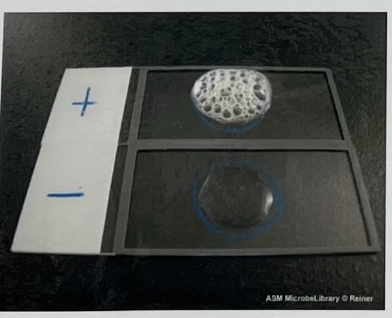
2 H2O2 —————-(Catalase)———> 2H2O + O2
Catalase is an enzyme that breaks down hydrogen peroxide into water and oxygen. The presence of oxygen bubbles indicates a positive result. This test must be conducted using specimens from a plate or slant, and not from a broth
Blood Agar
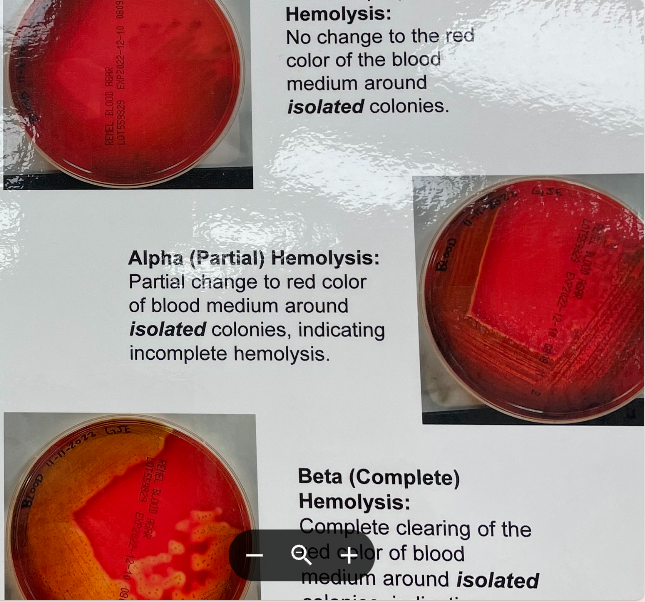
Differential for types of hemolysis
blood plates must be streaked for isolation, and hemolysis must be rad at isolated colonies by holding the plate up to the light and looking for changes to the medium and around isolated colonies
Gamma (No) Hemolysis:
No change to the red color of the blood medium around isolated colonies
Alpha (Partial) Hemolysis:
partial change to red color of blood medium around isolated colonies, indicating incomplete hemolysis
Beta (Complete) Hemolysis
complete clearing of the red color of blood medium around isolated colonies, indicating complete hemolysis
How many organisms will you streak on an individual blood agar plate?
1
What are two important things to remember when obtaining an inoculum to do a catalase test? (Select the two that apply)
You should never take samples for this test from a medium that contains blood.
You need many cells, so samples must come from a solid medium, such as a plate or slant
What are important things to remember when reading the results of a hemolysis test? (Select all that apply)
There are three possible hemolysis results
Read only around isolated colonies
Read the change in the media, not in the bacteria
The selective reagent in Mannitol salt agar is
table salt (NaCl)
How many organisms will you use to inoculate the mannitol salt agar plate?
3
You obtain your mannitol salt agar plate after it has incubated for 2 days. One of the species did not grow. Select the correct results for this from the options below.
Growth negative; Mannitol???
If the organism did not grow, you have no way of knowing whether it is capable of using the mannitol in the medium.