environmental psychology
 Call Kai
 Learn
Learn Practice Test
 Spaced Repetition
 Match
Match Flashcards
 Knowt Play
1/34

There's no tags or description
Looks like no tags are added yet.
Name | Mastery | Learn | Test | Matching | Spaced | Call with Kai |
|---|
No analytics yet
Send a link to your students to track their progress
35 Terms
what is environmental psychology (Steg et al., 2013)
the discipline that studies the interplay between individuals + the built/natural environment
includes both the impact of individuals on the environment, and the influence of the environment on human behaviour + wellbeing
why does the environment have an impact on behaviour
behaviour necessarily occurs in an environmental context → environmental cues can shape/afford behaviours while constraining others
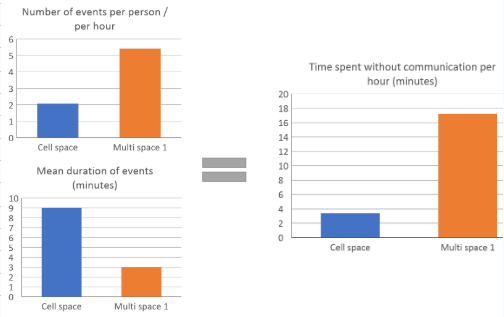
how did Boutellier et al. (2008) study the effect of office layout on communication
assigned office workers to two conditions:
cell offices → areas were much more cornered off + separated
multispace layout → more open-plan space, meaning environment was more shared/interactive
assessed frequency of face-to-face communication + the duration of each event
what were Boutellier et al. (2008)’s findings + what does this suggest
found that while participants in the multispace had more events interacting with coworkers, these events were much shorter on average + they spent more time without communication
suggests multispace offices benefit productivity more than cess spaces, as communication lingered longer in cells → shows how people cohabit changes how they behave with one another
what factors are the effect of the environment on behaviour determined by
the nature of the task
the nature of the person performing it
how does the nature of a task moderate the effects of the environment on behaviour
the nature of productivity depends on the goal → some tasks may require individual concentration, whether some may require communication about ideas
there needs to be a match between the environment + what people are trying to do in it
how did Seddigh et al. (2014) study the effects of task nature moderating environmental impact
participants from 3 organisations were assigned to one of 6 office types:
cell/individual offices
shared-room offices
small/medium/large open-plan offices
flex offices
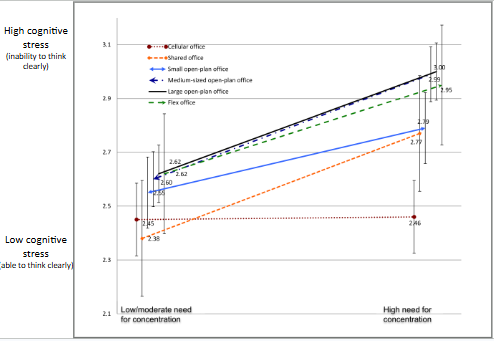
and measured whether tasks were individual + required concentration. DVs included:
distraction → how often you are disturbed so you cannot fully immerse yourself in the task
cognitive stress → how much of the time in the past 4 weeks did you struggle to think clearly
what were Seddigh et al. (2014)’s results
found that tasks that required a higher level of concentration in shared spaces with other people caused more distraction + increased cognitive stress
essentially, the environment has to match the nature of the task being performed
what is field theory (Lewin, 1940) + what is the associated equation
behaviour is determined by the interaction between a person + their environment
𝐵 = 𝑓(𝑃, 𝐸)
where behaviour = function of person + environment → the ‘life space’
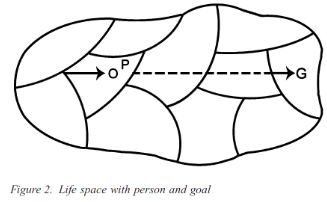
how did Lewin use topology to illustrate his theory + what is one issue with this
used topology to map the ‘life space’, where:
P = the individual
O = their current situation/behaviour
G = the goal they wish to achieve
from this he could measure the strength of supportive/constraining forces on the person, affecting their current behaviour + therefore goal achievement
however, trying to adapt topology to be more dynamic while visualising the theory limited research impact
what is the environmental response inventory (McKechnie, 1974)
measures individual characteristics that can shape the effects of the environment on an individual → included urbanism/rural preference, but more importantly the need for privacy
what association did Gifford (1980) find in reference to the environmental response inventory
found weak negative correlation between need for privacy + evaluations of a cafe (r = -0.22) + a city hall (r = 0.17) → busy spaces with low privacy
how did Roskams et al. (2019) assess the effects of individual characteristics + task nature on productivity
measured effects of 2 IVs on response to open-plan office spaces:
characteristics of the task → complexity + interactivity
individual characteristics → big 5 extroversion subscale + noise sensitivity scale
measured outcome variables including:
acoustic discomfort, speech disturbance + difficulty concentrating
perceived stress
work engagement/productivity
what were Roskams et al. (2019)’s findings + what is one limitation
participants with higher noise sensitivity tended to rate acoustic quality of the office more negatively, concentrated less, were more stressed + had lower self-rated productivity
suggests appropriateness of open-plan offices for effective work performance is moderated by individual noise sensitivity
however control condition was not used → individual characteristics may impede validity of results
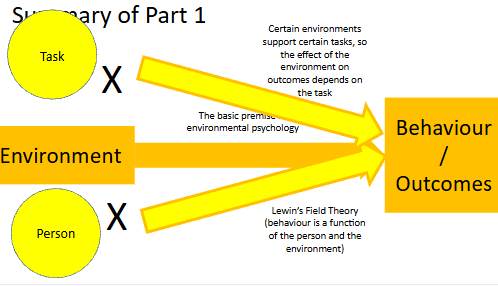
overall, how does the environment + moderating variables contribute to behaviour
the nature of the environment contributes to behavioural outcomes e.g. productivity, while moderating the following variables’ effect on behaviour (either supporting or constraining it)
task → certain environments support certain tasks
person → Field Theory (behaviour is a function of the person + environment, so individual characteristics moderate how individual responds to the environment)
what 4 items are included in the perceived restorativeness scale (Hartig et al., 1996)
fascination → my attention is drawn to many interesting things
being away → spending time here gives me a good break from day-to-day routine
coherence → whether there is too much going on
compatibility → I can do activities I enjoy here
what 5 predictors did Pals et al. (2009) measure to represent restorativeness + in what 2 environments
measured participants’ ratings of butterfly gardens and baboon enclosures to rank their restorativeness based on:
fascination
novelty
escape
coherence
compatibility
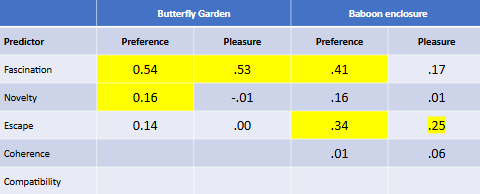
what variables were associated with zoo attractions in terms of preference + pleasure (Pals et al., 2009) + what does this imply
butterfly garden → moderate correlations with fascination + novelty in terms of preference + pleasure
baboon enclosure → moderate correlations with fascination + escapism
shows that what makes one environment restorative differs between people, and environments can be restorative for different reasons
how did Jiang et al. (2021) assess whether visual or auditory aspects of the environment were more important at determining how restorative it is
participants were randomly allocated to watch one of 12 videos that differed in terms of:
visual scene → urban park, street or office plaza
sound scape → mute, nature sounds, mechanical sounds, traffic sounds
measured how sounds being consistent or inconsistent with the visual environment affected self-reported emotions
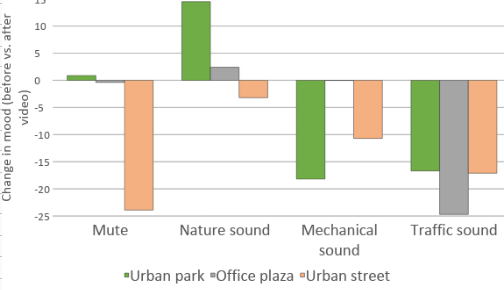
what were Jiang et al. (2021)’s results in relation to mood + what does this imply
measured change in mood:
found mood was improved when sounds were congruent with the urban park, and nature sounds reduced the negative impact of the urban street on mood
found mechanical sounds caused the lowest mood when paired with the urban park → shows visual + auditory aspects need to be compatible
overall, found acoustic environment = more important than visual in determining mood
what are 2 strengths + 3 weaknesses of Jiang et al. (2021)’s research
good factorial design → 3×4 levels mean that researchers could assess factors both in isolation + the interaction between them
participants were randomly allocated + repeated measures were used → individual differences controlled for
may lack ecological validity due to use of a video rather than real environment → may not accurately reflect response
possible demand characteristics from the repeat measures design
temporal effects → mood may change depending on how long one spends in the environment; this was not accounted for
how did Mayer et al. (2009) assess what effects restorative environments have on two individual variables
drove participants to two separate environments after telling them to reflect on a loose end in their lives that needs tying (not to trivial or serious) → participants walked for 10 minutes + sat for 5 in either:
nature park
city centre
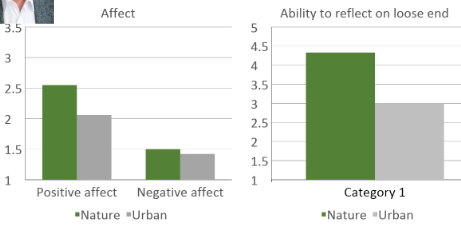
and measured affect + ability to reflect on the personal problem after the fact
what were Mayer et al. (2009)’s findings + what does this suggest
found the natural environment positively affected both people’s mood + ability to reflect on the personal problems they had, despite not having a personal tie to the location → shows natural environments = more restorative both affectively and cognitively
how did Soga + Gaston (2024) study the effects of restorative environments on pro-environmental behaviour + what did they find
conducted systematic review from 52 studies + 12 case studies → studied the interplay between the environment + individuals (whether spending time in natural environments causes people to ‘give back’)
found direct experiences with nature were positively correlated (r = 0.20) with actions undertaken with intention to reduce environmental harm + protection → could be due to changing cognition or desire to protect environments they themselves find restorative
what is Ulrich (1983)’s stress recovery theory pertaining to restorative environments
features of natural environments immediately evoke positive affect without conscious recognition of this fact
this serves to automatically lower arousal + reduce stress
in this theory positive affect is a proximal mediator + stress reduction = DV
how did Kang + Shin (2020) test stress recovery theory
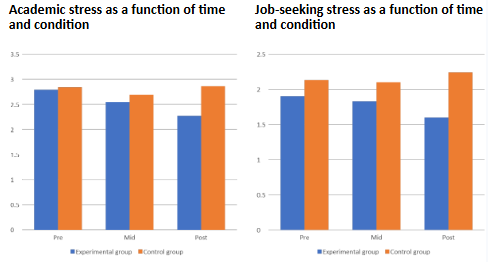
participants were randomly allocated to 8 week forest therapy or control (no intervention)
measured participants’ academic stress using a burnout inventory + other types of stress using a job-seeking stress inventory both after the intervention + later follow-up
what were Kang + Shin (2020)’s findings + one key limitation of this study
found generally, forest therapy marginally decreased both academic + job-related stress
however, the study didn’t test immediacy of the intervention on stress reduction, which is key to the theory
what is Kaplan (1989)’s attention restoration theory + what are 4 key functions
most environments ‘fight’ for our attention (introduce high demands), so deplete it → known as ‘directed attentional fatigue’. however, natural environments restore our attention by:
providing fascination
have a sense of connectedness
have a sense of being away from daily hassles
are compatible with inclinations
what findings did Mayer et al. (2009) obtain that both supported + opposed attention restoration theory
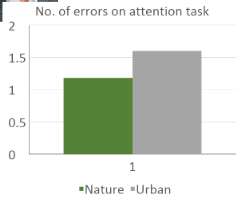
measured how many errors participants made on an attentional task (visual scan) after being in a nature vs urban environment
found that participants made fewer errors after being in a natural environment, supporting attention restoration theory
however rather than attentional capacity, it was changes in how connected participants felt to the environment that mediated effects of environment on task performance → while increased attention may be a side effect of the natural environment, study doesn’t provide direct support for the theory
how did Bratman et al. (2024) study effects of contact with nature on increasing attentional capacity to regulate emotions
performed survey of 600 adults measured frequency of contact with nature as well as emotional wellbeing + coping strategies including:
less effective emotional regulation → use of distraction + rumination
more effective emotional regulation → reappraisal (requires more attention)
what were Bratman et al. (2024)’s results + what does this suggest
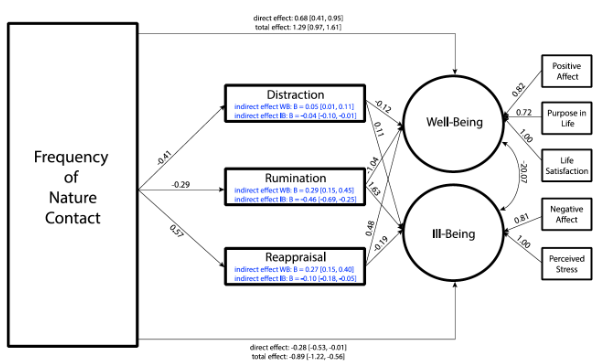
created a path model of variables + found:
FoNC had direct effect on wellbeing factors e.g. affect, purpose in life, perceived stress etc.
emotional regulation strategies strongly mediated the effects of FoNC on wellbeing → rumination was negatively associated with wellbeing + positively associated with illbeing, while reappraisal was positively associated with wellbeing
suggests that emotional regulation mediates the relationship between frequency of nature contact + wellbeing, as more contact with nature increases capacity to reappraise situations
what is the perceptual fluency account (Joye et al., 2016) as to why natural environments are restorative
natural environments are processed more fluently (requires less attention to process) than urban settings due to their fractal patterns, which mean that they contain more redundant information than urban scenes
what are fractals
shapes with various dimensions, which are more or less random
some of these are more organic (more likely encountered in the natural world), while others are more structured/symmetrical (more likely encountered in urban environments)
fractals that are more random tend to be more associated with natural environments
how did Hagerhall et al. (2015) assess the validity of the perceptual fluency account + what did they find
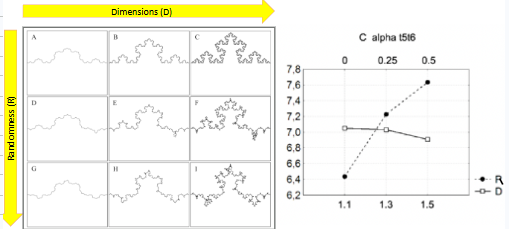
exposed participants to fractals that differed in both randomness + dimensions, and measured their alpha response → essentially measure of mindfulness
found while number of dimensions had little impact on alpha response, randomness did → random fractals made participants more relaxed due to having more redundant information that doesn’t consume our attention
this meant that attention not consumed by symmetrical patterns could be directed inward, making participants more mindful
overall, what are 3 theories as to why environments are restorative
stress recovery theory → has some limited evidence
attentional restoration theory → has more, but partially limited evidence
perceptual fluency account → has experimental evidence