Study Guide: Glycolysis & Gluconeogenesis
 Call Kai
 Learn
Learn Practice Test
 Spaced Repetition
 Match
Match Flashcards
 Knowt Play
1/22

There's no tags or description
Looks like no tags are added yet.
Name | Mastery | Learn | Test | Matching | Spaced | Call with Kai |
|---|
No analytics yet
Send a link to your students to track their progress
23 Terms
Where does glycolysis occur in eukaryotic cells?
Cytosol
The end product of the "payoff phase" of glycolysis is
Pyruvate
Under hypoxic conditions, the end product of the glycolysis "payoff phase" is further converted into
lactate
How many ATPs are yielded as “net gain” per glucose in each glycolysis cycle?
2
How many pyruvates are yielded per glucose in each glycolysis cycle?
2
How many ATPs are produced during the payoff phase of glycolysis per glucose in each glycolysis cycle?
4
Six-carbon glucose is split into two 3-carbon intermediates in the
the "investment phase" of glycolysis
How many NADH are yielded as “net gain” per glucose in each glycolysis cycle?
2
Which of the following catalyzes the first step of glycolysis to trap glucose inside the cells?
Hexokinase
During glucose glycolysis, which of the following catalyzes the conversion of a 6-carbon carbohydrate intermediate into two 3-carbon intermediates?
aldolase
The Warburg effect of cells refers to
the preference of aerobic glycolysis for ATP production
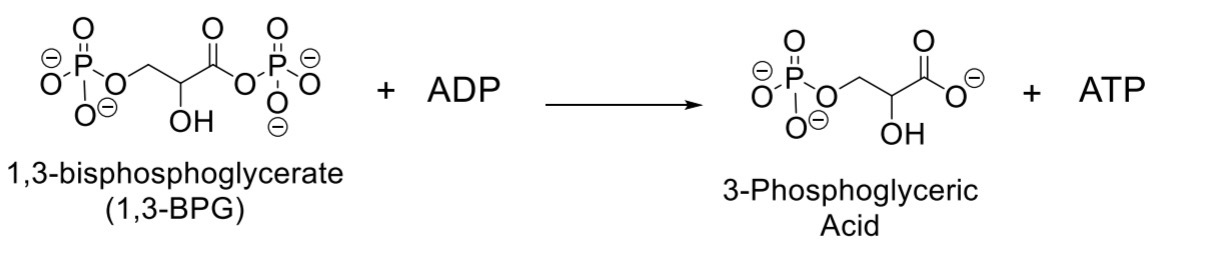
Which of the following about the reaction between 1,3-BPG and ADP is correct?
1,3-BPG has a higher phosphoryl-transfer potential than that of ATP
Which of the following is true?
Insulin inhibits gluconeogenesis
What is the primary organ/tissue conducting gluconeogenesis in humans?
liver
What is the primary organ/tissue conducting glycogenolysis in humans?
liver
Which of the following is not an initial input to start gluconeogenesis?
Leucine
The first step of gluconeogenesis is the carboxylation of pyruvate to oxaloacetate. How many carbon atoms do oxaloacetate have?
4
To catalyze the carboxylation of pyruvate, pyruvate carboxylase uses biotin prosthetic group to carry
CO2
Conversion of pyruvate to oxaloacetate, the first step of gluconeogenesis, occurs in
Mitochondrion
From the following, select all cellular organelles that are involved in gluconeogenesis
Mitochondrion, Endoplasmic Reticulum (ER)
In the liver and kidney cells, glucose-6-phosphatase that catalyzes the last step of gluconeogenesis, is located at
Endoplasmic Reticulum (ER)
Skeletal muscle-produced lactate is transported to the liver for gluconeogenesis and the newly-synthesized glucose then returns to the muscles. This process is
Cori cycle
Which of the following about fructose-2,6-bisphosphate (F-2,6-BP) and the regulation of glycolysis and gluconeogenesis is correct? Select all that apply.
Fructose-2,6-bisphosphate (F-2,6-BP) is a master regulator of both glycolysis and gluconeogenesis
Cellular concentration of F-2,6-BP is regulated by the bifunctional enzyme PFK2/FBPase2
PFK2 is a kinase and FBPase2 is a phosphatase
F-2,6-BP is an allosteric inhibitor of FBPase-1 which is a required enzyme in gluconeogenesis
Glucagon signaling pathway increases the phosphatase activity of the bifunctional enzyme PFK2/FBPase2