MA Jewish Material Cultures
 Call Kai
 Learn
Learn Practice Test
 Spaced Repetition
 Match
Match Flashcards
 Knowt Play
1/30

There's no tags or description
Looks like no tags are added yet.
Name | Mastery | Learn | Test | Matching | Spaced | Call with Kai |
|---|
No analytics yet
Send a link to your students to track their progress
31 Terms
demographic arc + political context: waves anti-Jewish violence
c. 900-1300 (HMA): pop. rise, paralleling gen. European trends
after c. 1300 (LMA): expulsions, forced conversions, persecution
(initially) Christian Church cared little for their actual beliefs → gradually more concerned w/proper rooting of these converts in Christianity
(1413-14, Tortosa) Public disputation bet. representatives still-Jewish communities & Christians (amongst them Jewish converts to Christianity) occurred for 18 months. Presided over by convert Joshua Lorki (Jewish name but accepted Christian name Jeronimo de Santa Fe). Aim to convince remaining Jews convert Christianity.
→ preaching campaign by Vincent Ferrer across Castille & Aragon. Dominican (expert preaching) who preached in synagogues → Jews compelled to listen. Effective: produced another wave conversions.
🔗 young scholar martyr
Jewish texts: need make sense tragic violence befell Jewish communities found form in varite commemorative genres = chronicles, lists, laments, poems, folk tales & trial transcripts
overall issue been around drawing boundaries within Jewish community
- Constructed their identity w/polemic representations to forge a spec. Jewish identity, narratives martyrdom & polemic – ways constructing identity as means creating boundaries both within & sep. them ß majority culture
- Touches on who has auth. within Jewish community + how to reconcile trad. Jewish identity w/demands contemp. currents
- Jews need to react to changing circumstances: navigate attempts to (1) address/ adjust to these changes (2) preserve its uniquen. & spec. nature → projected onto these issues
key terms
conversos: non-Rabbinic lit. converts to Christianity in Spanish, Portuguese, Catalan & Ladino
Marranos: non-Rabbinic lit. conversos practiced Judaism in secret à targeted by Spanish Inquisition.
o Derogatory term later à more widespread (means swines) as Christian soc. got more suspicious faith
o Growing no. conversions à sociopolitical problem – const. questioned & scrutinised
Anussim: legal category Jews in Halakhah (Jewish law) forced to abandon Judaism against their will, typically dur. forced conversion to anoth. religion – forced converts
Act og abandonment of religion done against Jew’s will à remains kosher Jew under force, as long as keeps practicing Jewish law to best abilities under coerced condition
Rambam (Mishneh Torah) gives this label to children rebels; ‘reared in erroneous way his parents’
Clearwhat happens to 2nd-gen. converts who lack knowl. Judaism + those who’ve lived as converts for long time
Min/ apostate Judaism: legal category Jew denied God’s existence (voluntary)
Meshumad: legal category self-destroyed/ heretic, rebels against Jewish principles faith &/pr Halakha (Jewish relig. law) – abandons Jewish observance/ miszvah (voluntary)
Counted as Jew for purposes lineage BUT cannot claim any privilege pertaining to Jewish status:
counted in minyan/ quorum
What transformation response Ashkenazi Jews 1012 → 1096 attacks?
(1012) People converted, kids
(1096 3 Hebrew chronicles massacres 1st Crusade) active martyrdom: 1000s when crusaders descended upon their communities - self-sacrifice, killing wives & children = 12thc chronicles
mock, spit & urinate on crucixes
Gave rise to powerful martyrdom ideal: writers use trad. term kiddush ha-Shem (sanctification of God’s name)
Communities chose death over forced baptism
Commemorated in chronicles, liturgical poems & memorbucher
Been change in their idealistic and emotional world prep. them for mass martyrdom…
(at this point, pre-Blois) martyrological conventions
chronicles
1. Emphasise martyrs’ demographic diversity (those refuse save their lives by converting): women, children, young, old, scholars & simple folk
(prose chronicles 1096) Uniform defiance/ collective obed.: die together (source prov. this[FS1] ) - scenes heroic self-sacrifice, hysteria frightened & trapped communities, hesitation parents & children, bravery those revert after forced baptism, those who suicide/ slaughter others to prevent conversion.
(2nd Crusades) commemorates victim judicial violence → espec. those die result judiciary
justice…
your earlier source: 1096 Isaac the parnas
Historians typically remember as hallmark example new ideal type Jewish martyr who boldly inflicted death upon himself
What happened?
Crusaders killed his wife à submitted to forced baptism, hoping prevent them ß kidnapping his 2 kids & raising them as Christians, which other contemp. sources confirm as well-grounded fear
(3 days later) Isaac regretted his conversion: killed himself, mother & children – even after most imminent danger had passed
Longer account contains phrase: ‘for they [my children] are young; they cannot distinguish bet. right & wrong’ – this context, he applies it to show his children will not be able to protect themselves ß errors of Christianity – but it also shows their innocence of the whole ordeal… they are not able to consent to what happens to them (self-sacrifice/ martyrdom) – p21 – surely had not yet matured sufficiently so as to make such a decision wisely!
Portrays him as sacrificing his children for his sins: mother feels pity for him
Inverts Biblical tropes – e.g. goes towards the fire unlike Lot in Sodom & Gomorrah + Jacob told not to sacrifice his son
Slaughter his children to cleanse himself of sin, defiance crippled mother’s last request, indecisiven. & frenzy moving ß his house à synagogue & back 7 forth again, leaving death in his trail at every turn, burning every corner synagogue = ridiculous x pitiful
Depicts him w/ridicule, sarcasm, helplessness & irony: pardoy sacrifice, sanctuary & priest/parnas
Way wrestling w/themselves & their trauma + God – multiple meanings because diffic. to reconcile/ understand
Longer account calls him ‘Master Isaac the pious’
Longer account: he sets fire to house in which mother burns
Link to fact Master Uri wanted to burn synagogue, since had heard Christians wanted convert it into house idolatry/ building for minting coins – then Master Isaac burnt to death when kindling synagogue
- These stories contain lots inaccuracies and contradictions[FS1] … implies touched up to fit ideal?
[FS1]
Why did Crusaders attack Jews/ forcibly convert?
(1096) Urban II à recapture HL, partic. Holy Sepulchre à Germany
When Pope Urban II delivered his fateful address to the Council of Clermont in November 1095, launching the First Crusade, the essential crusading idea had already taken shape. Although Urban successfully blended this concept with popular notions of the soldier of Christ (miles Christi), his guiding idea was basically a notion of world order; the crusade comprised a means for establishing a thoroughly Christian society subject to the authority of the papacy
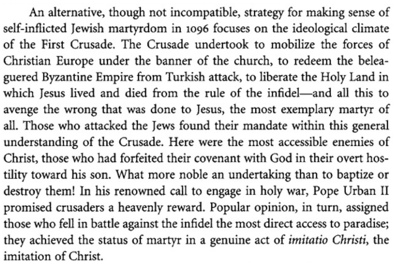
Why this transform.? Avraham Grossman: internal factors (expressed disting. characteristics EMA German Jewry)
deep enmity tow. Christianity ∵ cultural & structural estrangem.
Sefarad more culturally integrated into mainstream soc./ courtly life
attit. to philosophy + intellectual focus: embraced rationalism + phil., science, grammar, secular poety alongside halakhah
communal leaders = courtier scholars → politically prov. secular reasons all could access
lang.: spoke & wrote in Arabic - vernacular x literary languages (prayers, supplications, Jewish law books… influenced by Islamic legal lit. + elite partic. in joint gatherings w/Muslims & read books Islamic thought)
Ashkenazi
attit. to phil. & intellectual focus: suspicion; pietism - focused on Talmud commentary more than phil., science, grammar, secular poetry alongside halakhah
sharper boundary; martyrdom ideal
↑ pressure convert - concern & reality
escalation social, econ. & relig. measures/ policies (desperation & destitution) + physical attacks (threat viol.)
✝ claims 🕎 humiliation & political weakn. tes
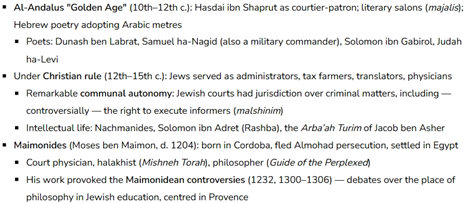
tified to ✝’s rightn. & victory → humiliating & diffic. to cope w/: if kids converted, would’ve been terrible & final admittance to their failure
diminished leaders & undermined shaky morale communities under stress → chaos, disarray → dissent
peaked mid 13thC: poss. reached 5-10% Jewish pop. (some reverted)
(by 1150s, after 2nd Crusade) secular authorities ↑ willing prosecute Jews → ↑ urgency
(1300-1430s) decline: expulsions, forced conversions, persecutions → Jewish communities fraction what had been prev.
function in wider state: merchants, moneylenders ∴ excluded ← wider soc. & unis where learning happened…
reason learn/ adopt Latinlang.: wider divide bet. vernacular & literary languages. Latin = lang. ✝ cult → ↑ assoc. w/✝
→ ↑ 💪ly rejected ✝ culture: estranged & distant; emotional & intellectual rejection
deep-seated polemic ✝ as idolatry polygamy & false religion: God’s deadly enemy + obstacle to revelation His Kingdom on earth
→
MA Sephardic Jews typically opted for conversion; Ashkenazi in n Europe chose martyrdom
contrast 🇪🇸-born Rambam (condemned acts martyrdom) VS 11th-c 🇫🇷 Rashi: interpreted ↑ ½ psalms as referring to gentiles’ enmity tow. people 🇮🇱, terrible suffering 🕎s in diaspora & future redemption
common econ. activity → closen. & friendly relationships? &
Why this transform.? Avraham Grossman: internal factors (expressed disting. characteristics EMA German Jewry)
Messianic expectations/ faith
Rashi’s disputation w/Christian sage calculations Messiah would come 1099 + Hebrew chronicles 1096 clearly allude to messianic anticipation on eve decrees
Prep. people emotionally for mass martyrdom
Apostasy = fear espec. prevalent amongst German Jews MA (see above for why)
Fear apostate’s assistance to enemies God’s kingdom = impediment
Feeling martyrdom secure salvation next world: great reward
Marranos of Spain inspired by Babylonian rabbinic traditions: placed ↑ value on redemption in this world →↑ likely stay alive
Why this transform.? Avraham Grossman: internal factors (expressed disting. characteristics EMA German Jewry)
Attributed consid. auth. to Aggadah (rabbinic lore), include. tale suicide pact at Madada found in 10th-c Hebrew history book Jossipon
Considered ancient holy book à gave weight to such stories in defining halakhah/ legal norms
Recounts collective suicides Jews at Gamla & Madada dur. rebellion against Rome
Describes acts self-sacrifice in great detail & as act heroism: mass suicide & slaughter children so would fall into hands Romans
Mentions other examples too 2nd Temple period à view person may kill himself & family so fall into enemy hands, captivity & violated = sanctified principle?
· Use same lang. to draw parallels
Why this transform.? Avraham Grossman: internal factors (expressed disting. characteristics EMA German Jewry)
· Piyyut
§ Only centre to regard them as integral part holy scripts
§ Expressed sorrow: carried deep rejection Christianity
§ Educational influence on community: instrument for sages to strengthen faith members community + resistance to Christian propaganda & pressure convert
Why this transform.? Avraham Grossman: internal factors (expressed disting. characteristics EMA German Jewry)
· Strengthening community’s foundations
§ No. Jews in Germany ↑ → strengthened communal structures & rabbinical leadership (institutions, auth. & sages ↑) → ↑ influential & appreciated by commonfolk: hierarchy & rabbis ran community to easy for them to influence whole communities
§ à deep relig. awakening → leaders worried & ↑ efforts influence their followers’ relig. world & strengthen their opposition to acts apostasy
Why this transform.? Avraham Grossman: internal factors (expressed disting. characteristics EMA German Jewry)
🔗 connection w/heritage Eretz Israel in German communities
§ Jews as heirs to rabbinical traditions formed in land Israel in antiquity by books, essentially piyyutim, & memory martyrdom (remember to use that spec. word)
§ Inherited rabbinic traditions land Israel that cherished memories ancient Jewish martyrdom but generate active involvem. in messianic & political movements.
→ Collective self-image piety: ideal righteousness emphasised exemplary morality & spirituality their community
→ May have modified halkhah to reflect their coded customs
Stated in chronicles 1096 decrees
Why this transform.? Cohen: external factors contrib. to emergence this ideal
What does this reveal about Christian-Jewish interactions?
Christian crusader ideology/ ideal → salvation via death in battle
Monastic chronicles bequeathed to posterity classic Christian ideals crusading:
1. Engaging just earthly but holy/ spiritual war untold cosmic signif.
2. Emulation biblical models by elect group (Christian martyr trad.), espec. in conquest promised land
3. Commitm. to martyrdom as preferred means for imitating JC in battle for liberation his grave
- Christian models offered standard for emulation & competition ∵ their physical & ideological threat
→ speaking common lang. w/Christians – problematises thesis Ashkenazi Jews more isol… see Tartakoff
Sim. structuring because shared symbolic world: worked w/sim. symbols, just employed diff. aims… both passive influence daily interactions + active integration these ideals into own worldview, which shaped their ideals
Goes both ways: precedent in Judaism but increased motivation because lived in environm. promoted parallel/ analogous ideas ab. what means to follow God properly
What was Blois incident?
catalyst was the claim of a Christian servant that he had seen a Jew cast the corpse of a Christian child into the Loire River. Long-simmering resentments between a local Blois lord and a prominent Jewish woman named Pucellina (to whom we return in chapter 2) escalated tensions and resulted in the mass arrest of the Blois Jewish community, totaling some forty adult men and women. Ransom negotiations broke down and on May 26, 1171, 32 Jews were burned at the stake.41
Good few = Tosafists (members cadre scholars reinterp. Rabbinic law for Jewish world of their times)
Why was Blois incident so traumatising?
1st time MA secular ruler respons. for their welfare had prosecuted & condemned his Jews → new sense crisis & dismay
1st judicial attack on Jewish community, mob – legal procedure where Jews convicted for crime
Put into question protection had enjoyed ← secular authorities
Framework Jewish existence in Europe: rec. privilege ← secular auth. to settle in partic. region, providing financial services in exchange for legal protection → doesn’t work anymore; not protecting them but suppressing them
How does this 🔗 poetry?
(Einbinder) (Jews Rhineland & n France/ n France & Ashkenaz, 12th-13thC) Enshrined martyrs/ commemorative genre in verse (poetry martyrdom/ martyrological poetry)
kiddush ha-Shem of individuals: tell willing deaths individuals converted/ returned to faith subordin. relig. minority
Death for sake Judaism expressed MA Jewish view martyrdom constituted ultim. expression Jewish piety
Why was this enshrined in poetry? Aims
internal (🔗Grossman)
polemical response to historical conditions (even as served penitential & commemorative ends)
(n France, LMA) Martyrological poetry evolved as tool resistance(/ effort stem defection) to growing pressure to convert/ commemorative genre enshrine martyrs in
Nec. intended dir. emulation but rather…
Liv. ideals vicariously: offered symbolic mediation contradictions. Ideals reflected what was missing in Jewish life. This = Jew liberated ß
conflictingloyalties, dependencies, frailtiesRabbis privileging identity persecuted, endured God’s chastisem. w/renewed sense own election
(Tosafists) Reinforce own auth. within community: show their rightenousn. & holin. by assoc. themselves w/martyrs
encapsulated conflicts Jewish identity under stress
FUNCTION:
just commemorative & therapeutic(glory eternal sainthood upon people endured much humiliation)Poems repeatedly describe their foes ‘conspiring’/ ‘taking counsel’/ ‘plotting’ to intimidate Jews = reflects ecclesiastical presence & pressure inside & beyond courtroom + libel plots
(12th-13thc) Set motifs descr. execution martyrs evolved to reflect poets’ concern w/communal morale & attitudes tow. relig. auth.
Drew on Jewish literary & historical traditions martyrdom/ adapted ← rabbinic sources, adapting & extending them in light MA attitudes, tastes & concerns
Hence why such effective/ efficient tool used?
🔗 aim strengthen Jewish identity
(texts) Appealed espec. to learned/ textually skilled, y/men who studied/ had studied in Tosafist schools n France
Would’ve understood truncated verses & exegetical associations
Texts contain lots references/ quotations Bible, allusions to biblical stories/ images
(performed) Conveyed meaning to wider aud. sensitive to extratextual effects (music, gesture, ritual, liturgical context)
Crude lang. dialogues clear to less educ. men, deaf to subtle allusions
motif polemical lang. pollution, desecration, offensive lang. + polemical elements drawing on biblical elements where Christian elements presented as idols
· Survive in single manuscript prob. Connected w/community: we know how many people read these stories, just that important en. for community for writer to preserve it. Hard to say how widespread were ∵ WOULD HAVE BEEN RECITED ALOUD, used in synagogue (context liturgy + partic. on anniversaries events poets descr.)
· But would heard 1x but repeated on anniversaries…
external (Tarkakoff)
✝: product so-called 12th-c renaissance
Scholar-rabbis’ relig. & financial dealings brought them into deeper contact w/ ✝ world & their cultural developments → partook in wider cultural trends/ deeply immersed in ✝ Europe’s intellectual & cultural environment
Shared concerns apostasy → more powerful religion: fear
stabilityrelig. identityConverts & returnees transmitted conceptions agents transfer
Striking no. MA converts to Judaism = former Christian clergy/ mendicant friars
Franciscan chronicles discussed precedent Christians against Islam + martyrs in Rome
Christian literary & historical traditions martyrdom – Christian converts die martyr’s death in way echoes many images in Christian lit.
Suicide/ act martyrdom = powerful way promoting partic. way dying for God – medium expose commit. To ideals & incline brethren incorp. these ideals into their ‘home repertoires’.
Used symbols, traditions & literary devices share dby communities.
∴ ✝s & ✡s prod. v/sim. accounts willing deaths people converted to other religion: share tropes & structure →
encounter each other’s martyrological narratives
shared cultural repetoire → shaped perceptions indiv. exper. + structured pop. reception → JUST applied to diff. ends
communities came into contact w/1 another -
binary
Ironic: about policing boundaries but development as genre rooted in boundaries becoming more permeable… drew on both… (Tartakoff) shows long history interpenetration bet. Jewish & Christian representations
(post-Blois) martyrological conventions/ set motifs reflecting poets’ concern w/communal morale attitudes tow. relig. auth. (↓ Tosafist hegemony)
poets introd. new set motifs & intro. new martyrological conventions…
change focus: who did it depict
(commemorative laments for martyrs Blois, executed 1171) Collective witness: focus on elite corps scholar-martyrs – idealised figure scholar-martyr
Cast ideal martyr as member scholar elite x images biblical revelation (see later)
Praises martyrs, little focus on those
emulate themMotif heroic martyr reflects acculturation: absorption courtly ideals valour & nobility
Demonstrate total conformity to Tosafist conventions– shared ✡-✝ repertoire
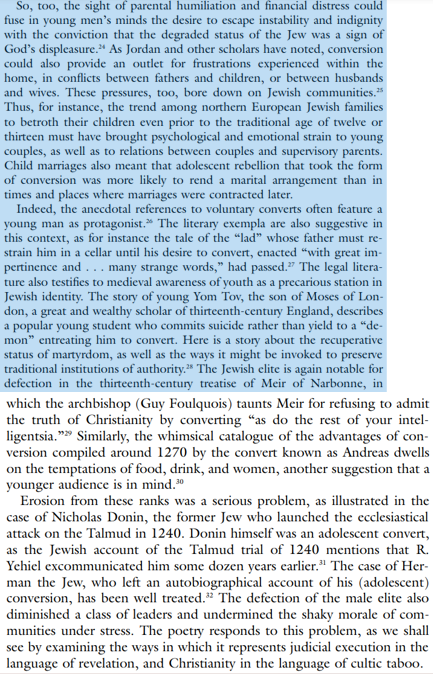
Why was focus now scholastic young man?
Intellectual arguments persuading young men to return Jews – perhaps visceral images purity would stand them in stead?
Group most likely convert - 🔗 source man converts but
wife
(post-Blois) martyrological conventions/ set mofits
signif. for the martyr
represent martyr’s death as moment personal redemption & transfiguration/ revelation + packed w/allusiosn to prophetic/ divine revelation
AIM: (✝) martyrdom would elevate their status as Jews (✡) martyrdom would expiate their sins
🔗 Sinai motif God on fire: analagous to God being revealed… since countering/ counter-argum. Christian accusations that Jewish executions meant God had abandoned them → use motifs to claim it’s the opposite - Gershom
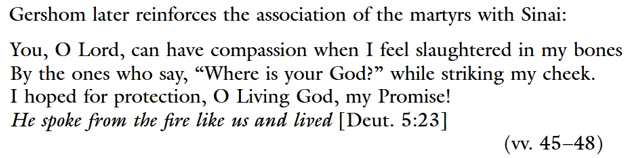
(post-Blois) martyrological conventions/ set motifs reflecting poets’ concern w/communal morale attitudes tow. relig. auth. (↓ Tosafist hegemony)
How did represent✝ vs martyr? + why
Represented ✝ in lang. cultic taboo: set cruder images… → inculcate visceral revulsion for ✝’s sacred rites & symbols
Tap cultural taboos & fears pollution
Confrontation w/oppressors
Often publicly preaches just before their faith (verbally assaulting faith they’ve rejected + extolling faith in which chose to die)
Publicly blaspheme against ✝ + defiantly proclaim their Jewishness - ← within precincts ✝ place worship/ after desecrating ✝ devotional objects?
CONTRAST: righteous martyr’s death memorialises them as blemished model & ritual offering to God, whose purity juxtaposes idolatry ✝ worship & symbols.
Poetic descriptions/ motif martyrs throwing themselves into fire/ burning at stake/ crushed & impaled on (breaking on the) wheel (form execution used for apostates MA soc. → Jewish offenders)/ spurn waters baptism
WHY?
Had to reassure listeners
been abandoned by God…‘Converted’ images debasement & suffering→ affirmations God’s presence, that
had abandoned thembut partnered to renewed & bloody rebirth covenant– represented judicial execution in lang. revelationdraw on images ritual purity
anchored death in lang. covenantal renewal/ cultic sacrifice
🔗 Hebrew 12:12: ‘Our God is a devouring fire’ + reenactment his appearance at Sinai[FS3]
Fire = doorway tow. God, light, salvation
Reclaiming martyr’s punishment as glorious death taken upon themselves voluntarily as way to redeem oneself/ get closer to God? Reclaiming death as opportun. for person transformation/ transfiguration, whose sufferings show hand omnipresent God
Images martyrs broken on wheel evoke visions Ezekiel/ wheels Pharoah’s chariots overturning in sea
OR just hastening their death – might as well do it on their own terms
SIGNIF.: shows rabbis deemed intellectual argum./ subtle reasoning on own suffic. Conscious effort to foster intellectual contempt & visceral antipathy for ✝.
🔗How did Jews treat phenomenon conversos? + signif.
(Tartakoff) attitudes varied BUT OVERALL: integrated converts into their communities
Married, engaged w/economically, supp. them in times need, sought protect them ← Christian arrest, welcomed them into many aspects relig. & intellectual life
Effort to get them back – Rambam in Mishneh Torah said efforts should be made to reach out to children Jewish rebels (have status anus)
(Se’adya ben Maimon ibn Danan, 15thC) ‘when it comes to lineage, all the people of Israel are brethren’ – rebels, criminals, heretics, forced ones, prosletyes… ‘the yoke of that Law is still upon their shoulders & will never be removed ß them’
BUT some HMA rabbinic authorities made disparaging remarks ab. converts & debated if included in partic. communal practices
see Avraham of Augsburg → point to enduring Jewish tensions & sensitivity regarding converts’ status + some Christian converts to Judaism had to move to compl. new regions where nobody knew them → could pass as Jewish (∵ (1) apostasy = capital offense + (2) Jews struggled to accept them)
1 source said wasn’t a big deal - just sprinkling some water on head. OTHERS inverted Christian symbol baptism as purification → polluting/ damaging person’s soul but not indellibly - can be purified again
some scholars) had to undergo/ immerse themselves in ritual purification, like mikvah
same for people converting to Judaism
baptism left some kind mark
Converso crisis explicated what would us. be visible: what makes someone Jewish in MA context - is it belief, practice, communal/ social recognition (when soc. says you’re Jewish, you’re Jewish) → clear Jewish identity contested by diff. people w/diff. stakes
where were the poems sourced?
Poems found in liturgical laments & penitential hymns in prayerbooks & liturgical miscellanies
1 your sources:
Avraham of Augsburg piyyut/ liturgical poem by Moses ben Jacob
see Word for ref.
12thc account martyrdom
We know if his courting martyrdom born of ideals he imbibed before or after his conversion ß Christianity to Judaism
Know: who he was; when, where, how/ why converted; what triggered his purported iconoclastic rampage…
BUT his death & memorialisation show…
tenacity LMA Jews in face Christian persec.
shared meanings martyrdom for LMA Christians & Jews
unique pos. converts & returnees in a soc. bred interfaith animosity as fostered cultural cross-influence
sim. to 12thc chronicles 1st crusade
1. Protagonist makes declaration faith before death – like Talmud, Rabbi Akiva, other MA martyrs: ‘Hear, O Israel, the Lord is Our God, the Lord is One’… - also functions as proclamation Jewish identity in explicit opposition to religious identity of their persecutors (like peeps in Book of Danie[FS1] l & real earlier chronicles[FS2] )
2. Protagonist physically displays contempt for Christian devotional objects: physically attacked Christian devotional objects to show their impotence
o Hebrew chronicles 1st Crusade portray martyrs 1096 as mocking, spitting & urinating on crucifixes
o Speak to drawing both tradition & Christianity
suggestion martyrdom elevated status Jews of non-Jewish lineage
(brink death) ‘God, now I will [truly] be [part of your] inheritance & treasure!’
Intimation he felt/ regarded as
feriorpoint to enduring Jewish tensions & sensitivity regarding converts’ statusMartyrdom elevated status/ expiated sin
Speaks to tensions conversos: could it be reversed?
fiery death
(Mordechai ben Hillel) Likens him to biblical Isaac: by quoting him (mishradic elaborations on Genesis 22 portrayed as act. hav. been sacrificed)
Issues provenance…
Many still in manuscript BUT good amount → 19th & early 20th-c anthologies
Published corpus reflects Enlightenment & mid-20thc preoccupations w/place persecute on in formation modern Jewish identity
Prof. clear moral frame – us. history to prove their Zionism: historically-conditioned interp.
Reason why many emphasise (respond to) incidents judicial execution following libel accusations, mob viol. erupted w/onset crusades…
Convey fullness exper. lived by MA Jews in shadow persecution
Issues provenance…
(Christian chronicles –
Augsburgbut sim.) Echo age-old Christian tropes ab. Jews as desecrators holy objects & blasphemers
Inclusion suicide: shock Christian audiences w/exploits protagonists who spiralled <- grave sin apostacy à most extreme expression (suicide) worst sin in Christian trad.: despair (see 2nd tale: reaction sister former Dominican lector to brother’s death modelled desired effect?)
· Fabricated/ embellished to…
· conform to negative Christian stereotypes Jews
· fan Christian readers’ horror for Christian converts to Judaism
· BUT same for Jewish sources: (Christian sources) demonised converts & returnees to Judaism (Jews) same behaviour glorified converts & returnees – just opposite polemical aims/ deployed to opposite polemical effect
How did this develop summer 1391?
violence & forced conversions → conversos
wave violence agaisnt Jewish communities Iberian peninsula: Started in Seville (Martinez deacon’s anti-Jewish preaching (inflammatory sermons interpreted Jewish presence as sign city in need spiritual reform: 1 sparked wave violence spread v/quickly across peninsula). affected all major & smaller Jewish communities: scale viol. unprecedented - many killed/ fled to N Africa or Italy. large number (unsure if majority or 1/3) converted to Christianity - in some places, entire communities became Christian → created whole new sit…
suddenly large number new converts - now legally Christian & lived amongst Christian but had been Jews before
→ questions who these people were + how Christian majority should approach them
- some converts returned to Judaism as these communities worked hard → entailed (for some) relocation to Italy/ N Africa/ Ottoman Empire
- majority remained Christian: called conversos (Spanish)/ anusim (Hebrew: those who were forced (to accept Christian faith). Derogatory term marranos later → more widespread (means swines) as Christian soc. got more suspicious faith.
→ more emphasis on beliefs to counteract conversos → appeals to reason: succ. disputations & preaching campaigns
sources
(1391) Maestre Astruc Rimoc ß Fraga: conversion as threat to community
(1396) Profayt Duran: Be Not Like Your Fathers: intellectual resistance to conversion – intellectual arguments & appeals to reason – need to believe, not just practice (as in Christianity) + emphasis on singularity + Jewish heritage & community + hatred conversos à banishment
(15thC?) Joshua al-Lorqui’s anti-Christian letter to his friend Solomon ha-Levi (Paul de Burgos): sense astonishment & betrayal + investigates motives à take such step: conversion learned young men + prevailing sense abandonment by God
- Ambition
- Mania for wealth & power
- Satisfaction sensual desires
- Doubt truths Judaism