CPSY 4331 Unit 3 Exam
 Call Kai
 Learn
Learn Practice Test
 Spaced Repetition
 Match
Match Flashcards
 Knowt Play
1/58

There's no tags or description
Looks like no tags are added yet.
Name | Mastery | Learn | Test | Matching | Spaced | Call with Kai |
|---|
No analytics yet
Send a link to your students to track their progress
59 Terms
Development of self-concpet
1-2m: repeat acts centered on their bodies (thumb-sucking)
4-8m: repeated actions centered on environment (delight in making moblie move)
habituate to own bodies
protest when social exchanges disrupted
18-24m: recognize self in the mirror (rouge test with dot on nose)
2-3 years: use of lang to refer to self (me, mine)
Early self-definitions
focus on concrete characteristics
preschoolers and early school age: physical features, preferences, possessions, social characteristics, competencies
by age 8-10: more complex descriptions- focus on abilities and interpersonal attributes
Later self-defintions (adolescence and beyond)
more abstract and psychological
more aware of multiple selves
eventually more coherent and integrated
Alt approach to self defintions—> Eder
preschoolers have psychological conceptions of self long before they can express this in trait-like terms
test via procedure that does not require advanced verbal skills
child self-view questionnaire (puppet show)
“when i get angry, I feel like hitting someone”
“I really like myself”
Can see how their well-being is, social closeness, etc is
Erickson’s theory of identity development
psychological development over the life span
how our self concept develops over time
development is cummulative
all development crises build on each other
meaning issues of mistrust/ shame accumulate (or get better) over time
8 stages
Erickson’s theory of identity development (development involves vital involvement and a balance needed for healthy adaption)
how you relate to the word, and how the world relates to you, influences development
interaction of biological characteristics, psychological elements, and cultural context
balance between too much and little autonomy
Marica’s 4 stages of identity—> punnet square
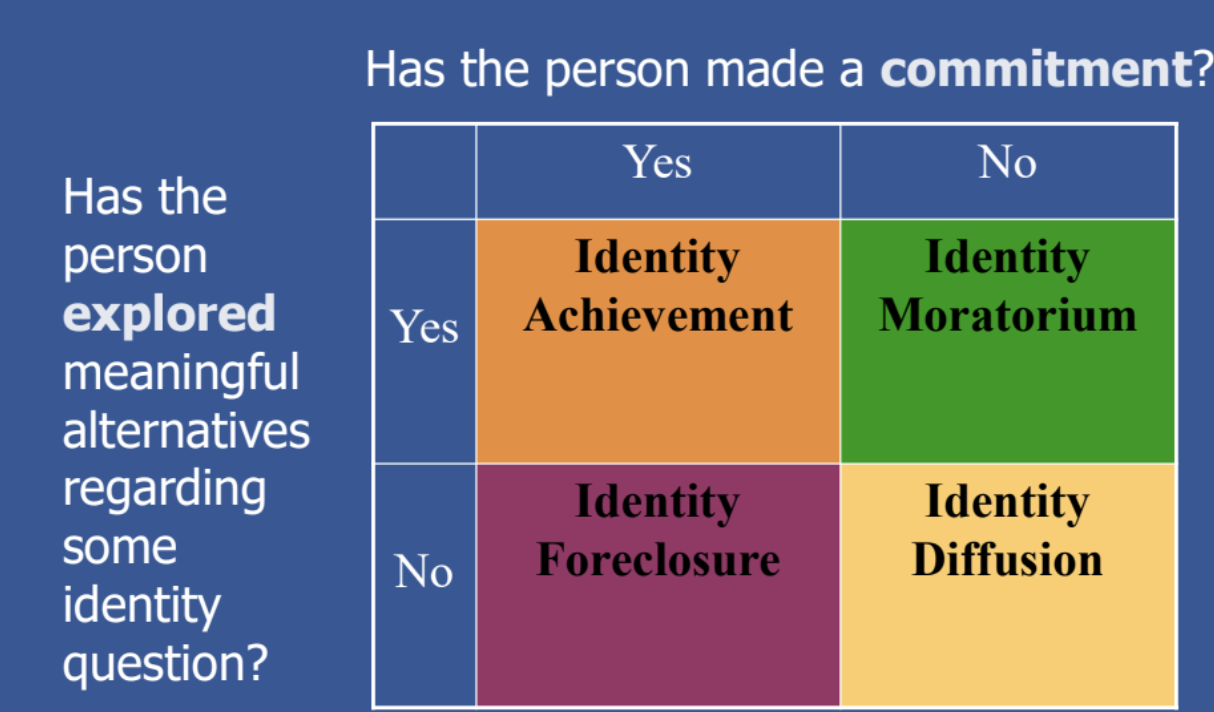
Marcia’s 4 stages of identity—> findings
in general, move toward commitment
either foreclosure or achievement
Moratorium= exploring options
a heightened anxiety (not necessarily bad)
common example: college years
Diffusion associated with more problems
Identity work continues throughout life span
Ethnic Identity Development- Infants
Enduring, basic aspect of the self that includes a sense of membership in an ethnic group and the attitudes and feelings related to that membership
Tends to be stronger among minority youth
positive ethnic identity associated with higher self-esteem and better mental health
very young children are aware of racial and ethnic groups
3m: look longer at faces of own race (if they are exposed to that race)
9m: associated positive emotions with same race faces
Implicit bias appear in early childhood
Doll study—> pref for white doll.
What do we do to better ethnic identity development?
talk to kids about race
desegregation vs. integration
racial socialization strategies
ethnic pride, preparation for bias
Awareness of own biases
Ethnic identity development—> Adolescence
Most active period of ethnic-identity development
unexamined ethnic identity
Values, characteristics of dominant culture preferred/incorporated
Ethnic identity search
eploring own ethnicity; questioning of majority culture
Ethnic identity acheivement:
integration of minority and mainstream culture
openess and confidence about one’s ethnic identity
Phinney’s ethnic identity group—> punnet sqaure
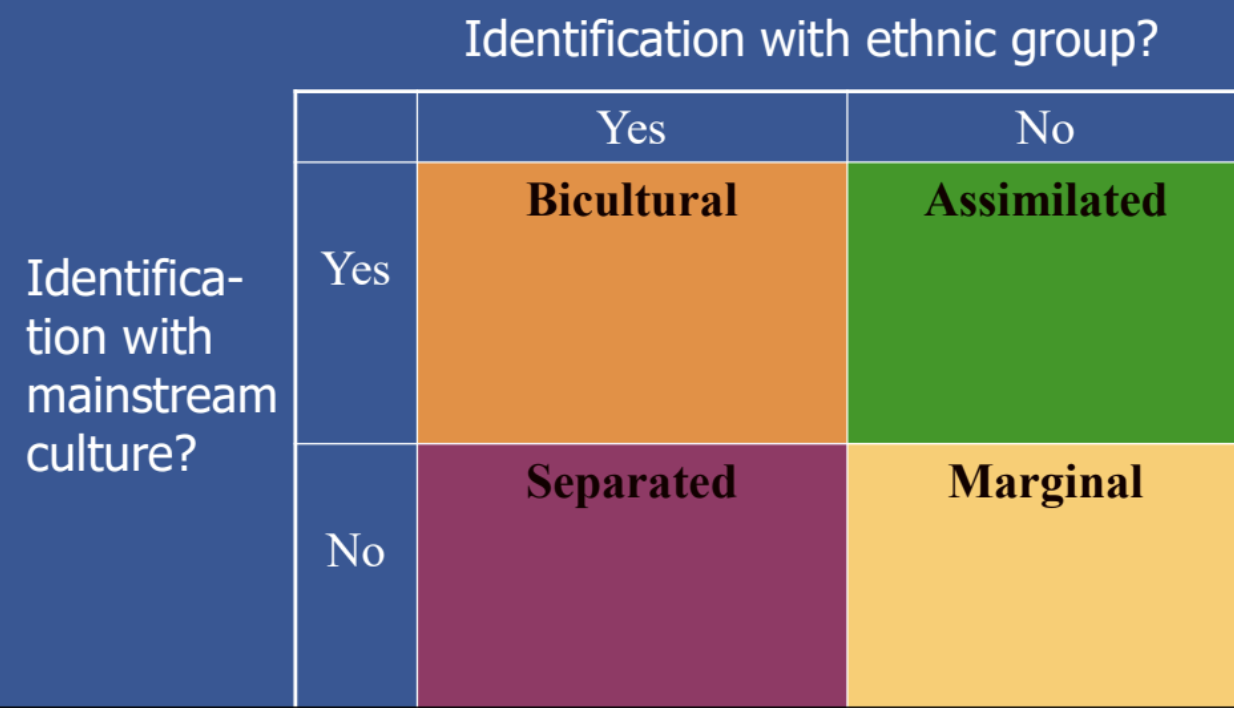
Ethnic identity development- implications
biculturalism may be most positive way to resolve ethnic identity “crisis”
but difficult to accept norms of both cultures, if differ significantly
Self-esteem
one’s evaluation of one’s worth as a person based on an assessment of the qualities that make up self-concpet
High self-esteem
generally feel positively about one’s characteristics and competencies, while acknowledging weaknessl
low self-esteem
view self in less favorable light, dwelling on perceived inadequacies
Changes in self-esteem: ages 4-7 self-evaluations center on:
social acceptance
task/general competence
often overly positive and unrealistic
Changes in self-esteem: ages 8-10 self-evaluations center on:
physical, academic, and social competence
self-esteem typically declines why?
social comparison
more realistic appraisals
Changes in self-esteem compare early adolescence to adolescence
early adolescence: more differentiated and emphasis on interpersonal relations
adolescence: inclusion of romantic appeal and quality of close friendships
Bowlby’s working model theory predicts that securely attached children
construct a positive working model of self and one’s relationship
should evaluate themselves more favorably than insecurely attached children
Verschueren et al. 1996 development of self-esteem
4-5 year olds; asked questions about their worthiness; answered through a hand puppet
results: children with secure ties to their mothers:
described themselves more favorably
were rated as more competent by preschool teachers
Role of praise: mueller and dweck 1998
128 5th graders completed simple puzzle IQ tests
Half recived intelligence praise
Half recived effort praise
Then offered them a challenging task that they could learn from, or an easy one
Intelligence praise: opted for easy one (avoid mistakes)
Effort priase: opted for challenge (opportunity to learn)
Given the same IQ test again at the end
Conclusions?
Children praised for intelligence→ fixed mindset
Lost motivation and enjoyment in activity
Avoided challenging tasks
Children praised for effort→ growth mindest
sought out challenge and increased effort/persverance
Note: this effect has been found to be robust among children of all different ages and ethnicities
How should we praise children?
Focus on thier:
effort, strategies, focus/concentration, perserverance, improvement
Can you have too much self-esteem?
Findings are mixed:
achievement→ high self-esteem rather than vice versa
Involvement with delinquent peers→ higher self-esteem
adolescents with high self-esteem→ more likely to use alcohol
how can children with low self-esteem be helped?
improve parenting/ parent-child relationships
foster “growth mindset”
work on skill improvement
Social cognition (durkin)
cognition about social phenomena
how individuals learn about the world through their own actions and perceptions
Cognition as a product of social interaction
how individuals learn about the world through interaction with others
Role-taking
the ability to assume another person’s perspective and understand their thoughts, feelings, motives, and behaviors
a basic building block of social competence
The foundation for increasingly mature social behavior
Difficulties in the development of social cogntion
people are not always predictable
we cannot observe the inner processes of people
people are also perceiving us and changing their actions based on their thoughts about us
what we do understand is further confused by our own emotional responses
What in the development of social cognition affects social reasoning?
complexity of reasoning ability affects social learning
Piaget’s cognitive development theory
skills attained in his proposed cognitive developmental periods seem to be in line with emerging social skills
Sensorimotor period
recognizing self as seperate entity→ self concpet
object permance→ attachement
peroperational period
decreasing egocentrism→ development of empathy
concrete operations
internalizing of thought→ logical, decentered thinking→ undersstanding of others’ perspectives
formal operations
abstract thought→ ability to see complexities in others’ behaviors, more abstract moral decisions
sex
refers to genetic and biological distincitions b/w males and females
gender
refers to our social assignment or slef-categorization as male, female, neither, or different.
What is the development of gender-typed behavior?
by age 2: show gender-related toy preferences
by age 3: sort occupation by gender, often rigid gender stereotypes.
Liben experiment on development of gender-typed behavior
examined 6-8 and 10-11 yr old perceptions of occupational status.
tradtitionally “male” occupations rated as higher status (doctor, lawyer)
invented male occupations rated as higher status (“clisper” and “cartoner) by 10-11 yr olds
What flexibility do we see in changes of gender-stereotype flexibility?
with age, if parents engage in nontraditional roles, if encouraged to think more flexibility about gender, if have oppostie-sex older sibling
What are the stereotypes and how have they changed?
active, aggressive= male
emotional, caring= female
our stereotypes about males and females have not changed much since the 1950s
To what degree do differences exist?
more similarities than differences
magnitude of differences is quite small
a lot of overlap.
Differences in social behaviors
aggression: boys have more physical aggression
activity level: boys have more and it starts in the womb
compliance: girls have more
fearful, timid, cautious: girls have more
emotional expressiveness and responsiveness: girls have more (like masking negative emotions)
Help seeking: girls are more likely to seek help and this is constant across ages and cultures.
Benenson and Koulnazarian, 2008
3 and 6 yr olds, asked to complete four tasks, adult offered to help if needed
results: younger, lower SES children asked for help sooner than older, higher SES children, but girls asked for help sooner than boys, across ages.
Implications of differences in help seeking?
related to differences in percieved self-competence?
maybe but few differences found at preschool/early school age
boys less encouraged when seeking help?
maybe
Related to girls’ greater cooperativeness/affliation with adults?
probably
Where do differences come from in gender development?
Biological influences, cognitive explainations, social factors
What are some cross-cultural evidence in biological influences?
simlarity in gender differences across diverse cultures
concerns with using this as evidence of biological influences= could be a reflection of similarity in gender socialization
What are some hormal evidence for differences in gender development?
from animal models
exposure to increased testosterone prenatally
more rough and tumble play
girls exposed to androgens prenatally (CAH), later engage more in traditonally male activites.
Pasterski 2005: Hormonal evidence
do children with CAH display more pref for male-perferred toys?
how do parents socialize toy preferences in CAH girls?
3-10 yr olds (65 kids with CAH and 52 unaffected siblings)
played alone with mother and father, measured time spent with each toy and coded parent responses
results: girls with CAH displayed more male-typical preferences than their unaffected sisters (no differences for boys), both mothers and fathers had more positive responses to sex-typical toy play.
esp true for CAH girls playing with girls’ toys
what does this tell us about socialization practices?
socialization didn’t override possible biologicla predispositions
differences in brain structre and lateralization
female brains show more activiation in socail regisons
emotion center larger
male brains are more lateralized for spatial tasks
threat center larger
MAJOR caution in interpreting findings like these!!
are differences in brain structure the CAUSE or EFFECT?
Other evidence for biological influences Bruce—> Brenda—> David Reimer story
born a boy until accident during circumcision led to alter him to a girl. Treated as a girl= initial reports of great success
by late childhood/early adolescence: brenda very unhappy, never identified as female, 14 got reconstructive surgery to return to orginal sex
Social learning perspective
observational learning: esp attending to same-sex models
differential reinforcement: encouraging sex-typed behavior, actively reinforcing sex-typed behavior, punishing non-sex typed behavior
Parents with social influences are:
more likely to…
talk more to girls and encourage girls to express feelings
encourage boys to be more independent and risk-taking
Mothers treat sons and daughters more similarly
fathers engage in more rough tumble play esp. with sons
Fathers show more negative reaction to sons playing with female-stereotpyed toys
but this may be changing
Parents with social influences are: (culturally)
less prominent differences in black families
more prominent differences in latino families
Father-absent homes (social influences on gender)
more influential on young sons
more tolerance for gender-inconsitent behaviors
impact on girls in adolescnec
higher risk of early sexual activity
chidlren in lesbian parent homes (less gender stereotyped)
peers influence on gender development
children self-segregate by gender from early age
playground osbervations: preschoolers play with same-sex playmates 3.5x as much as opposite sex
group norms evolve within same-sex groups
girls use polite requests/persuasion, but boys use commands
boys tend to dominate in mixed-sex settings
Peers react negativly to gender-inconsistent behavior
esp. true for boys
do same-sex peers shape gender-typed behavior? (Martin and Fabes)
observational study of preschoolers over a 6 m period
-observed activity level and gender-typed toy preferences
results: more time spent playing with same-sex peers
greater INCREASES in activity level and sex-typed choices of toys for BOYS
greater DECREASES in activity level, and INCREASED sex-typed choices of toys for GIRLS
Are classrooms biased against boys?
girls are higher on rule following
boys are more likely than girls to be reprimanded
boys (active) behavior often stereotyped as problematic.
boys are more likely than girls to have a learning disability, ADHD or to drop out.
most teachers are female, esp in elementary schools
Are classrooms biased against girls?
-boys can get more attention: call on boys more and instruct them more
-teachers more liekly to: interrupt girls, praise boys for knowledge, girls for neatness