1 Cardiovascular drugs
 Call Kai
 Learn
Learn Practice Test
 Spaced Repetition
 Match
Match Flashcards
 Knowt Play
1/45

There's no tags or description
Looks like no tags are added yet.
Name | Mastery | Learn | Test | Matching | Spaced | Call with Kai |
|---|
No analytics yet
Send a link to your students to track their progress
46 Terms
What is the common cause of hypertension?
→ systolic BP >130 mm Hg OR diastolic BP >80 mm Hg on at least 2 occasionS
results from ↑ peripheral vascular arteriolar smooth muscle tone → ↑ arteriolar resistance
What are the 2 disorders that chronic hypertension can contribute to?
Heart disease
Stroke
.
HTN an important risk factor for the development of…
Chronic kidney disease
Heart failure
What are the risk factors for HTN?
Family hx
Age
Medical conditions: DM, obesity, or disability status.
Environmental factors: stressful lifestyle, high Na+ intake & smoking
Name the 2 factors that have a direct influence on arterial BP.
CO
Peripheral resistance
How do antihypertensive drugs ↓BP?
↓ CO & ↓ Peripheral resistance
Name the 2 mechanisms for regulating BP.
Baroreflexes
Renin–angiotensin–aldosterone system (RAAS)
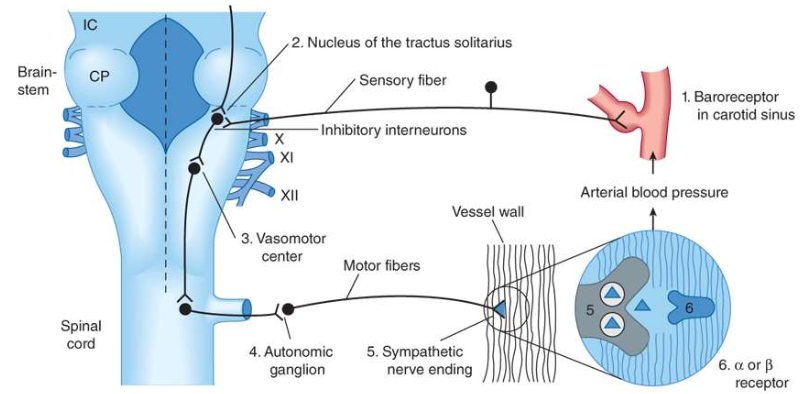
Briefly explain how baroreceptors regulate BP when the pressure drops.
When BP falls, baroreceptors in the aortic arch and carotid sinuses send fewer impulses to the spinal cord
This triggers ↑ sympathetic output reflex (↓ parasympathetic output) → vasoconstriction & ↑CO
This causes compensatory ↑BP
Briefly explain the steps involved in elevation of BP due to activation of RAAS.
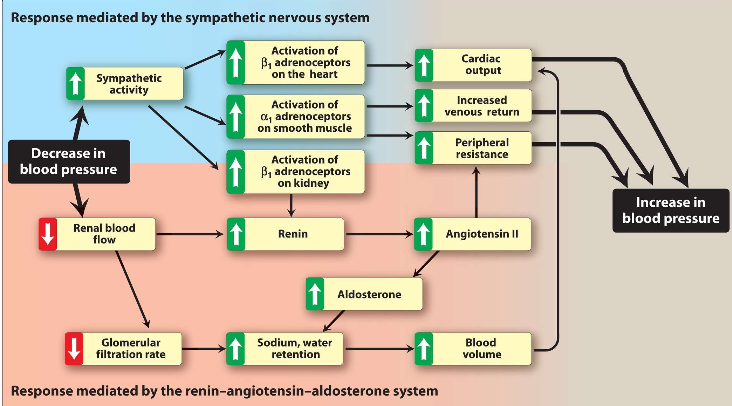
↓ arterial pressure or ↓ Na+ triggers the kidney to release renin
Renin converts angiotensinogen to Ang 1
ACE converts Ang 1 → Ang 2 (potent vasoconstrictor)
Ang 2 ↑ BP by:
constricting arterioles & veins
stimulating aldosterone secretion → Na+/H2O retention
↑BP
What is the goal of antihypertensive therapy?
↓ cardiovascular & renal morbidity and mortality
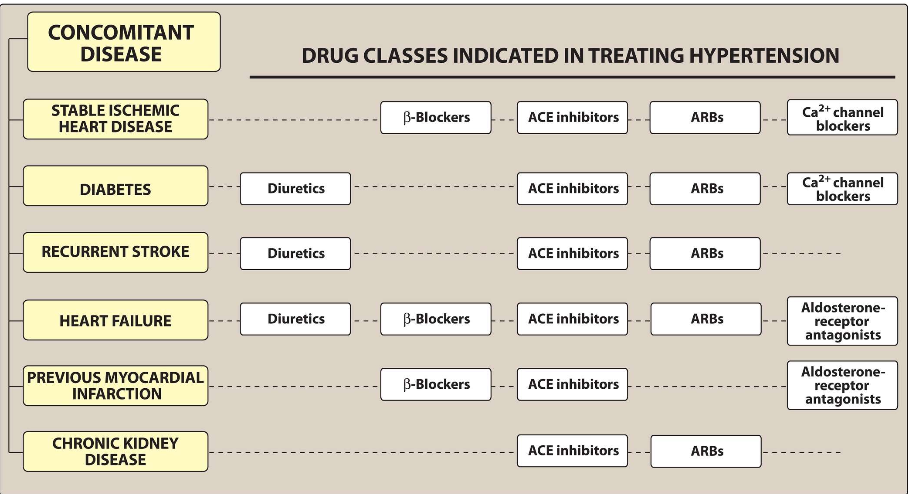
Name the 4 classes of drugs that can be commonly used as initiation therapy for treatment of hypertension.
Thiazide diuretic
ACE inhibitor
Angiotensin receptor blocker (ARB)
Ca2+ channel blocker
Why are β-blockers not preferred in treatment of diabetes patients with hypertension?
FIND ANSWER TO THIS
What are the 3 ways by which β-blockers reduce hypertension & HF?
↓ CO (
↓ sympathetic outflow from CNS (prevents NE from acting on the heart)
Inhibit renin release from kidneys (which ↓ Ang 2 & aldosterone formation)
What are Diuretics?
↓ blood volume → ↓BP
Name 3 side effects of thiazide diuretics.
Hypokalemia (↓K+)
Hyperuricemia (↑ uric acid)
Hyperglycemia (↑ blood sugar)
Why should non-selective β-blockers not be used in the treatment of hypertension in asthma patients?
block β-mediated bronchodilation → worsen asthma
What are the 3 contraindications for β-blockers use for hypertension?
Reversible bronchospastic disease (e.g., asthma)
2nd & 3rd degree heart block
Severe peripheral vascular disease
What is the influence of nonselective β-blockers on lipid metabolism?
disturb lipid metabolism by ↓ HDL cholesterol & ↑TG
How does bradykinin influence BP?
↑ NO & prostacyclin production
both are potent vasodilators that ↓BP
Give 2 main side effects of ACE inhibitors.
Dry cough
Hyperkalemia
Why should ARBs not be used with ACE inhibitors?
b/c they have similar mechanisms and adverse effects
What is the concern of using ARBs in pregnant women?
teratogenic
Name hypertensives approved for use in pregnant women.
Methyldopa (mainly used for management in pregnancy)
Labetalol (used for gestational hypertension)
Hydralazine (accepted for pregnancy-induced hypertension)
Of the 3 different Ca2+ channel blockers, which one has the greater affinity for vascular
Ca2+ channels than for Ca2+ channels in the heart?
Dihydropyridines (e.g., Nifedipine)
Why are α-adrenoreceptor blocking agents no longer used as initial HTN treatment?
Due to their side effect profile (but may be used for refractory cases)
What is hypertensive emergency?
severe BP elevation (systolic > 180 mm Hg or diastolic > 120 mm Hg) + impending or progressive target organ damage
What drugs are used for hypertensive emergency?
Ca2+ channel blockers (nicardipine & clevidipine)
NO vasodilators (nitroprusside & nitroglycerin)
Adrenergic receptor antagonists (phentolamine, esmolol, and labetalol)
Vasodilator (hydralazine)
Dopamine agonist (fenoldopam)
What is resistant HTN?
BP that remains elevated despite an optimal 3 drug regimen + diuretic
Name drugs that can lead to resistant hypertension.
Sympathomimetics
NSAIDs
Corticosteroid
What is Heart failure?
→ complex, progressive disorder where heart can’t pump enough blood to meet the needs of the body
sx = dyspnea, fatigue & fluid retention
List the underlying causes of HF.
Hypertensive heart disease
Atherosclerotic heart disease
Valvular heart disease
Congenital heart disease
List the pharmacologic intervention provides the following benefits in HF.
↓ myocardial work load
↓ extracellular fluid volume
↓ cardiac remodeling rate
Improved cardiac contractility
What are Cardiac myocytes?
→ electrically excitable cells
have spontaneous, intrinsic rhythm generated by specialized “pacemaker” cells located in the SA & AV nodes
have unusually long action potential, which can be divided into 5 phases (0 to 4)
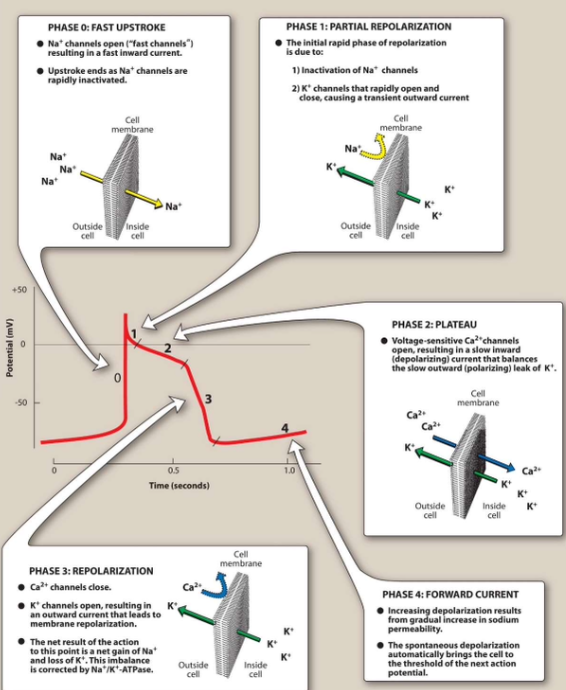
What are the 5 phases involved in action potential of cardiac muscle? What are the changes involved in each phase in terms of ion movement?
Phase 0 (Fast Upstroke): Na+ channels ("fast channels") open → fast inward current of Na+
Phase 1 (Partial Repolarization): Na+ channels are inactivated, and K+ channels rapidly open and close → transient outward current
Phase 2 (Plateau): Voltage-sensitive Ca2+ channels open → slow inward current of Ca2+ that balances the slow outward K+ leak
Phase 3 (Repolarization): Ca2+ channels close and K+ channels open → outward current of K+ & membrane repolarization
Phase 4 (Forward Current): Gradual increase in Na+ permeability → spontaneous depolarization that eventually reaches the threshold for the next AP
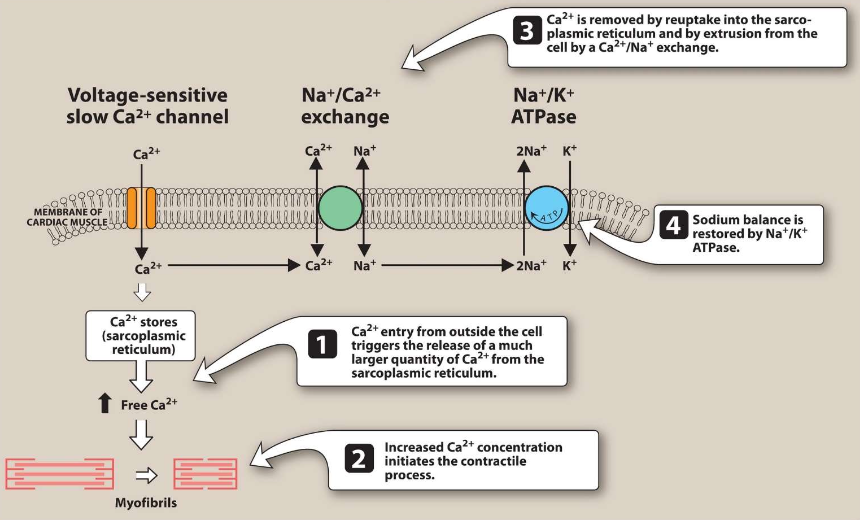
How is Na+ and Ca2+ balance maintained during cardiac muscle contraction?
Ca2+ balance
maintained through a cycle where Ca2+ entry from outside the cell triggers a much larger release of Ca2+ from SR
Ca2+ is then removed via reuptake into SR + extrusion from the cell via a Ca2+/Na+ exchange
Na+ balance
restored by the Na+/K+ ATPase
What are the 4 major compensatory mechanisms evoked by failing heart?
↑ SNS activity
RAAS activation
Natriuretic peptide activation
Myocardial hypertrophy (thickening heart)
What are the 2 major side effects of spironolactone?
Gynecomastia
Dysmenorrhea