UA Exam 2
 Call Kai
 Learn
Learn Practice Test
 Spaced Repetition
 Match
Match Flashcards
 Knowt Play
1/48

There's no tags or description
Looks like no tags are added yet.
Name | Mastery | Learn | Test | Matching | Spaced | Call with Kai |
|---|
No analytics yet
Send a link to your students to track their progress
49 Terms
The kidneys play a role in regulation of blood pressure.
True
Urine collection/flow initiates at what component of the kidney?
Bowman’s Capsule
What component of the kidney is responsible for control of filtration and concentration functions?
Juxtaglomerular apparatus
What region is defined as the “functional units” of the kidneys and includes filtering and concentrating functions?
Nephrons
Which of the following does NOT perform concentrating functions within the kidney?
Glomerulus
Which statement about urine is INCORRECT?
A consistently isosthenuric voided urine sample is healthy
A body in urine sediment that contain numerous highly refractile droplets as a single entity is most likely a(n):
Oval fat body
A squamous epithelial cell appears to have shaggy (fuzzy/furry) edges. It should be reported as a(n):
Clue cell
Close examination and identification of specific characteristics of casts should be performed:
At high power (40x)
Healthy individuals may have which of the following in their urine, as a normal finding, after strenuous exercise?
Hyaline casts
Individual red blood cells (ONLY individual cells) observed under microscopic examination most likely indicate:
Bleeding from the bladder or urethra
Prior to reporting an RBC cast it is important to observe:
Free floating RBC’s in addition to the RBC cast
Renal tubule epithelial cells are always considered pathological and warrant further investigation.
True
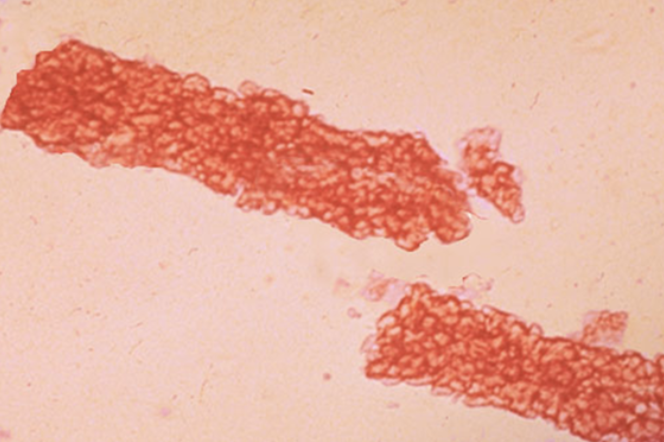
Identify the following.
Red blood cell cast
RTE cell casts are most indicative of which of the following pathological conditions?
Tubular necrosis
Renal tubule epithelial cells are most likely to be confused with:
White blood cells
The presence of which of the following is a strong visual marker (easily observed) in microscopy associated with bacterial vaginosis?
Clue cells
To distinguish between WBC clumps and WBC casts it is important to observe:
The presence of a cast matrix
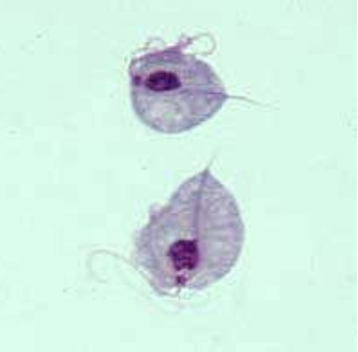
Identify the following:
Trichomonas vaginalis
Urinary casts are primarily composed of:
Uromodulin
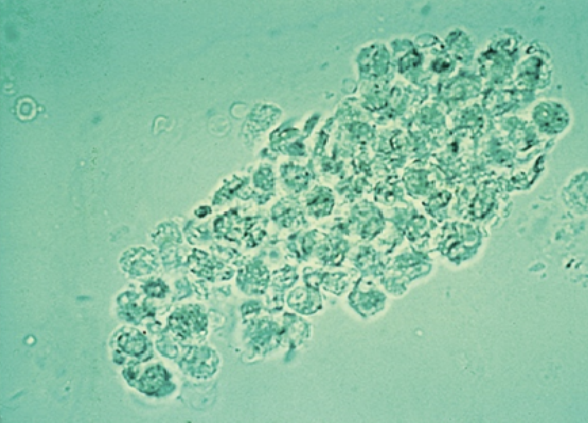
Identify the following.
WBC cast
Renal tubule epithelial cells are most readily and best identified by:
Noting the position of a nucleus relative to the center of the cell
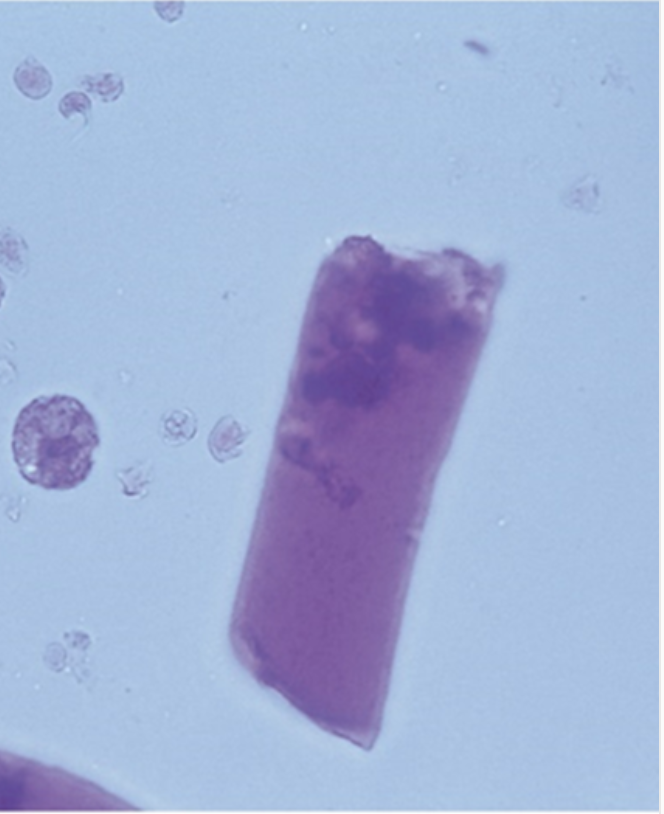
Identify the following.
Waxy cast
What condition is NOT ideal for the formation and viability of casts?
Alkaline pH
What entity is responsible for bacterial vaginosis?
Gardnerella vaginalis
What is the most commonly viewed WBC in urine?
Neutrophils
What urine microscopic constituents would most likely be present IN PYELONEPHRITIS but NOT CYSTITIS?
WBC casts
Which of the following aids in differentiating renal tubule epithelial cells from spherical transitional epithelial cells?
RTE cell nuclei are eccentric
Which of the following casts most frequently appears to have broken or serrated edges?
Waxy
Which of the following is a BACTERIAL cause of WBC’s in urine?
Pyelonephritis
Which of the following is most commonly associated with a non-clean catch urine specimen provided by a male?
Squamous epithelial cells
Which of the following is not a characteristic of a red blood cell in urine?
Refractile
Which type of cast indicates significant urinary stasis and a poor prognosis for the patient's kidney health?
Broad and waxy casts
White blood cell casts (with no bacteria) are most likely indicative of what condition?
Acute interstitial nephritis; Glomerulonephritis
A urine sample provided is provided by a female patient. Of the following, which microscopic entity is most certainly a NON-pathological indicator (not an indicator of a harmful condition)?
Mucus
Addition of acetic acid to a urine sample will remove which of the following entities?
Red blood cells
Presence of bacterial casts in urine is verified by what method?
Gram staining
Methylene blue is a stain useful for identifying what particular component in urine?
White blood cells
Which of the following casts most frequently appears to have broken or serrated edges?
Waxy
Prior to reporting an RBC cast it is important to observe:
Free floating RBCs
Hyaline casts found in the urine of a football player admitted to the hospital following a concussion are most likely the result of:
Dehydration and exertion
Fatty casts are most indicative of:
Nephrotic syndrome
RTE casts are most indicative of
Tubular necrosis
To distinguish between WBC clumps and WBC casts it is important to observe:
The presence of a cast matrix
Presence of what urine microscopic constituents would best differentiate between cystitis and pyelonephritis?
WBC casts
Urinary casts are primarily composed of:
Uromodulin
Transitional epithelial cells are identified by what nuclear characteristic?
Central positioned nucleus
Eosinophils in urine are often due to what pathological condition?
Acute interstitial nephritis