MODULE 5.5 Astrophysics and Cosmology
 Call Kai
 Learn
Learn Practice Test
 Spaced Repetition
 Match
Match Flashcards
 Knowt Play
1/64

Earn XP
Description and Tags
SELF EXPLANATORY
Name | Mastery | Learn | Test | Matching | Spaced | Call with Kai |
|---|
No analytics yet
Send a link to your students to track their progress
65 Terms
Define a planet.
A planet is an object that orbits a star, has enough mass for gravity to make it nearly spherical, has not undergone nuclear fusion, and has cleared its orbit of other objects.
Define a planetary satellite.
A planetary satellite is a body that orbits a planet.
Example: the Moon orbiting Earth.
Its centripetal force is provided by gravity.
Define a comet.
A comet is a small irregular body made of rock, dust and ice.
It travels around the Sun in a highly elliptical orbit.
Near the Sun it forms a tail.
Define a solar system
A solar system is a star and all the objects that orbit it, such as planets, moons, asteroids and comets.
Define a galaxy.
A galaxy is a huge collection of stars, gas and dust held together by gravitational attraction.
Each galaxy contains billions of stars.
Define the universe.
The universe is all space and all matter that exists.
It includes all galaxies, stars and planets.
How does a star form from interstellar dust and gas?
Stars form in nebulae, which are huge clouds of gas and dust.
Gravity pulls particles together.
Gravitational collapse increases.
Particles gain thermal energy.
A hot dense protostar forms.
Temperature and pressure become high enough.
Hydrogen nuclei fuse into helium.
A star is formed.
Why does a main sequence star remain stable?
Gravity pulls matter inward.
Radiation pressure from fusion and gas pressure push outward.
These balance, creating stable equilibrium.
Why do larger stars have shorter lifetimes?
Larger stars have higher core temperatures.
This causes faster fusion rates.
They use hydrogen fuel more quickly.
This gives them shorter main sequence lifetimes.
Describe the evolution of a low-mass star.
Nebula → Protostar → Main Sequence Star → Red Giant → Planetary Nebula + White Dwarf
Eventually it cools further.
Low-mass stars have core masses between about 0.5 and 10 solar masses.
Why does a low-mass star become a red giant?
When hydrogen runs low, outward pressure decreases.
Gravity causes the core to contract.
Temperature and pressure increase.
The outer layers expand greatly.
The star becomes a red giant.
What is a planetary nebula?
A planetary nebula is the outer layer of a red giant drifting off into space.
The remaining hot core becomes a white dwarf.
What is a white dwarf?
A white dwarf is the dense core left after a low-mass star dies.
It is very hot, very small and no fusion occurs.
It is supported by electron degeneracy pressure
What is electron degeneracy pressure?
Electron degeneracy pressure is the outward force caused because two electrons cannot occupy the same quantum state.
It prevents a white dwarf collapsing further.
What is the Chandrasekhar limit?
The Chandrasekhar limit is the maximum mass a white dwarf can have and remain stable.
1.44M⊙
where M⊙ means one solar mass.
Above this value, further collapse occurs.
Describe the evolution of a massive star.
Nebula → Protostar → Main Sequence Star → Red Supergiant → Supernova → Neutron Star or Black Hole
Massive stars are usually above about 10 solar masses.
Why does a massive star become a red supergiant?
Its higher temperature allows helium fusion into heavier elements.
This creates layers of heavier elements and the star expands greatly.
It becomes a red supergiant.
Why does fusion stop at iron?
Fusion of iron does not release energy.
It requires energy instead.
So iron cannot provide outward pressure and the core becomes unstable.
What is a supernova?
A supernova is the explosive collapse of a massive star.
The core collapses and the outer layers are ejected in a shockwave.
Elements heavier than iron are formed here.
What is a neutron star?
A neutron star is extremely small and extremely dense.
It forms when protons and electrons combine to form neutrons after a supernova.
It usually forms when the remaining core mass is above 1.44 solar masses.
What is a black hole?
A black hole forms when the remaining core mass is very large, usually above about 3 solar masses.
Its gravity is so strong that escape velocity is greater than the speed of light.
Even light cannot escape.
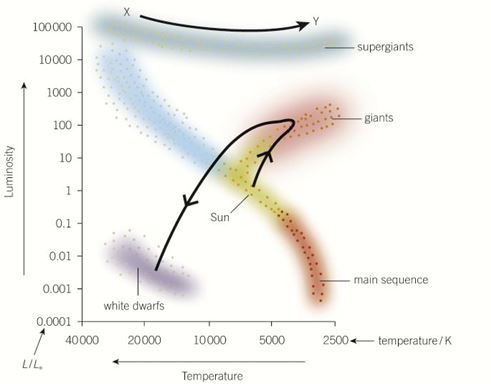
What is the Hertzsprung-Russell (HR) diagram?
It is a graph of luminosity against surface temperature of stars.
It shows star classification and stages of stellar evolution.
Main sequence, red giants, super red giants and white dwarfs can be identified on it.
What are energy levels of electrons?
Electrons in atoms can only exist in specific discrete energy levels.
They cannot exist between levels.
Each element has its own unique set of energy levels.
Why are energy levels negative?
Energy levels are negative because energy must be supplied to remove the electron completely from the atom.
An electron with zero energy is free from the atom.
The ground state is the most negative.
How are emission spectral lines produced?
When an electron moves from a higher energy level to a lower one, it releases energy as a photon.
This produces an emission spectral line.
Each line has a specific wavelength.
State the photon energy equations.
E=hf
and
E=hc/λ
Why do different elements have different spectral lines?
Why do different elements have different spectral lines?
Define a continuous spectrum.
A continuous spectrum contains all wavelengths with no gaps.
Example: hot solids
Define an emission line spectrum.
An emission line spectrum is a series of bright coloured lines on a dark background.
It is produced by hot gases.
Define an absorption line spectrum.
An absorption line spectrum is a series of dark lines on a continuous spectrum.
These lines show wavelengths absorbed by cooler gases.
What is a diffraction grating used for?
A diffraction grating separates light into its component wavelengths.
It is used to measure wavelength.
Different wavelengths diffract at different angles.
State the diffraction grating equation.
dsinθ=nλ
State Wien’s displacement law.
Peak wavelength is inversely proportional to absolute temperature.
λmaxT=2.9×10^−3
What does Wien’s law tell us?
It allows the surface temperature of a star to be estimated from its peak wavelength.
Blue stars are hotter.
Red stars are cooler.
Define luminosity.
Luminosity is the total power output of a star.
Unit: watts (W)
State Stefan’s law.
L=4πr²σT^4
How are Wien’s law and Stefan’s law used together?
Wien’s law gives temperature from peak wavelength.
Stefan’s law then uses temperature and luminosity to calculate radius.
What is an astronomical unit (AU)?
1 AU is the average distance from Earth to the Sun.
1AU=1.5×10^11
What is a light-year (ly)?
A light-year is the distance light travels in one year.
1ly=9.46×10^15
What is a parsec (pc)?
A parsec is the distance at which 1 AU subtends an angle of 1 arcsecond.
1pc=3.1×10^16
What is stellar parallax?
Stellar parallax is the apparent shift in position of a nearby star against distant background stars due to Earth’s orbit around the Sun.
It is used to measure distance to nearby stars.
State the parallax equation.
d=1/p
where
d = distance in parsecs
p = parallax angle in arcseconds
State the cosmological principle.
The universe is homogeneous and isotropic.
Homogeneous means matter is evenly distributed.
Isotropic means the universe looks the same in all directions.
The laws of physics are universal.
What is the Doppler effect?
The Doppler effect is the apparent change in wavelength due to relative motion between source and observer.
Moving away gives red shift.
Moving towards gives blue shift.
State the Doppler equation.
Δλ/ λ=v/c
State Hubble’s law.
he recessional velocity of a galaxy is proportional to its distance from Earth.
v=H0d
What evidence supports the expanding universe model?
Most distant galaxies show red shift.
This means they are moving away.
This supports the idea that space itself is expanding.
State the Big Bang theory.
The universe began as a hot, dense singularity.
It rapidly expanded and has continued expanding since.
This created space and time.
What evidence supports the Big Bang theory?
Galactic red shift from Hubble’s law.
Cosmic microwave background radiation at 2.7 K.
These support expansion from an originally hot dense universe.
What is dark matter?
Dark matter is matter that cannot be directly observed but is needed to explain galaxy rotation speeds and extra gravitational effects.
It does not interact with light.
What is dark energy?
Dark energy is the unknown form of energy causing the expansion of the universe to accelerate.
It makes up most of the universe.
What happens after the Big Bang?
Big Bang creates space and time
Rapid inflation occurs
Fundamental particles form
Protons and neutrons form
Hydrogen and helium nuclei form
Atoms form as universe cools
Stars and galaxies form
Heavier elements form inside stars and supernovae
Solar systems and planets form later
This helps for longer theory questions.
What is cosmic microwave background radiation (CMB)?
It is microwave radiation found uniformly across space at about 2.7 K.
It is redshifted radiation left over from the early hot universe after the Big Bang.
It is strong evidence supporting the Big Bang theory.
Why does a low-mass star stay as a white dwarf but a massive star becomes a neutron star/black hole?
If the remaining core mass is below the Chandrasekhar limit (1.44 solar masses), electron degeneracy pressure stops further collapse and a white dwarf forms.
If the core mass is above this limit, collapse continues.
A neutron star forms, and if the mass is extremely large (above about 3 solar masses), a black hole forms.
What are the characteristics of a white dwarf?
Very small radius
Very high density
Very hot surface temperature
Low luminosity
No fusion occurs
Supported by electron degeneracy pressure
What are the characteristics of a neutron star?
Extremely dense
Very small radius
Made mostly of neutrons
Strong gravitational field
Rapid rotation is common
Forms after a supernova
What are the characteristics of a black hole?
Extremely strong gravitational field
Escape velocity greater than speed of light
Even photons cannot escape
Cannot be observed directly, only by effects on nearby matter
What is meant by red shift?
Red shift is when observed wavelengths become longer.
This happens when a galaxy is moving away.
Its spectral lines shift towards the red end of the spectrum.
What is meant by blue shift?
Blue shift is when observed wavelengths become shorter.
This happens when an object moves towards the observer.
Its spectral lines shift towards the blue end of the spectrum.
What is the difference between isotropic and homogeneous?
Isotropic means the universe looks the same in all directions.
Homogeneous means matter is evenly distributed across large scales.
How do you identify stars on the HR diagram?
Main sequence stars run diagonally from top left to bottom right.
Top left = hot, very luminous stars.
Bottom right = cool, dim stars.
Red giants are cool but very luminous, so top right.
White dwarfs are hot but dim, so bottom left.
Super red giants are top right above red giants.
Why is parallax only useful for nearby stars?
For very distant stars, the parallax angle becomes too small to measure accurately.
So parallax is mainly used for nearby stars.
Why is CMB now microwave radiation?
Originally it was very high-energy radiation from the hot early universe.
As the universe expanded, wavelength increased due to red shift.
This stretched it into the microwave region.
Why are white dwarfs dim even though they are hot?
Because luminosity depends on both temperature and surface area.
White dwarfs are very hot but have a very small radius, so their surface area is small and luminosity is low.
This links Stefan’s law.
Why are red giants very luminous even though they are cooler?
Because they have a very large radius.
Even though temperature is lower, the huge surface area makes luminosity very high.
Again links Stefan’s law.